Selling to Buyers Who Have Seen It All

A sophisticated buyer has heard the promise before, and bold claims make them more suspicious, not less. But there are three kinds of sophistication. The market as a whole may be old and tired of claims.
The individual may have seen a great deal of marketing. Or the individual may have real expertise from doing the work. Each calls for a different response.
In general, make claims smaller and more exact, use proof that matches their situation closely, show the steps instead of an overview, and lead with a diagnosis instead of a pitch.
The used-car problem
In 1970 an economist named George Akerlof published a paper about used cars.
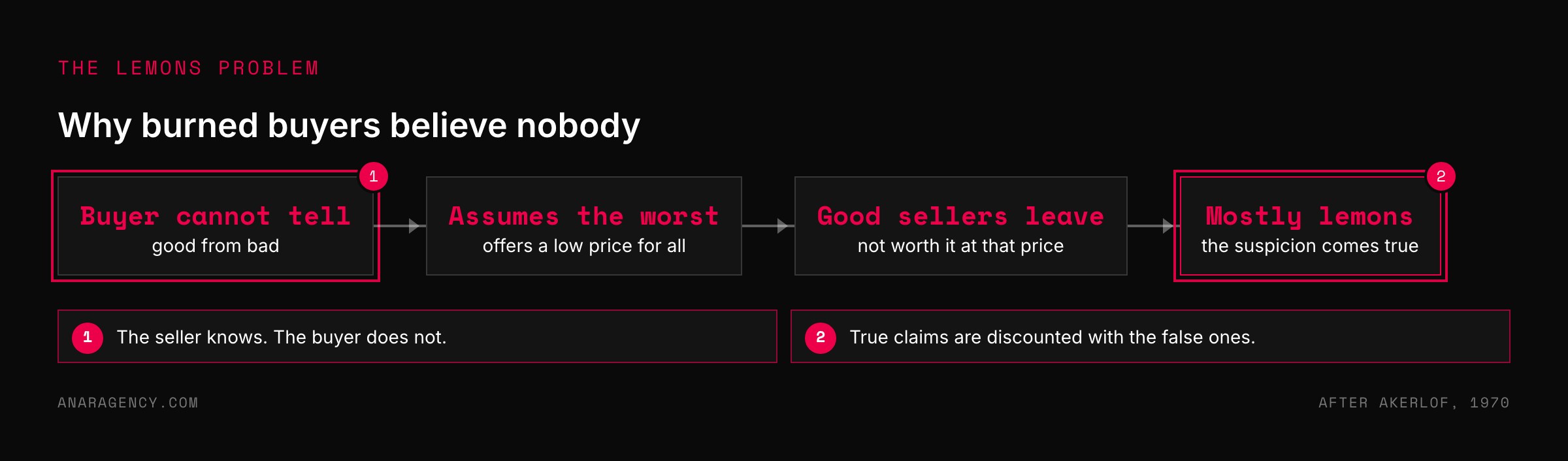
His question was simple. A seller knows whether the car is good or a lemon. The buyer cannot tell.
What happens to the market?
His answer was that buyers, unable to tell good from bad, assume the worst and offer a low price for everything. Owners of good cars will not sell at that price, so they leave. Now the market really is mostly lemons.
The paper was turned down by several journals before it was published. It later won him a Nobel Prize.
It describes any market where buyers have been burned. They stop believing claims altogether, including the true ones. That is the buyer this article is about.
The Three Lenses
People call a buyer sophisticated as if it meant one thing. It means three, and they do not always go together.
The market. How many times has this whole category heard the promise? The copywriter Eugene Schwartz described this in the 1960s as stages of market sophistication.
The first seller can make a plain, bold claim. By the time forty have made it, nobody listens.
The person's awareness. How much marketing has this one individual taken in? Someone who has sat through six webinars on a topic knows every turn in the script.
The person's own knowledge. What do they know from doing the work? A dietitian and a first-time dieter can be in the same market and at the same stage of awareness.
They will not read your ad the same way.
These three can point in different directions. A law firm owner is an expert in law, has seen a great deal of agency marketing, and may know very little about how ads work.
That last combination is common in service businesses. The buyer is expert in their trade and a beginner in yours, and has been pitched many times.
Sophistication is three questions. How old is the market and how tired of claims? How much marketing has this person seen?
What do they know from doing the work? Answer each separately. For an experienced buyer: make the claim smaller and exact, match the proof closely to their situation, show the steps, and lead with a diagnosis.
With a buyer expert in their own field and new to yours, show fluency in theirs first. Find out who else decides and answer that person too.
What an expert does to your claim
An inexperienced buyer takes a claim and asks, do I want this? An experienced one asks, is this true? Then they check it against what they already know.
They test two things. Your account of why the problem happens, and your account of why your fix works.
If either one clashes with something they know from experience, the claim is thrown out. So is everything after it, because you have shown you do not know their world.
There is research behind why a message built for beginners fails on experts. The expertise reversal effect is the finding that instruction designed to help novices can become less effective, or even get in the way, for people who already know the material.
So the simplification that makes a beginner feel safe makes an expert feel talked down to. Same sentence, opposite result.

Straight Dealers: what to change
A few sellers do well in tired, suspicious markets where everyone else struggles. They have not found a cleverer claim. They have changed four things.
We call them Straight Dealers.
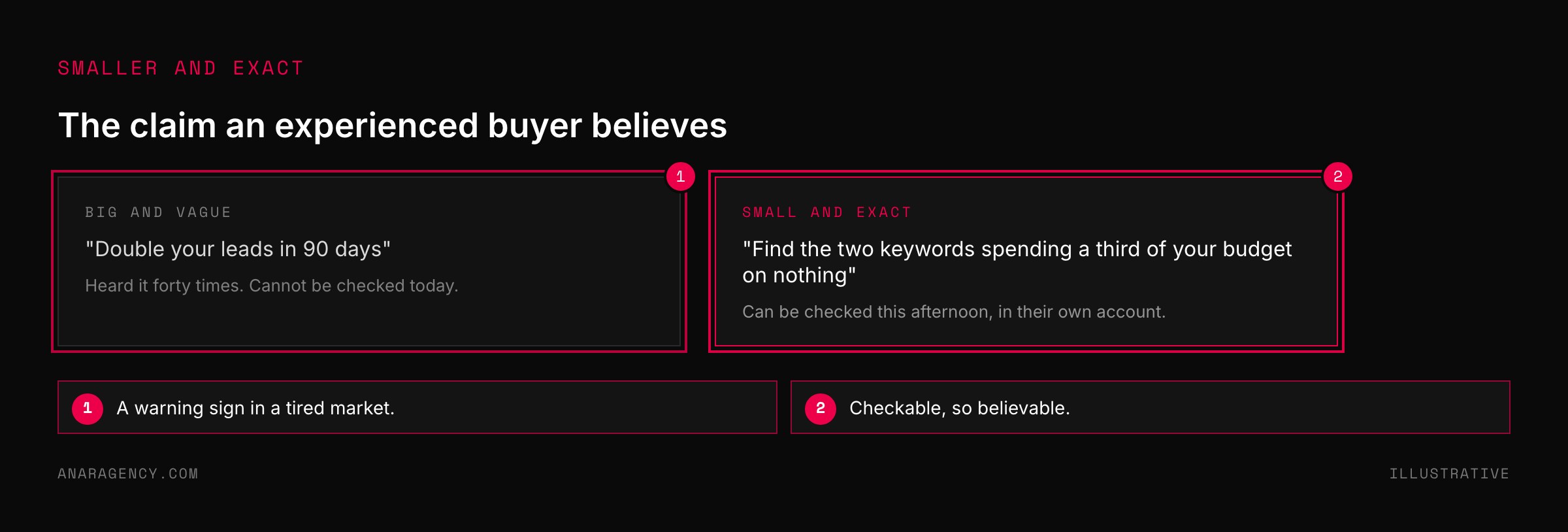
They make the claim smaller and exact. "Double your leads" becomes "find the two keywords spending a third of your budget on nothing." It is checkable, which is why it is believable.
They match the proof closely. A new buyer accepts any happy customer. An experienced one wants a case in their trade, at their size, with their problem.
One close match beats ten loose ones, a point we expand on in the Proof Grid.
They show the steps. A new buyer wants to feel inspired and an overview does it. An experienced buyer wants to feel informed.
Give them the process in order, including the parts that are dull.
They lead with a diagnosis. Instead of pitching, they offer to examine what the buyer already has and report what is wrong. An audit lets a skeptical buyer test your competence before trusting your claims.
We describe how to build that offer in audits as lead magnets.
They speak both languages. With a buyer who is expert in their own field and new to yours, they show fluency in the buyer's field first. A marketer who understands how a law firm bills gets a hearing that a general marketer does not.
"What about the buyer who only thinks they are an expert?"
You will meet a buyer who has watched forty videos and raises objections like a professional, with none of the experience underneath.
Psychologists have studied the gap between confidence and skill. The Dunning-Kruger effect is the finding that people with limited ability in an area tend to overestimate it.
Treat this buyer with the same respect as a real expert. Their filter works the same way: contradict something they believe and they are gone.
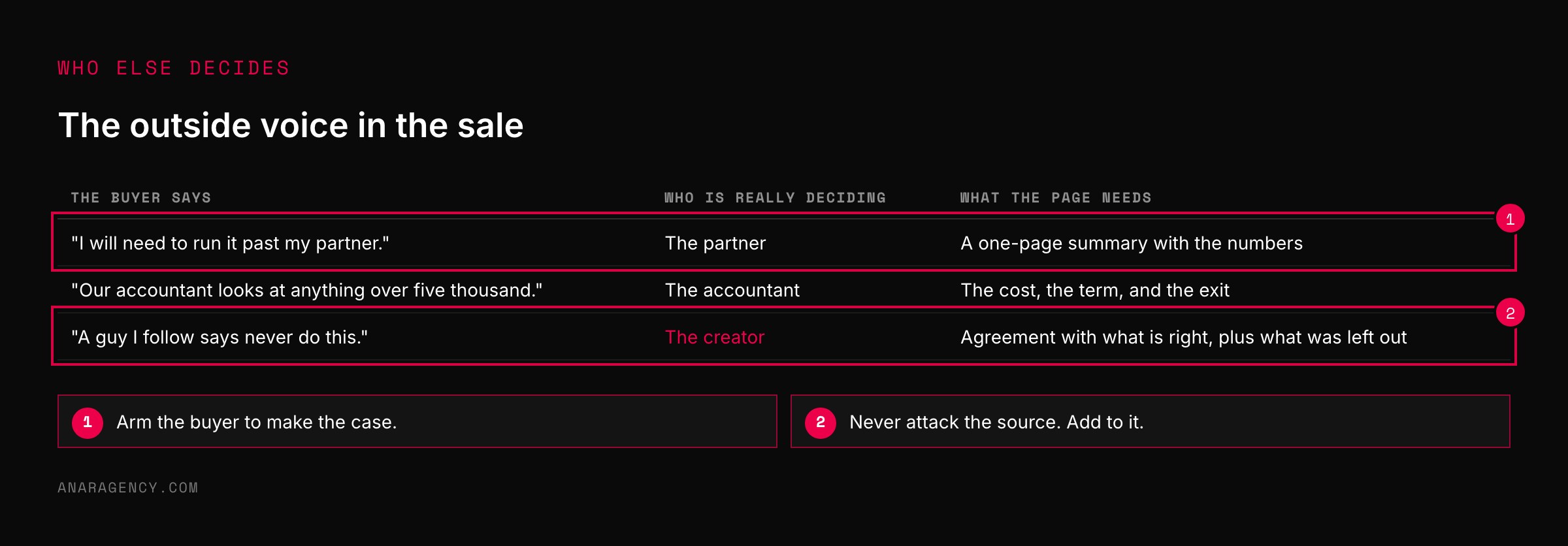
The difference is where their beliefs came from. They were given by someone else, usually a creator or a brand they follow. So do not attack the source.
Agree with what is right in it and add what it left out.
And check whether someone else holds the real decision. Many buyers defer to an outside authority: a business partner, a spouse, an accountant, a board.
When that is true, your page has to answer that person's objections too. Ask early who else will look at this, then give the buyer what they need to make the case.
What to read next, and why
The Market for Lemons (encyclopedia entry): Akerlof's paper explained. Why burned buyers stop believing anyone.
Eugene Schwartz (encyclopedia entry): The copywriter whose 1966 book set out how markets tire of claims.
Expertise reversal effect (encyclopedia entry): Why what helps a beginner can hinder an expert.
Dunning-Kruger effect (encyclopedia entry): The research on confidence and competence, including its limits and criticisms.
So the simple takeaway is this: when a market stops believing big claims, make a small one that can be checked, and offer to prove it on the buyer's own account before you ask for anything.
Questions executives ask
What is a sophisticated buyer?
A buyer who has heard the promise before and tests claims against what they already know. The term covers three things: a mature market tired of claims, an individual who has seen a lot of marketing, and an individual with real expertise from experience.
How do you sell to skeptical buyers?
Make a smaller, exact claim that can be checked. Use proof that closely matches their trade, size, and problem. Show the process step by step.
And offer a diagnosis of their current situation before pitching, so they can test your competence first.
What is market sophistication?
A concept from the copywriter Eugene Schwartz describing how a market responds to claims over time. Early on, a direct promise works. As competitors repeat and enlarge it, buyers stop responding, and sellers must explain how their approach works or shift to a different kind of appeal.
Why do bold claims fail with experienced buyers?
Experienced buyers have heard similar promises and seen them fail. A large claim signals to them that the seller is either exaggerating or does not understand the difficulty. A specific, modest claim signals knowledge.
How do I sell to someone who is an expert in their field but not in mine?
Show that you understand their field first, using its terms and its economics correctly. That earns the credibility to advise them on yours. Then keep your explanations concrete, since they are a beginner in your area despite being an expert in their own.

Filip Kovacevic is the founder of Anar Agency in Phoenix. He spent five years running SEO, Meta ads, email, and content for medical practices across the United States, and now does the same work for healthcare, home-service, legal, and professional-service businesses, alongside AI implementation. More from Filip →
Talk it through in 15 minutes
Bring one AI question from this article. We will tell you what we would do, whether or not you hire us.
Book a 15-Min Chat →