The Proof Grid: Nine Kinds of Evidence Every Offer Needs
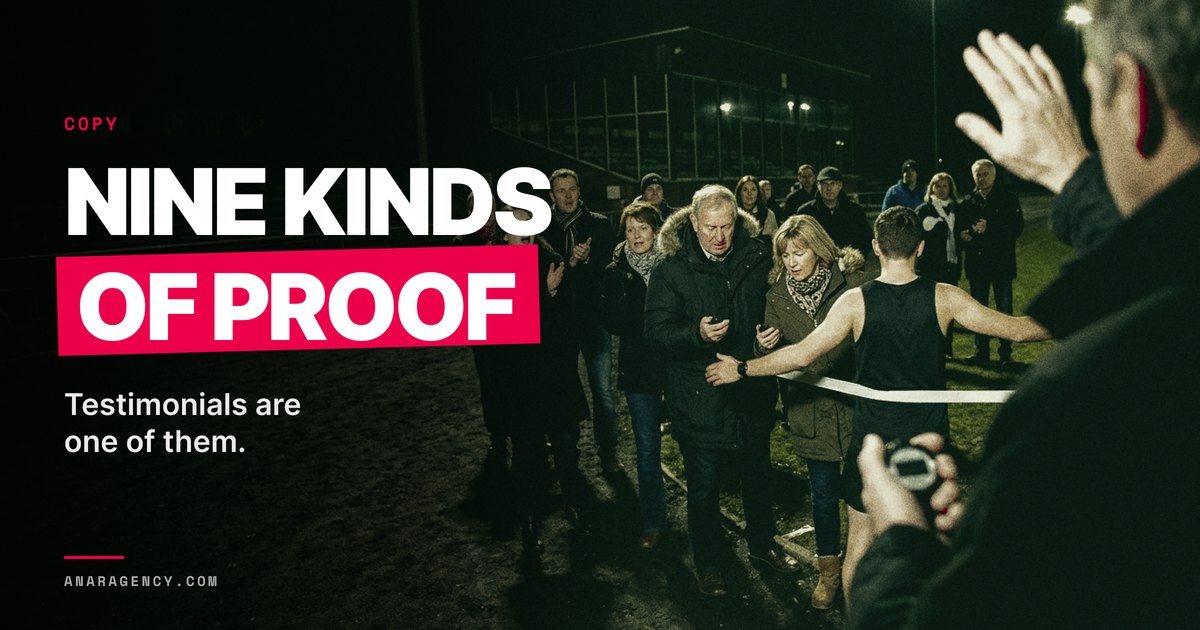
Proof has to answer three questions: is this possible at all, has anyone else done it, and can I do it. Each question has three tenses: why it was true before, why it is true now, and why it will hold in the future. That makes nine cells.
Testimonials fill one of them, which is why a page full of testimonials can still fail to convince. Fill the grid by asking of each claim, "what would have to be true for this to be true?" and supplying evidence for each answer, from more than one kind of source.
Forty-six days
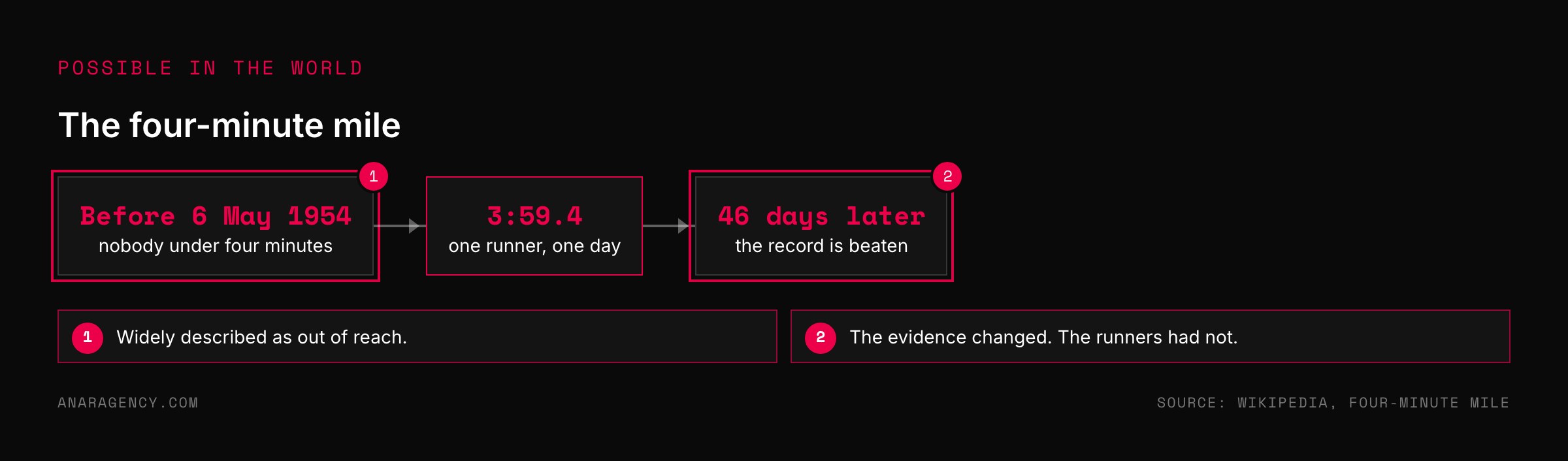
For years, runners and writers treated a mile in under four minutes as a wall. Some called it beyond what a human body could do.
On 6 May 1954 Roger Bannister ran it in 3 minutes 59.4 seconds.
Forty-six days later, another runner beat his time. More followed. Today it is a standard for good male middle-distance runners.
Bodies did not change in forty-six days. What changed was one piece of evidence: the thing was now known to be possible in the world.
That is a kind of proof most sales pages never offer. They skip straight to who else did it, when the reader has not yet accepted that it can be done.
Why testimonials are not enough
Ask most businesses for their proof and they hand you testimonials. Screenshots, star ratings, a quote with a first name.
That is social proof, the tendency to take other people's actions as a guide to what is correct. It is real and it works.
It also answers exactly one question: has someone else done this? A reader has two more.
Before that question comes a bigger one. Is this even possible now, in this market, with these rules? After it comes a more personal one.
Fine for them, but can I do it?
There is a second weakness. Testimonials are the winners. Readers know that, even if they could not name survivorship bias, the mistake of judging by the cases that made it through.
So they discount them.
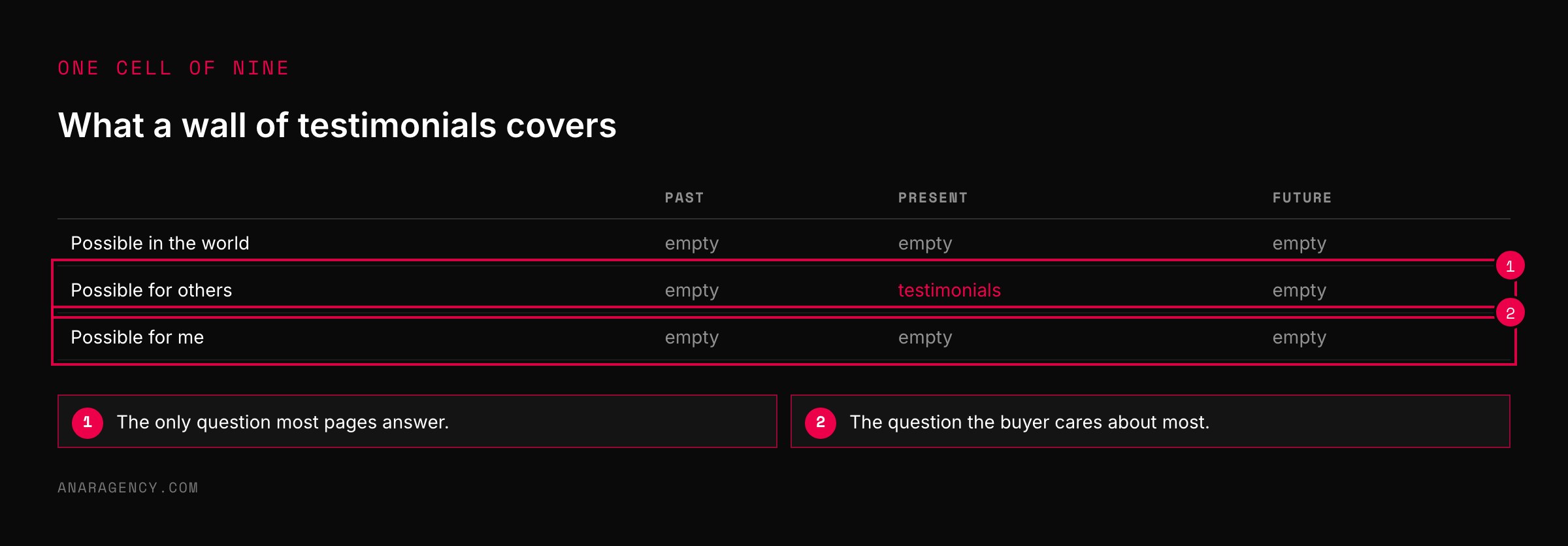
Three questions: can it be done at all, has someone already done it, and can this buyer do it. Three tenses for each: past, present, future. Nine cells.
Fill them by asking of the main claim, "what would have to be true for this to be true?" Use public numbers for the world row, similar customers for the me row, and count kinds of proof instead of pieces. Never invent evidence.
An empty cell that is admitted beats one filled with something unsupported.
The Proof Grid
Lay the three questions down the side of a page.
Possible in the world. Something changed that makes this achievable. A new rule, a new tool, a shift in how people buy.
Possible for others. Named people have done it. Here is how and what happened.
Possible for me. Someone with my limits, my budget, and my starting point can do it.
Now put three tenses across the top: past, present, future.
The past column explains why it was hard before, or how it used to work. The present column shows it working now, with dates. The future column gives a reason to think it will last.
Three by three is nine. The future column matters more than it looks. Nobody buys a path they expect to close, so a page that proves it worked last year and stops there leaves the reader's largest doubt untouched.
Grid Fillers: how to find evidence for each cell
Offers that feel airtight are rarely better at collecting praise. They have covered more cells. We call the people who build them Grid Fillers.
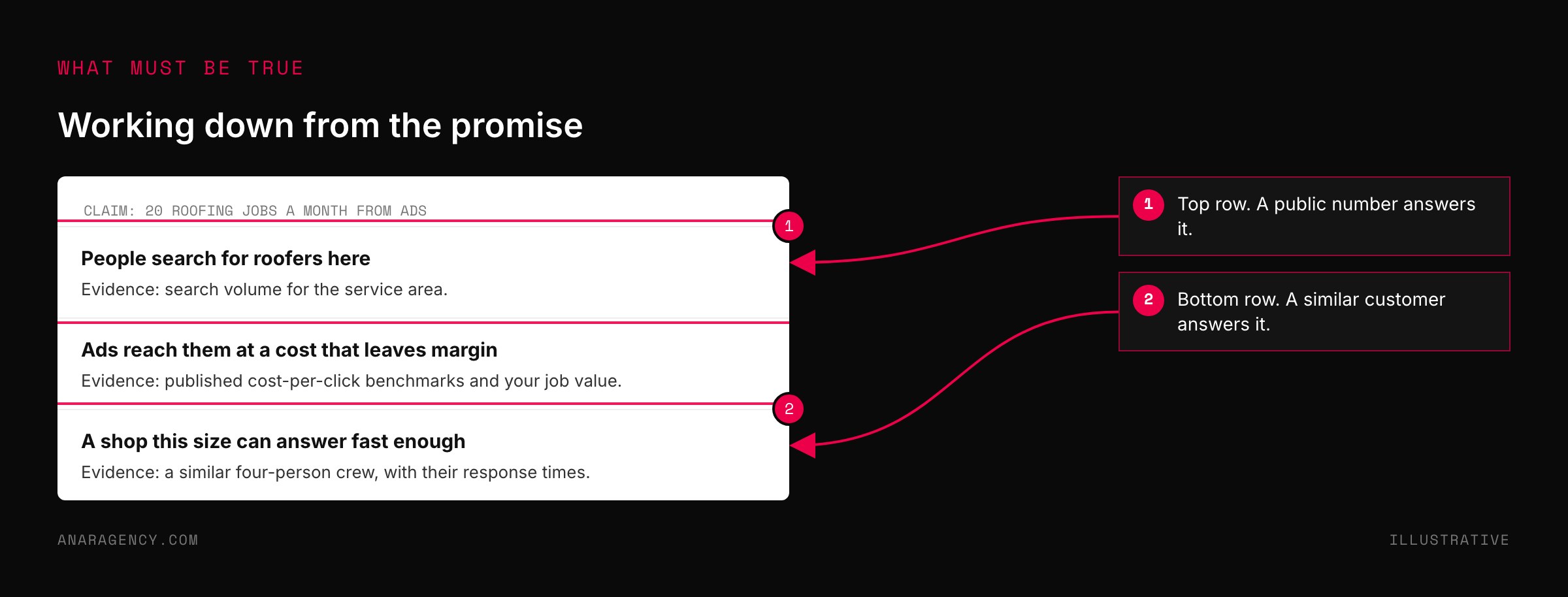
They start from the claim and work down. Take the headline promise and ask: what would have to be true for this to be true? Each answer is a cell that needs evidence.
"You can book twenty roofing jobs a month from ads." What has to be true? That people search for roofers.
That ads reach them at a cost that leaves margin. That a shop your size can answer the phone fast enough.
They use math for the world row. Market size, search volume, published benchmarks. A number from a public source is not an opinion, and it is the cheapest proof there is.
They match the "me" row to the reader. The most similar customer, not the most impressive. We cover why in the three stop-beliefs.
They count kinds, not pieces. Ten screenshots are one kind of proof. A named case, a public statistic, and a plain explanation of the mechanism are three.
Risk is measured in one. One source, one type, one tense. Each reads as fragile, however strong it is alone.
"I am new. I do not have nine kinds of proof."
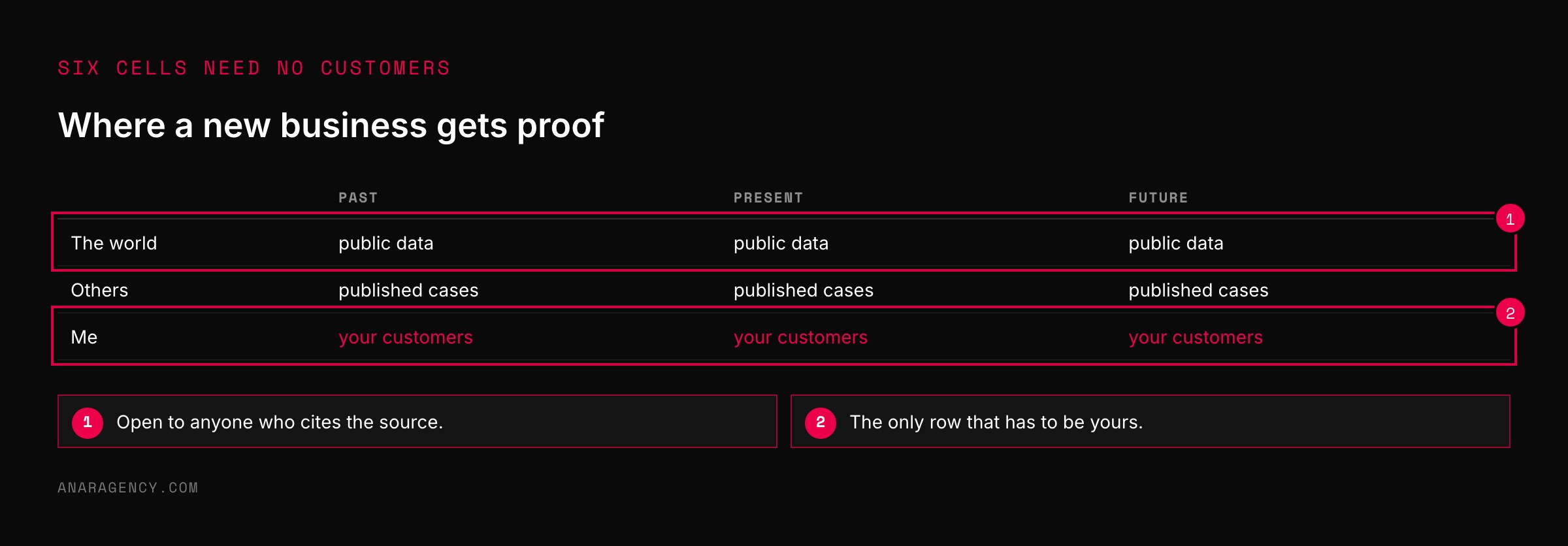
You may have two customers and no case studies. The grid is more useful to you than to an established firm, because six of its nine cells do not need customers at all.
The whole top row is about the world. Public data fills it. Our own article on what a click costs by industry is top-row proof anyone can cite.
The "others" row can use public cases that are not yours, as long as you say so. "Here is what a published study of 2,000 accounts found" is honest and strong.
What you may not do is invent. A made-up testimonial is a legal problem as well as a moral one. The FTC requires that claims be truthful and backed by evidence, and it has rules against fake reviews.
The same applies to results. If a customer's outcome was unusual, say what is typical. A cell left empty and admitted is safer than a cell filled with something you cannot support.
What to read next, and why
Four-minute mile (encyclopedia entry): The record, the dates, and how fast it fell once someone had done it.
Social proof (encyclopedia entry): The research on why other people's choices persuade us, and where it stops working.
Survivorship bias (encyclopedia entry): Why a wall of winners convinces less than you expect.
Advertising FAQs: A Guide for Small Business (FTC guide): What counts as evidence for a claim, in the regulator's own words.
So the simple takeaway is this: draw a three by three grid, put your proof in the cells, and look at which ones are empty. Start with the top row.
Questions executives ask
What is the Proof Grid?
A three by three layout of the evidence an offer needs. The rows are whether the result can be achieved at all, whether other people have achieved it, and whether this buyer can. The columns are past, present, and future.
Each of the nine cells is a separate doubt.
Why are testimonials not enough proof?
They answer one question: has someone else done it. They do not show that the result is possible under current conditions, that it is possible for this particular buyer, or that it will keep working. Readers also know testimonials are selected winners.
What kinds of proof can a new business use?
Public data about the market, published studies, a clear explanation of why the method works, and honestly labeled cases from other sources. These fill the cells about whether the result is possible in the world, which do not require your own customers.
How many testimonials should a landing page have?
The count matters less than the variety. Several testimonials are still one kind of evidence. A page is stronger with one similar customer story, one public number, and one explanation of the mechanism than with ten quotes.
Is it legal to use customer results in advertising?
Yes, if they are true and you can support them. In the United States the FTC expects claims to be substantiated, and if a featured result is not typical, the advertising should make clear what buyers can generally expect.

Filip Kovacevic is the founder of Anar Agency in Phoenix. He spent five years running SEO, Meta ads, email, and content for medical practices across the United States, and now does the same work for healthcare, home-service, legal, and professional-service businesses, alongside AI implementation. More from Filip →
Talk it through in 15 minutes
Bring one AI question from this article. We will tell you what we would do, whether or not you hire us.
Book a 15-Min Chat →