Ads for Buyers Who Already Know: Name It, Fix It, Hand It Over
A buyer who already knows they have a problem does not need to be convinced it exists. They need three things from an ad, in this order: their situation stated as a fact so they know you understand it, what has to change to fix it, and a clear offer to take the job. We call that Name It, Fix It, Hand It Over.
Spend about a tenth of the ad on the problem and the rest on the fix and the handoff. Say what to do, never how, and describe the business situation, never a personal trait.
The buyer who is already annoyed
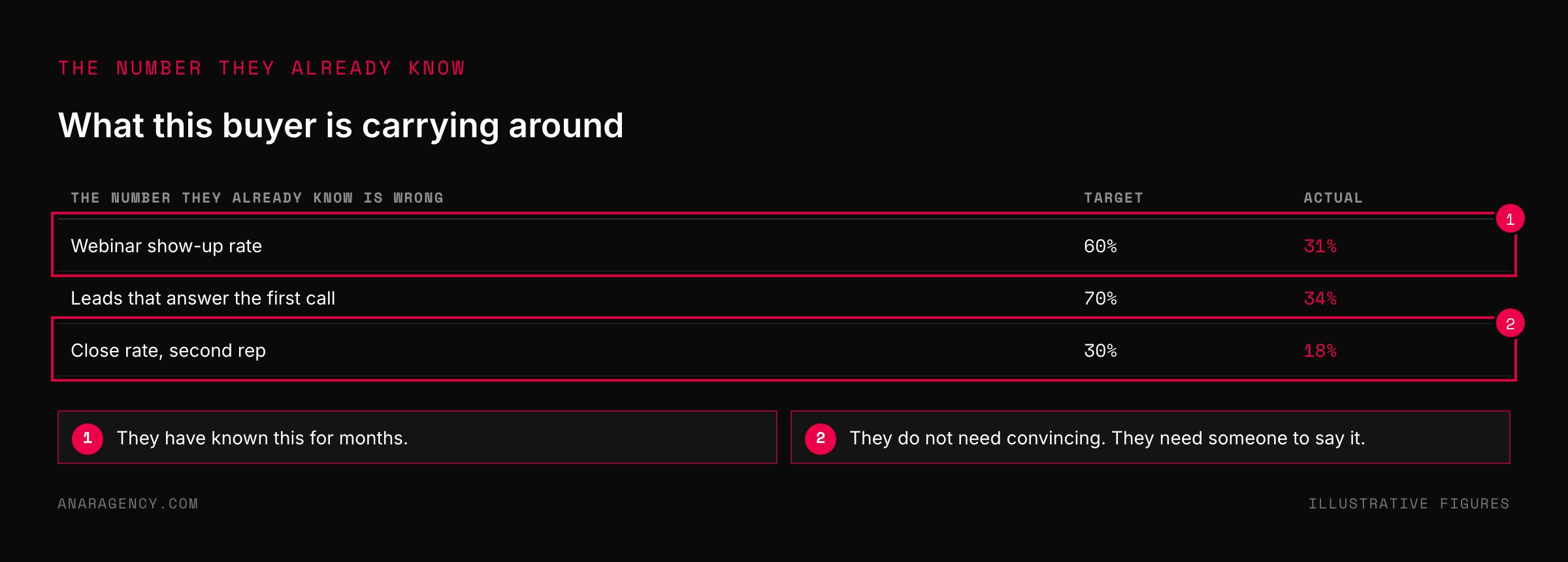
Some buyers do not need a story. They have a number in their head that is wrong, and they have known it for months.
The show-up rate that will not move. The lead cost that doubled. The sales rep who closes half of what the other one does.
These people have money. What they do not have is time, and they can tell in one line whether you understand their problem or are about to waste their afternoon.
Most ads waste the afternoon. They open with three paragraphs proving the problem exists, to a person who has been living in it since spring.
This article is about the ad for that buyer. It has three moves, and it is shorter than you think.
Name It, Fix It, Hand It Over
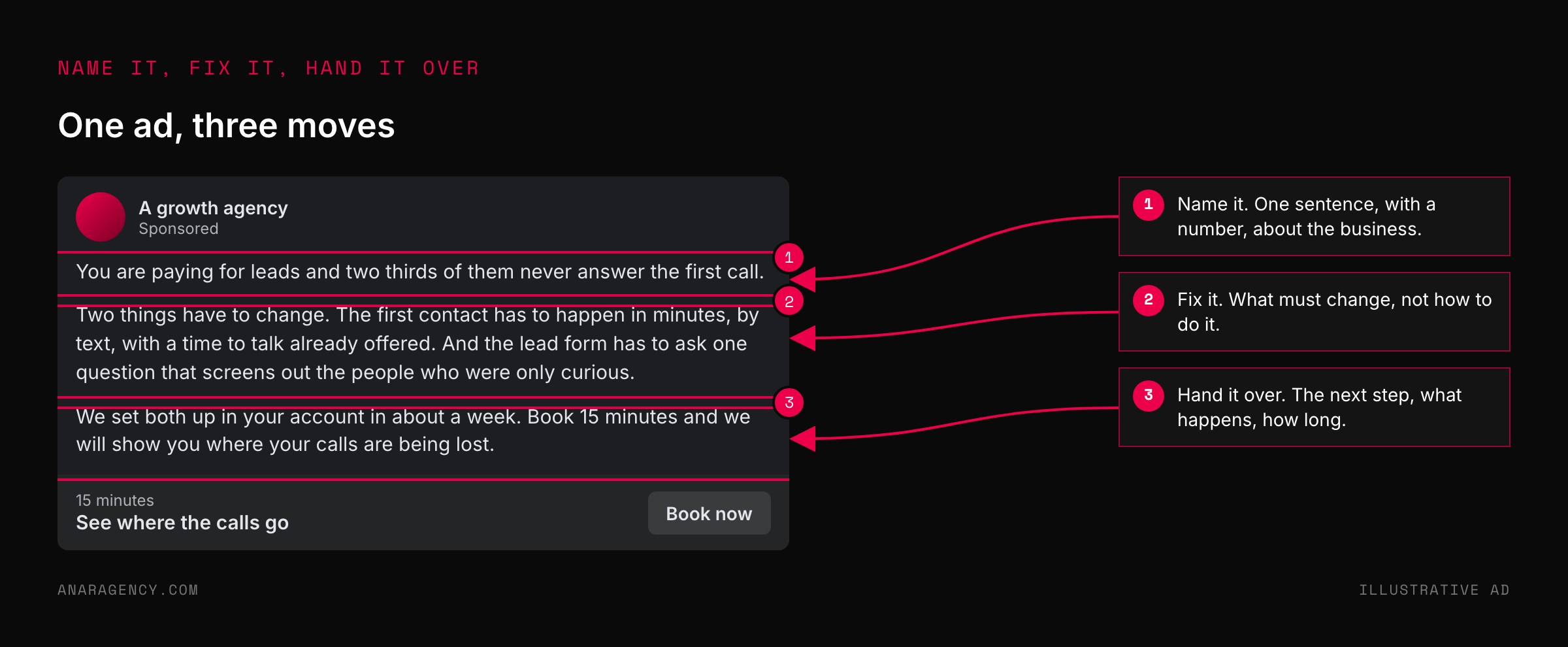
Name it. Say what is happening in their business, as a fact, with a number. "You run a webinar every month and half the people who register do not show."
One or two sentences.
Fix it. Say what has to change. Not how to do it.
"The reminder has to come from a person, by text, the morning of. And the replay has to stop being promised up front." This is most of the ad.
Hand it over. Offer to take the job off their desk. Say what the next step is, how long it takes, and what they will have at the end of it.
The proportions matter. For this buyer we spend about a tenth of the ad on the problem. They already agree with you.
Every extra sentence about the pain is a sentence that tells them you are stalling.
For a buyer who has not noticed the problem yet, the split is the reverse, and the opening is completely different. We cover that reader in before-words and after-words.
For buyers who already know they have a problem. Name it: state their business situation as a fact, with a number, in one or two sentences, never as a question and never as a personal trait. Fix it: say the two or three things that must change, without explaining how to do them.
Hand it over: one next step, what happens in it, how long it takes. Spend roughly a tenth of the ad on the problem and the rest on the fix and the handoff.
Why a statement beats a question
The most common way to open this kind of ad is with a question. "Tired of leads that do not convert?"
It feels friendly. To this buyer it reads as a tell. A question asks them to do the diagnosing.
It is what you say when you do not know.
Think about a good doctor. She does not ask whether you might possibly be unwell. She looks at the chart and says what she sees.
The confidence is the service.
There is research behind this from the sales world. A study of thousands of salespeople, later published as The Challenger Sale, sorted reps into five types and looked at who performed best.
Nearly 40 percent of the high performers were one type. Not the ones who built the warmest relationships. The ones who taught the customer something about the customer's own business and took control of the conversation.
An ad that names the situation precisely is doing the same thing in one line. It is not asking permission to help. It is showing that it already understands.
What, not how
The middle of the ad is where most people give away too much or too little.
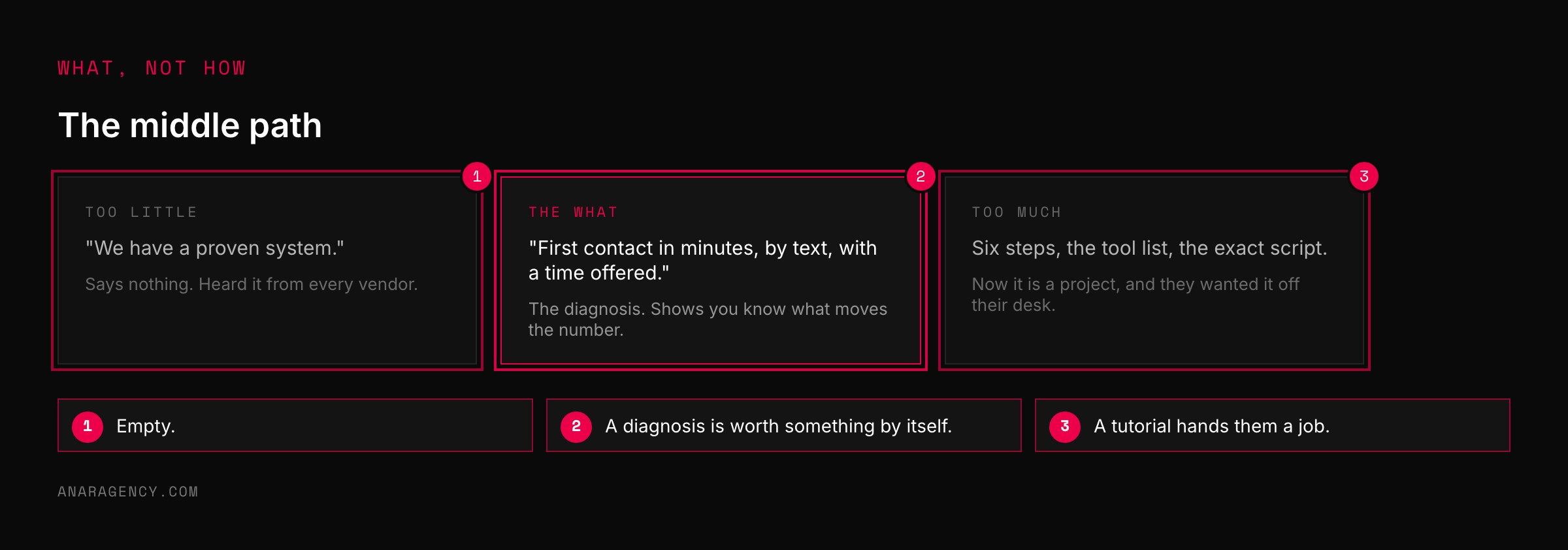
Too little sounds like this: "We have a proven system." That says nothing, and this buyer has heard it from eleven vendors.
Too much is a tutorial. Six steps, a tool list, the exact wording. Now they have a project, and people with money and no time do not want a project.
The middle path is what, not how. Tell them the two or three things that have to be true for the number to move. Leave the doing for the engagement.
Here is why that is honest and not a trick. The what is the diagnosis, and a diagnosis is worth something. The how is the labor, and labor is what they are paying to hand off.
A reader who could do the how themselves was never going to hire you. A reader who cannot will be relieved you offered.
"Stating their problem as a fact will get my ad rejected."
You may be thinking that an ad saying "you have this problem" breaks platform rules. Part of that worry is right, and the line is worth knowing exactly.
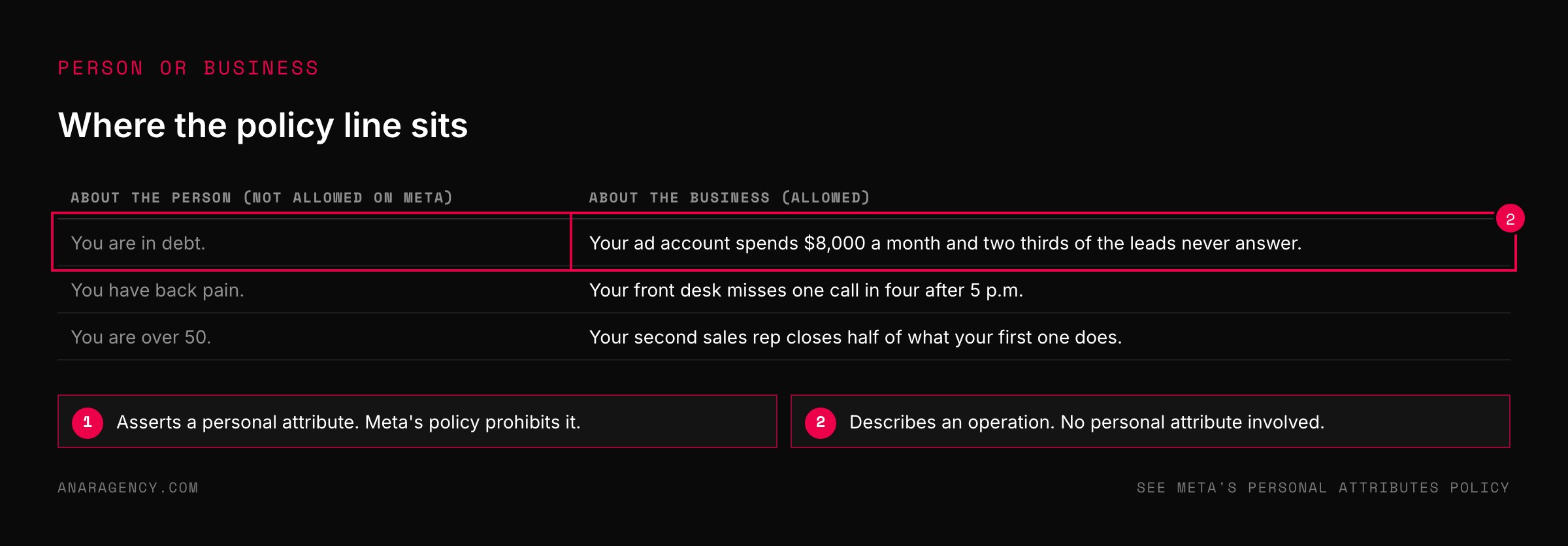
Meta does not allow ads that assert or imply personal attributes of the viewer. The policy's examples include race, religion, age, health conditions, and financial status. "Are you bankrupt?" is on its list of violations.
The same policy says you can use the words "you" and "your" as long as the ad does not mention a prohibited personal attribute.
So the line is between the person and the business. "You are in debt" is about a person's finances and is not allowed. "Your ad account spends $8,000 a month and two thirds of the leads never answer" is about how a company operates.
If you sell to consumers about health, money, or anything personal, this structure needs more care. Name the situation in the third person, or describe what commonly happens, and let the reader recognize it.
And one more check that has nothing to do with policy. Only state what is true for the reader you are targeting. A precise statement that is wrong is worse than a vague question, because now they know you guessed.
What to read next, and why
What is the Challenger sales methodology? (overview): The source of the 40 percent figure. The idea that teaching beats rapport is the same idea as naming the problem.
Meta's Personal Attributes advertising policy (policy): Read the examples before you write a single "you" sentence about health or money.
The Short Life of Online Sales Leads (research): A classic on how fast a lead goes cold. Useful raw material for the kind of specific fact that makes a strong opening line.
Our own book-a-call math (article): Where to find the numbers to name. Four rates, and the one furthest from target is your opening sentence.
So the simple takeaway is this: when the buyer already knows, stop proving the problem. Say it in one line, say what fixes it, and offer to do it.
Questions executives ask
What is a solution-aware ad?
An ad written for someone who already knows they have a problem and is deciding who should fix it. It does not spend time proving the problem. It states the situation briefly, says what fixes it, and makes a clear offer.
Should an ad ask a question or make a statement?
For buyers who already know their problem, make a statement. A specific statement of their situation shows you understand it. A general question asks the reader to do the diagnosing and could have been written for anyone.
How long should an ad be for high-ticket buyers?
Short on the problem and specific on the fix. As a rule of thumb, spend about a tenth of the ad naming the situation and the rest on what has to change and the next step. These buyers have money and little time.
Can I say "you" in a Meta ad?
Yes. Meta's policy allows "you" and "your" as long as the ad does not assert or imply a prohibited personal attribute such as health condition, financial status, age, race, or religion. Describing how a business operates is different from describing a person.
Does telling prospects what to fix give away the sale?
No. Saying what must change is the diagnosis and shows competence. Explaining how to do it is the labor the buyer wants to hand off. People who could do the how themselves were unlikely to hire anyone.

Filip Kovacevic is the founder of Anar Agency in Phoenix. He spent five years running SEO, Meta ads, email, and content for medical practices across the United States, and now does the same work for healthcare, home-service, legal, and professional-service businesses, alongside AI implementation. More from Filip →
Talk it through in 15 minutes
Bring one AI question from this article. We will tell you what we would do, whether or not you hire us.
Book a 15-Min Chat →