Relationship and Trust Cycles: Every Sale Spends Trust
Trust works like a budget. Useful, no-ask messages put trust in. Offers take it out, and so does a sale, because a new buyer does not yet know whether it will work for them.
Lists and audiences burn out when withdrawals run ahead of deposits. So run two cycles in turns: a relationship cycle of help and proof, then a sales cycle with a clear offer. And treat the two weeks after a purchase as a relationship cycle of their own: confirm what happens next, deliver a first win, show proof, and listen before you sell again.
A meter you can see
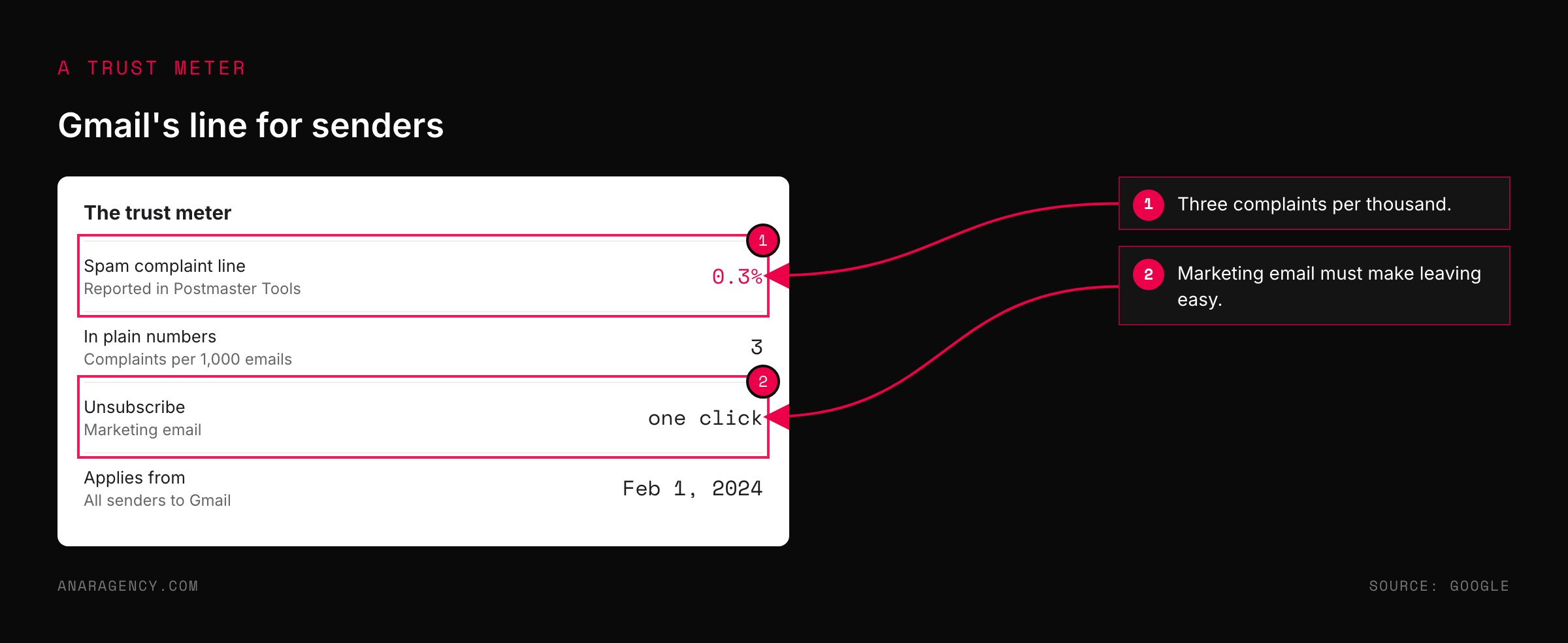
Since February 1, 2024, Gmail has asked senders to keep spam rates reported in its Postmaster Tools below 0.3 percent. Marketing email must also support one-click unsubscribe.
Read that as a trust meter. Three complaints in a thousand emails is the line.
Every email moves the needle a little. A helpful one moves it down, and an ask moves it up.
Most businesses never look at it until their email starts landing in spam. By then the trust is already spent.
The meter is new. The idea behind it is old: an audience gives you a budget of trust, and you spend it every time you ask.
Every ask is a withdrawal, even the ones that work
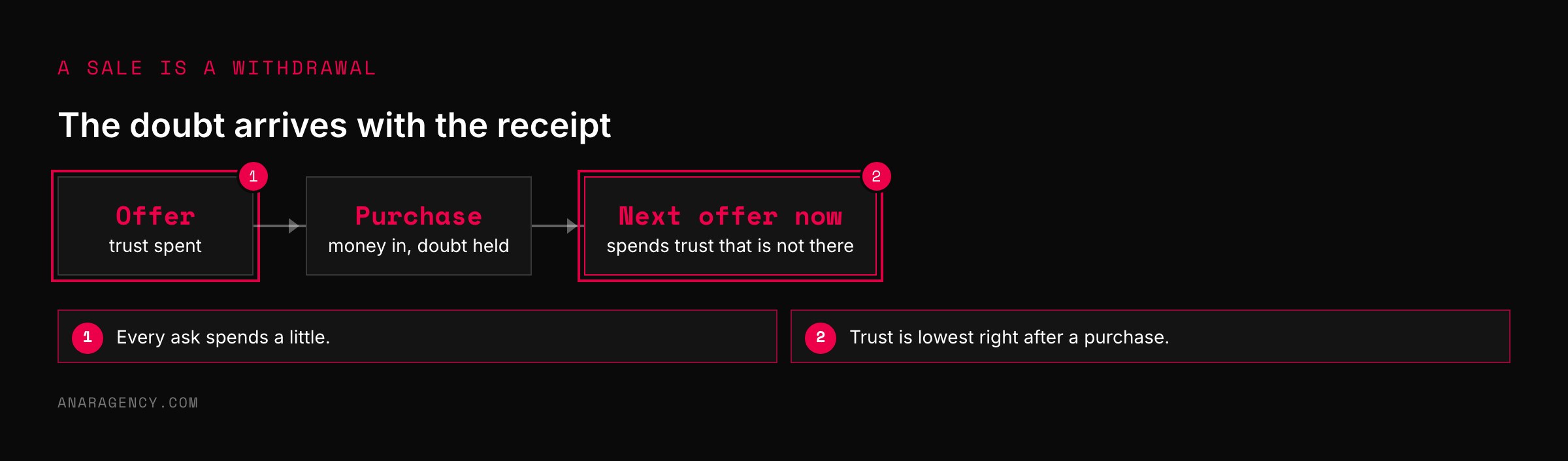
Here is the part that surprises people. A sale spends trust too.
The buyer has paid, but they do not yet know whether it will work for them. Until it does, they are holding a doubt.
That doubt has a name. Buyer's remorse is the regret that can follow a purchase, especially an expensive one, and it is linked to the discomfort of a hard decision.
So the moment you most want to send the next offer, right after a purchase, is the moment trust is lowest.
That is the trust budget. Deposits come from help, and withdrawals come from every ask, whether the reader says yes or no.
An audience gives you a budget of trust. Helpful, no-ask messages are deposits; every ask is a withdrawal, including a successful sale, because a new buyer still doubts the outcome. Run a relationship cycle and a sales cycle in turns rather than a constant drip, time asks for when buyers have money and attention, and treat the two weeks after a purchase as a relationship cycle: confirm next steps, deliver a first win, show proof, listen, then ask again.
Two cycles, taken in turns
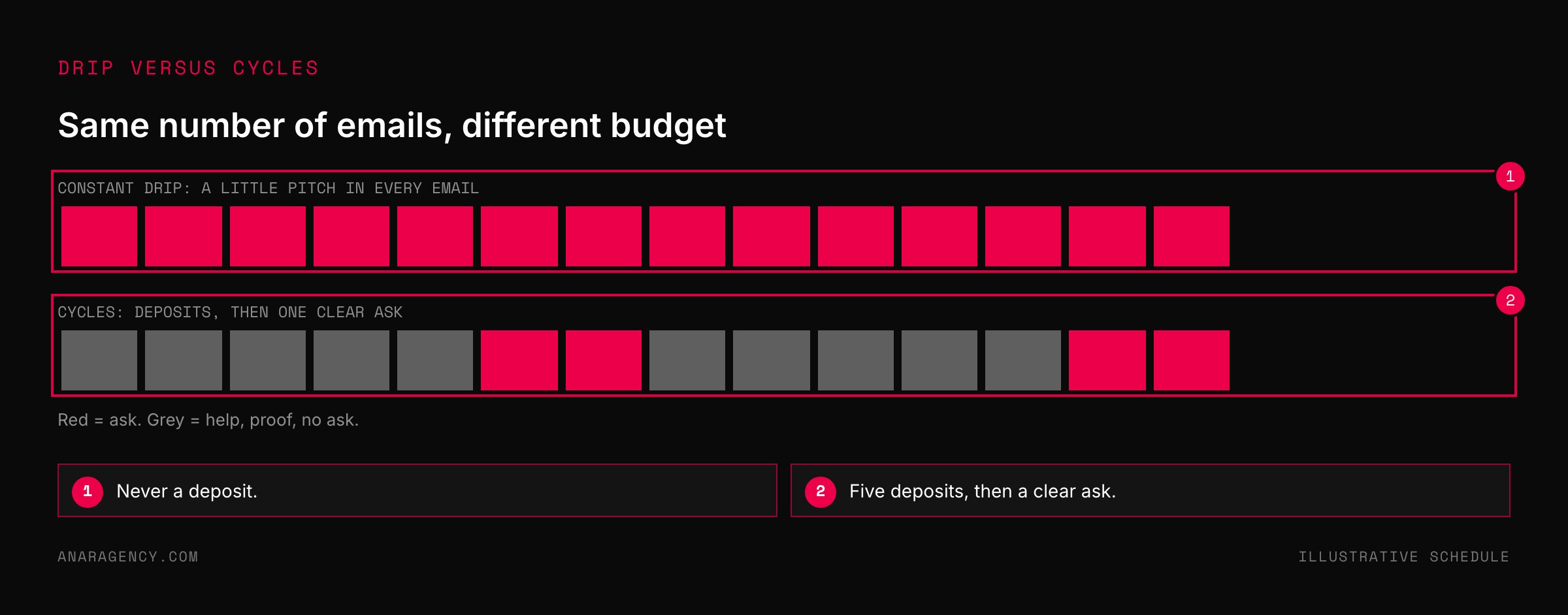
Healthy lists run on two cycles. A relationship cycle, then a sales cycle, then a relationship cycle again.
The relationship cycle gives without asking. Useful information, a quick win, proof that people like the reader got results. People tend to return favors, a pattern psychologists call reciprocity.
The sales cycle asks clearly. One offer, a real reason to act now, a deadline, then it ends.
The mistake is mixing them into a constant drip. Every email carries a little pitch, so there is never a deposit.
Our rule of thumb: time the sales cycle for when your buyers actually have money and attention. For consumers that may be payday; for businesses it may be the start of a quarter. For how often to ask at all, see the promotion cap.
The two weeks after a sale
Most businesses send nothing after a purchase except a receipt. Or they send the next offer.
Both waste the best moment you have. A new buyer is paying close attention, and they want to be told they chose well.
People tend to remember their own choices more favorably over time, a pattern called choice-supportive bias. You can help that along with facts, not flattery.
Day 0: confirm what happens next, who to contact, and when.
Days 1 to 3: deliver one quick, visible result, however small.
Days 4 to 7: show proof that people in their position got the same result.
Days 8 to 14: ask how it is going, and fix what is not. Only then is the next offer a fair ask.
"We cannot afford to send emails that do not sell."
You already are, just not on purpose. Every unread sales email is a no-sell email that also cost trust.
A relationship email is not free content for its own sake. It is the deposit that makes the next ask work.
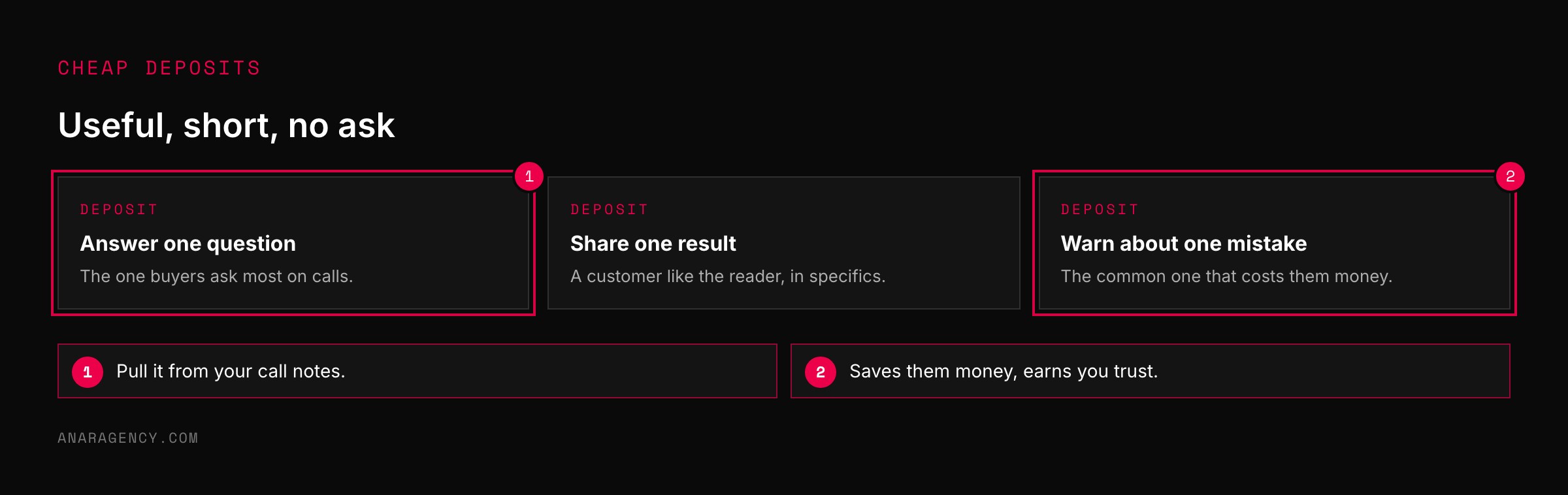
Keep it cheap to make. Answer one question buyers often ask, share one result, or warn about one common mistake.
Then measure the cycle, not the email. Compare sales per thousand subscribers over a month with alternating cycles against a month of constant asks.
For the email that earns the margin in a service business, see email as the profit center.
Who makes deposits on purpose
Some companies build the deposit into the sale itself. They make it safe to buy before they ask anyone to buy again.
Zappos, the online shoe store, offers free returns within 60 days anywhere in the United States. The doubt every new buyer holds is answered before it grows.
That is a deposit made at the exact moment of a withdrawal. The buyer pays, and in the same breath they are told they can undo it at no cost.
A service business can do the same thing at a smaller scale. A clear first-week plan, a named contact, and a written promise about what happens if the first result is late.
Here is a simple way to check your own balance. Count your last twenty messages to customers and leads, and mark each one as a deposit or a withdrawal.
If more than a third are withdrawals, the next month should be mostly deposits. Our rule of thumb: never run two sales cycles back to back.
Then watch the signals that tell you the budget is low. Replies fall, unsubscribes rise, and spam complaints creep toward the line.
Those three numbers move before revenue does. Read them every week and you will see a tired list a month before it costs you a sale.
When you do see it, stop asking for a while. Send three useful messages in a row, and let the numbers recover before the next offer.
What to read next, and why
Email sender guidelines (Google help page): The 0.3 percent spam line and the one-click unsubscribe rule.
Buyer's remorse (encyclopedia entry): Why the moment after purchase is fragile.
Choice-supportive bias (encyclopedia entry): How buyers come to feel good about a choice, and why facts help.
Reciprocity (encyclopedia entry): The research behind giving before asking.
So the simple takeaway is this: look at your last ten emails, mark each one as a deposit or a withdrawal, and send a deposit next.
Questions executives ask
What is a customer trust cycle?
The pattern of building trust with useful, no-ask contact, then spending some of it with an offer, then rebuilding it. Audiences burn out when asks outpace the rebuilding.
Why do email lists stop responding?
Usually because the list has been asked too often without enough useful contact in between. Each ask spends trust, and complaints and unsubscribes rise as the budget runs out.
What should I send after a customer buys?
Confirm what happens next, help them get one quick result, show proof that people like them succeeded, and ask how it is going before sending a new offer.
What is Gmail's spam rate limit?
Google asks senders to keep the spam rate reported in Postmaster Tools below 0.3 percent, and marketing messages must support one-click unsubscribe.
Does a sale build or spend trust?
In the short term it spends it, because the buyer has not yet seen whether it works. Delivering an early result is what turns the sale into trust.

Filip Kovacevic is the founder of Anar Agency in Phoenix. He spent five years running SEO, Meta ads, email, and content for medical practices across the United States, and now does the same work for healthcare, home-service, legal, and professional-service businesses, alongside AI implementation. More from Filip →
Talk it through in 15 minutes
Bring one AI question from this article. We will tell you what we would do, whether or not you hire us.
Book a 15-Min Chat →