Markets Are Emotional Entities
A market exists because a need or a feeling is still unmet. Each market tends to have one leading feeling, such as safety, control, status, or certainty, and the product is how buyers try to get it. Buying also often asks the buyer to admit something uncomfortable, like "I could not fix this myself."
That admission can stall the sale. The fix is to name a true outside cause of the problem, such as a change in the platform or the rules, before you ask for the sale. The cause must be real.
An invented villain is deception.
A foundation that beat its own cause
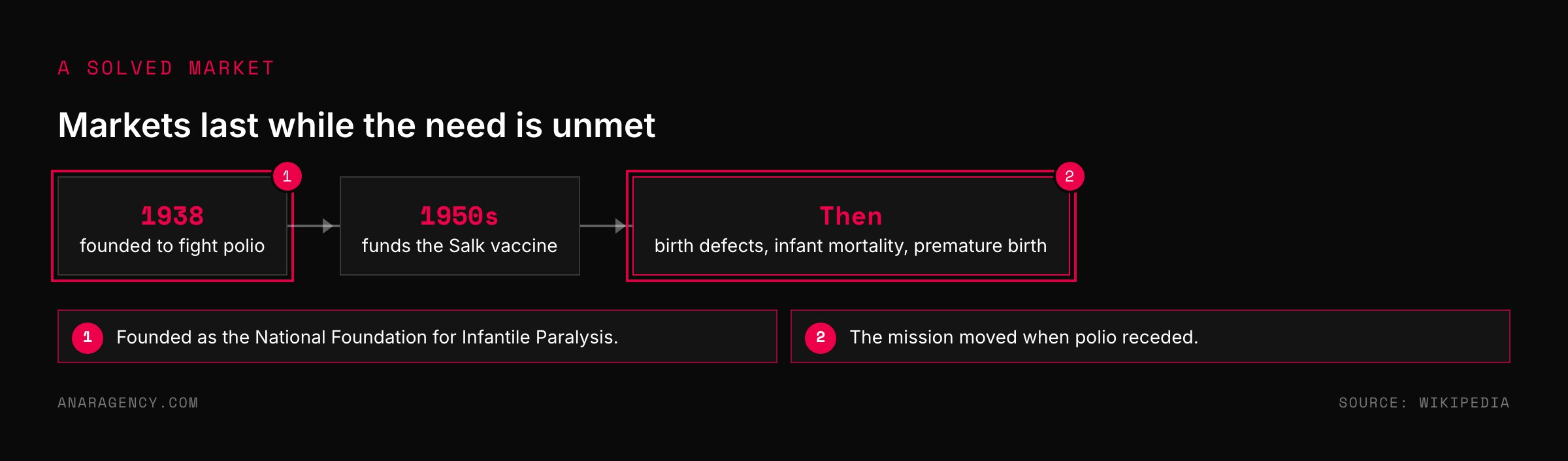
In 1938 President Franklin D. Roosevelt founded the National Foundation for Infantile Paralysis to fight polio. Its fundraising drive became known as the March of Dimes.
It funded Jonas Salk's polio vaccine. Then the thing it was built to fight began to disappear.
So the organization expanded its focus to birth defects and infant mortality, and later to premature birth. Its name changed along the way.
There is a hard lesson for any business in that story. A market exists only while a need is unmet.
Solve it completely and the market shrinks. Most markets last because the need underneath them is never fully met.
A market has a mood
Copywriting is usually taught one buyer at a time. Imagine the reader, feel what they feel, write to them.
That works. But a whole market also has a mood, one leading feeling that is still unmet across most of the people in it.
A home security buyer is not buying a camera. They are buying the feeling of being safe at night.
Feelings steer decisions quickly. Researchers describe an affect heuristic, a mental shortcut where a current emotion shapes a judgment before careful reasoning catches up.
So find the feeling first. When your message is built around the market's leading feeling, it speaks to thousands of people at once, not one imagined reader.
Markets exist because a feeling is unmet, and each market tends to have one leading feeling such as safety, control, status, or certainty. Buying often asks the buyer to admit something uncomfortable, which stalls the sale. Name the admission, find the true outside cause of the problem, state it with evidence before the ask, and sell the fix rather than the failing.
The cause must be real; an invented villain is deception.
The admission problem
Here is the part most pages miss. To buy, a person often has to admit something about themselves.
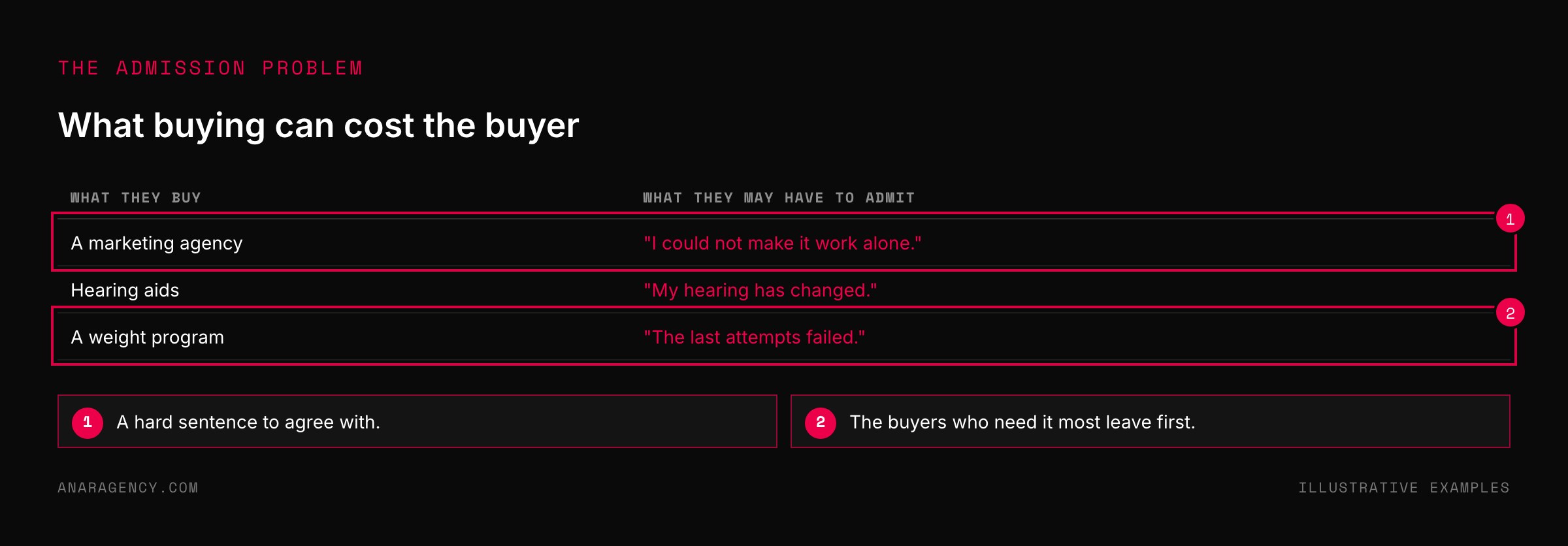
Hiring a marketing agency can mean admitting the owner could not make it work alone. Buying hearing aids can mean admitting your hearing has changed. Joining a weight program can mean admitting the last ten attempts failed.
Admissions hurt. They pull the buyer's mood down at the exact moment the sale needs it to rise.
And people resist them. We tend to credit successes to ourselves and failures to outside factors, a pattern called the self-serving bias.
So a page that makes the buyer confess first will lose buyers who need it most. They close the tab rather than agree they failed.
What a mouthwash ad learned in the 1920s
Listerine was invented in the nineteenth century as a surgical antiseptic. It did not become a big seller until the 1920s.
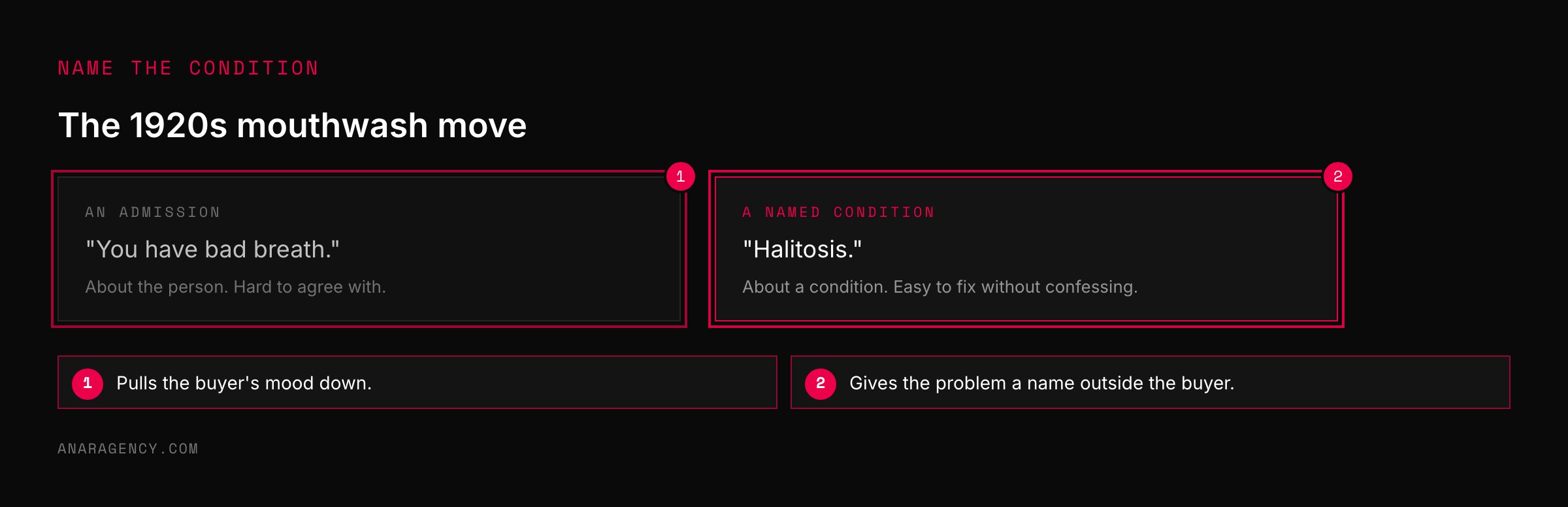
Then the company began advertising it as a cure for "chronic halitosis", an obscure medical term for bad breath. As one advertising scholar put it, the company did not so much make mouthwash as make halitosis.
Revenue reportedly rose from $115,000 to more than $8 million in seven years.
Notice the move. "You have bad breath" is an admission. "You may have a condition called halitosis" is a problem with a name, outside your character.
Now notice the warning. The same ads leaned on shame, and the company later had to run corrective ads after the FTC ruled its cold and sore throat claims misleading. A named cause works; a manufactured one costs you later.
The Admission Problem: four steps
1. Name the admission. Write down, honestly, what your buyer has to admit to buy from you.
2. Find the true outside cause. Most problems have one.
For example, in 2021 Apple began requiring apps to ask permission before tracking users, and ad tracking that once worked got weaker for many advertisers.
An owner whose ads stopped working did not suddenly get worse at business. The ground moved.
3. Say it before the ask. Put the cause early on the page, plainly, with a source.
It lets the buyer agree with you without confessing anything. See agree on the cause first for the order of the argument.
4. Sell the fix, not the failing. The buyer is now someone responding to a change, not someone who failed.
That is a much easier person to be.
"Isn't that just blaming someone else?"
It is, if the cause is not real. Inventing a villain to make buyers feel better is deception, and in the US advertising claims must be truthful and backed by evidence.
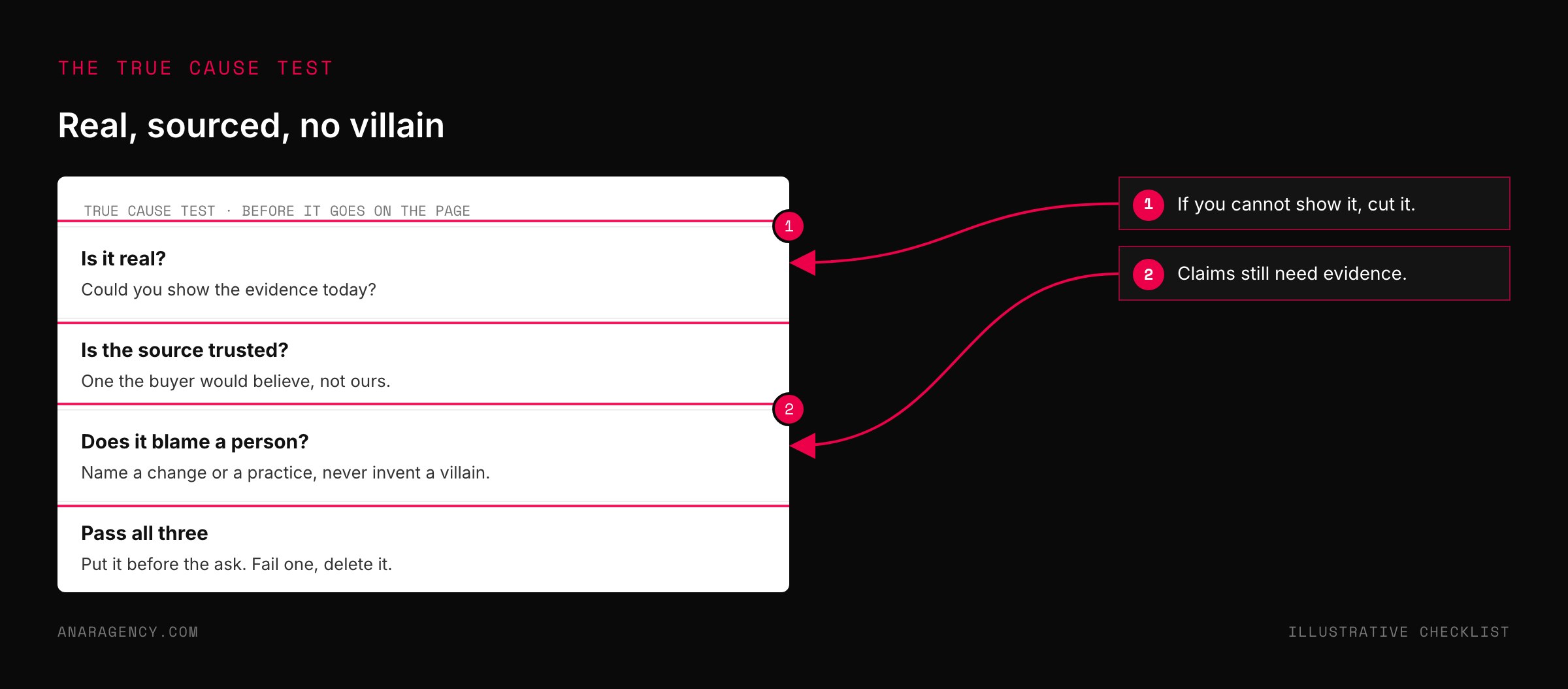
The test is simple. Could you show the buyer the evidence for the cause, today, from a source they would trust?
If yes, you are giving them accurate information they did not have. If no, delete it.
Also watch for the opposite mistake. Some pages make the admission worse on purpose, to raise the stakes, and that tends to bring in buyers who resent the seller later.
Respect the buyer's self-image, tell the truth about the cause, and the sale gets lighter. For more on the gap buyers feel, see desire is a gap.
What to read next, and why
March of Dimes (encyclopedia entry): A clear case of what happens when a cause is actually solved.
Listerine (encyclopedia entry): The halitosis campaign, and the later FTC ruling on its cold claims.
Affect heuristic (encyclopedia entry): How emotion shortcuts judgment.
Self-serving bias (encyclopedia entry): Why buyers resist admitting a failure.
So the simple takeaway is this: write down what your buyer has to admit to buy from you, then find the true outside cause and put it on the page before the ask.
Questions executives ask
What is market psychology in marketing?
The idea that a whole market, not just an individual, has a leading unmet feeling such as safety or status. Messages built around that feeling reach far more people than messages written to one imagined buyer.
Why do customers who need a product not buy it?
Often because buying would mean admitting something uncomfortable about themselves. If the page asks for that admission before offering a reason outside the buyer's control, many leave.
How do emotions affect buying decisions?
Emotions act as a fast shortcut. Research on the affect heuristic describes how a current feeling shapes judgment before careful reasoning catches up.
Is it ethical to give customers someone to blame?
Only when the cause is real and you can show the evidence. Inventing a villain is deceptive and can break advertising law.
What is an example of naming an outside cause?
An advertiser whose results dropped after Apple began requiring apps to ask permission before tracking can be told, accurately, that the platform changed, rather than that they did something wrong.

Filip Kovacevic is the founder of Anar Agency in Phoenix. He spent five years running SEO, Meta ads, email, and content for medical practices across the United States, and now does the same work for healthcare, home-service, legal, and professional-service businesses, alongside AI implementation. More from Filip →
Talk it through in 15 minutes
Bring one AI question from this article. We will tell you what we would do, whether or not you hire us.
Book a 15-Min Chat →