UGC Hook Video Ads: The Format Library
A video ad format is a container: the kind of scene and speaker a message is delivered through. The useful ones for small advertisers include the teacher, the podcast, the insider in uniform, the mini sales video, the street interview, the skit, the point-of-view shot, and the real customer. Nearly all share four layers: a short hook banner, word-by-word captions, cutaways that show what is being said, and proof on screen.
Pick the format by how aware and how skeptical the audience is, and make three formats of one message before judging any. Real customers must be real.
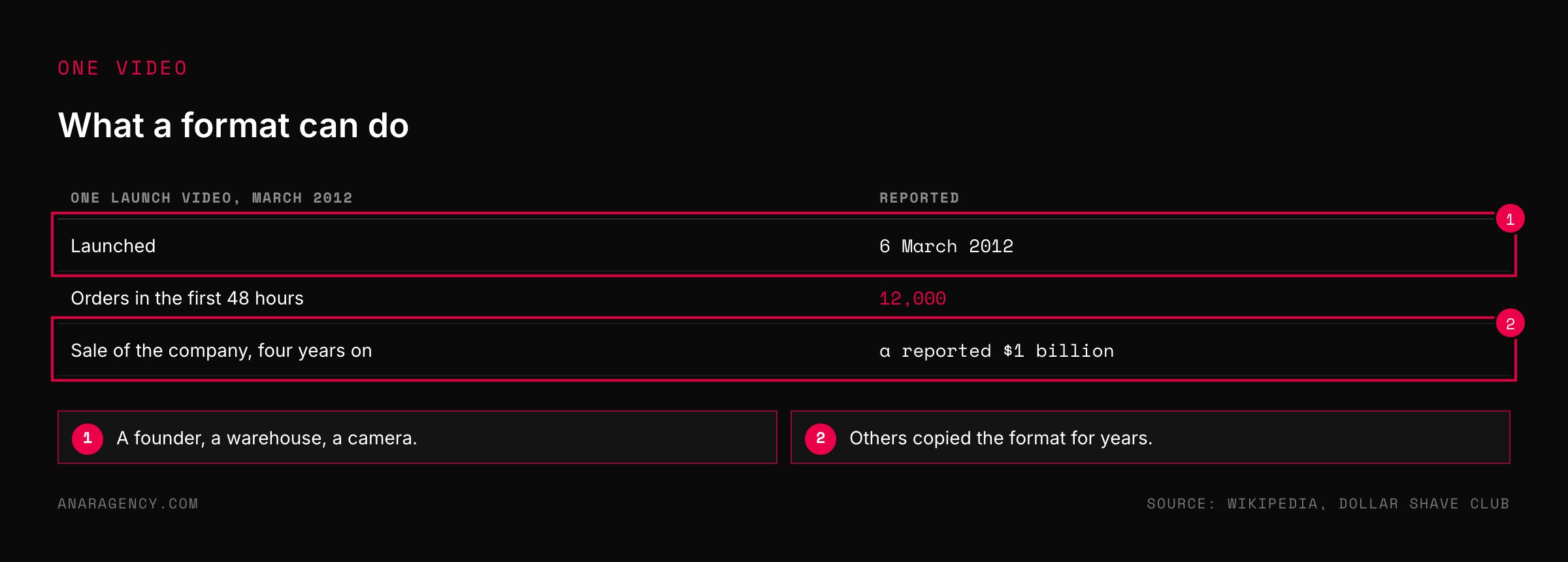
Twelve thousand orders in two days
In March 2012 a small company that sold razors by post put a video on the internet.
It was a minute and a half long. The founder walked through a warehouse talking straight to the camera, deadpan, while odd things happened behind him.
It was cheap to make by advertising standards. It brought in 12,000 orders in the first 48 hours, and the traffic crashed the company's server in the first hour.
Four years later the business was sold for a reported one billion dollars.
The razors were ordinary. What was new was the container: a founder, one location, direct address, a joke every few seconds. Other companies copied that container for years, because it could be copied.
A format is a container
Most small advertisers think about what to say and give no thought to the shape it is said in. So they make the same kind of video every time.
A format is the shape. Who is speaking, where they are, how the camera relates to them, and how the thing is cut.
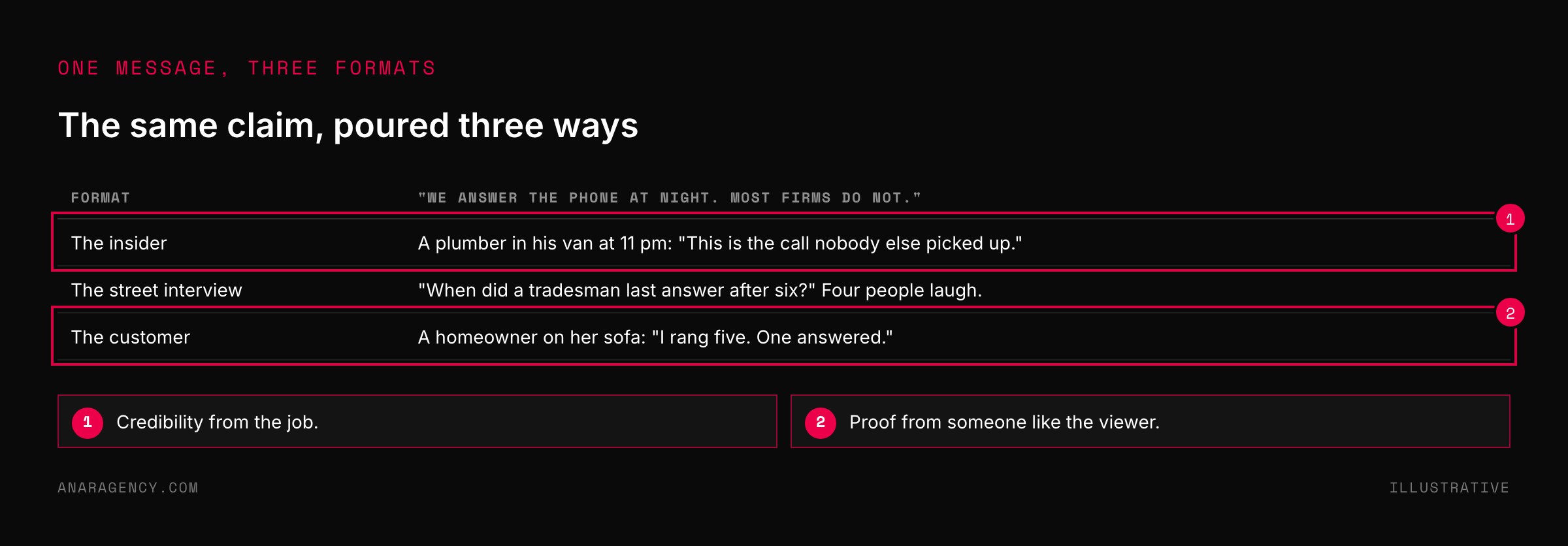
The same message, "we answer the phone at night and most firms do not," can be a teacher at a whiteboard, two people on a podcast, a plumber in a van, or a customer on her sofa.
Each reaches a different viewer. And you cannot know in advance which will work, which is the reason to have a library to choose from.
Much of this style grew out of user-generated content: ordinary people filming themselves on phones. Advertisers adopted the look because it reads as a person talking, not a company broadcasting.
A format is a container: who speaks, where, and how it is cut. Keep a library, including the teacher, the podcast, the insider, the mini sales video, the street interview, the skit, the point of view, and the real customer. Give each four layers: a hook banner, phrase captions, cutaways that show the noun, and proof on screen.
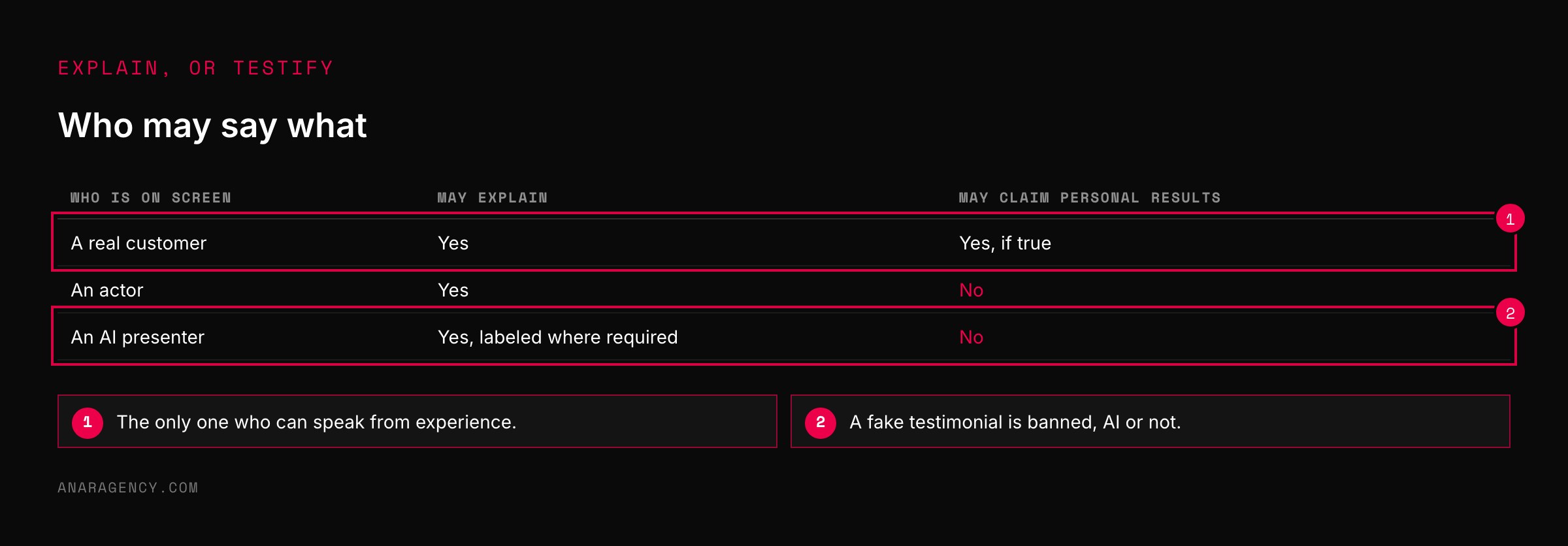
Match the format to the audience's awareness and skepticism, and test one message in three formats. Actors and AI presenters may explain. Only real customers may testify.
Label dramatizations and AI-made realistic video.
The Format Library
Our working library has fifteen formats. Here are eight that suit a small advertiser.
The teacher. One person explains one idea. The podcast.
A host or two at a microphone, opening on a strong opinion. Good for skeptical buyers.
The insider. Someone in the uniform of the trade, in a place that proves the job, names a problem only an insider would see. The mini sales video.
A pain scene, the hidden cause, the new way, the recommendation, in under a minute.
The street interview. One question put to passers-by. Short, and good at reaching people who were not looking.
The skit. Two people act out the problem.
The point of view. The camera is the customer's eyes. The customer.
A real customer, in their own words, on their own phone.
Under the surface nearly all of them share four layers. A hook banner of two to six words for the first few seconds. Captions that change with every phrase.
Cutaways every two or three seconds that show the thing being named. And proof on screen: a screenshot, a highlighted line, a real review as text. How to open any of them is in the first three seconds.
Format Matchers: how to choose
Advertisers who keep finding winners are not luckier. They choose formats on purpose and test more than one. We call them Format Matchers.
They match the format to awareness. People who do not know they have the problem need a street interview or a skit that shows it. People who know and are choosing need the insider or the mini sales video.
They match it to skepticism. A wary, experienced audience responds to the podcast and the insider, where someone reasons out loud. See selling to buyers who have seen it all.
They pour one message into three formats. Same claim, same offer, three containers. Judging a message on one format tells you about the format.
They show the noun. When the speaker says "invoice," there is an invoice on screen. It sounds trivial, and it is a large part of why some ads are easy to follow.
They keep the length honest. A street interview is done in fifteen seconds. A mini sales video may need fifty.
Padding a format past its natural length loses the viewer.
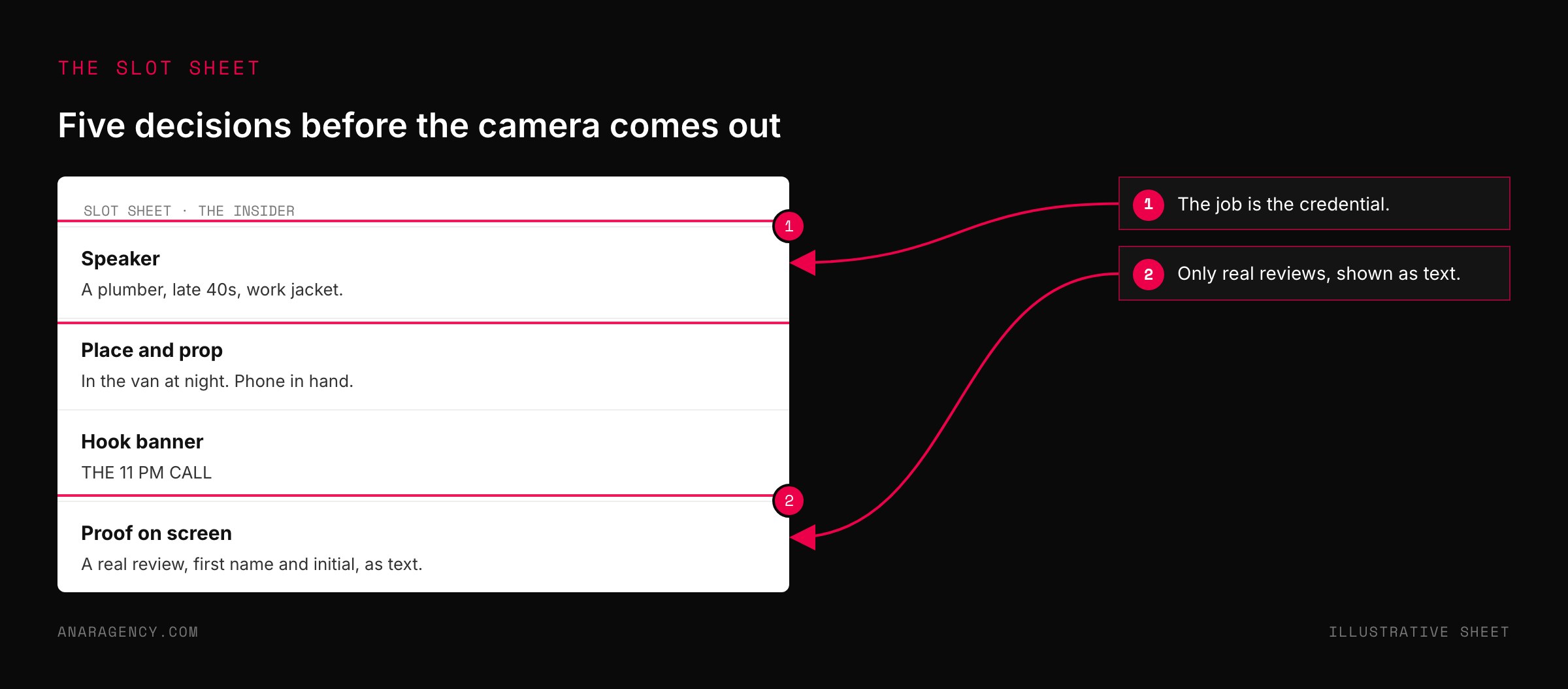
They keep a sheet. For each format: the speaker, the place, the prop, the hook line, the proof. Fill it in before anyone films.
The production pipeline is in creative volume for Meta ads.
"Can I use actors or AI for the customer?"
This is where many advertisers go wrong, and the rules are clear.
A testimonial has to come from a real customer describing a real experience. In 2024 the FTC finalized a rule banning fake reviews and testimonials, and it covers ones generated by AI.
So an actor or an AI character may not pose as a customer or claim results. Paid endorsers also have to be disclosed as such.
What an actor or AI presenter may do is explain. The teacher, the podcast host, and the narrator can all be performed, as long as they state general truths and do not claim personal experience or credentials they lack.
If a scene could be mistaken for a real event, label it as a dramatization. And where a platform asks for AI-made realistic video to be labeled, label it. Meta applies AI labels across its apps.
Our own rule is simple. AI people explain, real customers testify, and every fact on screen is one we have checked. The detail on AI presenters is in the clip pipeline.
What to read next, and why
Dollar Shave Club (encyclopedia entry): The launch video, the orders, and the sale of the company.
TikTok Creative Center: Top Ads (ad library): A free, searchable collection of high-performing ads by industry. The quickest way to see formats in use.
FTC final rule banning fake reviews and testimonials (FTC announcement): What counts as a fake testimonial, including AI-generated ones.
Meta's approach to labeling AI-generated content (Meta newsroom): When and how AI labels are applied.
So the simple takeaway is this: take the last ad you ran and write down its format. Then make the same message in two formats you have never used.
Questions executives ask
What is a UGC ad?
An ad made in the style of user-generated content: a person speaking to a phone camera in an ordinary setting, with captions and quick cuts. It may feature a real customer, a creator, or a presenter, and it reads as a person talking instead of a brand broadcasting.
What are the main video ad formats?
Common ones include a teacher explaining one idea, a podcast-style conversation, an insider in the uniform of the trade, a condensed sales video, a street interview, a two-person skit, a point-of-view shot, and a real customer testimonial.
Which video ad format works best?
It depends on the audience. People unaware of the problem respond to formats that show it, such as a skit or street interview. People comparing options respond to an insider or a condensed sales video.
Test the same message in three formats to find out.
Can I use AI or actors in UGC-style ads?
They may explain a product or state general facts. They may not pose as customers or claim personal results. The FTC's 2024 rule bans fake reviews and testimonials, including AI-generated ones.
Label dramatizations and follow platform rules on AI labels.
How long should a UGC video ad be?
As long as the format needs. A street interview works in eight to fifteen seconds, a teaching clip in fifteen to twenty-five, and a condensed sales video in up to a minute. Stretching a format beyond its natural length loses viewers.

Filip Kovacevic is the founder of Anar Agency in Phoenix. He spent five years running SEO, Meta ads, email, and content for medical practices across the United States, and now does the same work for healthcare, home-service, legal, and professional-service businesses, alongside AI implementation. More from Filip →
Talk it through in 15 minutes
Bring one AI question from this article. We will tell you what we would do, whether or not you hire us.
Book a 15-Min Chat →