The Take-Away Close and a Three-Step Objection Method

A take-away close works because people want what they might lose. When a buyer stalls, an honest take-away says what is true: based on what they have said, this may not be right for them yet, and here is what would need to change. Objections need a three-step method: acknowledge neutrally, ask one question to find the real objection, then solve that one thing, tied back to what the buyer said they want.
Never invent scarcity, never pressure someone to stay on a call, and remember that some sales carry a legal right to cancel.
The cookie jar
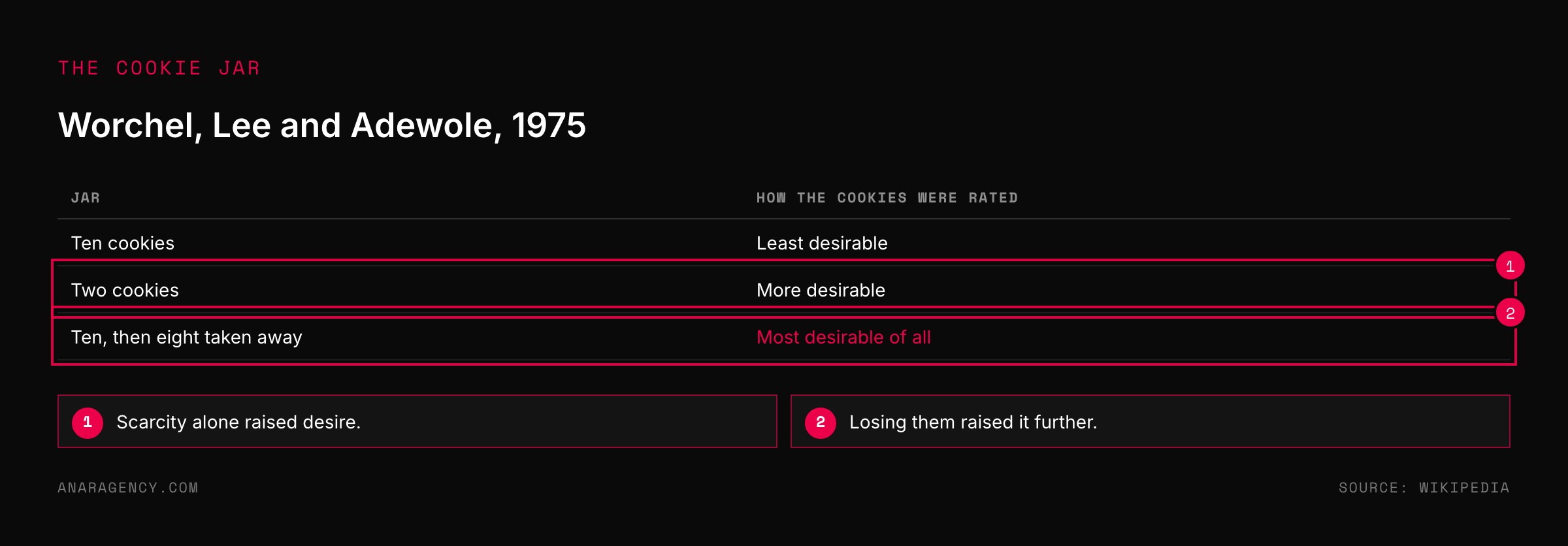
In 1975 researchers Worchel, Lee, and Adewole gave people a jar of cookies to rate. Some jars held ten cookies and some held two.
The cookies from the jar of two were rated more desirable.
Then the researchers added a twist. Some people started with a jar of ten, and before they tasted, eight were removed.
Those people rated the cookies highest of all. Not just scarce, but taken away.
That is the take-away in one experiment. We want things more when we feel them slipping out of reach.
Why taking away works
Psychologists have a name for part of this: reactance. When people feel a freedom is being removed, they tend to want it back.
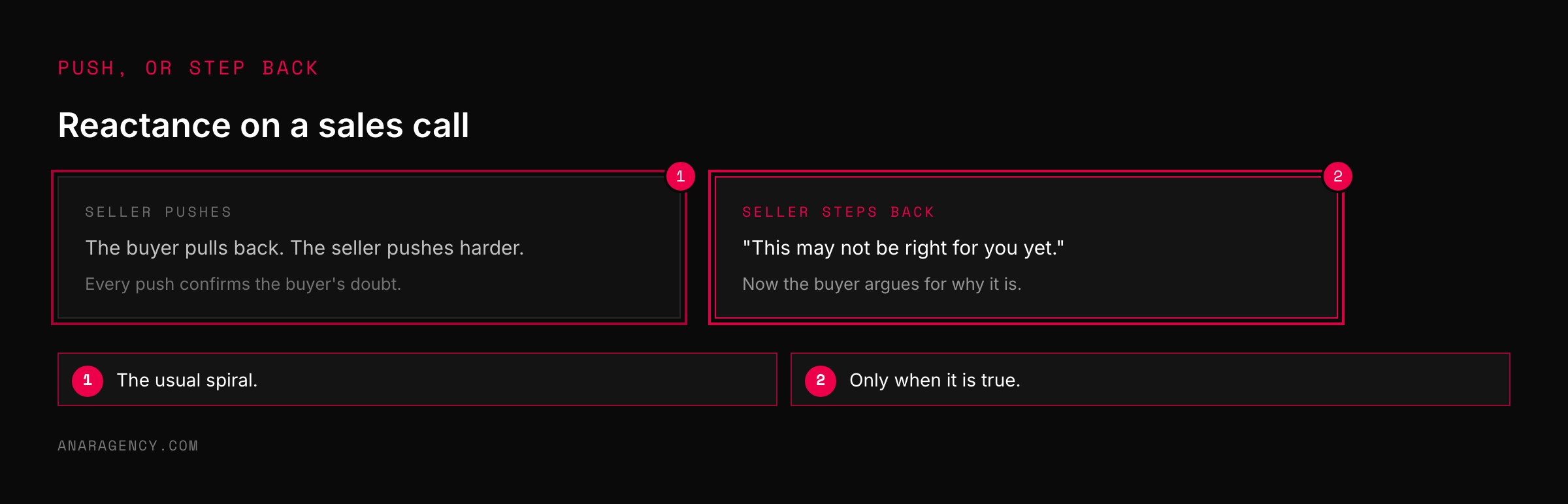
On a sales call, the usual move is the opposite. The seller pushes harder as the buyer pulls back, and the buyer pulls back further.
A take-away reverses it. The seller steps back and says, honestly, that this may not be the right fit.
Now the buyer is the one leaning in. They have to argue for why it is right for them, and people believe their own arguments.
But it only works because it is true. The moment it is a trick, it becomes the pressure it was meant to replace.
People want what they might lose. When a buyer stalls after hearing how you would help, say what is true: this may not be right for them yet, and here is what would need to change. Handle objections in three steps: acknowledge neutrally, ask one question to find the real objection, and solve that one thing tied back to what the buyer wants.
Never invent scarcity, never hold someone on a call, and respect cancellation rights.
The three-step objection method
Objections are where most calls are lost. Here is a method that keeps them from turning into arguments.
1. Acknowledge, neutrally. "Okay."
"Fair enough." Not "I understand, but," which tells the buyer an argument is coming.
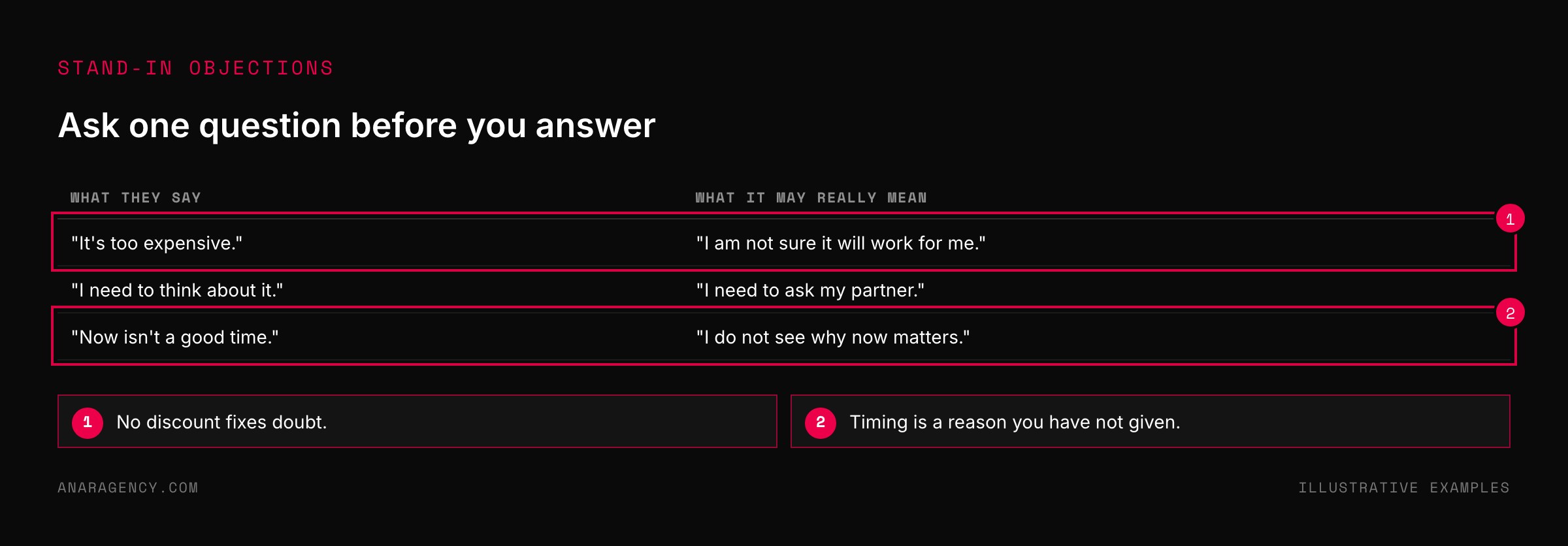
2. Find the real objection. Ask one question.
"Is it the total, or how the payments fall?" "Is it the timing, or whether it will work for you?"
The first objection is often a stand-in. "Too expensive" can mean "I am not sure it works," and no discount solves that.
3. Solve that one thing. Answer the real objection, and tie it back to what the buyer told you they want.
Listening closely enough to do that is a skill, often called active listening.
If you cannot solve it honestly, say so. That is where the take-away belongs.
Where the take-away belongs on the call
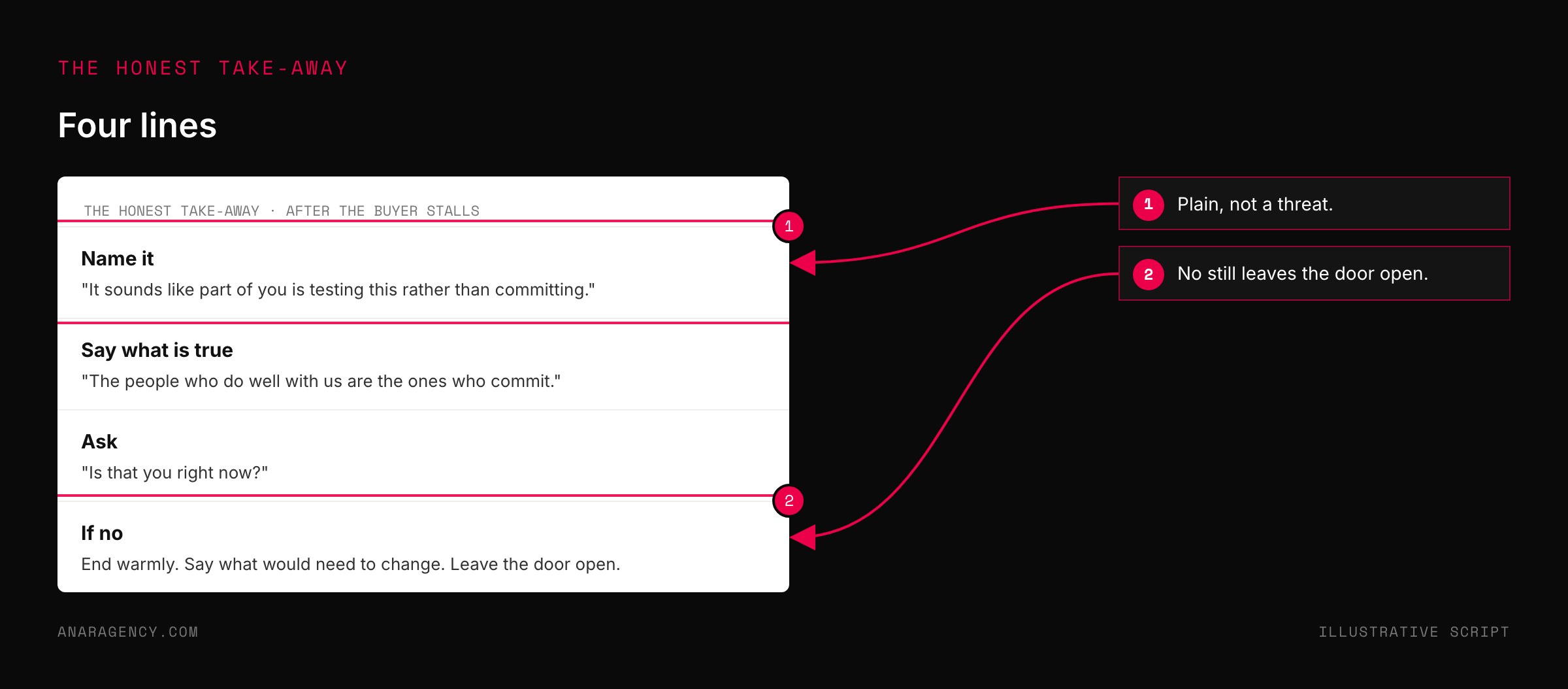
Not at the start, and not as a threat. It belongs after the buyer has told you what they want and you have shown how you would help.
If they stall then, name it plainly. "It sounds like part of you is testing this rather than committing. The people who do well with us are the ones who commit.
Is that you right now?"
That question is not pressure if you mean it. You are giving them permission to say no, and many people find it easier to say yes once no is allowed.
If the honest answer is no, end the call warmly. Tell them what would need to change for it to be a fit, and leave the door open.
For deciding who should get a call in the first place, see qualify before the call.
"Isn't this just a pressure tactic?"
It is, if it is fake. And fake versions are everywhere.
"Only two spots left" when there are twenty is a false claim. Advertising claims must be truthful, and the FTC has published a 2022 staff report on dark patterns, design tricks that manipulate people into choices they did not intend.
Some sales also come with a legal right to change your mind. Under the FTC's Cooling-Off Rule, buyers have three days to cancel certain sales made at home or at temporary locations such as hotel rooms and convention centers.
Never keep someone on a call who wants to leave. A buyer pushed into a yes often becomes a refund, a chargeback, or a bad review.
Use the take-away the way a good doctor uses "this treatment is not for you": because it is true, and because it is in the buyer's interest to hear it.
What the take-away sounds like in different businesses
The words change by industry. The principle does not: say what is true about fit, and let the buyer decide.
A dental practice selling a treatment plan. "From what you have told me, the cost is the real worry, and this plan is not going to feel comfortable this year. Would it help to do only the urgent part now?"
An accounting firm selling a monthly retainer. "You mentioned you only want help at tax time. Honestly, the monthly service is built for owners who want numbers every month, so it may be more than you need."
A contractor quoting a large job. "You are getting three quotes, which is smart. If the main thing is the lowest price, we are probably not your firm, and I would rather say that now."
A coach or consultant. "This works when someone can put in a few hours a week. If the next three months are already full, it may be better to wait."
Each one is true, specific, and offers a path forward. None of them invents a deadline or a shortage.
And each one tends to produce one of two answers. Either "no, that is right, thanks", which saves you both time, or "actually, let me explain why I do want this".
The second answer is the buyer making the sale to themselves. Your job is to listen, and then answer the real question they raise.
These lines are illustrative. Write your own from the real reasons your service is not right for some people.
What to read next, and why
Scarcity (social psychology) (encyclopedia entry): The cookie jar study and related research.
Reactance (encyclopedia entry): Why people push back when a freedom is removed.
The Cooling-Off Rule (FTC consumer advice): When buyers have three days to cancel.
Bringing Dark Patterns to Light (FTC staff report): Manipulative design to avoid.
So the simple takeaway is this: on your next call, when the first objection comes, say "okay" and ask one question before you answer it.
Questions executives ask
What is a take-away close?
A closing approach where the seller steps back and honestly says the offer may not be right for the buyer yet, which lets the buyer argue for why it is. It only works, and is only fair, when it is true.
How do you handle sales objections?
Acknowledge the objection neutrally, ask one question to find the real concern behind it, then solve that specific concern and tie it back to what the buyer said they want.
Why shouldn't I say "I understand" to an objection?
Because it is usually followed by "but", which signals an argument. A neutral acknowledgment such as "okay" keeps the conversation open.
Is false scarcity legal?
Advertising claims must be truthful, so claiming a limit that does not exist is a false claim. The FTC has also reported on manipulative design practices known as dark patterns.
Do buyers have a right to cancel?
For some sales, yes. The FTC's Cooling-Off Rule gives buyers three days to cancel certain sales made at home or at temporary locations such as hotel rooms and convention centers.

Filip Kovacevic is the founder of Anar Agency in Phoenix. He spent five years running SEO, Meta ads, email, and content for medical practices across the United States, and now does the same work for healthcare, home-service, legal, and professional-service businesses, alongside AI implementation. More from Filip →
Talk it through in 15 minutes
Bring one AI question from this article. We will tell you what we would do, whether or not you hire us.
Book a 15-Min Chat →