The Three Beliefs That Stop a Buyer: Not Worth It, Can't Do It, Won't Work

A buyer who wants a result and does not act is held back by one of three beliefs. "It is not worth it" is doubt about the prize. "I cannot do it" is doubt about themselves.
"It will not work" is doubt about the world, usually from having tried before. Each needs a different answer: show the value, shrink the task, or show it working for someone like them. Most copy piles on proof of value for a reader whose real doubt is one of the other two.
Find which belief your market holds most, and write to that one.
They wanted it and did not buy
The strangest thing in selling is the person who clearly wants what you have and does not take it.
They read the whole page. They asked two good questions. They said it sounded great.
Then nothing.
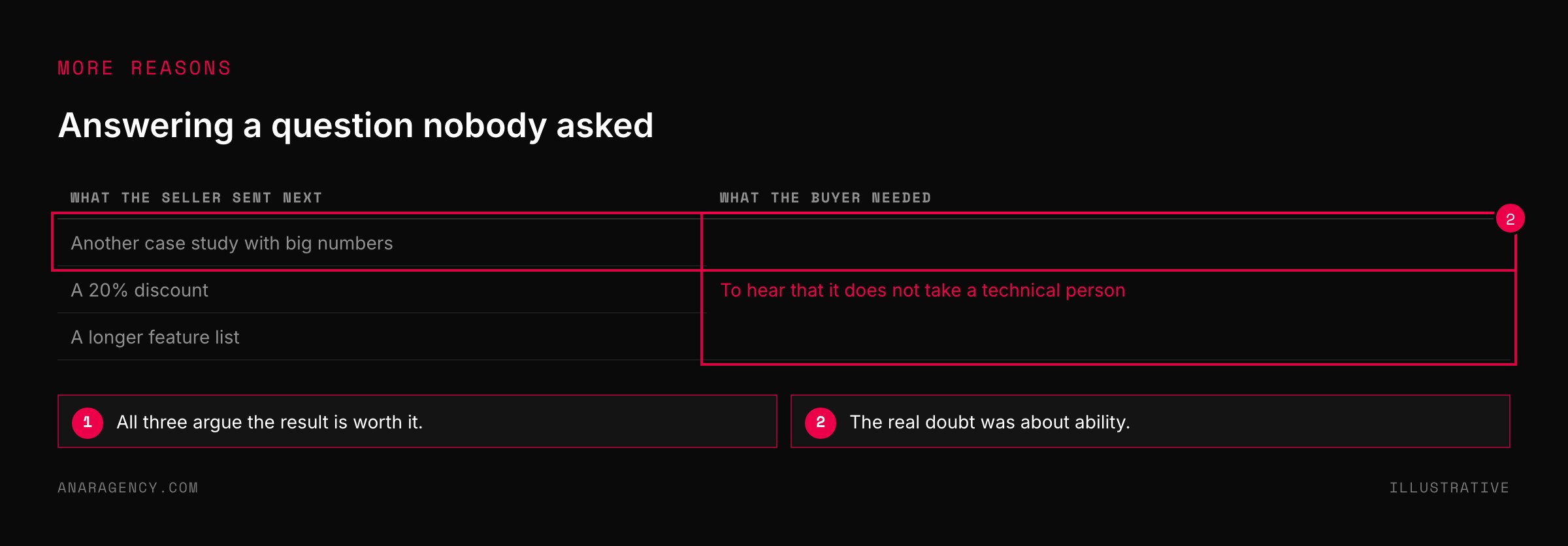
The usual response is to send more reasons. Another case study. A bigger discount.
A longer list of features.
It rarely works, because they were not short of reasons. Something specific was in the way, and it was one of three things.
An old formula from the factory floor
In the 1960s a psychologist named Victor Vroom was studying why people at work put in effort, or do not.
His answer, known as expectancy theory, was that effort depends on three beliefs multiplied together.
Do I value the reward? If I try, can I actually do the task? And if I do the task, will the reward really follow?
Multiplied is the important word. If any one of the three is zero, the whole thing is zero. A huge reward does not help someone who is certain they cannot do the work.
He was writing about employees. It describes buyers exactly. A purchase is effort made in the hope of a reward, and the same three doubts decide it.
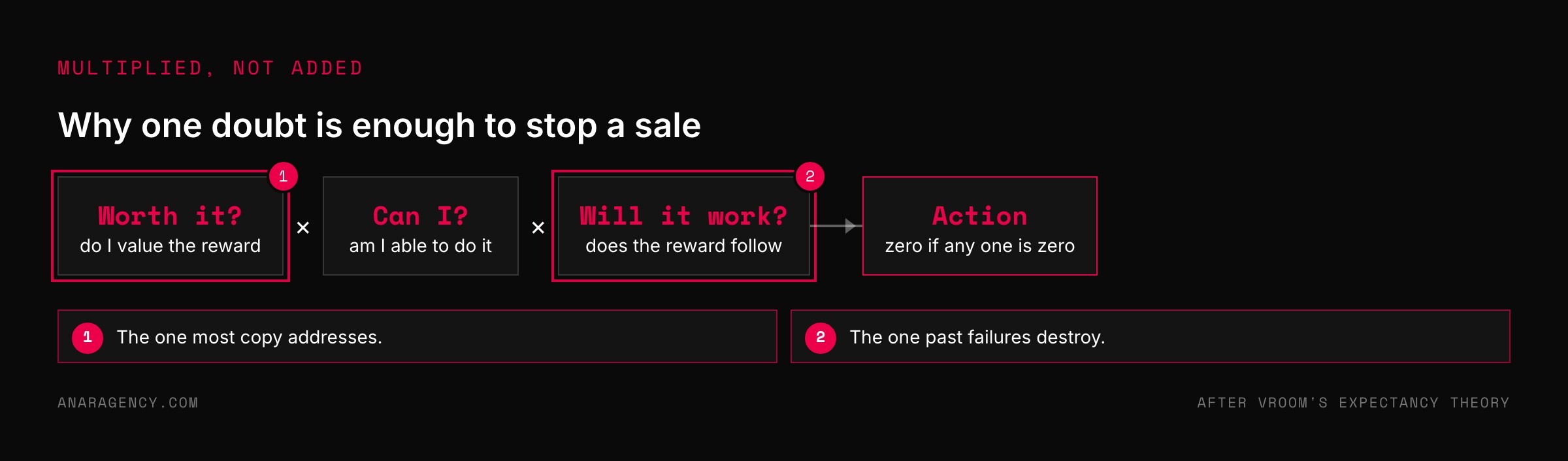
A buyer who wants a result and does not act holds one of three beliefs. "It is not worth it": answer with the math of the problem and the result. "I cannot do it": answer by shrinking the task.
"It will not work": answer with someone similar for whom it did. Write one ad per belief for the same offer to learn which your market holds. Lead with one in an ad and cover all three on the page.
Describe the situation, never the reader's beliefs about themselves.
The Three Stop-Beliefs
Here they are in a buyer's words.
"It is not worth it." Doubt about the prize. The result does not seem big enough, or certain enough, for what it costs.
"I cannot do it." Doubt about themselves. They believe it takes skill, time, or discipline they do not have.
Psychologists call the opposite of this self-efficacy: the belief that you are able to carry something out.
"It will not work." Doubt about the world. Often they have tried something like it and been burned.
People who fail repeatedly can come to expect failure even when things have changed, a pattern researchers named learned helplessness.
Notice how different they are. The first is about your offer. The second is about the buyer.
The third is about their history.
And notice that proof of value only answers the first. If the real doubt is the second or the third, one more testimonial about big results makes it worse. It widens the gap between what is promised and what the buyer believes is possible for them.
Belief Matchers: one offer, three ads
Some advertisers seem to know exactly what to say to a cold audience. They are not guessing. They work out which belief is in the way first.
We call them Belief Matchers.
For "not worth it," they do the math. They put a number on the problem and a number on the result, so the value is plain. This is the classic sales argument, and it is right about a third of the time.
For "I cannot do it," they shrink the task. Fewer steps. Nothing to learn.
Done for you. The message is not that the result is great. It is that the reader is capable of getting it.
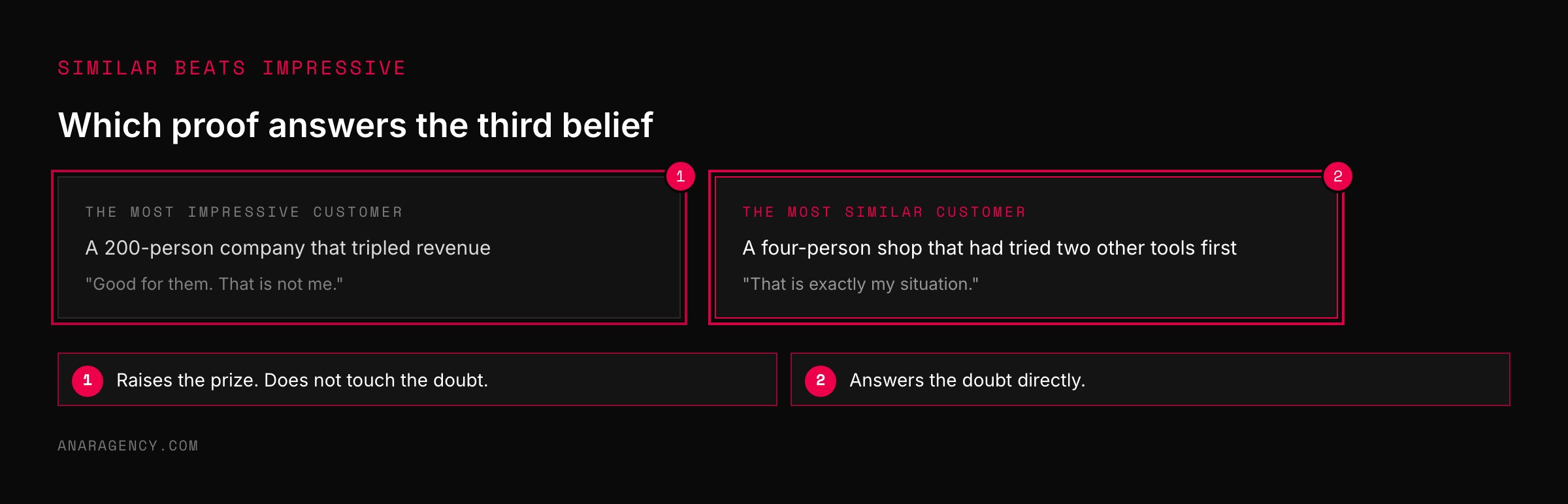
For "it will not work," they show someone like the reader. Not the most impressive customer. The most similar one.
A person who was skeptical, in the same trade, with the same history.
The practical move is to write three ads for one offer, one per belief, and see which a market responds to. That tells you what the market mostly believes.
You can often guess in advance. A market full of people who have tried four tools already mostly holds the third belief. A market of beginners mostly holds the second.
How to open each kind of ad is covered in before-words and after-words.
"Should I not just answer all three?"
You may be thinking the safe thing is to answer every doubt in every ad. On a long sales page, you should. In an ad, you cannot.
An ad gets a few seconds. Three messages in that space is no message. Pick the belief most of that audience holds and lead with the answer to it.
The page behind the ad is where the other two get their turn. That is one reason long pages work for considered purchases, which we discuss in the long ad.
A warning about tone. These are beliefs about a person's own worth and ability. Naming them directly can feel like an accusation.
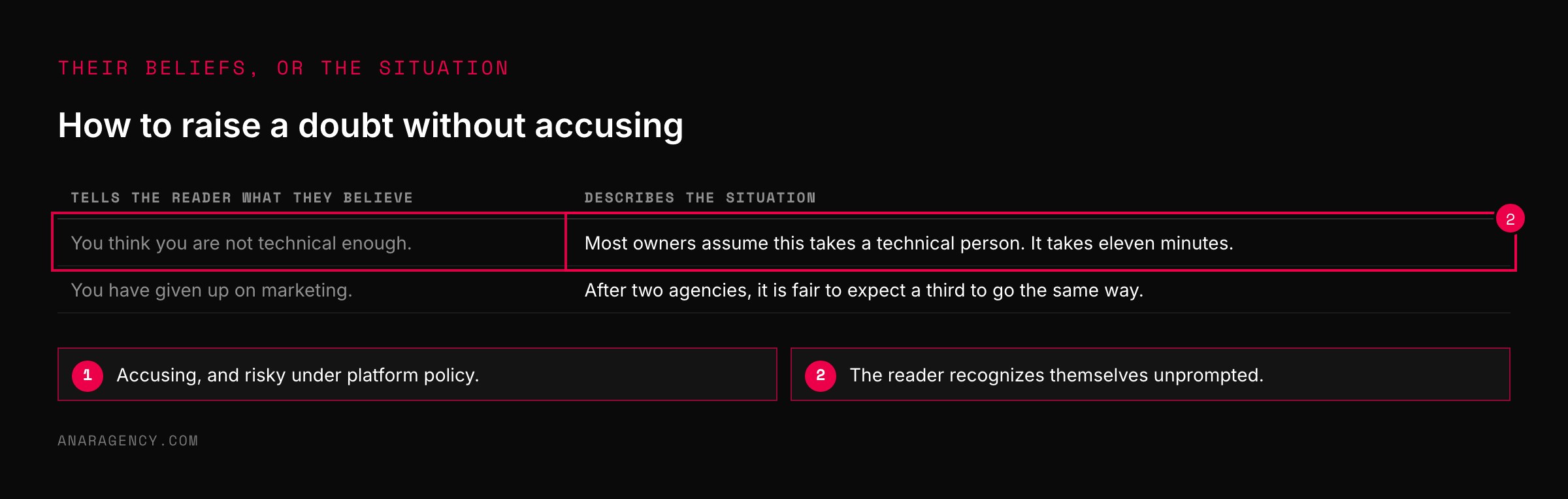
It can also break platform rules. Meta's advertising policy does not allow ads that assert or imply personal attributes of the viewer. "You think you are not smart enough" does both.
So never tell the reader what they believe. Describe the situation and show the answer. "Most owners assume this takes a technical person.
It takes eleven minutes." The reader recognizes themselves without being told.
What to read next, and why
Expectancy theory (encyclopedia entry): Vroom's three-part model of motivation. The cleanest map of why people do or do not act.
Self-efficacy (encyclopedia entry): The research on believing you can do a thing, and how that belief is built.
Learned helplessness (encyclopedia entry): Why people who have failed before stop trying, even when the situation has changed.
Meta's Personal Attributes advertising policy (policy): The rule that decides how directly you may speak to a reader's doubts.
So the simple takeaway is this: when someone wants it and does not buy, do not add reasons. Ask which of three doubts is in the way, and answer that one.
Questions executives ask
Why do customers want something and still not buy?
Usually one of three beliefs is in the way: that the result is not worth the cost, that they personally cannot do what it takes, or that it will not work in their situation. More reasons to buy rarely help unless they address the specific belief.
What are the three stop-beliefs?
"It is not worth it" is doubt about the value of the result. "I cannot do it" is doubt about one's own ability. "It will not work" is doubt that the result will follow, often based on past failure.
They correspond to the three parts of expectancy theory in psychology.
How do I find out which belief my market holds?
Write three ads for the same offer, each answering one belief, and compare the response. You can often predict it: experienced buyers who have tried several solutions tend to doubt it will work, while beginners tend to doubt they can do it.
What is expectancy theory?
A model of motivation developed by Victor Vroom in the 1960s. It holds that effort depends on three beliefs multiplied together: that the reward is valued, that effort will lead to performance, and that performance will lead to the reward. If any one is absent, motivation collapses.
Can I mention a buyer's doubts directly in an ad?
Describe the common situation instead of the reader's state of mind. Telling people what they believe about themselves can feel accusatory, and on Meta it may violate the policy against asserting or implying personal attributes of the viewer.

Filip Kovacevic is the founder of Anar Agency in Phoenix. He spent five years running SEO, Meta ads, email, and content for medical practices across the United States, and now does the same work for healthcare, home-service, legal, and professional-service businesses, alongside AI implementation. More from Filip →
Talk it through in 15 minutes
Bring one AI question from this article. We will tell you what we would do, whether or not you hire us.
Book a 15-Min Chat →