Customized Audits as Lead Magnets: Moving the Free Line

The line between what a business gives away and what it charges for just moved, because AI collapsed the cost of making something custom. A real audit of a prospect's live ads, pages, or rankings used to take a skilled person a day, so it was either the paid product or the bait for a call. Now a system can pull the prospect's real data, score it against a named framework, and show the gaps in a grid within minutes.
That audit is your lead magnet. What stays paid is the fix, and the audit sells the fix by making the gap visible before anyone pitches anything. The design rule is strict: pull instead of ask, score against your own framework, show gaps instead of praise, and put the ask after the prospect has taken in the grid.
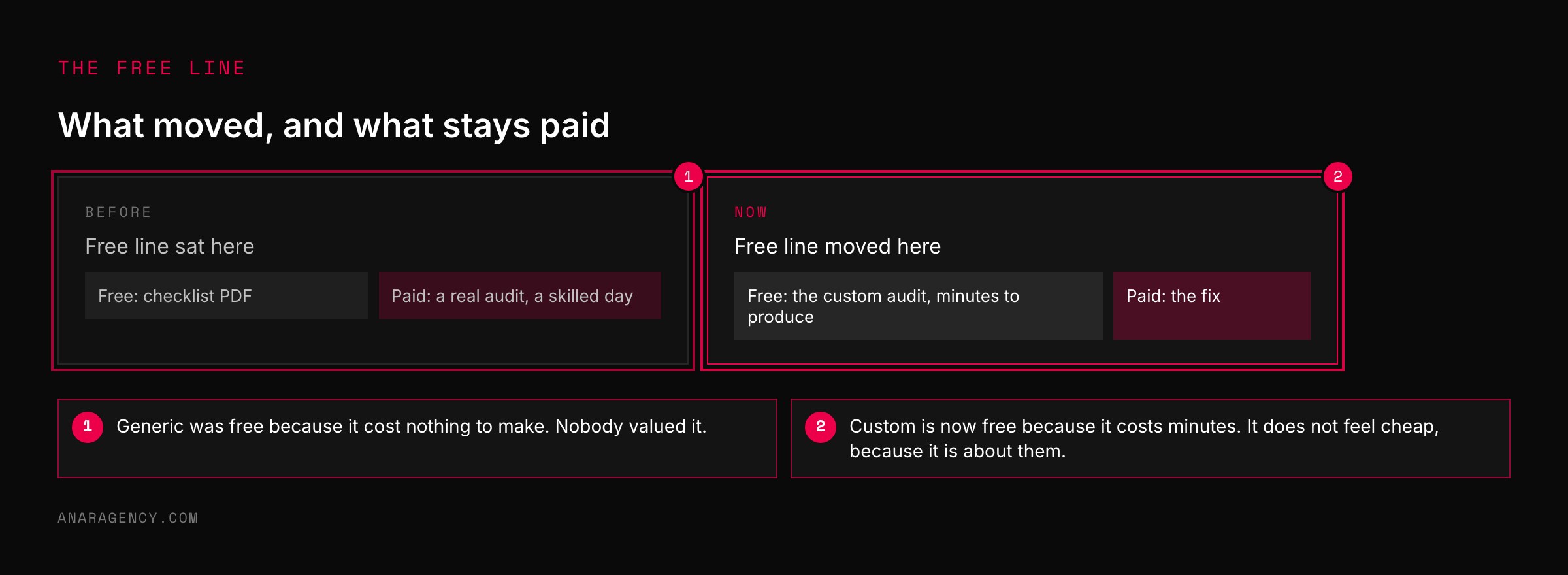
The free line, and why it moved
Every business has a line between what it gives away and what it charges for. Most businesses drew theirs years ago without noticing.
A checklist PDF was free because it cost nothing to make and nothing to read. A real audit of your Google Ads account, your landing pages, or your rankings was paid, or it was the bait for a sales call, because it took a skilled person a day to do properly. The free thing was generic.
The valuable thing was custom. And custom cost money.
That line is now in the wrong place for almost everyone.
A system that takes one input from a prospect, a URL, a Facebook Page name, a business name, can pull their live ads, their page speed, their structured data, and their reviews, and score all of it against a framework. It runs in minutes and costs cents. The deliverable that used to anchor a $2,000 engagement can be the thing you give a stranger for free, and it does not feel cheap, because it is about them.
What stays paid is the fix. Knowing you have eleven gaps is free. Closing them takes the work the audit just showed you understand.
That beats any pitch, because the prospect arrives at the call having already seen, in their own numbers, what they are leaving on the table.
The persuasion is the grid
The audit that converts has a specific shape, and the shape matters more than the depth.
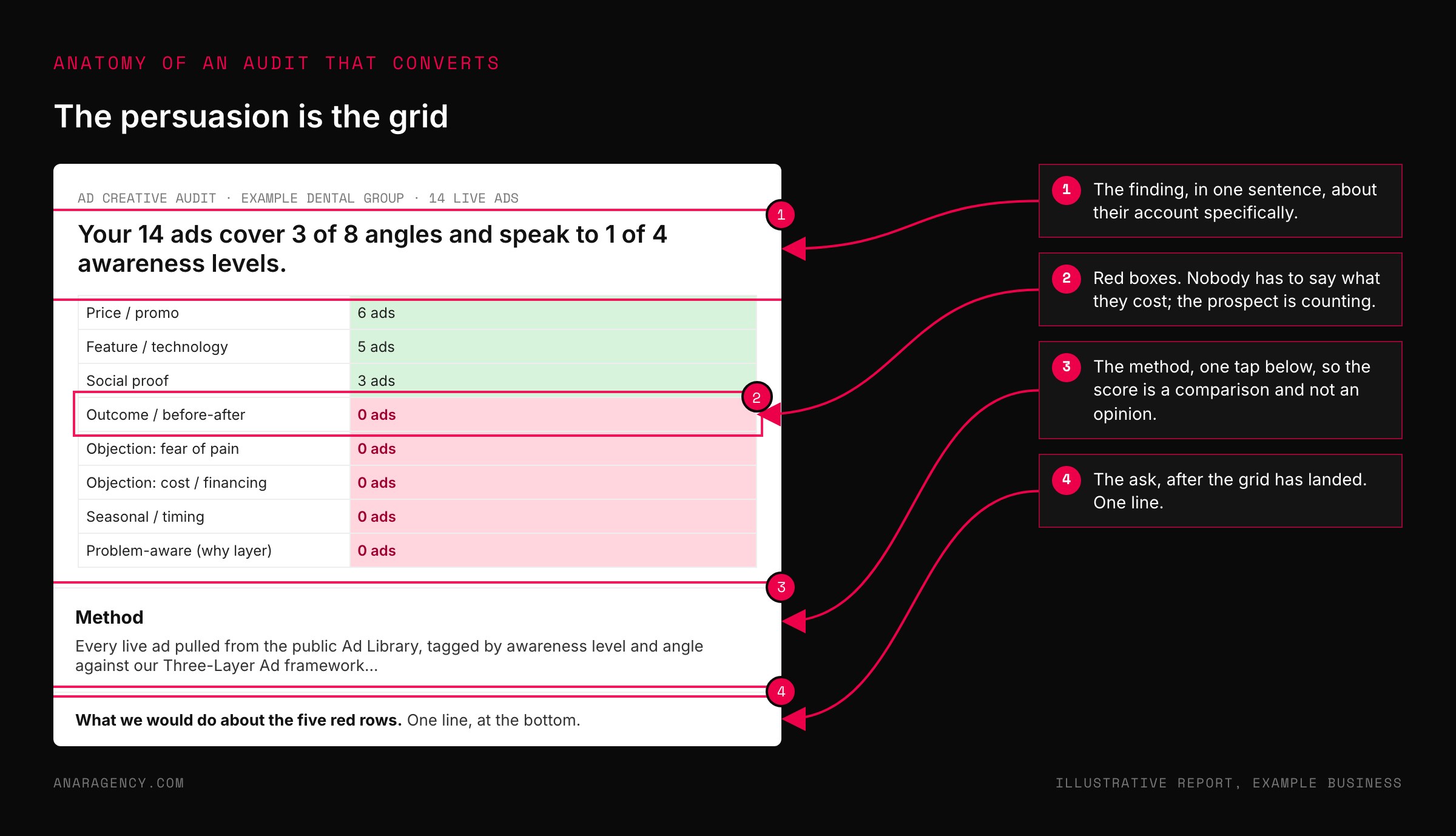
The prospect gives one input and nothing else. Every question you ask at the form instead of pulling from public data is a lead lost. The system then scores what it pulled against a named framework, one you own, so the score carries your method with it.
For ads, that means every live ad tagged by the awareness level it speaks to and the angle it uses: price, feature, outcome, social proof, seasonal, objection. For a site, it means the seven things that stop conversions and the structural checks that decide whether a page can rank.
Then the gaps, not the praise, in a grid. Angles covered in one color, angles missing in another. Pages that pass, pages that fail.
The prospect reads their own red boxes, and nobody has to tell them what the red boxes cost, because they are already counting.
An audit that opens with a compliment, or buries the gaps in paragraphs of explanation, converts like a brochure. The grid is the argument.
The ask comes last, after the grid has been on screen long enough to land. One line: here is what we would do about the red ones. In our experience the prospect who has taken in their own gap grid does not need to be sold the fix.
They need to be told it exists and who does it.
That is why the call to action sits at the bottom of the report and not the top, and why the report has to be good enough to be read to the bottom. It is the same reason the felt-problem quiz works: the prospect does the persuading by looking at their own answers.
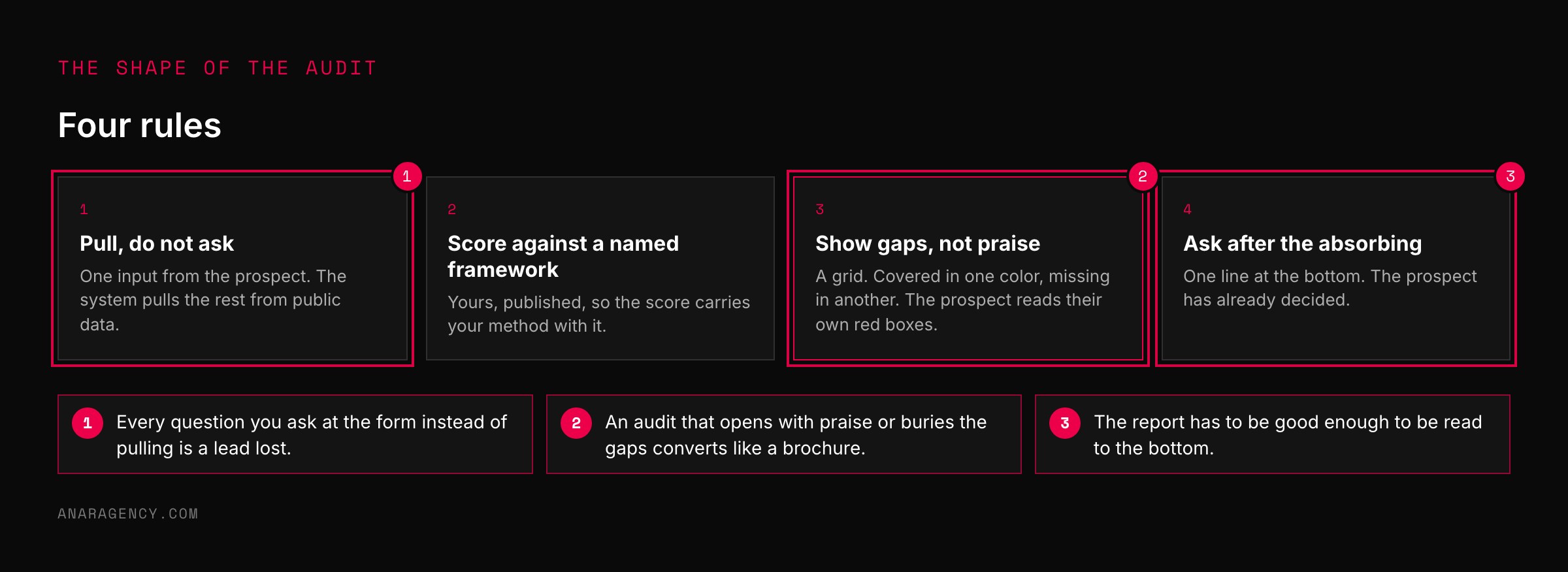
What used to be the paid deliverable, a custom audit of a prospect's real ads, pages, or rankings, is now the lead magnet, because AI made customization cheap. Build it so the prospect gives one input and the system pulls the rest; score against a framework you own and publish; show gaps in a grid rather than praise in paragraphs; put the ask after the grid, in one line. Do five by hand before automating anything.
The fix stays paid, and the audit sells the fix by making the gap visible.
What the public data makes possible
The free line moved because so much of what an audit needs is already public.
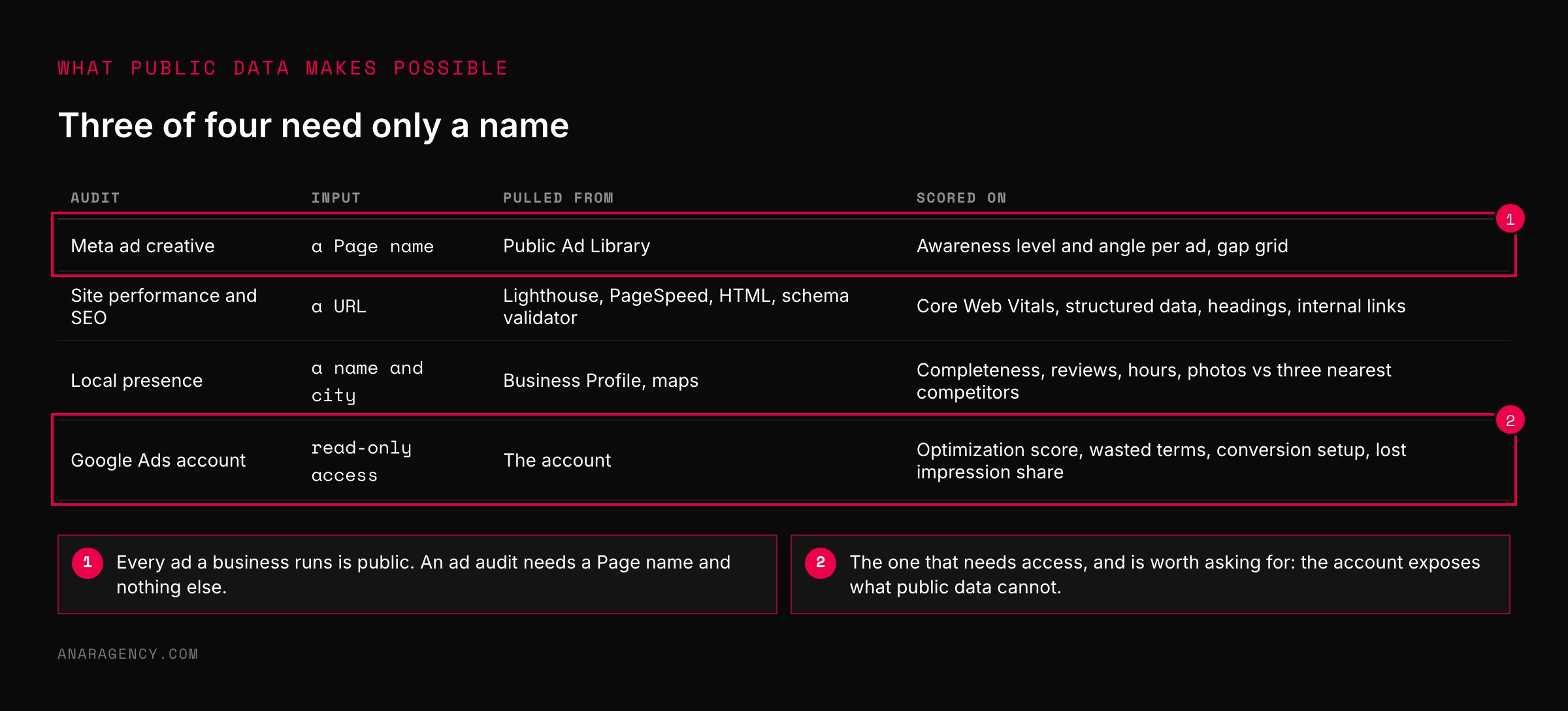
Every ad a business runs on Meta is visible in the Ad Library, so an ad creative audit needs only a Page name. A site's speed and stability can be measured by anyone with Lighthouse or PageSpeed Insights, scored against Google's own Core Web Vitals thresholds.
Its structured data can be checked with the Rich Results Test and the schema validator. Its heading hierarchy, title tags, and internal links are in the HTML. A local business's profile completeness, review count, hours, and photos are on the map for everyone to see.
Three of the four audits in the figure above need nothing from the prospect but a name. The fourth, a Google Ads account audit, needs read-only access, and it is worth asking for, because the account shows what public data cannot.
It shows the optimization score and its recommendations, the search terms the budget is actually buying, whether conversions are set up and what they count, and how much impression share is lost to budget. Our own site audit tool and competitor analysis tool are first steps in this direction: one input, public data, a scored result.
The method behind each audit should be one a reader could check. The Nielsen Norman Group's guide to heuristic evaluation is the model: a fixed set of principles, applied the same way to every subject, so the result is a comparison and not an opinion.
An audit scored against a published framework is harder to argue with than one scored against taste. It also travels better, because the prospect can hand it to a partner and the partner sees the same grid.
Build it manually first
The mistake we see most with audit tools is building the automation before doing the audit by hand.
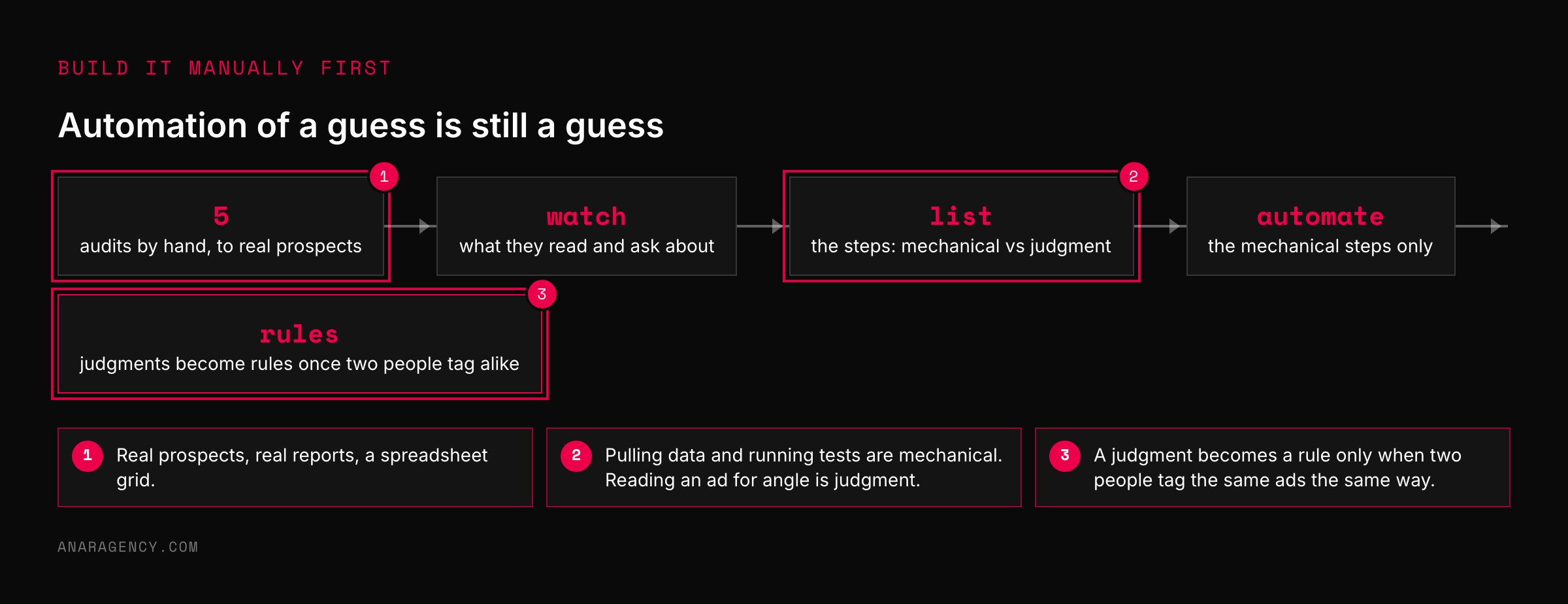
Do five by hand first. Pull the ads, tag them, score the pages, write the grid in a spreadsheet, send it to five prospects, and watch what they read and what they ask about on the call. Only then does the shape of the tool become clear: which inputs matter, which scores land, which gaps prospects care about and which they shrug at.
Automation built before that is automation of a guess.
Once the manual version has converted a few times, the steps are a list, and the list is the specification. Each step is either something a system can do, such as pull the ads, run the speed test, check the schema, count the reviews, or something a person must do, such as read the ads for angle and awareness and judge the page against the framework.
The machine takes the first kind. The person keeps the second kind until the judgments are consistent enough to write down as rules, and then the machine takes those too. In our own builds the tagging step stays manual until two people tag the same ads the same way.
Only then does it become a rule the system applies, with a person reviewing the output.
The report itself is the last thing to automate, and the one to get right. It should be a page the prospect can open on a phone, with the grid above the fold, the method one tap below it, and the ask at the bottom.
It should carry a named author, because an audit from a person is read differently from an audit from a form. And it should be honest in both directions: the green boxes are real, and the red ones are too.
Why this works on the prospect's side
A free thing that is obviously generic creates no obligation. A free thing that was clearly made for you does.
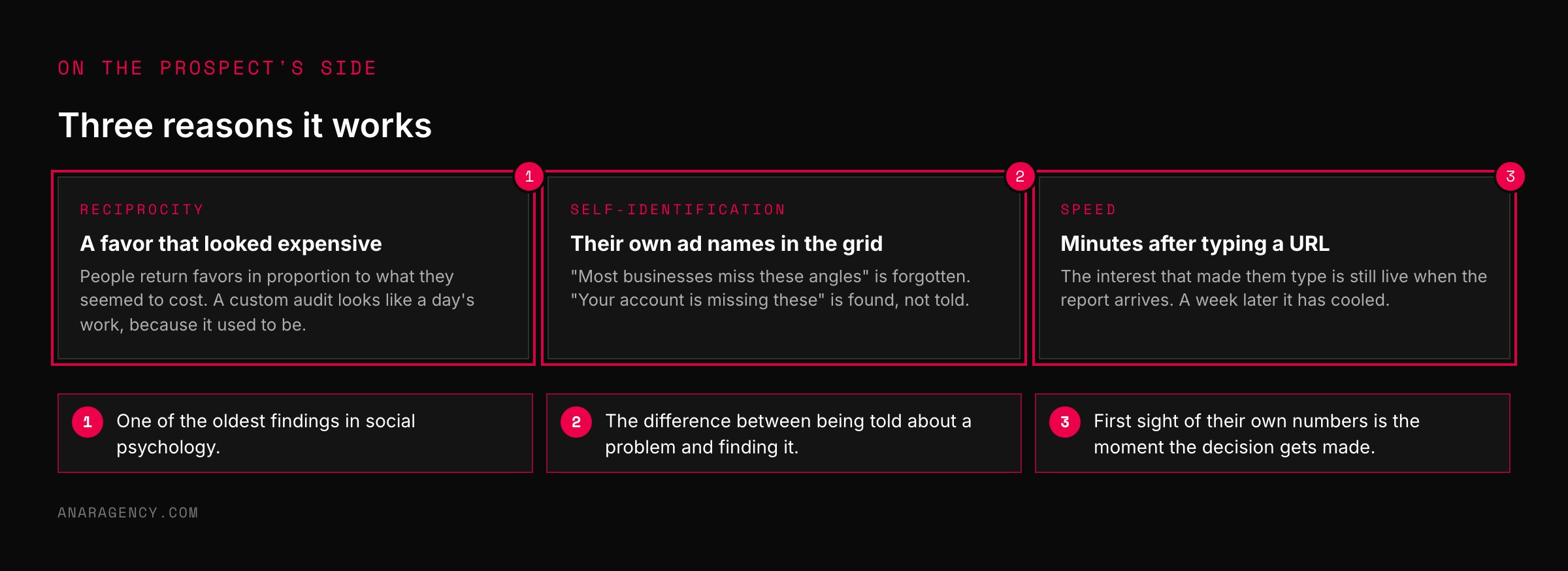
The pattern has a name in social psychology, reciprocity, and it is one of the oldest findings in the field: people feel moved to return a favor in proportion to how much the favor seemed to cost the giver. A custom audit looks expensive, because until recently it was, so it carries weight a PDF never could.
The second reason is self-identification. A prospect told "most businesses in your industry miss these angles" nods and forgets. A prospect shown that their own account is missing those angles, in a grid with their own ad names in it, has identified themselves as the business with the gap.
No pitch does that. It is the difference between being told about a problem and finding it, and the finding is what makes the fix feel necessary instead of merely offered.
The third reason is speed. A prospect who waits a week for a human audit has a week to cool. A prospect who gets a scored report minutes after typing a URL is reading it while the interest that made them type is still live.
Google's own guidance on measuring a business's profile performance and on Search Console both reward owners who look at their numbers. An audit that puts those numbers in front of an owner who never looked is often the first time they have seen them. First sight is the moment the decision gets made.
The rules we hold ourselves to
An audit that is really a pitch wearing a chart is worse than no audit, because the prospect can tell. So we hold four rules.
The scores are real and the method is published, so a prospect can check any box. The red boxes are things we can actually fix, not things we scored red to make the grid redder. The ask is one line at the bottom, and the report is complete without it.
And the data stays the prospect's. We pull what is public or what they granted, we do not keep what they did not ask us to keep, and we say so on the report.
There is also a line we do not cross with the inputs. A site audit uses public data. A Google Ads audit uses read-only access the prospect grants and can revoke.
We never ask a prospect to hand over a login, and we never run an audit on an account the prospect did not ask about.
Those rules cost a few conversions and keep the rest honest, which is the only kind worth having in a business that sells trust.
Last, the audit has to be good even when it does not convert. A prospect who gets a useful grid, fixes two things themselves, and never calls has still been shown that the method works, and that prospect tells other owners.
The audit is the lead magnet, and it is also the content. Anonymized patterns across fifty audits are the most citable thing a firm can publish, and they feed back into every article on this site. The free line moved.
The work did not.
Questions executives ask
What is an audit lead magnet?
A free, individually customized report on a prospect's real marketing, their live ads, their site, their local profile, or their ad account, scored against a published framework and showing the gaps in a visual grid. It replaces the generic checklist PDF, which nobody valued, with something made for the prospect, which creates both obligation and self-identification.
How can an agency afford to give away a full audit for free?
Because the cost of producing one collapsed. A system that pulls public data and scores it against a framework runs in minutes. The fix, which is the actual work, stays paid, and the audit sells the fix by showing the prospect their own gaps.
What should a marketing audit include?
Only what can be scored against a named method and shown as a gap. For ads: every live ad tagged by awareness level and angle, with missing angles flagged. For a site: speed and Core Web Vitals, structured data, heading and title hygiene, internal links, and the conversion elements of key pages.
For local: profile completeness and reviews versus nearby competitors.
Should I automate the audit or do it by hand?
By hand first, five times, with real prospects. Watch what they read and ask about. Then automate the steps that are mechanical, pulling data and running tests, and keep a person on the judgments until the judgments are consistent enough to write as rules.
Where should the call to action go in an audit report?
At the bottom, after the gap grid and the method, in one line. The persuasion is the grid; an ask at the top turns the report into a pitch and the prospect reads it as one.

Filip Kovacevic is the founder of Anar Agency in Phoenix. He spent five years running SEO, Meta ads, email, and content for medical practices across the United States, and now does the same work for healthcare, home-service, legal, and professional-service businesses, alongside AI implementation. More from Filip →
Talk it through in 15 minutes
Bring one AI question from this article. We will tell you what we would do, whether or not you hire us.
Book a 15-Min Chat →