What Makes People Act: Safe Place, Unsafe Place
People act to move from a place that feels unsafe toward one that feels safe. Money, status, health, and belonging are all versions of that. So a buyer's real question is whether a purchase leaves them safer or more exposed.
Copy that only describes benefits answers half of it. The other half is making the step itself feel safe: showing what is inside, giving a way out, pointing to people who went first, and keeping the first step small. Some buyers are moving away from a danger and others toward a gain, and the wording should match.
Thirty-one million bottles
In the autumn of 1982, seven people in the Chicago area died after taking a common painkiller. Someone had tampered with capsules on store shelves and laced them with poison.
The maker had done nothing wrong. It could have said so and waited.
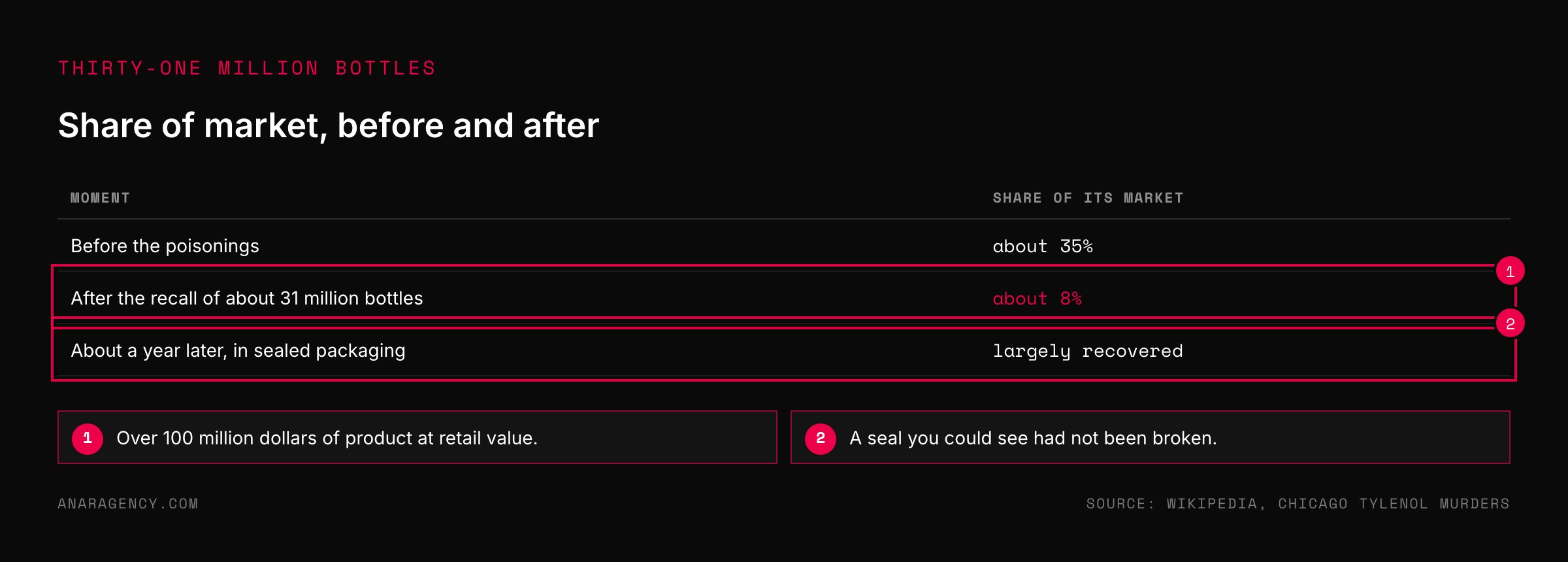
Instead it recalled the product across the country: about 31 million bottles, with a retail value of over 100 million dollars. Its share of the market fell from about 35 percent to about 8 percent.
Then it brought the product back in a new kind of package, with a seal you could see had not been broken. Within about a year its share had largely recovered.
It did not argue that the product was good. It made buying it feel safe again, and that was the only question customers had.
One question under all the others
That story is extreme. The same question sits under ordinary purchases.
A person's mind is constantly sorting the world one way. Is this safe, or is it not? Feeling good is the signal for safe.
Feeling uneasy is the signal for not.
Most of what people chase is a route to the first feeling. Money buys a margin against bad luck. Status means others will not push you around.
A group means you are not alone.
The psychologist Abraham Maslow put safety just above food and water in his ordering of human needs. Until it is met, little else gets attention.
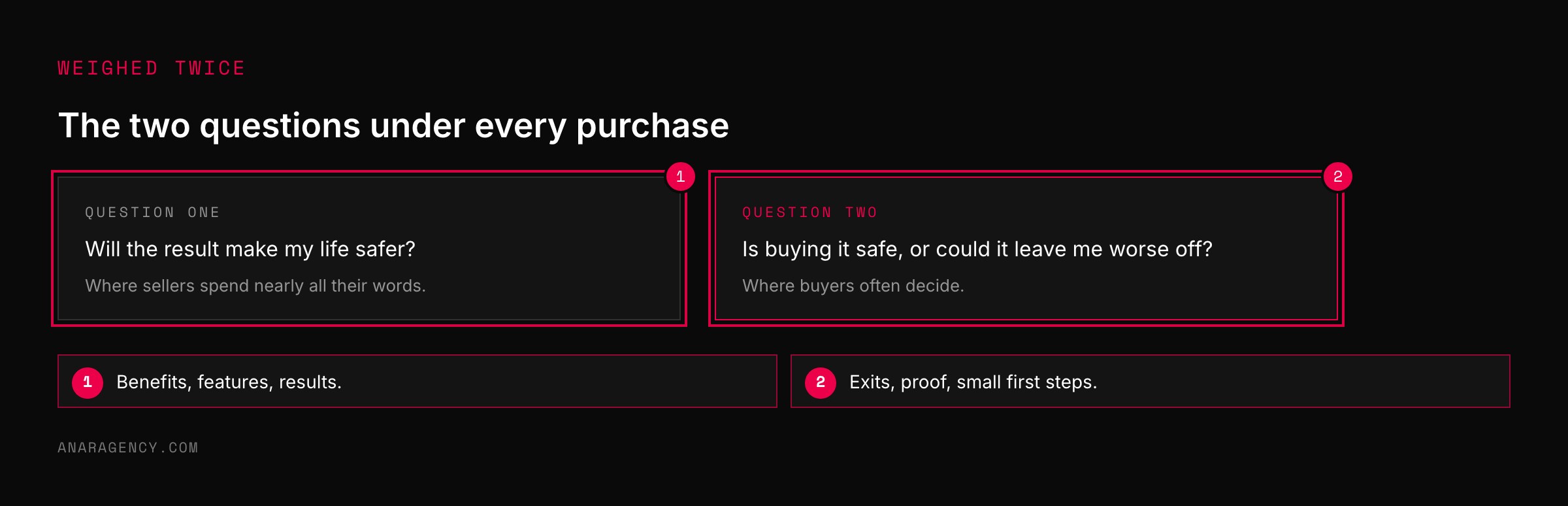
So every purchase is weighed twice. Will the result make my life safer? And is the act of buying safe, or could it leave me worse off?
Sellers spend nearly all their words on the first. Buyers often decide on the second. People feel a loss more sharply than a gain of the same size, a finding known as loss aversion.
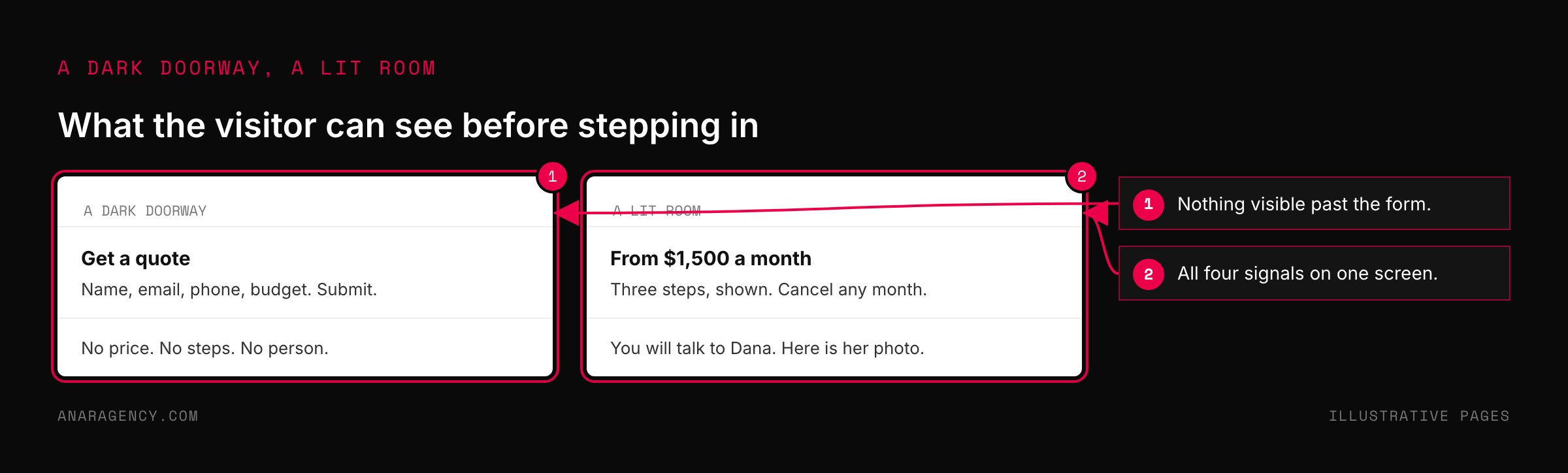
People act to move from unsafe toward safe. A buyer weighs two things: whether the result makes life safer, and whether the act of buying is safe. Answer the second with four signals: let them see inside, show the way out, show who went first, and make the first step small.
Match wording to direction, prevention words for buyers avoiding a loss and promotion words for buyers seeking a gain. Lower the reader's sense of danger. Never raise it with an invented threat.
Two directions
There is a refinement worth knowing, because it changes the wording.
The psychologist Tory Higgins proposed that people pursue goals in one of two modes. He called it regulatory focus theory.
In a prevention focus, a person is trying not to lose. They are watchful, and they respond to protect, secure, avoid, and guaranteed.
In a promotion focus, a person is trying to gain. They are eager, and they respond to grow, win, first, and more.
Research in this area suggests a message is more persuasive when its framing matches the mode the listener is in.
So "stop losing a third of your leads" and "win a third more jobs" are one fact, written for two people. A business owner who has just had a bad quarter is the first. One who is hiring is the second.
Harbor Builders: four signals of a safe step
Some businesses are easy to buy from, and it has little to do with price. They have made the act of buying safe. We call them Harbor Builders.
They let you see inside. Real prices, the actual steps, a named person with a photograph. A form with nothing behind it is a dark doorway.
They show the way out. A cancel link in plain view. A refund with no conditions buried in it.
A short first term. People walk into a room more easily when they can see the exit.
They show who went first. People like the buyer, named, who came through fine. This is what testimonials are for, and it is why a similar customer matters more than an impressive one.
They make the first step small. A look at the numbers. A sample.
A check that takes ten minutes. Nothing that cannot be undone.
None of the four makes the offer larger. Each lowers the danger of the next step, which is the side of the scale most pages ignore.
We go deeper on the second signal in what a guarantee actually covers and on the fourth in quick-win offers.
"So I should scare people?"
You may read this as a case for fear. It is the opposite.
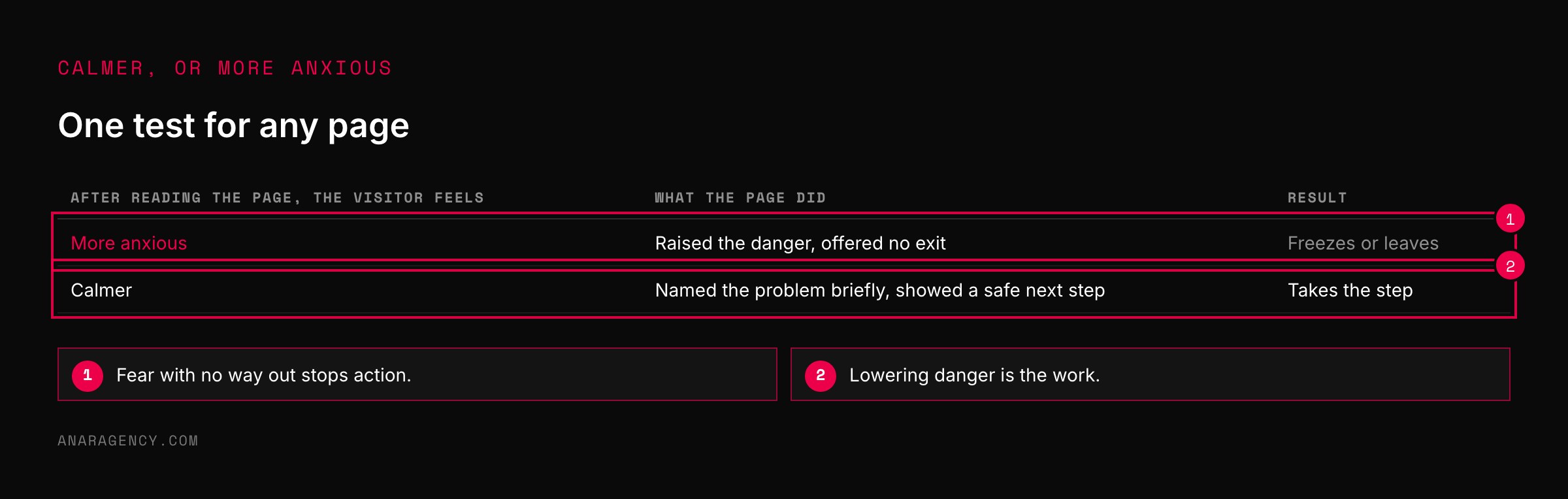
A frightened person does not buy. They freeze, or they leave. Raising the sense of danger without lowering it only pushes the reader further from a decision.
The work is to lower danger. The honest order is to name the unsafe place the reader is already in, accurately and briefly, and then spend your effort on the way to the safe one.
Inventing a threat is a different thing, and it is both wrong and risky. Regulators treat false or unsupported claims as deceptive, and platforms restrict ads that play on a person's fears about themselves.
There is a simple check. After reading your page, does a person feel calmer or more anxious? If the answer is more anxious, the page is working against you.
How much of a page to give to the problem, depending on the reader, is covered in action is desire minus objections.
What to read next, and why
Chicago Tylenol murders (encyclopedia entry): The recall, the cost, and the packaging that followed. Still taught as the model response to a crisis.
Regulatory focus theory (encyclopedia entry): The research on prevention and promotion, and why matching the message to the mode matters.
Loss aversion (encyclopedia entry): Why the downside of buying weighs more than the upside.
Maslow's hierarchy of needs (encyclopedia entry): Where safety sits among human needs, and the criticisms of the model.
So the simple takeaway is this: read your page as a nervous stranger. Count the places where they can see inside, see the exit, see who went first, and take a small step.
Questions executives ask
What motivates people to buy?
At root, a move from a situation that feels unsafe toward one that feels safer. Money, status, health, and belonging are forms of that. A buyer also judges whether the purchase itself is safe, and that second judgment often decides the sale.
What is the Safe Place Model?
A way of looking at buyer behavior as movement from unsafe to safe. It says an offer must show both that the outcome improves the buyer's position and that the step of buying carries little danger.
What are trust signals on a website?
Things that make the next step feel safe. The four most useful are visible prices and process, a clear way to cancel or get a refund, named customers similar to the visitor, and a small, reversible first step.
What is the difference between prevention and promotion focus?
In a prevention focus a person is trying to avoid a loss and responds to words about protecting and securing. In a promotion focus a person is trying to achieve a gain and responds to words about growing and winning. Messages tend to work better when they match.
Should marketing use fear?
Naming a real problem accurately is fair and helps the reader feel understood. Raising fear without offering a way out makes people freeze, and inventing a threat is deceptive. A page should leave the reader calmer than it found them.

Filip Kovacevic is the founder of Anar Agency in Phoenix. He spent five years running SEO, Meta ads, email, and content for medical practices across the United States, and now does the same work for healthcare, home-service, legal, and professional-service businesses, alongside AI implementation. More from Filip →
Talk it through in 15 minutes
Bring one AI question from this article. We will tell you what we would do, whether or not you hire us.
Book a 15-Min Chat →