Action Is Desire Minus Objections

A person acts when what they want outweighs what holds them back. You can raise the wanting or lower the resistance, and lowering resistance usually works better, because pushing harder makes people push back. In copy that means finding the specific objections and removing them instead of adding more benefits.
How you do it depends on the reader. People who already know the problem need mostly solution. People who have given up need to feel understood first.
And the more a reader blames themselves, the gentler the ask should be.
A lesson about pushing
In the 1940s the psychologist Kurt Lewin was working on a practical question: how do you get a group of people to change a habit?
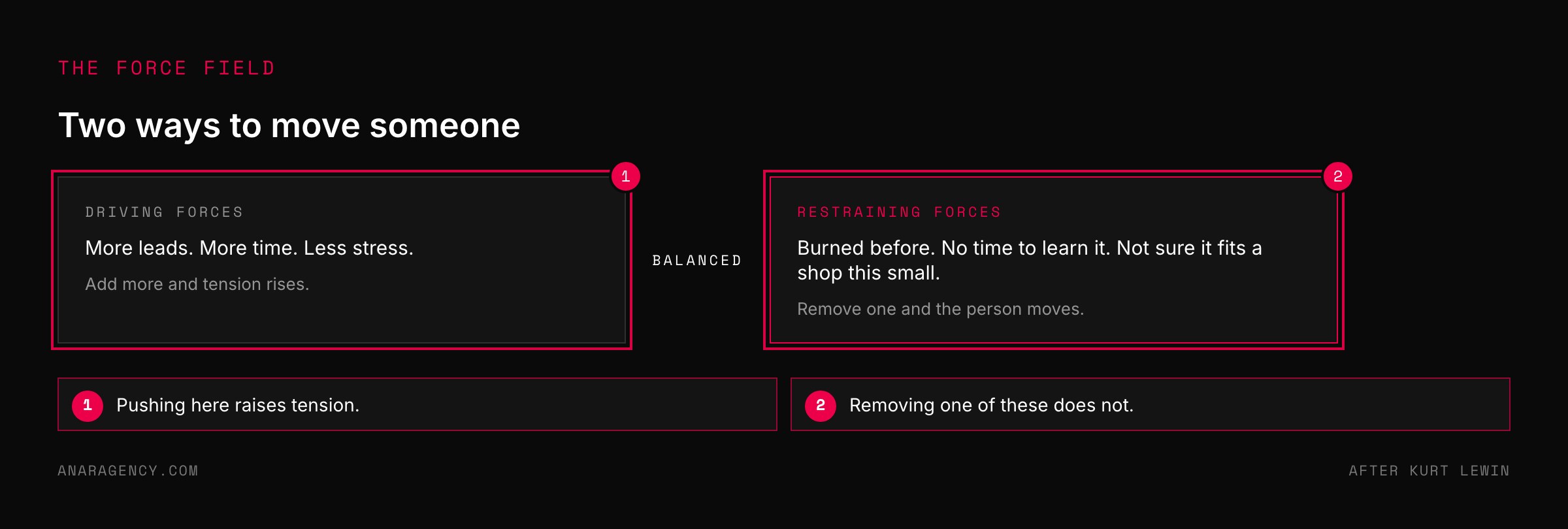
He drew it as a tug of war. On one side, the forces driving a person toward the change. On the other, the forces holding them where they are.
A person stays put when the two are balanced. He called the picture a force field.
The obvious move is to add driving force. More reasons, more urgency, more reward. Lewin's point was that this raises tension, and people under tension resist.
The other move is to take away a restraining force. Nothing pushes back against that. The person simply moves.
Action is desire minus objections
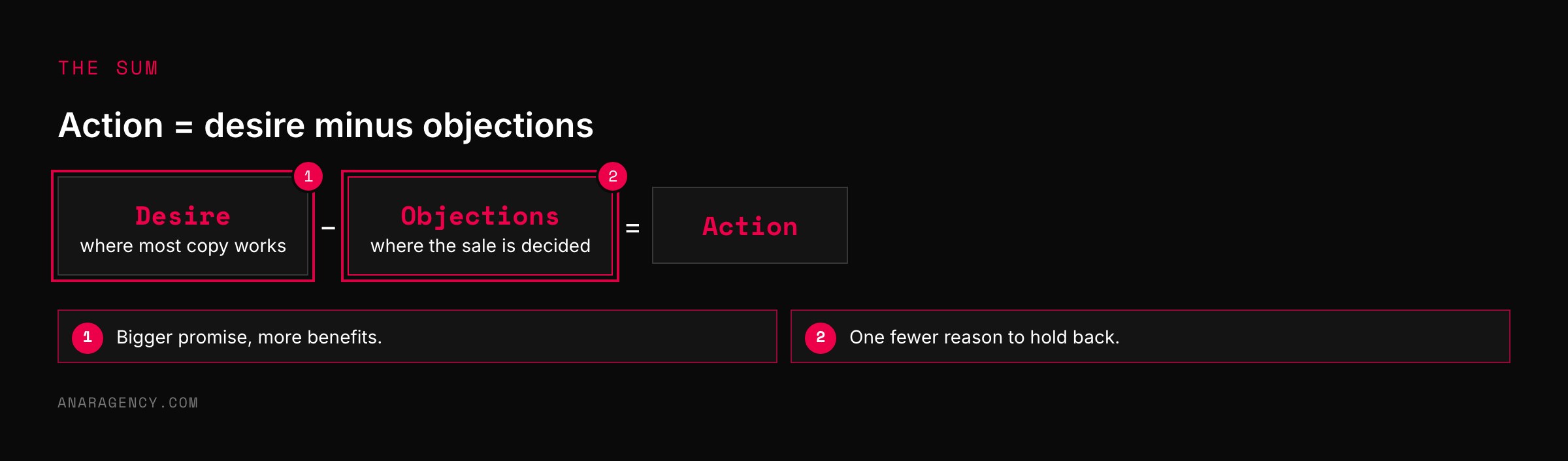
That is the whole idea, and you can write it as a sum. Action equals desire minus objections.
Most copy works only on the first term. Bigger promise. More benefits.
Louder headline.
But a reader who already wants the result does not need to want it more. They need one fewer reason to hold back.
A later model says the same thing from another angle. The Fogg Behavior Model holds that a behavior happens when motivation, ability, and a prompt arrive together, and that making the action easier is often more reliable than raising motivation.
We cover how to build the wanting in desire is a gap. This article is about the other side of the sum.
A reader acts when wanting outweighs resistance. Removing resistance usually works better than adding desire. List every reasonable objection before writing and answer each on the page.
Set the split between problem and solution by the reader's state: mostly solution for those who know the problem, even for those who have not named it, mostly problem for those who have given up. Explain the cause, do not add blame to a reader who already carries it, and ask by suggesting, not pleading or commanding.
How much problem, how much solution
The first practical question on any page is how long to stay on the problem before moving to the answer. The right split depends on where the reader is.
Readers who know the problem and blame themselves. They have lived with it for years. Describing it again at length is a lecture.
Give the problem a line or two and spend the page on the way out.
Readers who feel it but have not named it. They need the problem put into words and explained before a solution means anything. Roughly half and half.
Readers who have given up. They have tried, failed, and decided it is not fixable. A solution offered early is not believed.
Stay with the problem until they feel understood, and offer the answer briefly at the end.
As starting points we plan one part problem to nine parts solution for the first group, an even split for the second, and nine to one for the third. Those are our rules of thumb, not measured constants.
The idea that people at different stages need different messages is well established. The stages-of-change model used in health research describes people moving from not considering a change, to weighing it, to preparing, to acting, and matches the approach to the stage.
Friction Removers: who is to blame, and how to ask
Some pages get a yes without ever seeming to sell. Their writers spend their effort on what is in the way. We call them Friction Removers.
They explain the cause. A reader who understands why they are stuck can accept it and move. "Your leads went cold because nobody called within the hour" does more than "you need better follow-up."
They are careful with blame. People differ in whether they see outcomes as their own doing or as the result of outside forces, which psychologists call locus of control. A reader who already blames themselves does not need more of it.
For that reader, point at the missing piece. "Nobody showed you the number that matters" lets them keep their dignity and still act.
They match the ask to the reader. There are three ways to ask: pleading, suggesting, and commanding. Pleading reads as weak.
Commanding works on someone who has decided and repels someone who has not.
Suggesting is the default. "If this sounds like your week, the next step is a fifteen-minute call." The word if leaves the choice with the reader, which is where they want it.
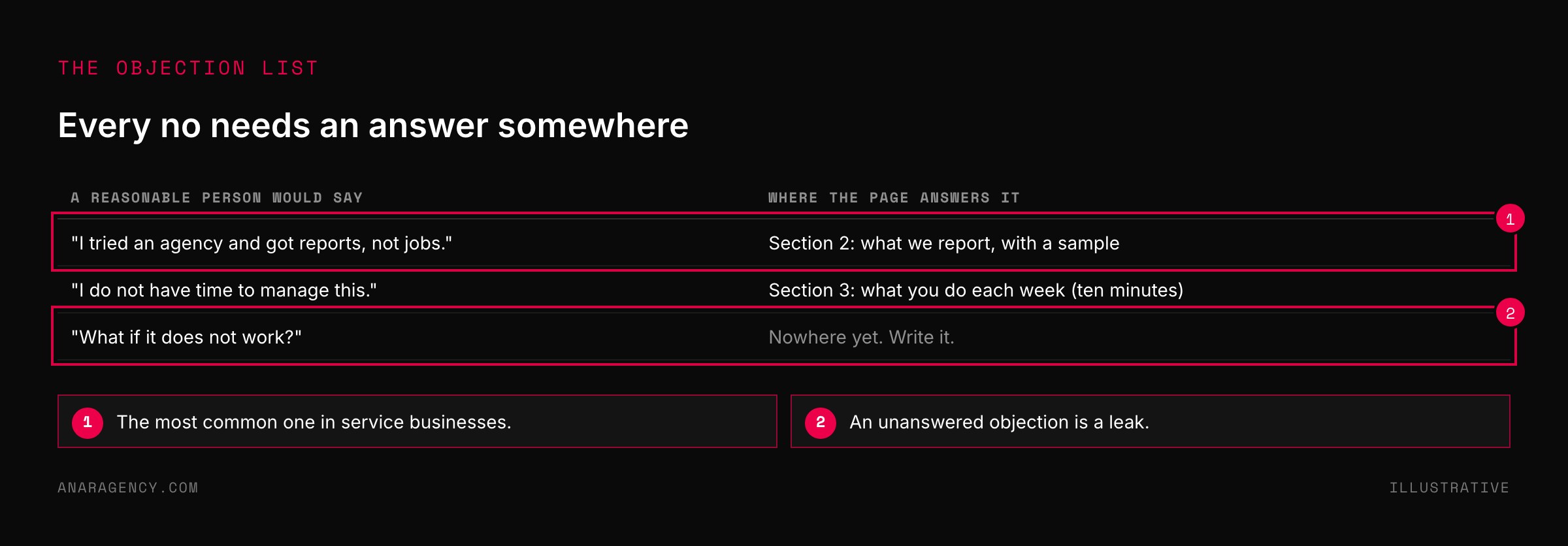
They list the objections first. Before writing, they write down every reason a sensible person would say no. Then each one gets an answer somewhere on the page.
Which objections matter most is covered in the three stop-beliefs.
"Is dwelling on the problem not just fear-mongering?"
You may dislike copy that pokes at pain. So do we, when it is done to frighten. The line between naming a problem and exploiting it is real.
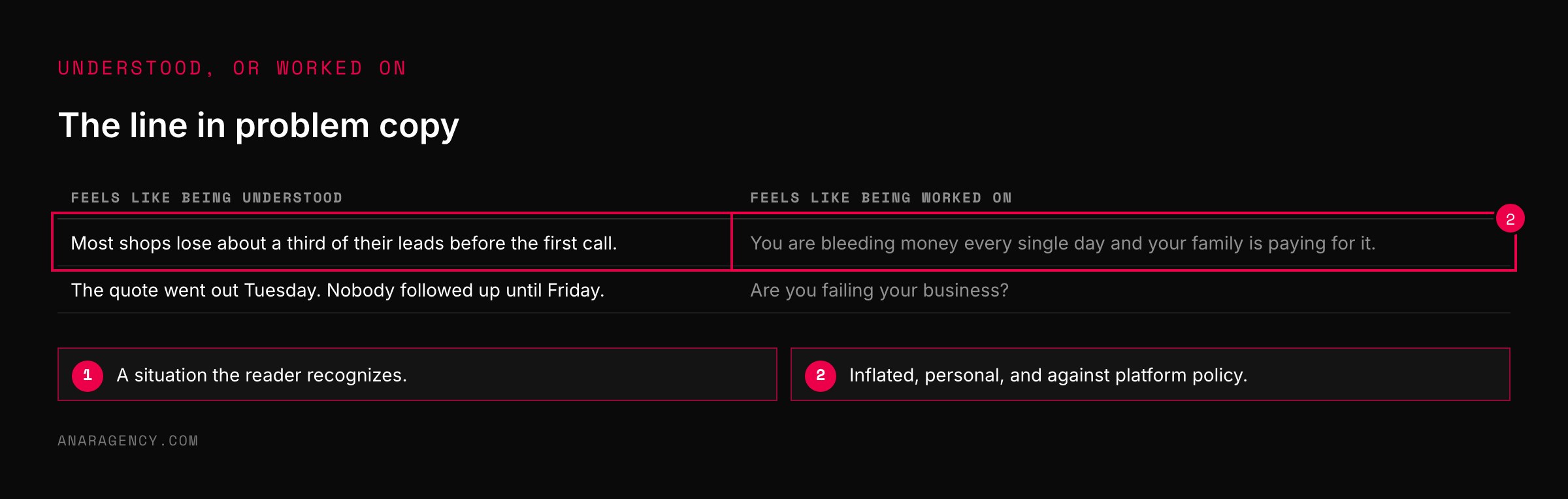
The test is whether the reader recognizes it. A problem described accurately feels like being understood. A problem inflated beyond what they live with feels like being worked on.
So describe what is true and stop. If the honest version of the problem does not move anyone, the offer is aimed at the wrong people.
There is also a platform rule. Meta's advertising policy does not allow ads that assert or imply a viewer's personal attributes, which includes their financial status, health, or state of mind.
"Are you failing at this?" breaks it. "Most shops lose a third of their leads before the first call" does not. Describe the situation, not the person, as we also advise in before-words and after-words.
What to read next, and why
Force-field analysis (encyclopedia entry): Lewin's picture of driving and restraining forces. Short, and it will change how you plan a page.
Fogg Behavior Model (encyclopedia entry): Motivation, ability, prompt. A compact way to ask why someone did not act.
Transtheoretical model (encyclopedia entry): The stages people pass through before changing a behavior, and why one message does not fit all of them.
Locus of control (encyclopedia entry): The research on where people place the cause of what happens to them.
So the simple takeaway is this: before adding one more benefit to a page, write down the three reasons a reasonable person would say no. Remove those first.
Questions executives ask
What does "action is desire minus objections" mean?
A person acts when what they want is greater than what holds them back. You can increase the first or reduce the second. Reducing objections is often more effective, because adding pressure tends to create resistance.
How do you handle objections in sales copy?
List every reason a reasonable buyer would say no before you write. Then answer each one somewhere on the page, in the order a reader would raise them. Explaining the cause of the problem often removes several objections at once.
How much of a sales page should be about the problem?
It depends on the reader. People who already know and accept the problem need very little of it. People who have not named it need about half the page.
People who have given up need the most, because a solution offered too early is not believed.
What is force-field analysis?
A model from the psychologist Kurt Lewin that pictures any situation as held in place by driving forces pushing toward change and restraining forces pushing against it. Change happens when the balance shifts, and reducing restraining forces avoids the tension that pushing creates.
Is problem-focused copy manipulative?
It is when the problem is exaggerated or invented. An accurate description of what the reader already experiences helps them feel understood. Advertising platforms also restrict copy that asserts personal attributes, so describe the situation instead of the individual.

Filip Kovacevic is the founder of Anar Agency in Phoenix. He spent five years running SEO, Meta ads, email, and content for medical practices across the United States, and now does the same work for healthcare, home-service, legal, and professional-service businesses, alongside AI implementation. More from Filip →
Talk it through in 15 minutes
Bring one AI question from this article. We will tell you what we would do, whether or not you hire us.
Book a 15-Min Chat →