Four Kinds of Problems and Two Kinds of Buyers

Customer problems fall into four kinds. Counting problems are measurable shortages of time, money, or capacity. Wanting problems are a felt lack.
Belonging problems are about safety in a group. Body problems are physical. Buyers also come in two kinds: those already in motion, who want a tool that speeds them up, and those who are stuck, who need guidance before they move.
Identify which problem and which buyer you have before writing a word. A counting problem, in particular, is rarely fixed by more of the same, because the scarce thing is usually the buyer's time.
A sentence from 1971
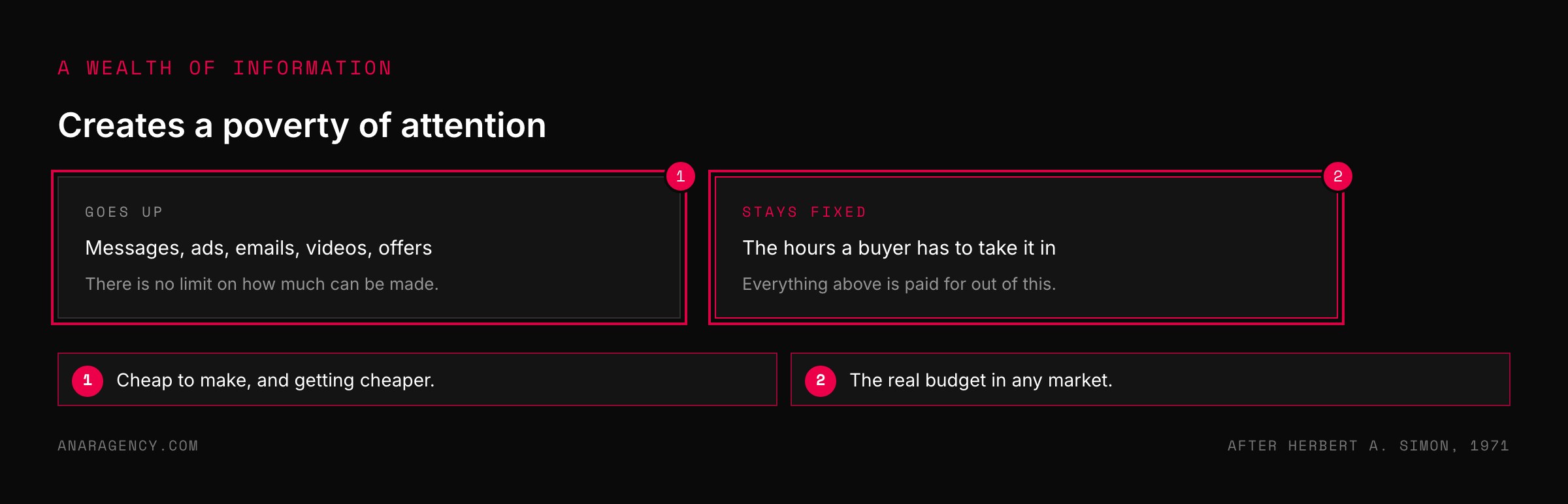
In 1971 an economist named Herbert Simon wrote one sentence that has aged better than almost anything else said about business that year.
A wealth of information, he wrote, creates a poverty of attention.
His point was about arithmetic. Information uses up the attention of the people who receive it. Make more information and the thing that becomes scarce is the attention to take it in.
The phrase attention economy grew from that idea. Simon went on to win a Nobel Prize in economics.
Keep the sentence in mind. It explains why one of the four kinds of problem below cannot be fixed the way most businesses try to fix it.
The Four Problem Types
Ask a business what problem it solves and you usually hear about the product. Ask what kind of problem it is and you get a pause. There are four kinds.
Counting problems. A shortage you can put a number on. Not enough time, money, staff, leads, or hours in the day.
Wanting problems. A felt lack. The person believes something is missing: status, meaning, or a version of themselves they have not reached.
This is where desire lives.
Belonging problems. People need to feel safe, and safety for a human usually means a group. Fear of being left out, or of standing out, drives a great deal of buying.
Body problems. Energy, comfort, health, physical limits.
The list will remind some readers of Maslow's hierarchy of needs, which also sorts human needs into physical, safety, belonging, and esteem. The difference is that we use it to sort problems, not people.
The same product can sit in any of the four. A gym membership is a body problem for one buyer, a belonging problem for the next, and a wanting problem for a third.
Sort the problem: counting (a measurable shortage), wanting (a felt lack), belonging (safety in a group), or body (physical). Sort the buyer: in motion (sell a tool that speeds them up) or stuck (sell guidance). Lead with one problem type.
Do not answer a counting problem with more volume, because the scarce resource is the buyer's time. Offer a repair before a replacement. Find the answers in reviews, call notes, and what customers were doing the week before they bought.
Why more does not fix a counting problem
Here is where Simon's sentence matters.
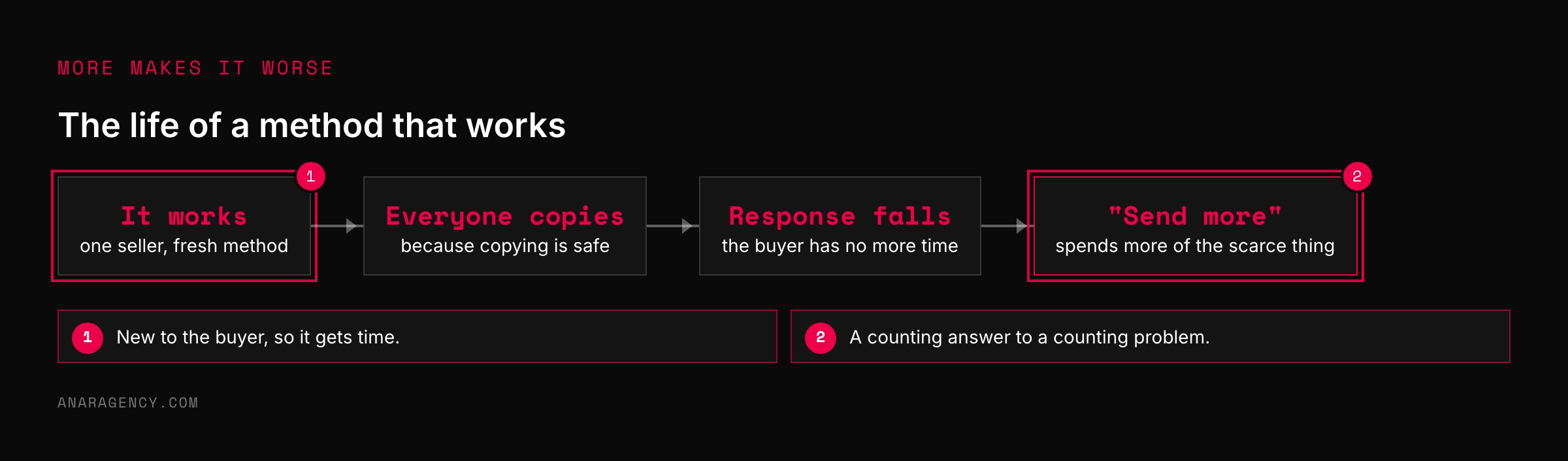
A new way of selling works. Other businesses see it working and copy it, because copying something proven is safe. Soon everyone in the market is doing it.
Now the buyer faces forty webinars, sixty cold emails, and a hundred look-alike ads. Economists call the end state market saturation. Response falls and costs rise.
That is a counting problem. The usual reply is a counting answer: send more emails, run more ads, post more often.
It makes things worse, because the scarce thing was never the number of messages. It was the buyer's time, and each extra message spends more of it.
The way out is to change how the time feels. A message that fits the reader exactly makes ten minutes pass quickly. A message that does not makes thirty seconds feel long.
That is a wanting or belonging answer to a counting problem.
Problem Sorters: two kinds of buyers
Some businesses seem to know what to sell before they build it. They sort the buyer as carefully as the problem. We call them Problem Sorters.
They ask if the buyer is in motion. A buyer in motion is already heading somewhere and wants to get there faster. Sell that person a tool.
Templates, software, a done-for-you service. It does not ask them to stop.
They ask if the buyer is stuck. A stuck buyer has stopped, or needs to. They want to understand what went wrong.
That person will pay for guidance: a diagnosis, a plan, a course, a coach.
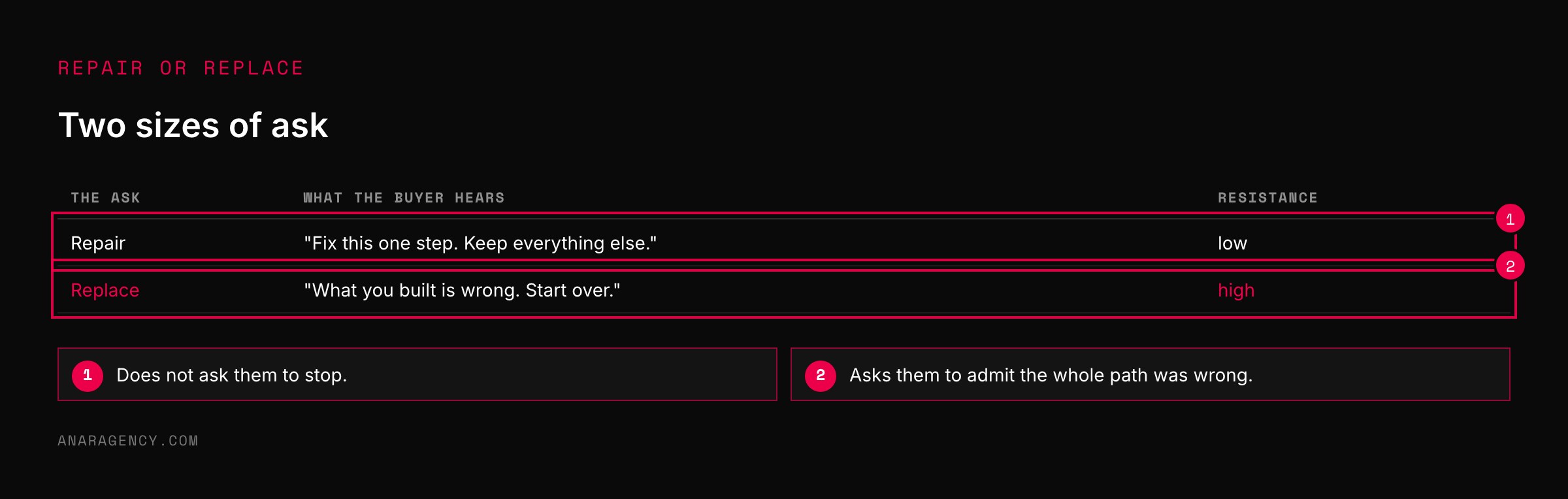
They do not sell guidance to a moving buyer. It asks a busy person to stop and rethink everything. People prefer the path they are already on, a tendency researchers call status quo bias.
They offer a repair, not a replacement. "Fix this one step" meets far less resistance than "rebuild the whole thing." If a rebuild truly is needed, the buyer has to reach that conclusion first.
To move a tool buyer to guidance, something has to interrupt the motion. Usually it is evidence that the current path has a ceiling. We describe how to sequence that in the funnel decision timeline.
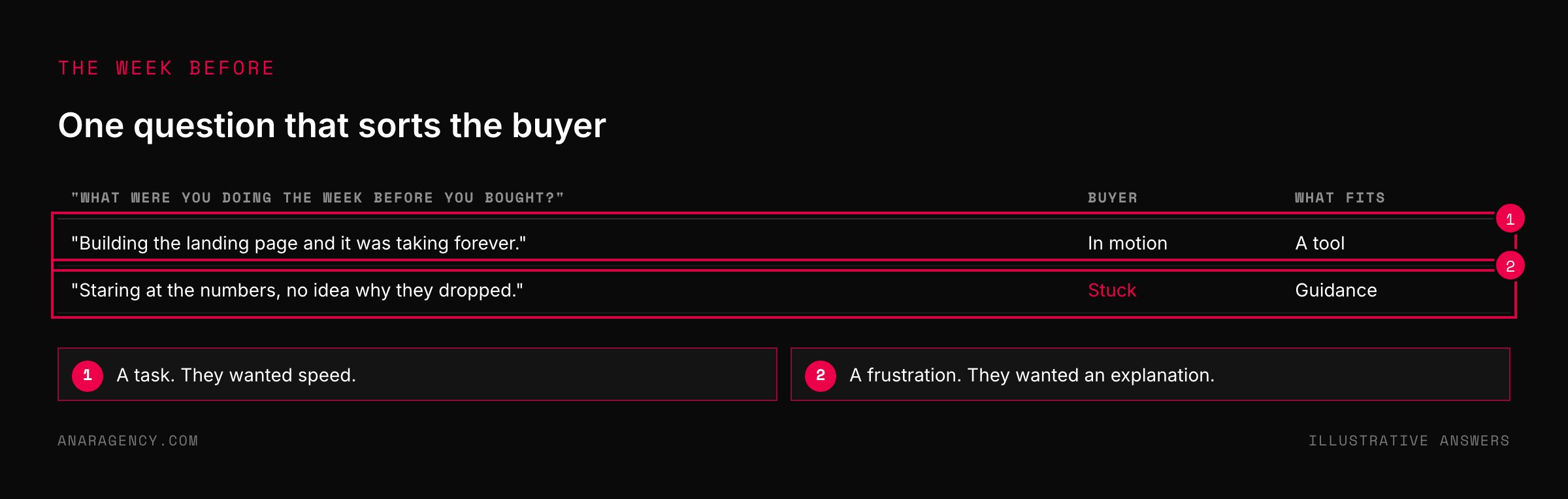
The cheapest way to learn which buyer you have is to ask recent customers what they were doing the week before they bought. Busy people describe a task. Stuck people describe a frustration.
"My customers have all four problems"
You may think your market does not sort neatly. It will not. Most people carry some of each.
The sorting is still worth doing, because a page cannot lead with four things. One has to come first, and the question is which.
A rough guide. Markets that already understand their problem tend to state it as a counting or wanting problem. "I need more leads."
"I want to be the known name in this town."
Markets that do not yet understand their problem tend to feel it as a body or belonging problem. They know something is off and cannot say what. That reader needs the problem named first, which we cover in before-words and after-words.
One caution on body problems. Health claims are regulated more tightly than almost any other kind, and the platforms restrict how you may address a person's health. Describe the product truthfully and stay well inside what you can support.
And do not guess. Read reviews, sales call notes, and support tickets, and count which kind of problem comes up most. The method is in the unasked questions.
What to read next, and why
Attention economy (encyclopedia entry): Simon's idea and what grew from it. The background to every counting problem in marketing.
Maslow's hierarchy of needs (encyclopedia entry): The best-known sorting of human needs, with its criticisms.
Market saturation (encyclopedia entry): What happens when everyone copies what works.
Status quo bias (encyclopedia entry): Why a buyer in motion resists being asked to stop.
So the simple takeaway is this: before you write, answer two questions. Which of the four problems does this buyer mostly have, and are they moving or stuck?
Questions executives ask
What are the four types of customer problems?
Counting problems are measurable shortages such as time, money, or capacity. Wanting problems are a felt sense that something is missing. Belonging problems concern safety and standing within a group.
Body problems are physical, such as energy, comfort, or health.
What is the difference between a tool buyer and a guidance buyer?
A tool buyer is already in motion and wants to reach a goal faster with fewer mistakes, so software, templates, or done-for-you services fit. A guidance buyer is stuck and needs to understand what went wrong before acting, so a diagnosis, plan, or coaching fits.
Why does sending more marketing stop working?
When a method works, competitors copy it until the market is saturated. The buyer's time is fixed, so each additional message competes for less attention. Adding volume spends more of the scarce resource instead of solving the shortage.
How do I find out which problem my market has?
Read reviews, sales call notes, and support tickets, and tally which kind of problem appears most. Then ask recent customers what they were doing the week before they bought. A task suggests a buyer in motion.
A frustration suggests one who was stuck.
Can one product solve more than one kind of problem?
Yes. The same product can be a body problem for one buyer and a belonging problem for another. The product does not change, but the message does, so it is worth writing separately for each group.

Filip Kovacevic is the founder of Anar Agency in Phoenix. He spent five years running SEO, Meta ads, email, and content for medical practices across the United States, and now does the same work for healthcare, home-service, legal, and professional-service businesses, alongside AI implementation. More from Filip →
Talk it through in 15 minutes
Bring one AI question from this article. We will tell you what we would do, whether or not you hire us.
Book a 15-Min Chat →