Who Owns AI? Choosing Between a CAIO, a Center of Excellence, and Champions
Who owns AI depends on your size and your stakes. Under about 200 people: a fractional owner plus team champions. Mid-size: a small center of excellence that enables instead of gatekeeping.
Enterprise or regulated: a Chief AI Officer with real budget. In all three, one rule holds: the business unit that runs a workflow owns its automation after deployment.
The three ownership models
There are three ways to do this, and each one breaks in its own way. Pick by size and stakes, then guard against the break.
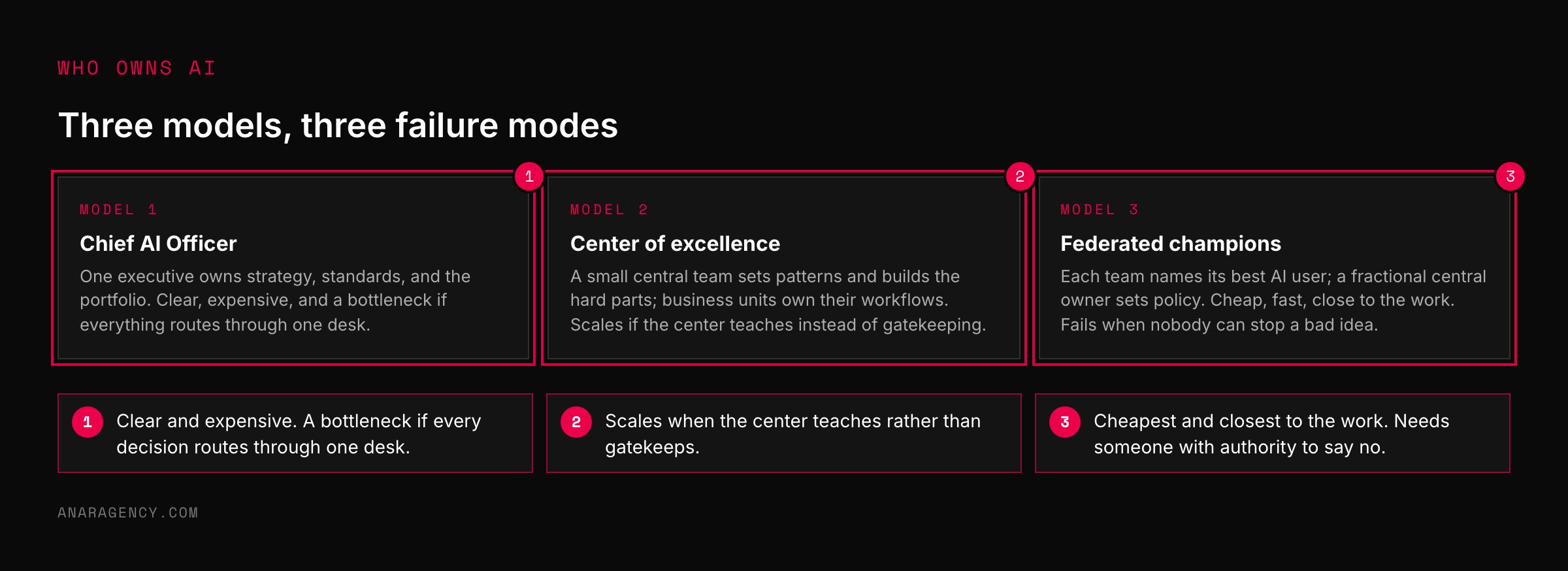
Federated champions. Each team names its best AI user, and a fractional central owner, often ops or engineering leadership, sets policy and shares patterns. It is cheap, fast, and close to the work.
It fails when nobody has the authority to stop a bad idea.
Center of excellence. Two to six people who own policy, platform choices, evaluation standards, and enablement. The healthy version is a service bureau and a pattern library.
The failure mode is a gatekeeping bottleneck that teams route around, which recreates shadow AI inside your own walls.
Chief AI Officer. Warranted when AI risk or opportunity is board-level: regulated industries, thousands of employees, AI-adjacent products. A CAIO without budget and mandate is a press release.
Do not appoint one to signal a seriousness you have not funded.
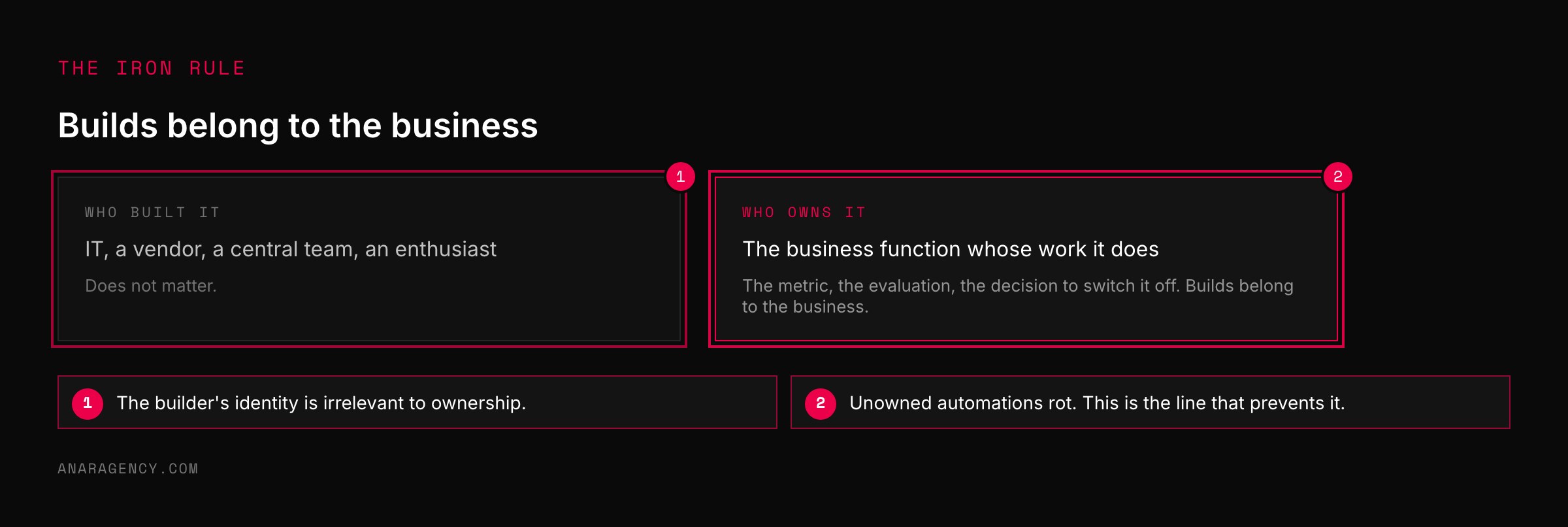
The iron rule: builds belong to the business
The most expensive org mistake in AI is a central team that owns deployed automations forever.
Central builds it, central ships it, central owns it. Every automation now eats central capacity permanently, and the backlog compounds until innovation stops.
The pattern that lasts looks like a good software platform team. The center owns standards, shared infrastructure, and the harness. The business unit that runs the workflow owns the automation, its metrics, and its upkeep.
Ownership transfers at deployment, formally, with a named owner and an evaluation in place. If the business unit cannot own it, it is not done.
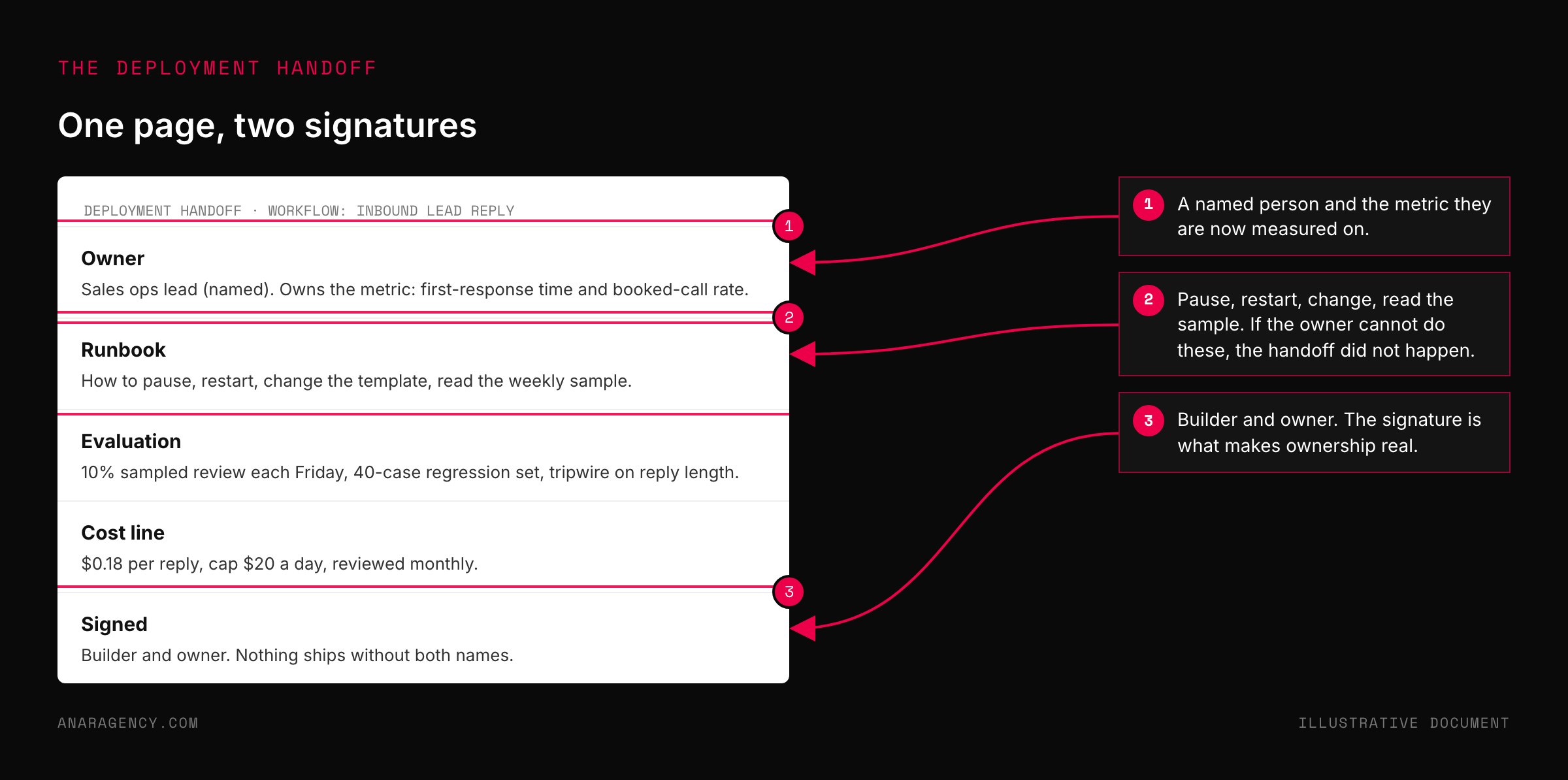
No automation ships without three signatures: the builder (it works), the business owner (I own it now, including its metric), and the evaluator (its check exists and runs). Central teams that keep ownership past deployment become the bottleneck they were created to remove.
The day-job problem
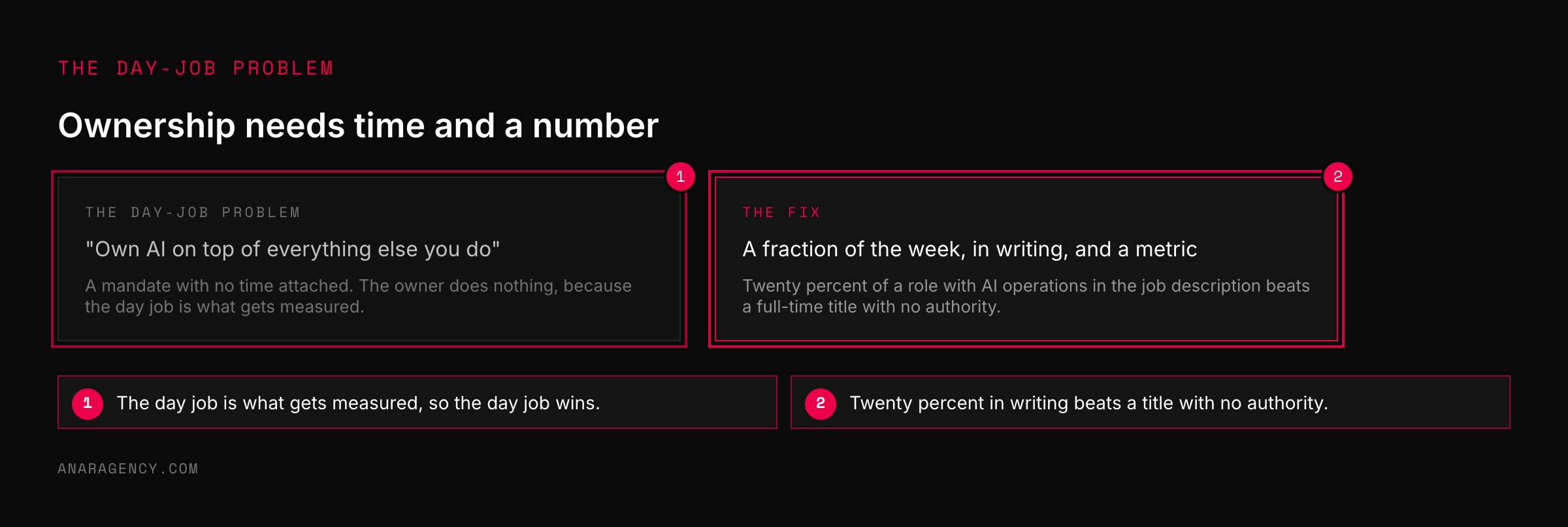
"Everyone also has their day job" is the real constraint in every AI rollout, and three structures beat it.
Buy time: champions get explicit hours, 10 to 20 percent, that their managers actually protect, because unfunded mandates die quietly. Rotate: a two-quarter tour through the center of excellence turns line employees into trained owners who carry the skill back. Sequence: automate the champions' own drudgery first, so the program funds its own time budget in saved hours.
What does not work is enthusiasm as a plan. Volunteer energy fades in about a quarter without structural time behind it.
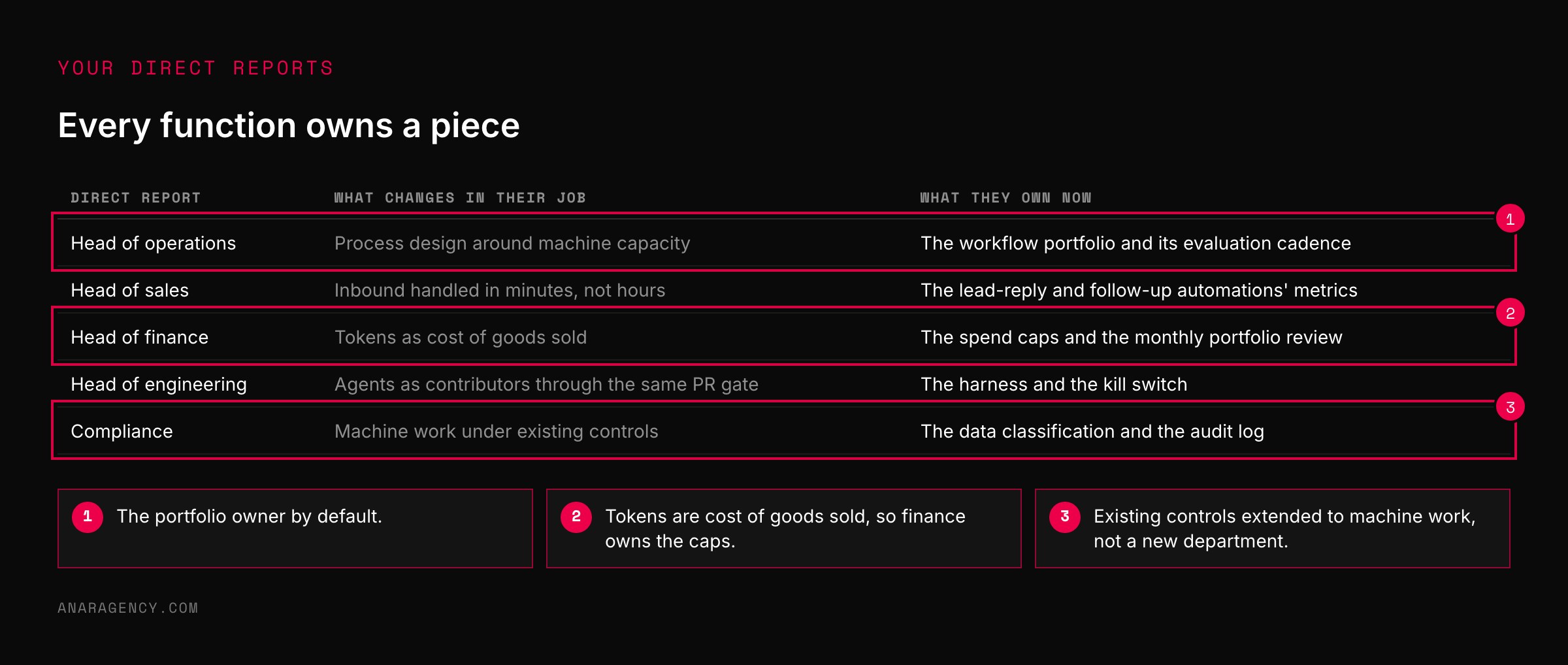
Your direct reports in an AI operating model
The executive team question is not "who gets the AI portfolio?" It is "which decisions move?"
Three shifts are predictable. Quality control moves up: managers spend more time reviewing machine output and less time producing. Capacity planning splits into a human lane and a machine lane with different economics.
And process design becomes a first-class leadership skill, because processes are now built rather than grown.
Run the org chart exercise once a year. For each function, ask what this team looks like when execution capacity is effectively unlimited and judgment is the constraint. The answer tells you who to develop and what to stop measuring.
Named Owners: what AI ownership that works has in common
Some companies make AI ownership look easy, and it is almost never because of the title they picked.
The title race is real. An IBM study of CEOs found that 76 percent of surveyed organizations have a Chief AI Officer in 2026, up from 26 percent a year earlier. But look past the title and the ones that work share three traits.
We call them Named Owners.
They have a name, not a committee. When the White House told federal agencies to get serious about AI in March 2024, the memo did not ask for a task force. It gave the head of every agency 60 days to designate one person.
When the next administration replaced that memo in April 2025, it rescinded the old memo and kept that requirement. Sixty days, one named person, and a notice within 30 days if the seat goes empty. Two administrations agree on very little, and they agreed on this.
They sit high enough to say no. The same memo says the owner must be placed high enough to talk with the agency's top leadership on a regular basis. That line is the whole difference between an owner and a mascot.
They coordinate. They do not hoard. Here is the part that surprises people.
IBM, the company that published the study, has no Chief AI Officer. Its people point to the senior vice president of transformation and operations as the one who does the job.
IBM's own researchers say the role is moving away from ownership and toward coordination. That is the iron rule from earlier in this article, arriving from the other direction. The center sets the standards, and the business keeps the builds.
"We are 40 people. This is big-company stuff."
You may be reading this and thinking it is a problem for companies with a C-suite big enough to add a chair. It is the opposite.
The federal memo lets an agency hand the job to someone it already has, such as the chief information officer or the chief data officer, as long as that person knows AI. The title is optional. The name is not.
A 40-person company can do the same thing this afternoon. Pick the person, write AI operations into their job, and tell the team who it is. A responsibility chart with one name in the accountable column beats an AI council that meets monthly and owns nothing.
And the cost of skipping it is not abstract. In the same IBM research, nearly seven in ten executives admitted they lack full visibility into the AI their teams are using. That is what no owner looks like from the inside: tools everywhere, and nobody who can tell you what they touch.
If you want to see where ownership sits among the other things a company has to get right, our maturity model scores it as one of six dimensions. It is usually the cheapest one to fix.
What to read next, and why
OMB Memorandum M-25-21 (government memo): Skip to the section on Chief AI Officers. It is the clearest one-page job description for an AI owner we have found, and it is free.
The rise and ROI of the chief AI officer (article): Worth it for the admission that the company selling the idea does not have one.
Microsoft's AI center of excellence guidance (documentation): A good checklist for the mid-size option. Read it for the duties, and ignore the platform pitch.
Team Topologies key concepts (framework): Written for software teams, but the idea of a platform team that serves other teams is exactly what a healthy center of excellence is.
So the simple takeaway is this: before you argue about the model, the budget, or the title, write down one name. Everything else in this article gets easier the moment somebody owns it.
Questions executives ask
Does my company need a Chief AI Officer?
Only if AI risk or opportunity is genuinely board-level: regulated industry, enterprise scale, or AI-adjacent product. Below that, a fractional owner with team champions, or a small center of excellence, delivers more per dollar.
Who should own an AI automation after it is deployed?
The business unit that runs the workflow. Central teams own standards, platform, and the harness; they hand each build to a named business owner at deployment, with evaluation in place.
How do we drive AI adoption when everyone has a day job?
Fund the time explicitly: protected champion hours, rotations through the central team, and sequencing that automates the champions' own drudgery first so the program pays for its own attention.
How many companies have a Chief AI Officer?
In IBM's 2026 CEO study, 76 percent of surveyed organizations said they have a Chief AI Officer, up from 26 percent in 2025. The title is spreading fast, but the study's own authors describe the role as moving from ownership toward coordination.
Can an existing executive own AI instead of a new hire?
Yes. The United States federal guidance on Chief AI Officers explicitly allows an agency to designate an existing official, such as a CIO or chief data officer, provided the person has real AI expertise and sits high enough to engage with top leadership. For a small or mid-size company this is usually the right first move.

Filip Kovacevic is the founder of Anar Agency in Phoenix. He spent five years running SEO, Meta ads, email, and content for medical practices across the United States, and now does the same work for healthcare, home-service, legal, and professional-service businesses, alongside AI implementation. More from Filip →
Talk it through in 15 minutes
Bring one AI question from this article. We will tell you what we would do, whether or not you hire us.
Book a 15-Min Chat →