Publish Someone Else's Expertise

The publisher model splits a business into two halves: the expert brings real skill and results, and the publisher brings packaging, marketing, sales, and the risk of the ad spend. Many experts have the first half and dislike the second, which leaves room for a partner who markets well. Choose markets with either repeat purchases or large purchases, ideally both.
Then settle five terms in writing before launch: what profit means, who decides marketing, how money flows, who owns the content and customer list, and how the deal ends.
A series built on other people's expertise
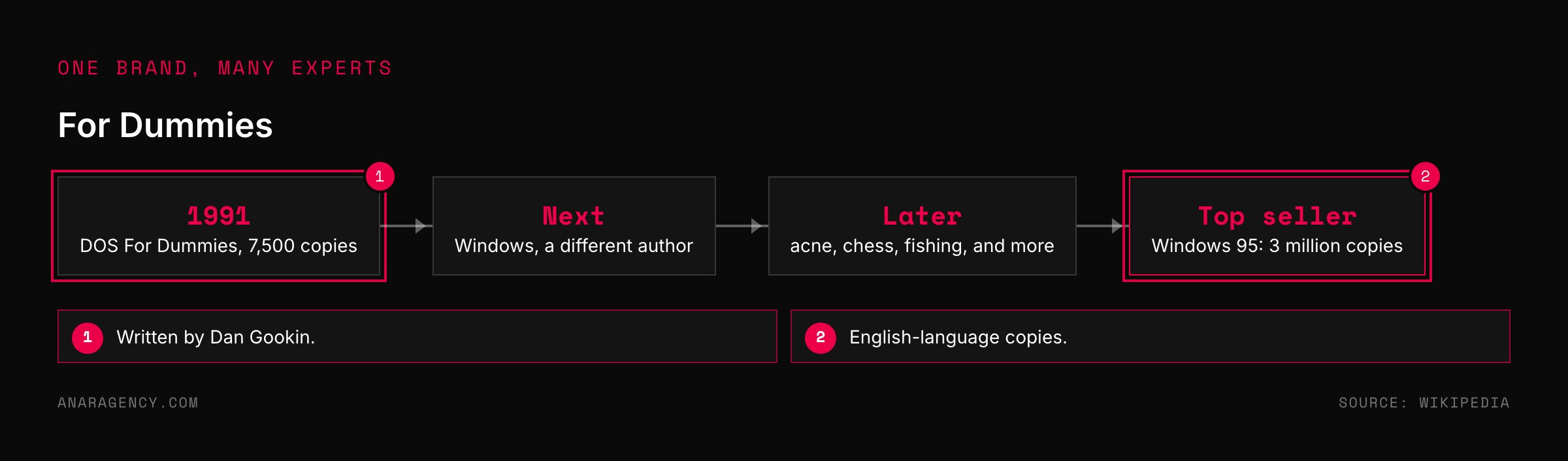
In November 1991, IDG Books published DOS For Dummies, written by Dan Gookin. The first printing was just 7,500 copies.
Beginner-friendly computer books were rare, and the book took off. The publisher soon released a Windows title by a different author, Andy Rathbone.
The series later branched far beyond computers, into titles such as Acne For Dummies, Chess For Dummies, and Fishing For Dummies. Windows 95 For Dummies became the top seller, with 3 million English-language copies sold.
Each book was written by a different expert. The brand, the format, and the distribution belonged to the publisher, and the series is now published by John Wiley and Sons.
That is the publisher model in its purest form. The expert brings the knowledge; the publisher brings everything needed to sell it.
Two halves of one business
Any business that sells expertise needs two things. Something worth selling, and a way to sell it.
Experts usually have the first. A practitioner with twenty years of results, a clinician with a method, a consultant whose clients get better outcomes.
Many of them have little interest in the second. Ads, funnels, follow-up, pricing tests, and the risk of spending money before it comes back.
A publisher takes that half. They package the expertise into something people can buy, market it, sell it, and deliver it.
Content is no longer the hard part. Almost anyone can record a video. Reach and the ability to turn attention into sales are the scarce half.
Split the business in two: the expert brings real skill and results; the publisher brings packaging, marketing, sales, delivery, and the ad risk. Choose markets with repeat purchases, large purchases, or both. Find experts with strong results and weak reach, and check results first.
Before launch, settle in writing what profit means, who decides marketing, how money flows, who owns content and customers, and how the deal ends. Keep all claims truthful and disclosed.
Picking the market: scale and magnitude
Not every expertise is worth publishing. Two questions sort the good markets from the hard ones.
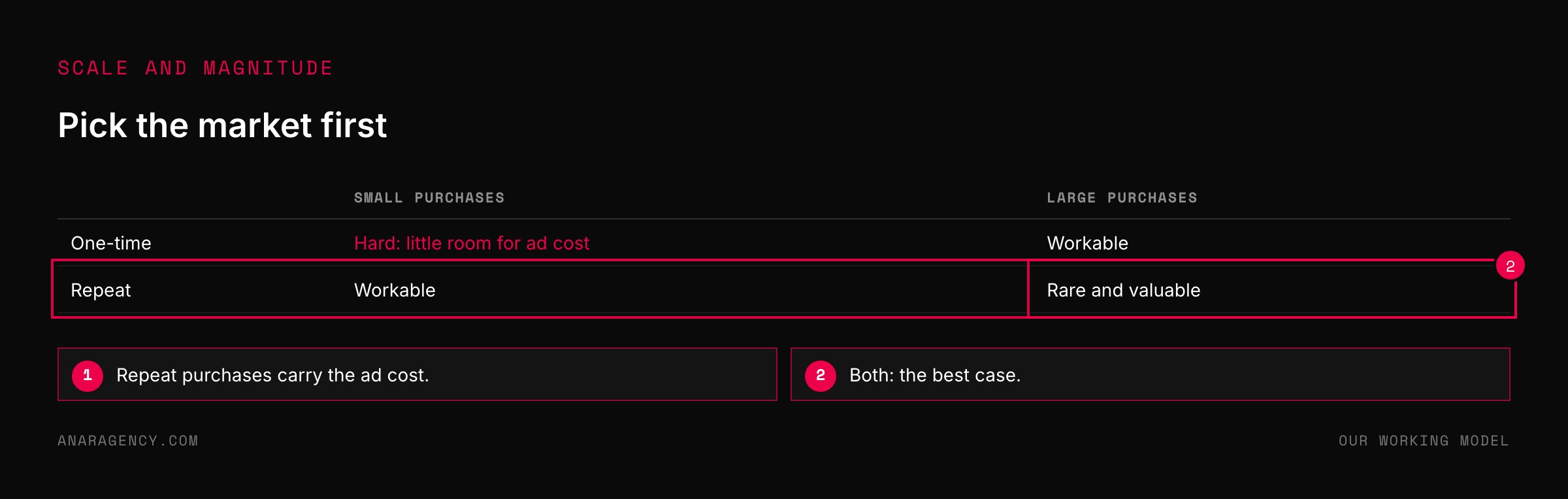
Scale: will customers buy again and again? A subscription, a membership, or a product people reorder.
Magnitude: is each purchase large? A high-priced program, a service, or a professional tool.
A market with neither is a hard place to build. A market with one can work. A market with both is rare and valuable.
Many first publishing attempts fail on magnitude. Low-priced products in a market with no repeat purchase cannot pay for the advertising needed to find buyers.
Check the numbers before you shake hands, the way you would for any offer. See offer economics before launch.
Finding the expert
The best partners are often not famous. Fame usually means someone else already handles the marketing.
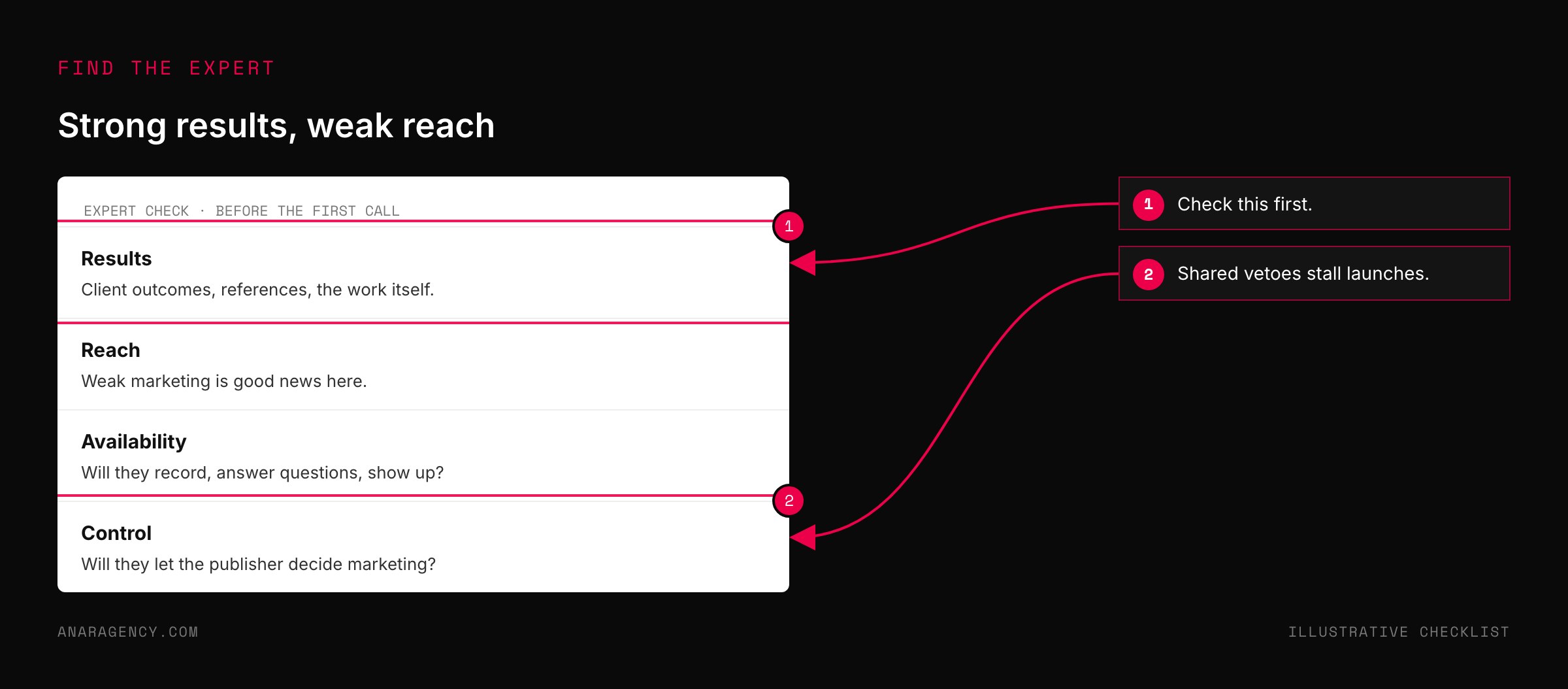
Look for people with strong results and weak reach. Practitioners respected by their peers, speakers who teach well but sell poorly, retired professionals with a method worth passing on.
Check the results before anything else. Ask for evidence: client outcomes, references, the work itself.
Then check the fit. Will they show up for recordings, answer customer questions, and accept that the publisher decides how it is marketed?
A brilliant expert who will not let anyone else make marketing decisions is a partner who will stall every launch.
Here is how it can look in practice. Picture a physical therapist whose patients with back pain recover well, using a home exercise method she teaches in person.
She has the result and the method, but no time or interest in marketing. A publisher could package the method into a guided program, run the advertising, handle support, and pay her an agreed share.
She keeps treating patients and gains a second income from the same expertise. The publisher gains a product with real results behind it.
The example is illustrative, and any health claims in it would need evidence. But the shape is the same in almost every field.
Five terms to settle before launch
Most publishing partnerships that fail do not fail on the product. They fail on money and control.
What profit means. Revenue minus exactly which costs. Ads, refunds, payment fees, software, staff.
Undefined "profit" is the most common fight.
Who decides marketing. One party has the final say on ads, offers, and price. Shared vetoes stall everything.
Money flow. Separate accounts, a fixed payout date, and statements both sides can read. Avoid a joint account that either side can drain.
Ownership and exit. Who owns the content, the brand, and the customer list, and what happens to each when the deal ends.
A partnership like this is a joint venture or a royalty arrangement, depending on how it is set up. Have a lawyer draft it; this list is a starting point, not legal advice.
"Why would an expert need me?"
Because selling is a separate skill, and most experts would rather practice their craft than run ads.
Offer what they lack and keep what they have. They keep the credit and the expertise, and you take the marketing work and the ad risk.
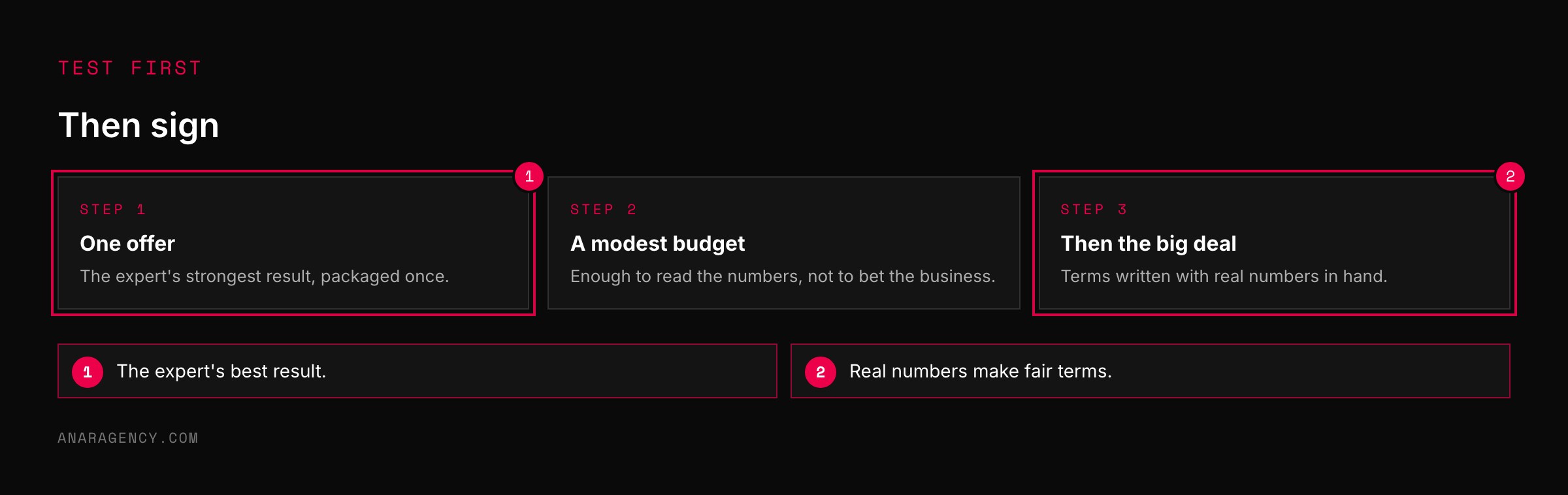
Show it working before asking for a big commitment. A small test with one offer and a modest budget proves more than a pitch deck.
Keep the marketing honest. Results claims about the expert's method must be truthful and backed by evidence, under FTC advertising rules, and endorsements from connected people must disclose the connection.
For the trust that makes an expert worth publishing, see four sources of credibility.
What to read next, and why
For Dummies (encyclopedia entry): The series that put many experts under one publisher's brand.
Joint venture (encyclopedia entry): The basic structure of most publishing partnerships.
Royalty payment (encyclopedia entry): The alternative structure, paying the expert a share per sale.
FTC's Endorsement Guides (FTC guide): The rules for marketing someone's expertise and results.
So the simple takeaway is this: list three people whose skill you respect and whose marketing is weak, and check one market for scale and magnitude before you call any of them.
Questions executives ask
What is the publishing business model?
A business where one party supplies expertise and another packages, markets, and sells it. The publisher takes the marketing work and risk in exchange for a share of revenue or profit.
How do I partner with an expert to sell their knowledge?
Find someone with strong results and weak reach, test one offer on a small budget, and settle the terms in writing: profit definition, marketing control, money flow, ownership, and exit.
What should a joint venture agreement cover?
At least what profit means, who has final say on marketing, how and when money is paid, who owns the content, brand, and customer list, and how the partnership ends. A lawyer should draft it.
What markets suit the publisher model?
Markets where customers buy repeatedly, buy at a high price, or both. Markets with neither rarely pay for the advertising needed.
How did For Dummies start?
DOS For Dummies, written by Dan Gookin, was published by IDG Books in November 1991 with a first printing of 7,500 copies. The series grew to many topics written by different experts.

Filip Kovacevic is the founder of Anar Agency in Phoenix. He spent five years running SEO, Meta ads, email, and content for medical practices across the United States, and now does the same work for healthcare, home-service, legal, and professional-service businesses, alongside AI implementation. More from Filip →
Talk it through in 15 minutes
Bring one AI question from this article. We will tell you what we would do, whether or not you hire us.
Book a 15-Min Chat →