What Not to Say in Copy: How a Bad Word Infects the Offer
A negative word in your copy does not stay attached to the thing you aimed it at. It attaches to whatever is nearby, which is usually you. Calling your industry sleazy, denying you are a scam, or criticizing the kind of sales call you are about to ask for all leave a bad feeling on your own offer.
Readers rarely recall the word. They keep the feeling. The fix is to say what your offer is instead of what it is not, remove any insult aimed at something you resemble, and check that no two lines contradict each other.
A speech that cost half a billion pounds
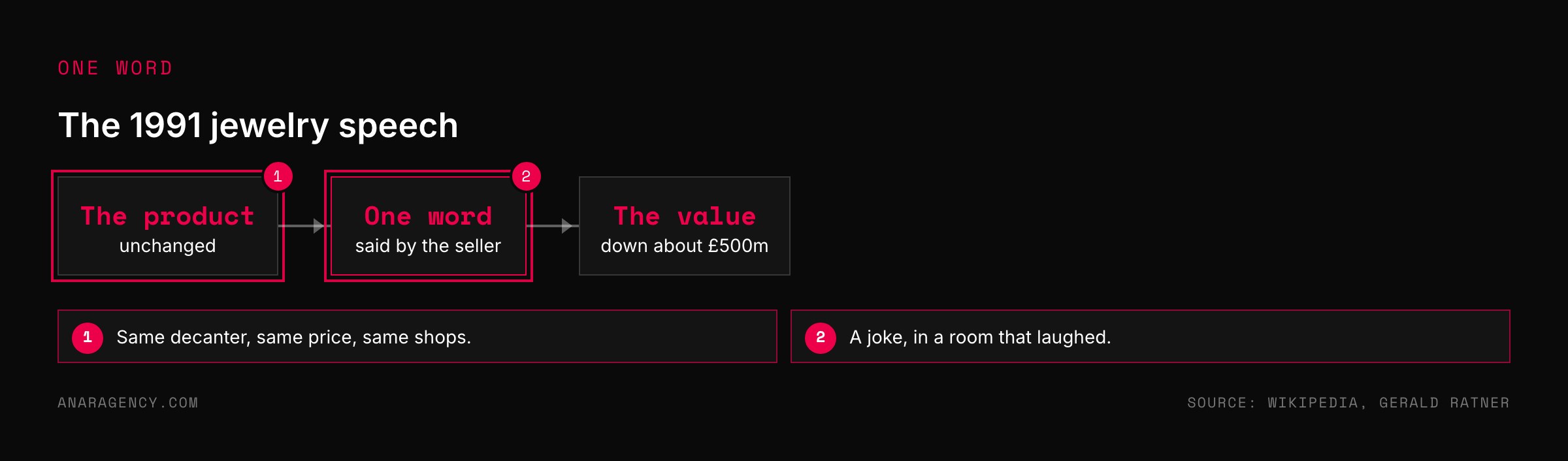
In April 1991 the head of Britain's largest jewelry chain gave a speech to a room of business leaders.
He was asked how his shops could sell a cut-glass sherry decanter so cheaply. He answered with a joke. He said it was because the product was, in his words, total crap.
He added that a pair of his earrings cost less than a prawn sandwich and probably would not last as long.
The room laughed. The newspapers did not. Customers stayed away and the company's value fell by around 500 million pounds.
He left the business in 1993, and the firm later changed its name.
Nothing about the products had changed. One word had been put next to them, by the person who sold them.
The feeling travels, the word does not
That is the extreme case. The everyday case is quieter and works the same way.
Psychologists have a name for it. Evaluative conditioning is the finding that when a neutral thing is shown alongside something people dislike, they come to like the neutral thing less.
The pairing is enough. People do not need to believe the two are connected. Often they cannot say later why their view shifted.
A related finding, the affect heuristic, is that people judge risk and benefit by how they feel about a thing, quickly, before any reasoning.
Put those together and you get a rule for copy. Every word leaves a feeling on the page, and the feeling settles on your offer, whoever you were talking about.
A negative word attaches to whatever is near it, and in your copy that is you. Three forms: the borrowed insult aimed at something you resemble, the denial that names what you are not, and the contradiction between two of your own lines. Fix each by saying what the offer is, aiming criticism at the problem instead of the category, and checking every earlier mention of the step you will ask for.
Search drafts for not, never, no, unlike, and without. Keep required disclosures and honest limits.
Word Infection: three ways it happens
We call this Word Infection, and it comes in three forms.
The borrowed insult. You criticize something that looks like you. "Most agencies are sharks."
"Coaches are a dime a dozen." "Sales calls are sleazy."
If you are an agency, a coach, or about to ask for a sales call, you have described yourself. The reader files the feeling under the category, and you are in the category.
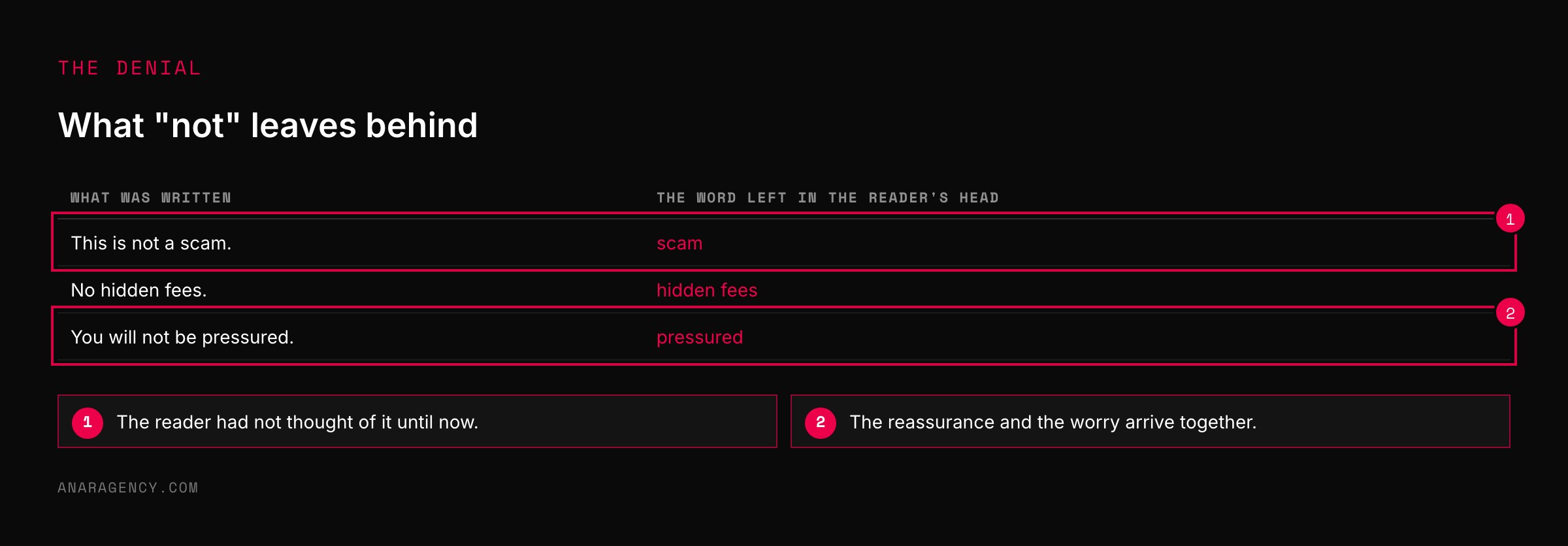
The denial. You name the bad thing in order to say you are not it. "This is not a scam."
"No hidden fees." "We are not like the others."
Minds are poor at handling a negative. Research on ironic process theory found that people told not to think of a white bear thought of it more. "Not a scam" puts the word scam in front of a reader who had not thought of it.
The contradiction. Two statements that cannot both be true. "We have never shared this method."
Then, two lines later, "which is why we are teaching it to everyone."
A reader may not spot the clash. They feel it as doubt, and doubt needs no reason to stop a sale.
Clean Writers: what they do instead
Some copy leaves you trusting the writer without knowing why. Usually nothing in it is working against itself. We call the people who write that way Clean Writers.
They say what it is. "No pushy sales call" becomes "a fifteen-minute look at your numbers." Same reassurance, no pushy.
They aim criticism at the problem, never the category. "Agencies are sharks" becomes "most reports show clicks, and you cannot pay staff with clicks." The reader's frustration is named, and nobody who resembles you is insulted.
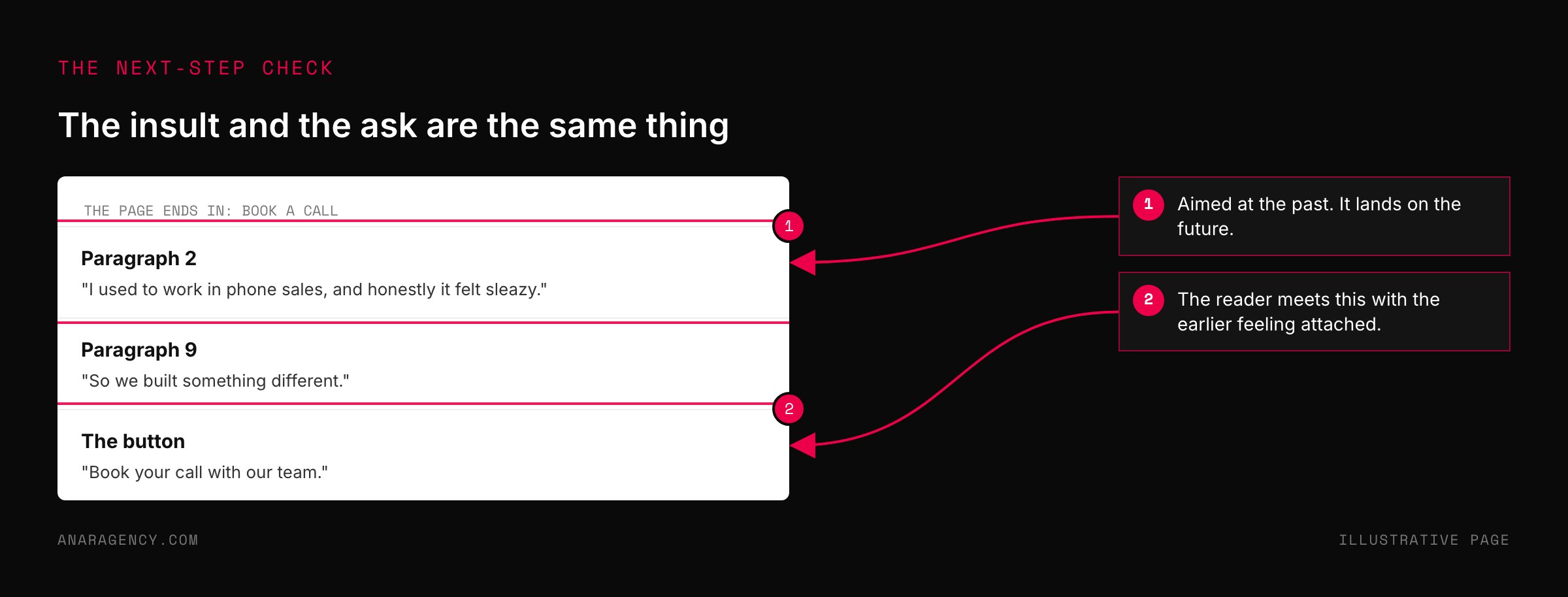
They read the page for the next step. If the page ends in a call, they check every earlier mention of calls, salespeople, and pitches. Anything negative there will be waiting for the reader when the phone rings.
They hunt contradictions. "Exclusive" beside "for everyone." "Simple" beside a twelve-step diagram.
"Limited spots" on a page that has said so for a year.
A fast way to check: search the draft for not, never, no, unlike, and without. Each one is a place where you may have named the thing you least want in the reader's head.
This is the mirror image of drawing the picture you do want them to see.
"Buyers need to know what I am against"
You may think this strips out everything with an edge. Good copy takes a side, and a side needs an enemy. That is true, and it does not conflict with any of this.
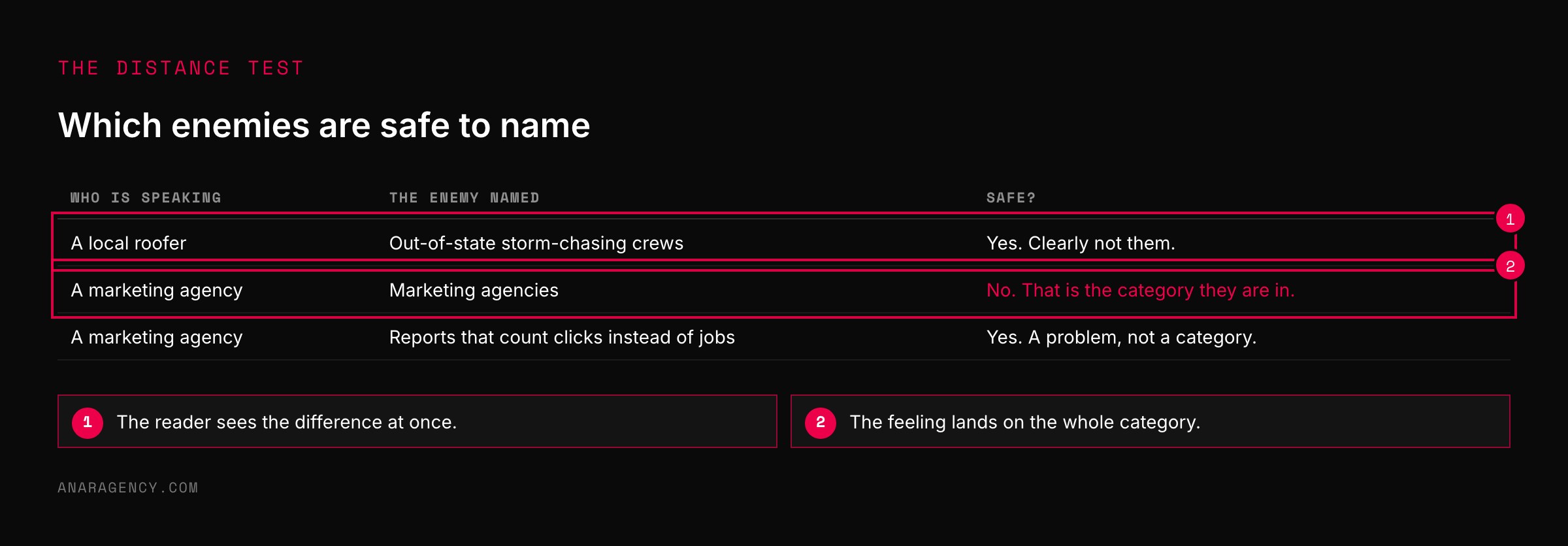
The test is distance. An enemy that is far from you is safe to name. An enemy that looks like you is not.
A local roofer can be against storm-chasing crews from out of state, because the reader can see the difference at once. A marketing agency cannot be against marketing agencies.
And some negatives are required. Disclosures, risks, and limits have to be stated plainly, and the FTC expects them to be clear and conspicuous. Word Infection is about careless negatives, not honest ones.
A stated limit builds trust. "This will not work if you cannot take calls within an hour" tells the reader you would turn away a bad fit, a point we return to in the three stop-beliefs.
What to read next, and why
Gerald Ratner (encyclopedia entry): The speech, the fallout, and why British business still uses his name as a verb.
Evaluative conditioning (encyclopedia entry): The research on how liking and disliking spread from one thing to its neighbor.
Ironic process theory (encyclopedia entry): The white bear studies. Why "do not think of it" backfires.
Affect heuristic (encyclopedia entry): How a quick feeling stands in for a judgment about risk and benefit.
So the simple takeaway is this: search your page for every not, never, and unlike. For each one, ask what word it just put in the reader's head, and whether you want it there.
Questions executives ask
What should you not say in sales copy?
Avoid insulting anything your offer resembles, such as your own industry or the kind of sales call you will ask for. Avoid naming the bad thing you are not, as in "this is not a scam." And avoid any two statements that contradict each other.
Why does "this is not a scam" hurt conversions?
Because it introduces the word scam to a reader who may not have been thinking it. Research on thought suppression suggests people handle negations poorly, so the idea stays active even though the sentence denies it.
Is it wrong to criticize competitors in marketing?
It is risky when the competitor looks like you. Readers tend to attach the negative feeling to the whole category. Criticize the problem the buyer is living with, or an alternative that is clearly different from you.
What happened with Gerald Ratner?
In a 1991 speech, the chief executive of the Ratners jewelry group joked that one of his products was "total crap." After the remarks were reported, customers stayed away and the company's value fell by around 500 million pounds.
How do I check my copy for negative associations?
Search the draft for not, never, no, unlike, and without, and rewrite each as a positive statement of what the offer is. Then read every mention of the next step you ask for, and remove anything negative attached to it.

Filip Kovacevic is the founder of Anar Agency in Phoenix. He spent five years running SEO, Meta ads, email, and content for medical practices across the United States, and now does the same work for healthcare, home-service, legal, and professional-service businesses, alongside AI implementation. More from Filip →
Talk it through in 15 minutes
Bring one AI question from this article. We will tell you what we would do, whether or not you hire us.
Book a 15-Min Chat →