CMO vs CRO: The Zigzag Revenue Diagnostic

A CMO owns marketing. A Chief Revenue Officer owns all revenue and aligns marketing, sales, and customer support. CRO can also mean conversion rate optimization, the detailed work of improving one step of a funnel.
To know which you need, chart twelve months of revenue. If it zigzags, with large swings month to month, the problem is usually macro: teams, incentives, and handoffs that do not line up, which needs someone who owns the whole chain. If it is flat and low, the problem is usually micro: a step that converts poorly, which needs conversion work.
Two titles, three meanings
Ask five owners what a CRO is and you may get two answers. Some mean a person, and some mean a kind of work.
A Chief Revenue Officer is an executive responsible for all revenue generation, aligning marketing, sales, customer support, pricing, and revenue management.
Conversion rate optimization, also shortened to CRO, is the practice of improving the share of visitors who take an action on a page or at a step.
A Chief Marketing Officer owns marketing: the market, the message, the brand, and the demand that feeds sales.
Two of these are roles that look at the whole business. One is detailed work on a single step. Hiring the wrong one can cost a year.
Macro and micro
The useful split is not marketing versus revenue. It is macro versus micro.
Macro work decides the shape of the whole system. Which market, which offer, how advertising, marketing, and sales hand work to each other, and what each team is paid to achieve.
Micro work improves one part inside that shape. A headline, a form, an email, a step in the sales call.
The macro sets the limits for the micro. No amount of button testing fixes a sales team paid to close deals the marketing team was never asked to attract.
And the micro informs the macro. A steady stream of small wins, or small failures, tells the people at the top where the system is weak.
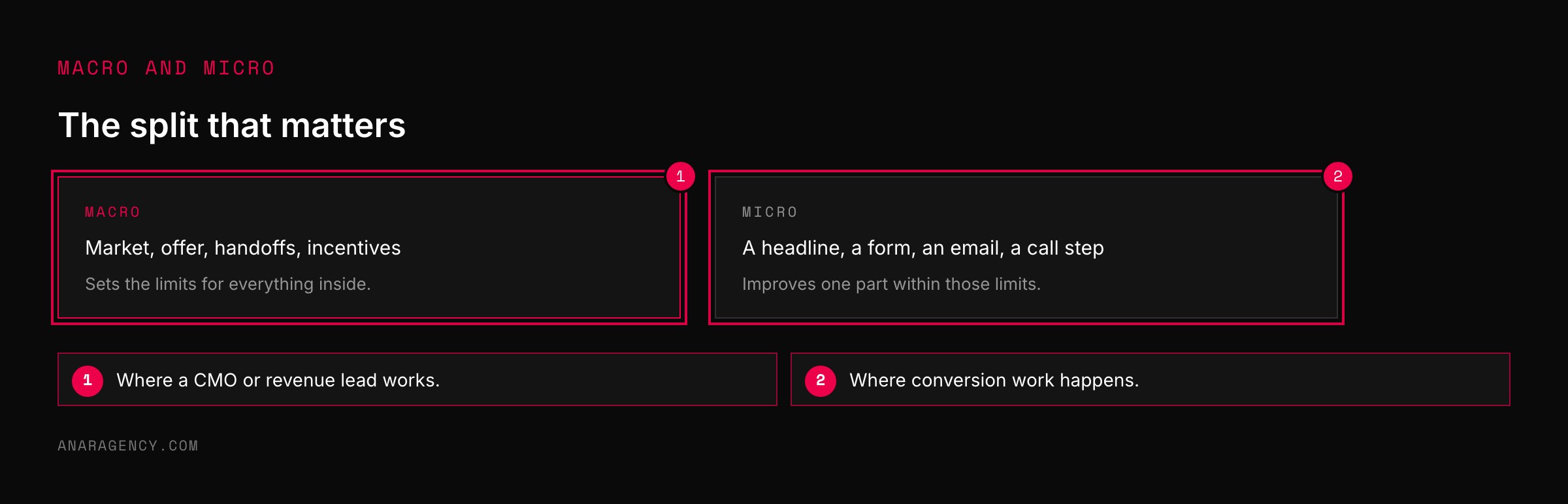
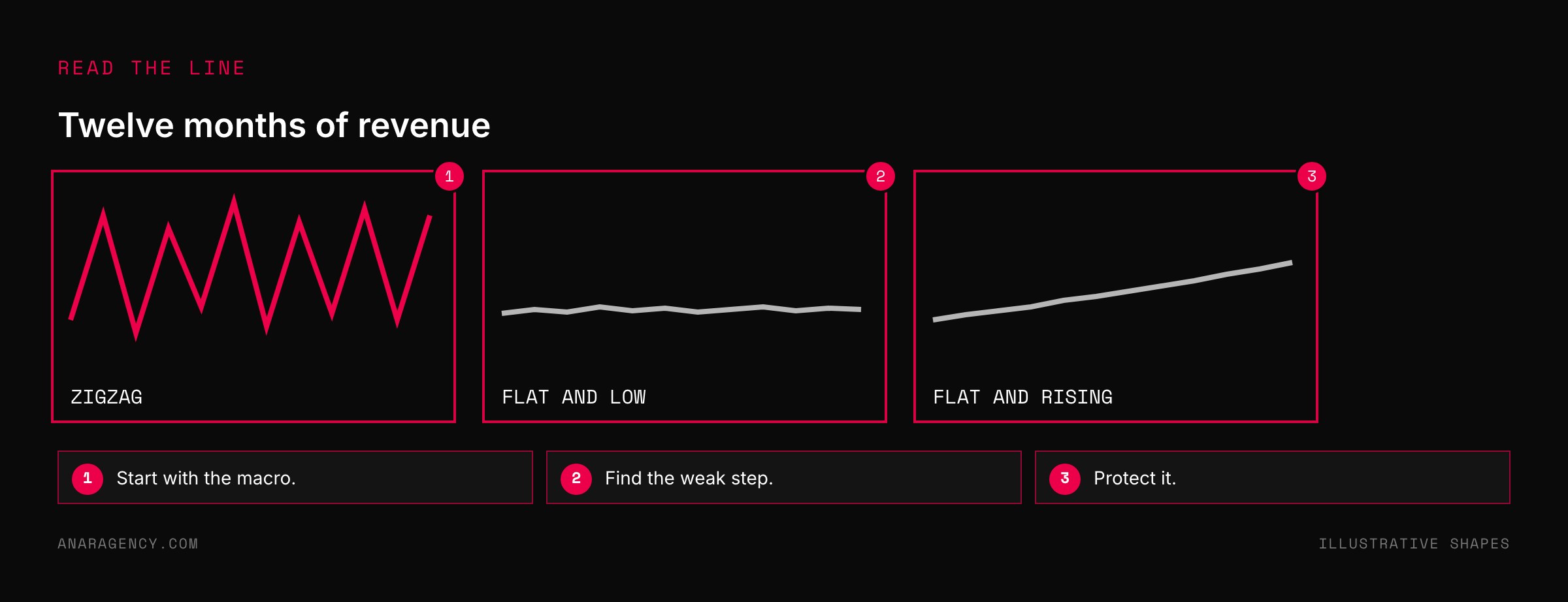
Chart twelve months of revenue. A zigzag, with large non-seasonal swings, usually signals a macro problem: stages without owners, teams paid on conflicting numbers, and handoffs nobody sees, which needs a Chief Revenue Officer, a CMO with authority over sales, or an owner doing that job. A flat, low line usually signals a micro problem: one step converting poorly, which needs conversion rate optimization.
A flat, rising line needs protection and one improvement at a time.
The zigzag diagnostic
Pull your monthly revenue for the last twelve months and draw it as a line. The shape tells you where to start.
A zigzag, with big swings up and down, usually means a macro problem. Leads arrive in bursts, sales cannot keep up, follow-up stops when the team is busy, and the next month is empty.
A flat, low line usually means a micro problem. The system runs steadily but one step leaks: few visitors book, few bookings show, or few shows buy.
A flat, rising line means the system works. Protect it, and improve one step at a time.
Our rule of thumb: if months regularly swing more than about a quarter above or below your average, and it is not a known seasonal pattern, start with the macro.
What owners are really buying from a CMO or a Chief Revenue Officer is the flat line. Predictable revenue gives them their time back.
Why the zigzag happens: incentives
Most zigzags come from three teams pulling in different directions. Advertising buys attention, marketing turns it into leads, and sales turns leads into customers.
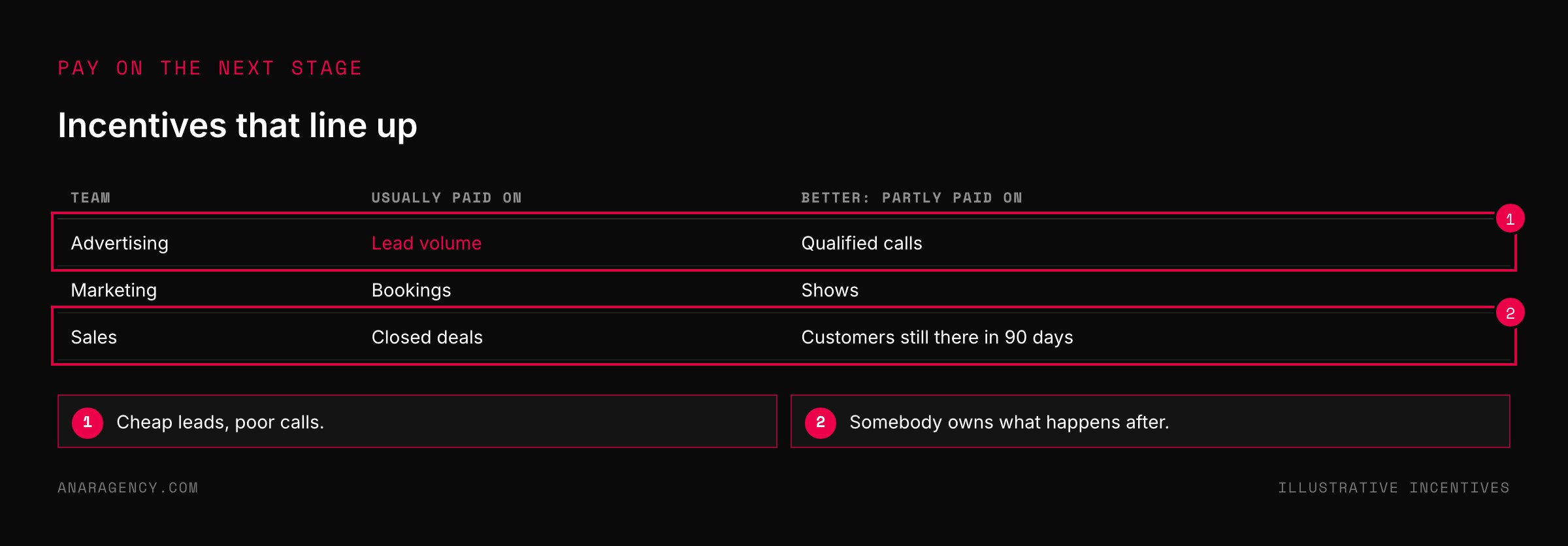
Pay each team on its own number and they optimize against each other. Ads chase cheap leads, sales complains the leads are poor, and nobody owns what happens after the sale.
Economists call a version of this the principal-agent problem: people acting for you follow their own incentives, which may differ from yours.
There is a related warning, Goodhart's law, often summed up as: when a measure becomes a target, it stops being a good measure. Cost per lead is a classic example.
The macro fix is to pay each team partly on the next team's result. Ads on qualified calls, marketing on shows, sales on retained customers.
That single change often does more for the zigzag than any campaign. For the full chain of rates, see book-a-call math.
Three questions before you hire
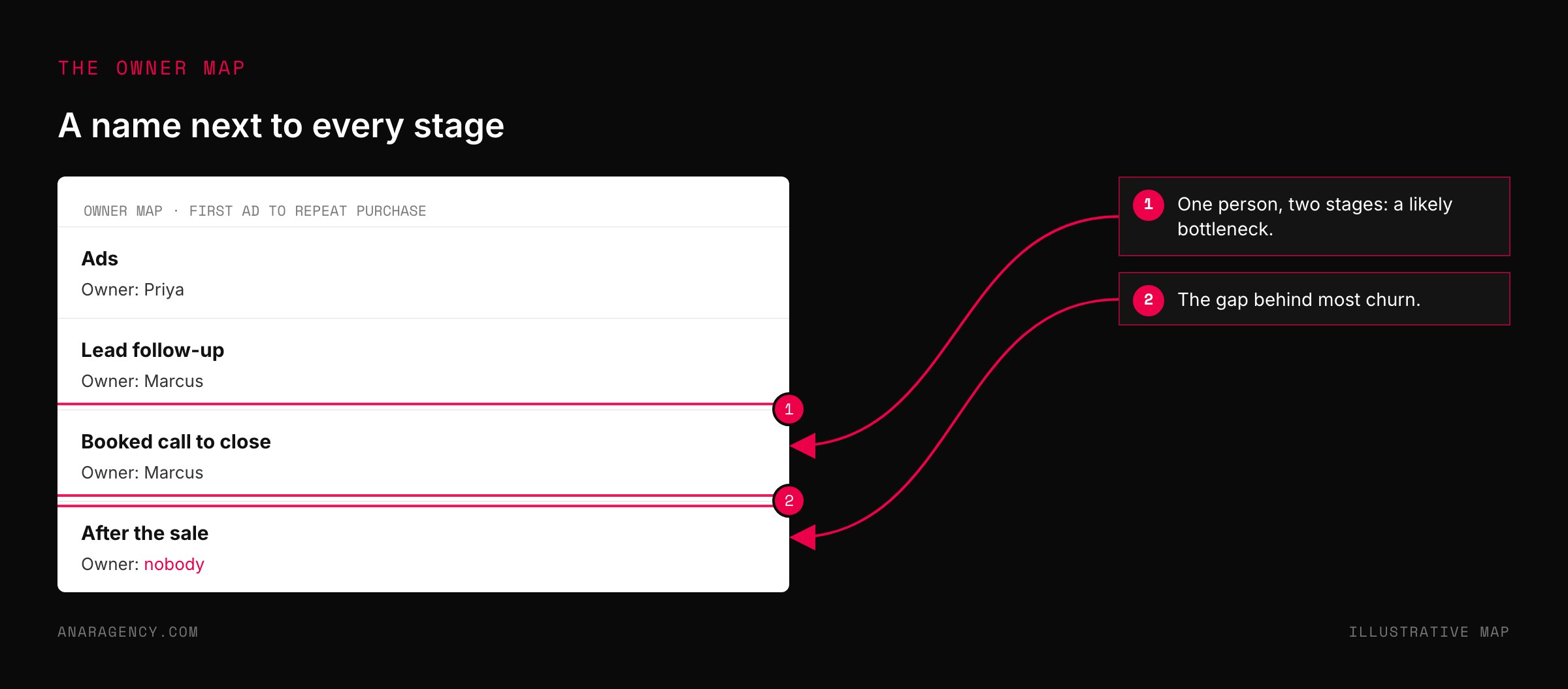
Who owns each stage? Write the stages from first ad to repeat purchase, and a name next to each. A blank is a macro gap.
What is each person paid on? If nobody is paid on what happens after the sale, expect churn. If ads are paid on lead volume, expect cheap, poor leads.
Does each team see the next team's numbers? If advertising never sees close rates, it cannot learn which leads matter.
If you find blanks and conflicts, you need macro work first, from a Chief Revenue Officer, a CMO with authority over sales, or an owner who takes that job seriously.
If every stage has an owner and the incentives line up, but one step converts poorly, you need conversion work. Start with a conversion-first audit.
"We are too small for a CMO."
You are probably too small for a full-time one. You are not too small for the job.
The macro job in a small firm can be one hour a week: look at the twelve-month line, check the three questions, and fix one handoff.
Many small firms hire this part-time, often called a fractional CMO or fractional revenue lead. What matters is authority, not the title.
A part-time lead who can change how sales is paid will fix more than a full-time marketer who cannot.
And if the line is already flat and rising, you may not need either. You may need someone to improve one step at a time.
What to read next, and why
Chief revenue officer (encyclopedia entry): What the role owns and how it aligns teams.
Chief marketing officer (encyclopedia entry): The marketing executive's remit.
Conversion rate optimization (encyclopedia entry): The detailed work the other CRO means.
Goodhart's law (encyclopedia entry): Why team targets can quietly work against each other.
So the simple takeaway is this: draw your last twelve months of revenue, and let the shape of the line decide whether you hire for the whole system or for one step.
Questions executives ask
What is the difference between a CMO and a CRO?
A Chief Marketing Officer owns marketing. A Chief Revenue Officer owns all revenue generation and aligns marketing, sales, and customer support. CRO can also mean conversion rate optimization, which is detailed work on single funnel steps.
What does CRO mean in marketing?
Usually conversion rate optimization: improving the share of visitors who take an action. In executive titles it means Chief Revenue Officer.
How do I know if I need a CMO or conversion work?
Chart twelve months of revenue. Big, non-seasonal swings point to a system problem that needs an owner of the whole chain. A flat, low line points to a weak step that needs conversion work.
Why does revenue swing month to month?
Often because leads arrive in bursts, sales cannot keep up, and follow-up stops when the team is busy, usually because teams are paid on separate numbers and nobody owns the handoffs.
Can a small business use a fractional CMO?
Yes. Many hire one part-time. What matters most is that the person has authority to change how teams work together and are paid.

Filip Kovacevic is the founder of Anar Agency in Phoenix. He spent five years running SEO, Meta ads, email, and content for medical practices across the United States, and now does the same work for healthcare, home-service, legal, and professional-service businesses, alongside AI implementation. More from Filip →
Talk it through in 15 minutes
Bring one AI question from this article. We will tell you what we would do, whether or not you hire us.
Book a 15-Min Chat →