Lead-First Nurture: Follow-Up That Gives Before It Asks

Lead-first nurture means every follow-up message gives the reader something useful before it asks for anything. Between a booking and a call, that is four gives and one ask: a confirmation with something to read, a story from a customer like them, a worked number, a note on what to expect, and only if they miss the call, a gentle request to rebook. It works because people return favors, because leads go cold in minutes, and because inbox providers now penalize senders whose mail gets ignored or marked as spam.
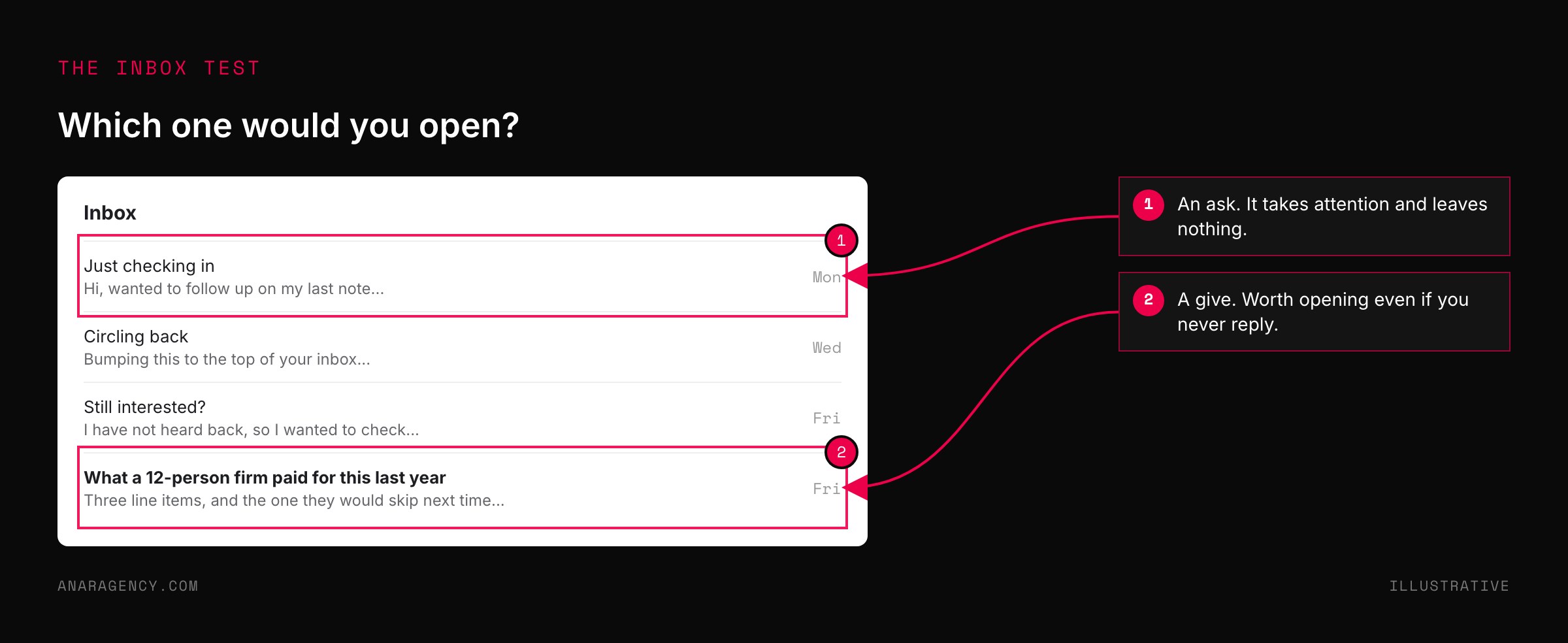
"Just checking in"
You know this email. You have received a thousand of them. "Just checking in."
"Circling back." "Wanted to bump this to the top of your inbox."
Each one is polite. Each one asks you for something, your attention, your reply, your time, and gives you nothing for it.
Now look at your own follow-up. Most businesses send exactly this to the people who raised a hand and said they were interested.
A lead is not a debt to be collected. It is a person who is still deciding. This article is about writing to that person.
Give first, then ask
The rule is one line. Every message gives the reader something before it asks for anything.
There is old research behind it. Psychologists call it reciprocity: people feel a pull to return a favor, even a small one they did not ask for.
You have felt it. Someone holds a door, and you hurry so they are not kept waiting. A shop hands you a sample, and it becomes slightly harder to walk out with nothing.
A follow-up that teaches the reader something is a small favor. A follow-up that says "are you still interested?" is a small bill.
Here is a quick test. Take any message you send and delete the call to action. Read what is left.
If nothing is left, the message was an ask.
Every follow-up message gives before it asks. Between booking and call: a confirmation carrying one useful read, a named customer's story about the same doubt, a worked number for a business their size, and a note on what to expect. Ask only once, and gently, if the call is missed.
Test each message by deleting the call to action: if nothing remains, rewrite it. Send the first one within a minute, and send fewer, better messages.
The clock, and the filter
Two outside facts make this urgent.
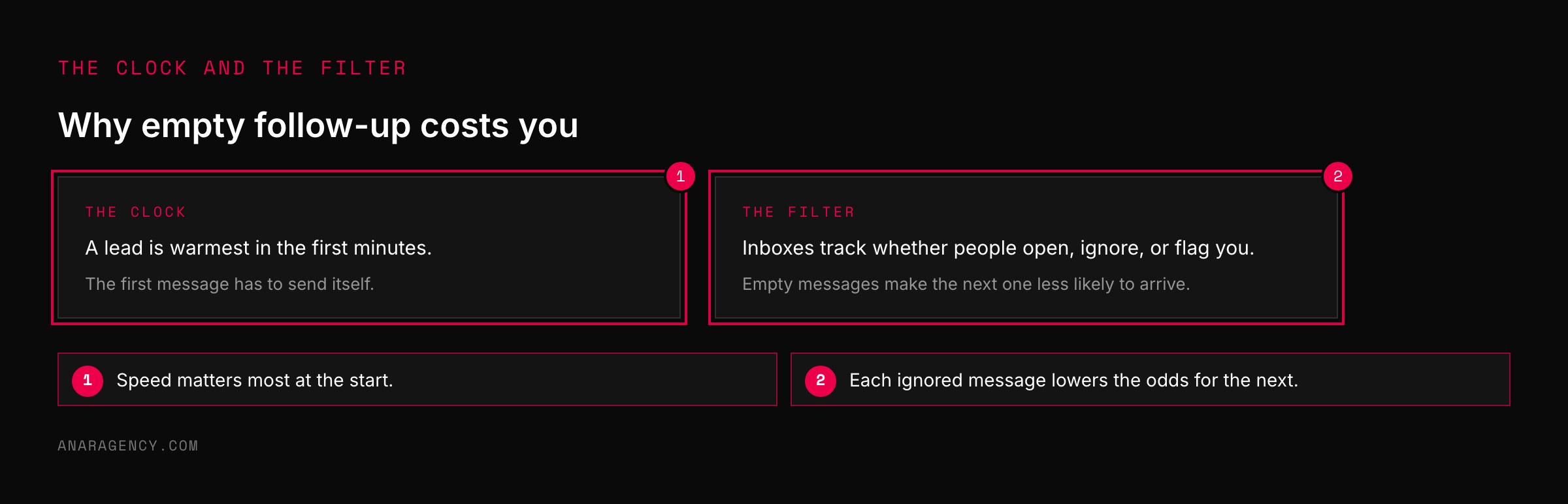
Leads go cold fast. A Harvard Business Review study of lead response found that companies that tried to reach a lead within an hour were far more likely to have a real conversation than those that waited even an hour longer. Most firms in the study took much longer than that.
So the first message cannot wait for a person to get around to it. It has to go out by itself, in the first minute, and it has to be worth opening.
Inboxes now grade you. Since 2024, Google's rules for email senders require bulk senders to keep reported spam rates low and to offer one-click unsubscribe. Mail that people ignore or flag makes the next mail less likely to arrive.
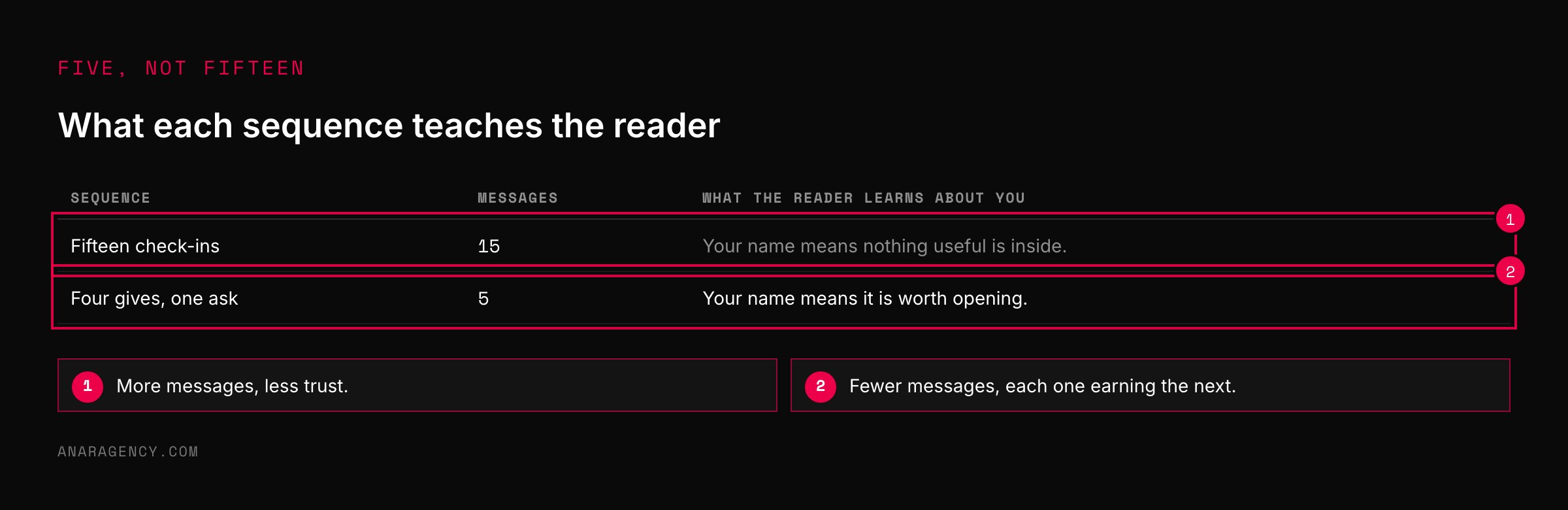
Put those together. A sequence of empty check-ins is not harmless. Each one teaches the reader, and the inbox, that your name means nothing useful is inside.
Givers: what a good sequence looks like
Some firms have show-up rates their competitors do not believe. They are not sending more reminders. They send different ones.
We call these senders Givers.
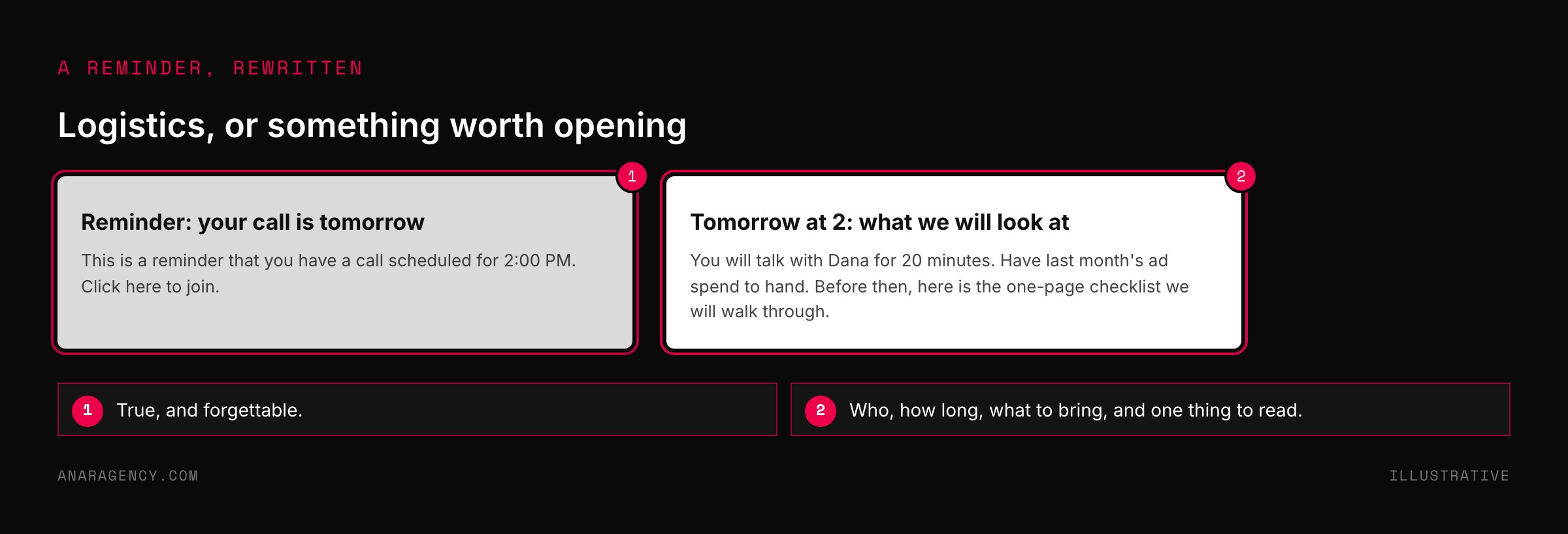
They treat the reminder as part of the product. The confirmation is not only a time and a link. It carries one thing worth reading before the call, so the reader arrives already further along.
They answer doubts with a person. The second message is a real customer who had the same hesitation, in their own words, with their name and their permission. Not a line of praise.
A story about the doubt.
They do the math for the reader. The third message is a short worked example for a business that size. It is the number the reader was going to ask about anyway.
They say what will happen. The morning of the call: who you will talk to, how long it takes, what to have ready. Uncertainty is a quiet reason people do not show.
They ask once, kindly. If the call is missed, a short human note. Did something come up?
Here is a link to pick another time. No guilt.
The numbers behind showing up, and what each point is worth, are in book-a-call math.
"If I give it all away, why would they book?"
You may be thinking that teaching people before the call leaves nothing for the call. It is the most common worry, and it has things backward.
What you can put in an email is knowledge. What people pay for is having it done, for their situation, by someone accountable.
A reader who learns something from your email does not think "now I do not need them." They think "these people know what they are doing."
There is a line, and the law draws part of it. The FTC's CAN-SPAM guide requires that commercial email be honest about who it is from and what it is, and that it give a clear way to opt out. A give that is really a disguised pitch fails the spirit of both.
And do not confuse giving with volume. Five useful messages beat fifteen thin ones. If you have nothing useful to send on day four, send nothing.
The same idea applies to the offer itself. Our piece on audits as lead magnets covers giving something real before the first conversation.
What to read next, and why
The Short Life of Online Sales Leads (research): Short and sobering. The case for sending the first message in minutes, not hours.
Reciprocity (encyclopedia entry): The research on why a small unasked favor changes what happens next.
Email sender guidelines (Google documentation): The rules your mail has to meet to reach an inbox at all. Hand it to whoever runs your email tool.
CAN-SPAM Act: A Compliance Guide for Business (FTC guide): Plain language on what commercial email must include.
So the simple takeaway is this: open your follow-up sequence and delete every call to action. Whatever still has something in it, keep. Rewrite the rest.
Questions executives ask
What is lead-first nurture?
A way of writing follow-up in which every message gives the reader something useful, such as a checklist, a customer story, or a worked example, before asking for anything. The ask comes once, late, and gently.
How many follow-up emails should I send before a sales call?
Enough to be useful and no more. A workable shape is four messages that give, sent from the minute of booking to the morning of the call, and one short note if the call is missed. Five useful messages beat fifteen thin ones.
How fast should I respond to a new lead?
Within minutes. Harvard Business Review research on lead response found that the chance of a real conversation falls sharply as time passes, and most firms studied responded far too slowly. The first message should be automatic.
Will giving away advice in emails reduce bookings?
It tends to do the opposite. An email can share knowledge, but buyers pay for having the work done for their situation. Useful messages show competence and make the reader more likely to show up.
Do follow-up emails affect deliverability?
Yes. Google's sender guidelines require bulk senders to keep reported spam rates low and to provide one-click unsubscribe. Messages people ignore or flag make later messages less likely to reach the inbox.

Filip Kovacevic is the founder of Anar Agency in Phoenix. He spent five years running SEO, Meta ads, email, and content for medical practices across the United States, and now does the same work for healthcare, home-service, legal, and professional-service businesses, alongside AI implementation. More from Filip →
Talk it through in 15 minutes
Bring one AI question from this article. We will tell you what we would do, whether or not you hire us.
Book a 15-Min Chat →