All Content Is About Change
Every piece of content that gets read is a report of a change. Something in the world, in what you did, in what you think, or in what happened to a customer is different from what the reader assumed. News is literally that, and the most followed people online are the ones who reliably tell you what changed.
So a content engine for a small business is not a calendar of topics. It is a weekly habit of finding one change in each of four places, opening each piece from one of six questions, varying the length in a wave, and asking for something at most one time in twenty.
Why the feed rewards change and ignores everything else
The word news tells you what it is: what is new, what changed. People read it to feel safe, because knowing what changed is how you avoid being surprised by it.
The same instinct decides what gets read on a feed. A post that reports a change, a platform rule, a test result, a belief revised, a customer's before and after, gets attention. A post that reports something that stayed the same, your services, your values, a tip everyone already knows, is wallpaper, however well it is written.
The platforms are built around that instinct. Meta's own description of how its feed is ranked and its earlier explanation of how the feed predicts what you want come down to predicted engagement, and engagement follows novelty.
TikTok's account of how it recommends videos and YouTube's performance guidance say the same thing in their own words. None of them rank for "consistent brand messaging." They rank for what people stop on, and people stop on difference.
This is stable, not a trend, and there is a reason. Minds habituate: a stimulus repeated stops registering, which is why you stop hearing the refrigerator. The pattern is documented as habituation, and a feed is a habituation machine.
The only thing that cuts through is a change the reader did not expect, framed so they can see what it means for them. Journalism worked this out a century ago and wrote it down as news values. The list still works.
Four places to find the change every week
So where do the changes come from when you are a business and not a newsroom? Four places, and between them they produce more than a week can use.
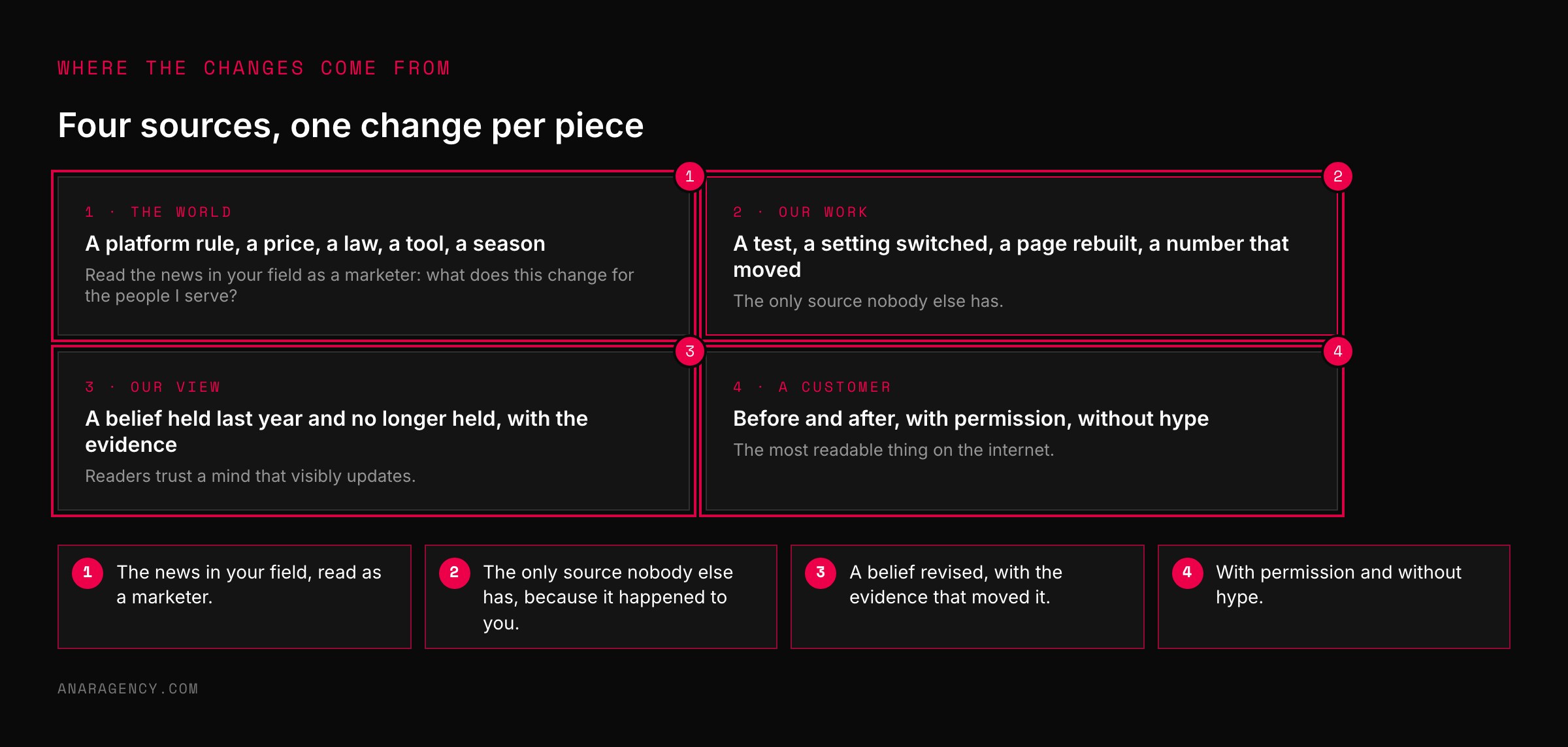
The first is the world: a platform rule, a price, a regulation, a tool, a season. Read the news in your field as a marketer and ask what it changes for the people you serve. The second is your own work: a test you ran, a setting you switched, a page you rebuilt, a number that moved.
This is the only source nobody else has, because it happened to you.
The third is your own view: a belief you held last year and no longer hold, with the evidence that moved it. Readers trust a mind that visibly updates far more than one that is always certain. The fourth is a customer: a before and after, with permission and without hype.
The shape of a change someone else went through is the most readable thing on the internet.
One change per piece. The failure is the post with three changes and no meaning, or the post that explains the thing instead of the change.
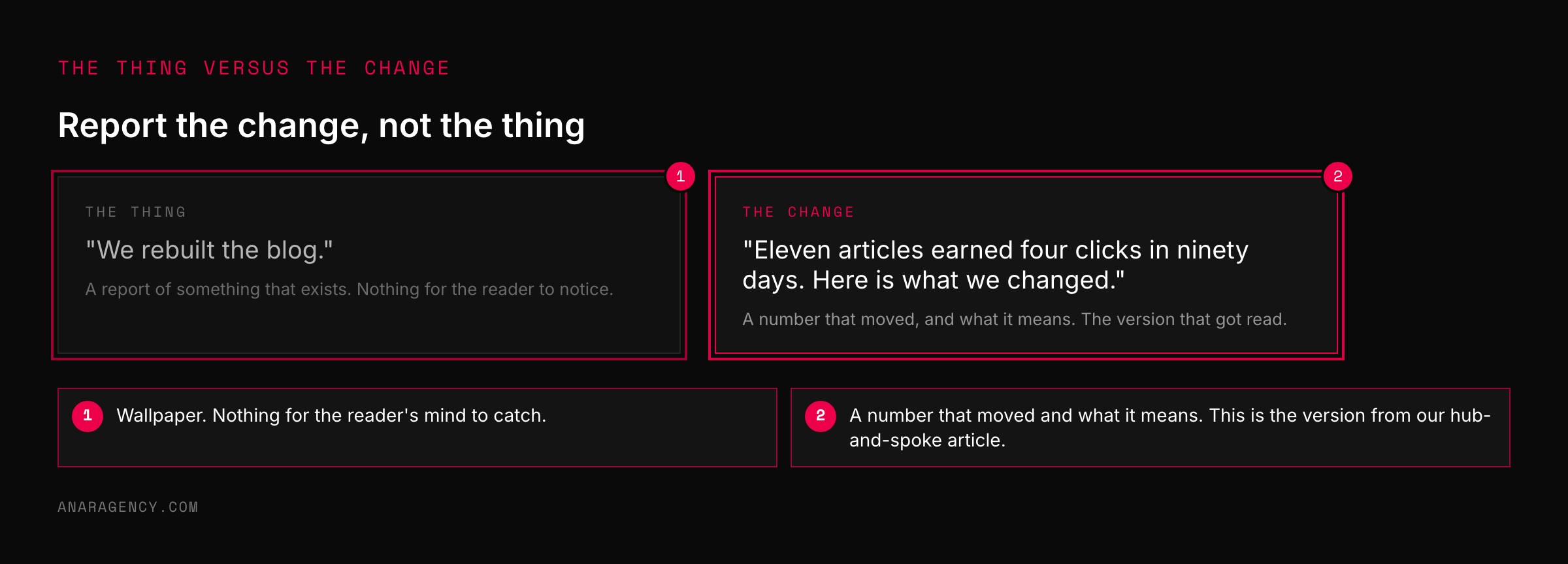
"We rebuilt the blog" is a thing. "Eleven articles earned four clicks in ninety days, and here is what we changed" is the change, and it is the version that got read. Our article on hub-and-spoke SEO is that post, and it opens with the number because the number is the change.
Every piece reports one change: in the world, in what you did, in what you think, or in what happened to a customer. Open from one of six questions, what, why, when, how, who, where, and use at least three, with what first and how last. One pillar a week becomes twenty pieces.
Vary length in a wave: short, medium, medium, long. Ask for something at most one time in twenty. Collect changes in a running list; do not sit down to invent.
Six openings, and the rule of three
Every piece starts from one of six questions, and each question opens a different door in the reader's mind.
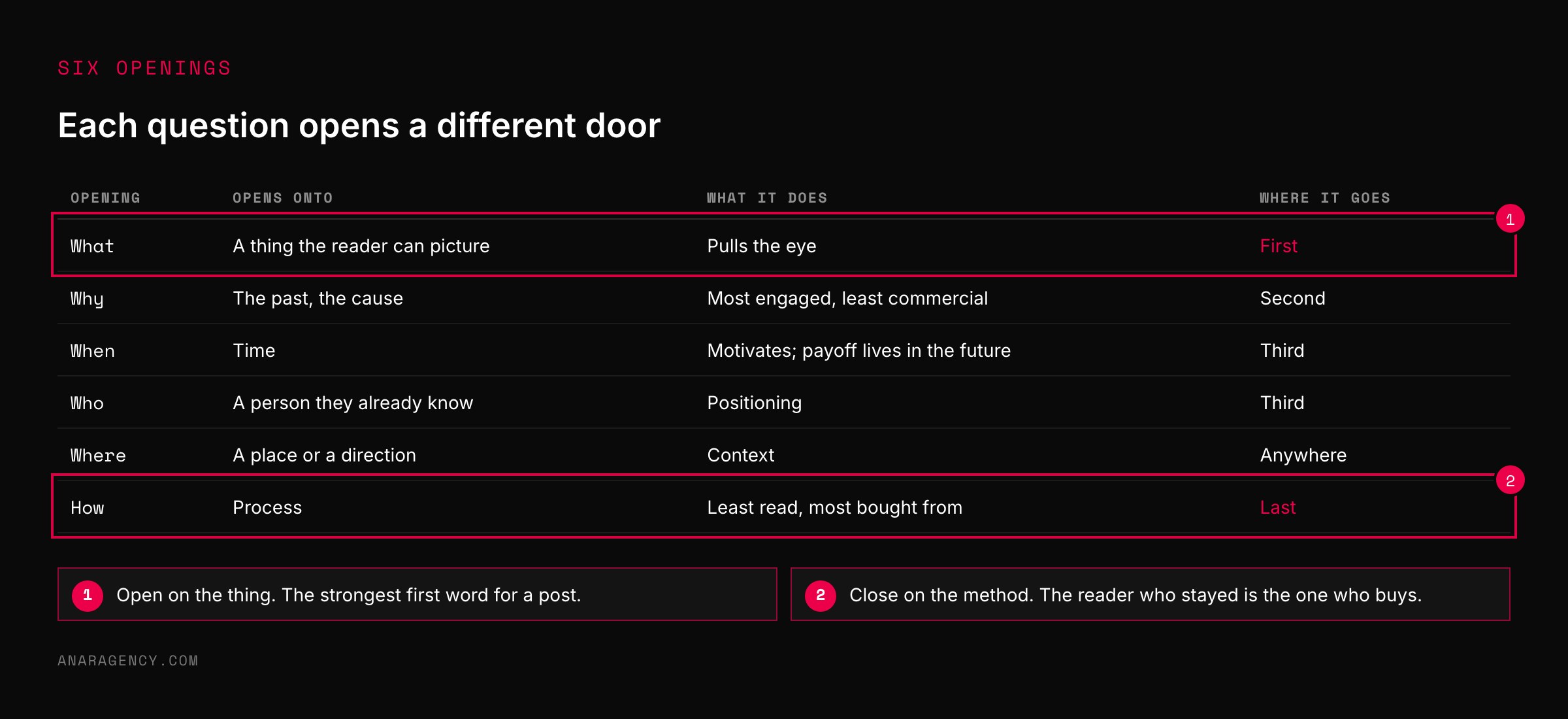
What opens onto a thing the reader can picture, which is why it is the strongest first word for a post. Why opens onto the past and the cause. It is the most engaged of the six and the least commercial, because readers linger on causes and rarely buy from them directly.
When opens onto time and motivates, because every payoff lives in the future.
How opens onto process. It is the least read and the most bought from, and it belongs at the end, where it completes the loop for the reader who stayed. Who opens onto a person the reader already recognizes.
Where opens onto a place or a direction.
A piece needs at least three of the six, and the order matters. Our default is what, then why, then who or when, then how: open on the thing, give the cause, place it in time or next to a name, close with the method.
Open on how and only the already-convinced read on. Open on why and the post reads as a lecture. Open on what and the reader can see it.
The rule of three exists because readers fill gaps. A post with a what and a how but no why leaves the reader to supply the cause, and they supply whichever one keeps them comfortable, which is usually "this does not apply to me." A post with a why and a when but no how leaves them motivated with nowhere to go.
Three of six is the minimum that keeps the reader inside the piece instead of finishing it in their own head. Nielsen Norman's research on how little people read is the other half of the argument: they read a fraction of the words, so the three questions have to be answered in the lines they actually see.
The engine: one pillar, twenty pieces, a wave
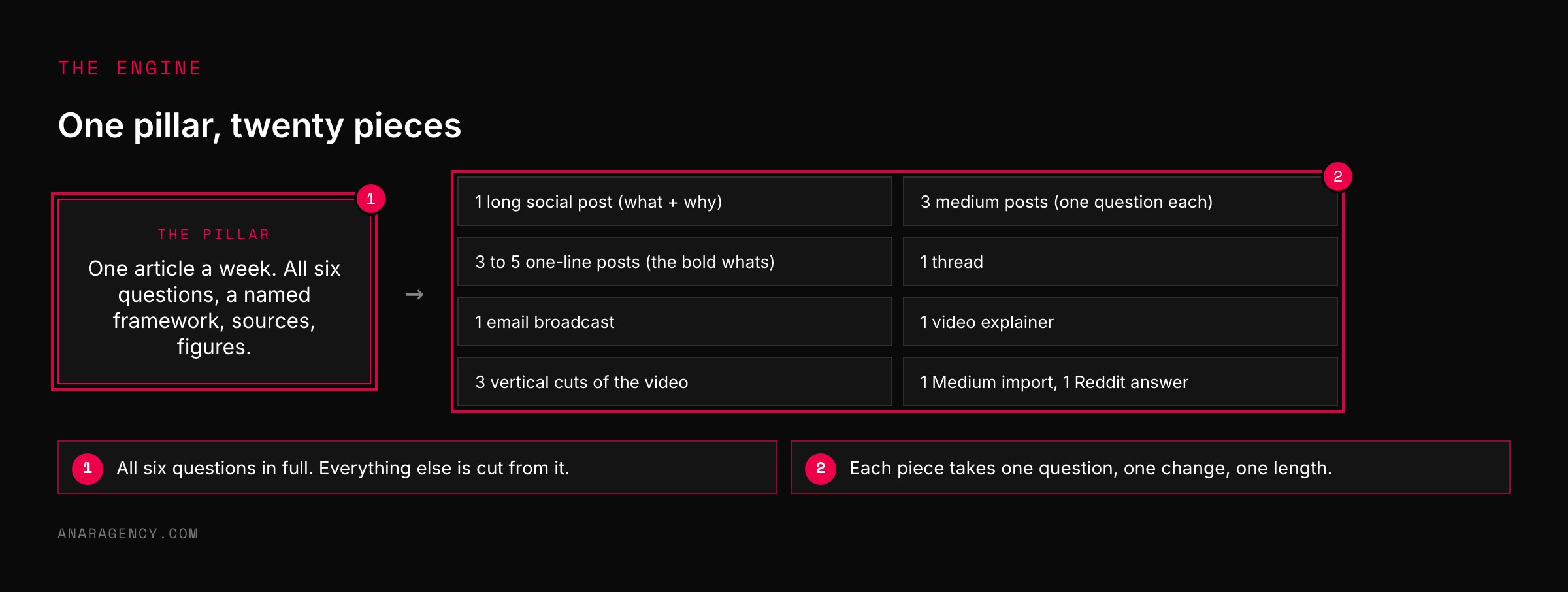
A content engine is not a calendar of topics. It is a habit with a fixed shape, and ours is one pillar article a week that becomes twenty pieces.
The pillar carries all six questions in full, with a named framework, sources, and figures. Everything else is cut from it: one long social post from the what and the why, three medium posts that each take one question, three to five one-line posts that are the bold what statements, a thread, an email, a video explainer and three vertical cuts of it.
The pillar is written once and read twenty ways.
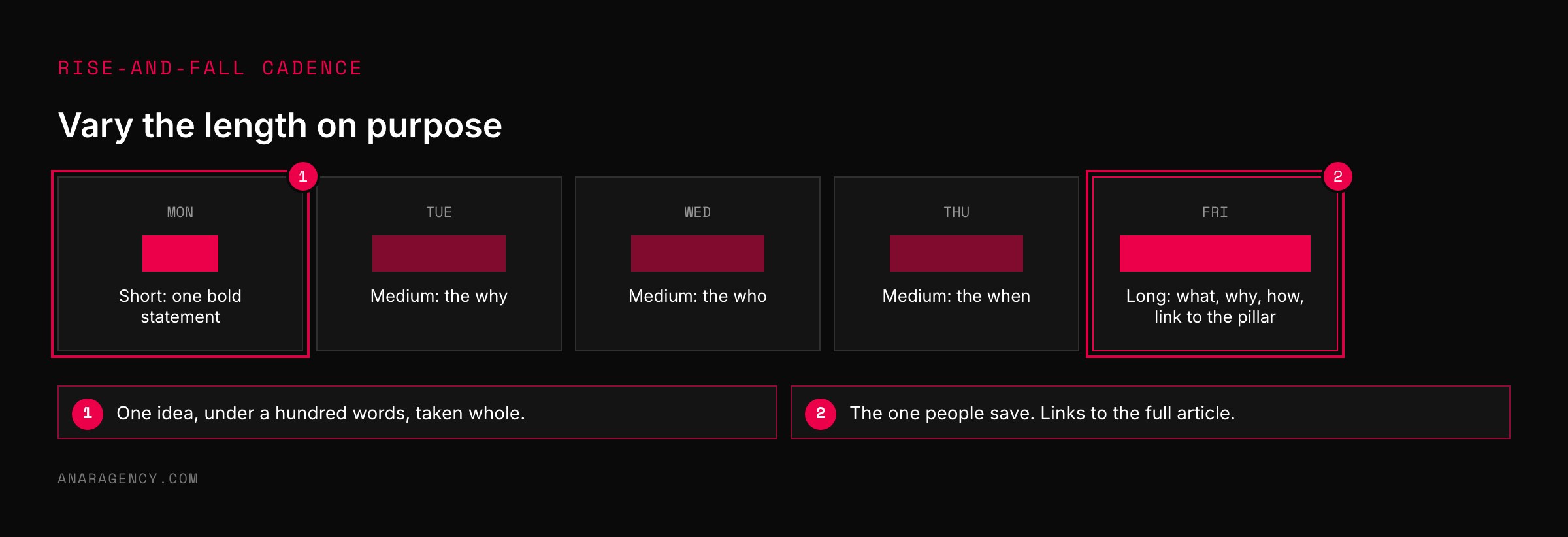
Length is varied on purpose, in a wave. One short post, two or three medium, one long, then again. A feed of long posts gets saved for later and never read.
A feed of short posts never earns the depth that makes someone cite you.
The wave gets both: the short post is read whole, and the long post is read by the people the short one convinced. Google's guidance on helpful content applies the same test to the pillar: would a reader who found it be glad they did.
And the engine runs on time. Write about what changed in the past, what is changing now, and what will change next, and the supply is infinite, because the one thing readers never stop being attached to is time. The same test, the same setting, the same customer story can be told as a past change, a present one, and a future one, and each is a different piece.
The promotion cap
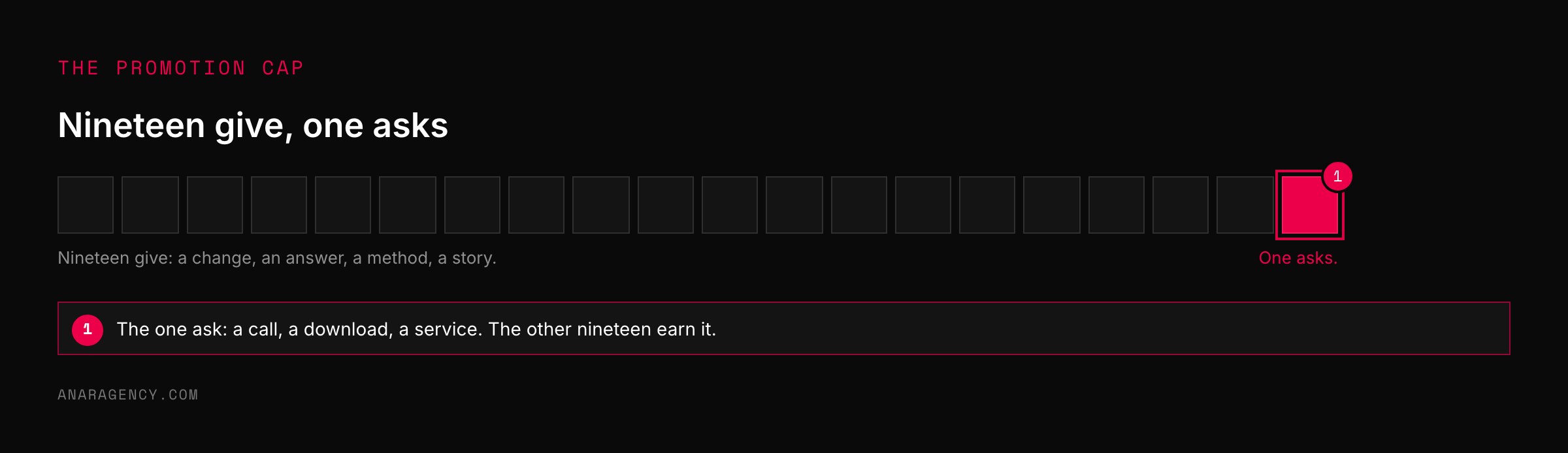
An organic audience can be sold to, but not often, and the limit is lower than most people assume. Our rule is one piece in twenty.
The other nineteen give: a change, an answer, a method, a story. The one asks: a call, a download, a service.
Cross that line and two things happen. The audience learns that your posts are pitches and stops opening them, and the platform, reading the drop in engagement, stops showing them. Neither comes back quickly.
The cap is also why the follower count is a vanity number. Reach is what matters, and reach on any platform is a small fraction of followers, so the audience that actually sees a given post is far smaller than the number on the profile.
Pew's social media and news fact sheet and the Reuters Institute's Digital News Report both track how people actually encounter content on these platforms, and the picture is of audiences that are easy to lose and slow to rebuild. Sell to the small slice that sees you, and you have sold to the whole audience you really have.
The honest version of the cap: it is not a trick to extract more later. It is the price of being the source people check. Being the one who reliably says what changed, without asking for anything, is what turns a feed into a following, and a following into the only kind of attention that compounds.
The attention economy is a crowded one. The scarce thing is a source worth returning to.
Collect, do not invent
The last rule saves you the most time. Do not sit down to invent content. Collect it.
The changes are already happening: in the test results, in the client calls, in the thing you said on a call last Tuesday that made someone write it down. Keep a running list, one line per change, and the week's pieces are already there when you open it.
Our own engine runs on this. Every article in this library started as a line in a list, a number that moved or a belief that did, and the writing was the last step, not the first.
Two practices make the list fill itself. First, write down any sentence you say twice in a week. If two different people needed to hear it, so does the feed.
Second, read your own numbers weekly, because a number that moved is a change with evidence attached, and evidence is what separates a post from an opinion.
Familiarity helps too. People warm to what they have seen before, a pattern known as the mere-exposure effect, which is the argument for showing up on a schedule even when a given post is small.
If the list is empty, the problem is not writing. It is that nothing changed this week that you noticed, and the fix is to run a test, switch a setting, or ask a customer what is different now. Content follows work.
It does not replace it.
Questions executives ask
What should a small business post about?
What changed. A platform rule or price in your field, a test you ran and what it showed, a belief you revised and why, or a customer's before and after. One change per piece, framed so the reader can see what it means for them.
Posts about things that stayed the same, your services, your values, get scrolled past.
How often should a business post on LinkedIn?
Most working days, in a wave of lengths: one short post, two or three medium, one long, then repeat. The pieces come from one pillar article a week, cut into about twenty parts, so the schedule costs one writing session rather than five.
How do I come up with content ideas every week?
Stop inventing and start collecting. Keep a running list of changes: numbers that moved, settings you switched, sentences you said twice, things customers told you. Read your own data weekly.
If the list is empty, run a test; content follows work.
How often can I promote my services to my audience?
About one piece in twenty. The other nineteen give something: an answer, a method, a change, a story. Sell more often than that and the audience learns your posts are pitches, engagement drops, and the platform stops showing them.
Why do my long posts get saved but not read?
Because every post is long. A feed of long posts trains readers to save for later and never return. Vary the length so short posts get read whole and earn the attention the long ones need.

Filip Kovacevic is the founder of Anar Agency in Phoenix. He spent five years running SEO, Meta ads, email, and content for medical practices across the United States, and now does the same work for healthcare, home-service, legal, and professional-service businesses, alongside AI implementation. More from Filip →
Talk it through in 15 minutes
Bring one AI question from this article. We will tell you what we would do, whether or not you hire us.
Book a 15-Min Chat →