Promo Calendars and the Catalog Model

A promo calendar maps your customer's year: for each month, the problem they will face, the product in your catalog that solves it, and the style of content that carries it. Win the customer with one front-door product, then use the calendar to offer the next right product at the moment it is needed. Promotions need a reason, not a holiday, and every discount must be genuine.
To decide how hard to push, estimate what a subscriber is worth: revenue per email per subscriber divided by the unsubscribe rate per email.
A shopping day invented from nothing
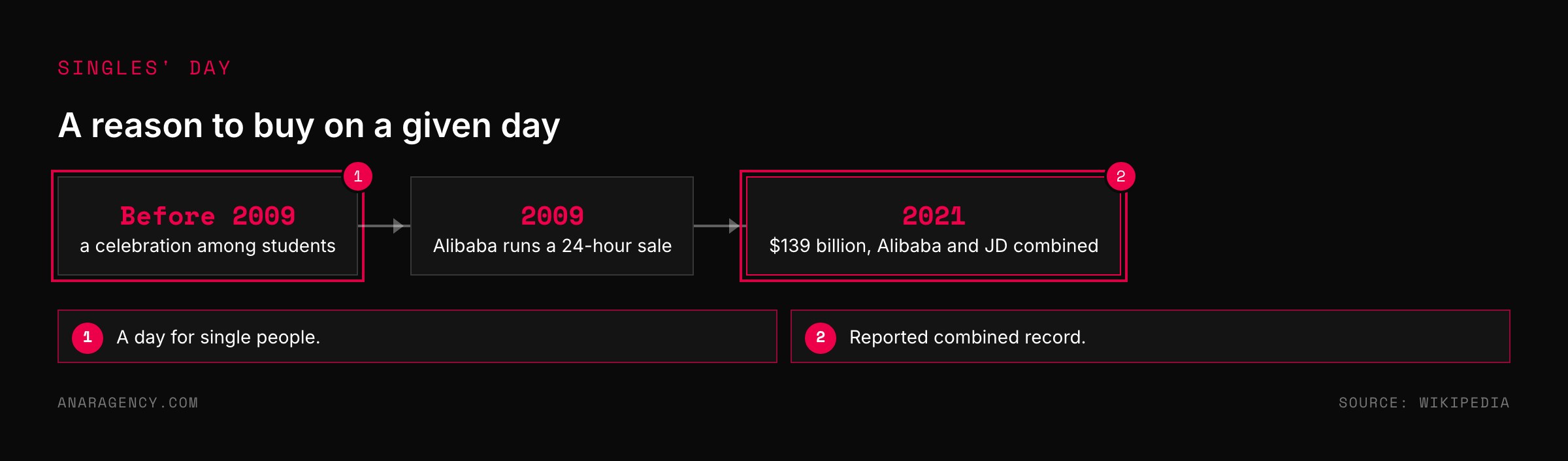
November 11 began as an informal celebration among Chinese college students. Singles' Day was a day to celebrate being unattached.
In 2009 Alibaba began using the date as a 24-hour shopping event with online discounts. It grew into the largest shopping day in the world.
In 2021, Alibaba and JD reported a combined Singles' Day sales record of $139 billion.
Nobody needed a traditional holiday. They needed a reason for buyers to act on a particular day, and they made one.
Your business can do the same on a smaller scale. Not by inventing holidays, but by planning a reason for each month.
One front door, then a catalog
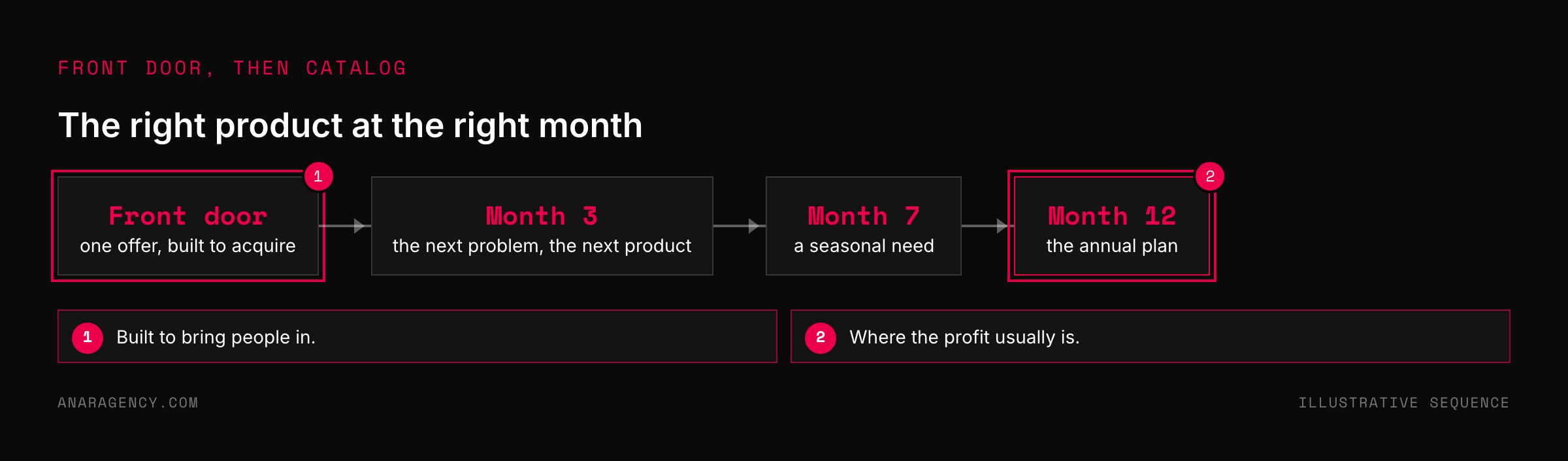
Most service and product businesses win a customer with one offer. A first job, a starter product, an entry package.
That front-door product is built to bring people in at a cost you can afford. It is rarely where the profit is.
The profit is in what comes next: the catalog. Related products and services the same customer will need later.
The mistake is offering the whole catalog at once, or offering it at random. A customer who just bought a roof inspection does not need a gutter clean the next morning.
So the question becomes timing. When will each customer need each thing? For the front door itself, see straight to the quiz, then the catalog.
Win customers with one front-door product, then sell the catalog on a calendar. For each month, write the problem the customer will face, the product that solves it, and the content style that carries it: a twelve-row messaging matrix. Promotions need a reason, not always a discount, and every discount must be genuine.
Estimate a subscriber's value as revenue per email per subscriber divided by the unsubscribe rate, and let it set how hard you push and what you can pay for a subscriber.
Map the customer's year
Take a calendar and go month by month. For each month, write three things.
The problem. What will your customer be dealing with that month? Season, tax deadlines, school terms, weather, year-end budgets.
The product. Which item in your catalog solves that problem?
The content style. How will you carry it: quick tips, a case study, a how-to, a list of common mistakes.
That grid is a messaging matrix. Twelve rows, and you never again sit down on the first of the month wondering what to send.
Retail already runs on this. Black Friday and back-to-school are calendar rows that every shopper expects.
What one subscriber is worth
Before you decide how often to promote, know what a subscriber is worth. The estimate takes four numbers.
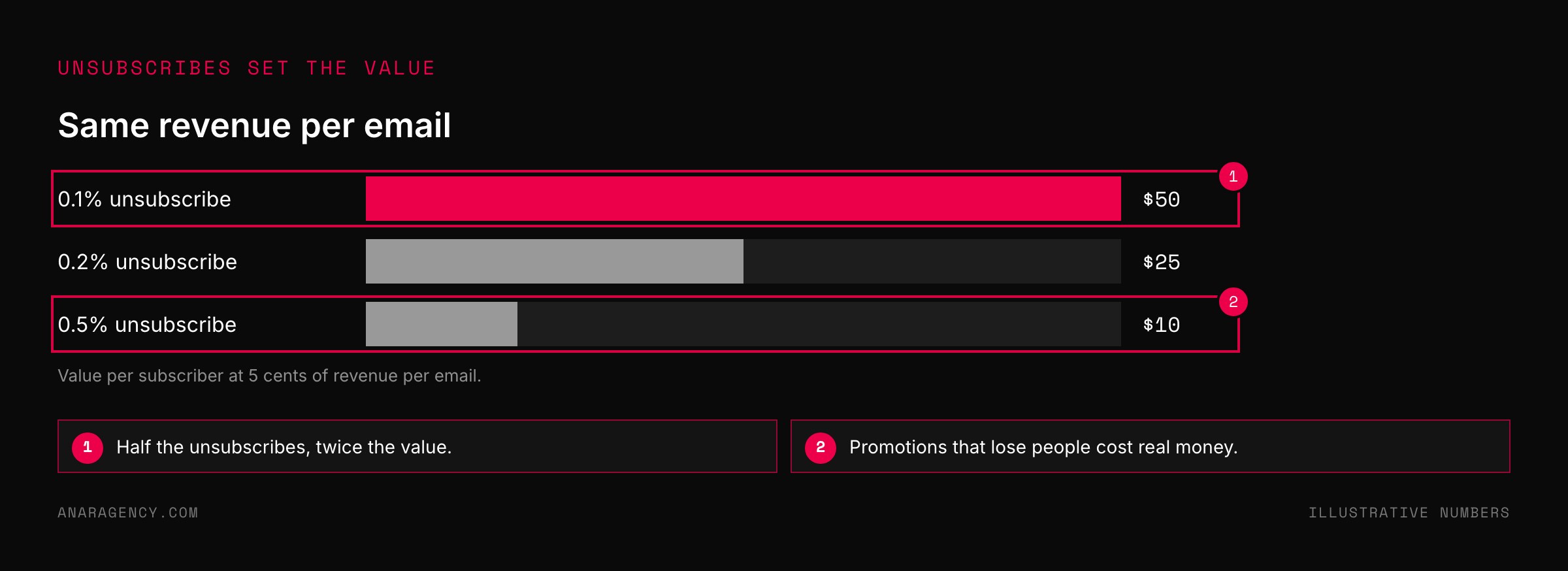
Revenue per email, per subscriber. Your unsubscribe rate per email. One divided by the unsubscribe rate gives the number of emails the average subscriber receives before leaving.
Multiply the two, and you have a rough value per subscriber. With illustrative numbers of 5 cents per email and a 0.2 percent unsubscribe rate, that is 500 emails and $25.
Two things follow. A higher unsubscribe rate shrinks the value fast, so every promotion has to be worth the people it loses.
And it tells you what you can pay for a subscriber. If one is worth $25, a $4 sign-up cost is cheap even before the first sale. The broader idea is customer lifetime value.
"Won't constant promotions train people to wait for discounts?"
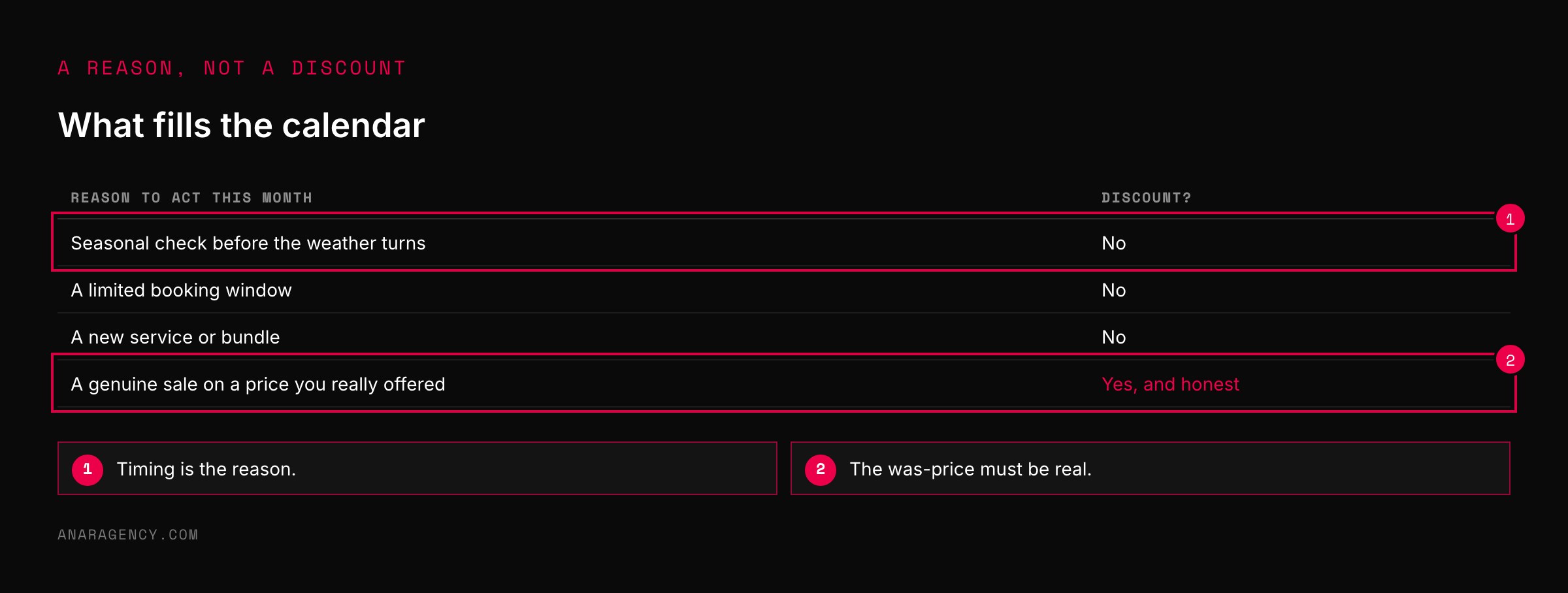
They will, if every row on the calendar is a discount. Most rows should not be.
A calendar promotion is a reason to act, not necessarily a lower price. A seasonal check, a limited booking window, a new service, or a bundle can all be the reason.
When you do discount, make it real. US rules on deceptive pricing say a "was" price must be one you genuinely offered to the public, in good faith, for a reasonably long period.
Keep the useful emails between the promotions. Gmail asks senders to keep spam complaints below 0.3 percent, and a list that only hears offers will cross that line.
For how often to ask at all, see the promotion cap.
Building the matrix from your own data
You do not have to guess which month each problem arrives. Most businesses already hold the answer in two places.
Your own sales by month. Export two or three years of orders or enquiries and line them up by month. The peaks and dips are your customers telling you when they feel each problem.
Search interest by month. Google Trends shows how interest in a term rises and falls over the year, relative to its own peak. Type in the problems you solve and look for the yearly wave.
Put the two side by side. When search interest starts rising a few weeks before your sales peak, that gap is when your promotion should go out.
Then fill the rows. Write the problem in the customer's own words, the product that solves it, and one content style you have not used recently.
Leave a few rows deliberately quiet. A month with only useful content and no offer is a deposit that makes the next row work.
Review the matrix every quarter. Note which rows produced sales, which produced nothing, and which produced unsubscribes.
After a year you will have a calendar built from evidence, not habit. Most businesses never get there, because they plan each month on the first day of it.
Start with three rows instead of twelve. The next three months are enough to prove the method.
What to read next, and why
Singles' Day (encyclopedia entry): How a student celebration became the biggest shopping day in the world.
Guides Against Deceptive Pricing (US federal regulation): What makes a discount claim honest.
Customer lifetime value (encyclopedia entry): The fuller version of the subscriber math.
Black Friday (encyclopedia entry): A calendar row every shopper already knows.
So the simple takeaway is this: write twelve rows, one per month, with the problem, the product, and the content style, and send the first row next week.
Questions executives ask
How do I build an email promotion calendar?
Go month by month and write the problem your customer will face, the product that solves it, and the content style you will use. Twelve rows give you a year of promotions with a reason behind each one.
What is the catalog model?
Win the customer with one front-door product built for acquisition, then offer related products from a catalog at the moments the customer needs them.
How much is an email subscriber worth?
A simple estimate is revenue per email per subscriber divided by the unsubscribe rate per email. With 5 cents per email and a 0.2 percent unsubscribe rate, a subscriber is worth about $25.
Do promotions need to be discounts?
No. A seasonal service, a limited booking window, a bundle, or a new product can each be the reason to act. When you do discount, the reference price must be genuine.
How did Singles' Day start?
It began as an informal celebration among Chinese college students, and in 2009 Alibaba began using the date as a 24-hour online shopping event.

Filip Kovacevic is the founder of Anar Agency in Phoenix. He spent five years running SEO, Meta ads, email, and content for medical practices across the United States, and now does the same work for healthcare, home-service, legal, and professional-service businesses, alongside AI implementation. More from Filip →
Talk it through in 15 minutes
Bring one AI question from this article. We will tell you what we would do, whether or not you hire us.
Book a 15-Min Chat →