Traffic Is Never the Problem: A Conversion-First Audit

When a business says it has a traffic problem, it almost always has a conversion problem wearing a traffic costume. Traffic is for sale to anyone with a credit card. What cannot be bought is a system that turns a click into a customer and a customer into a bigger customer.
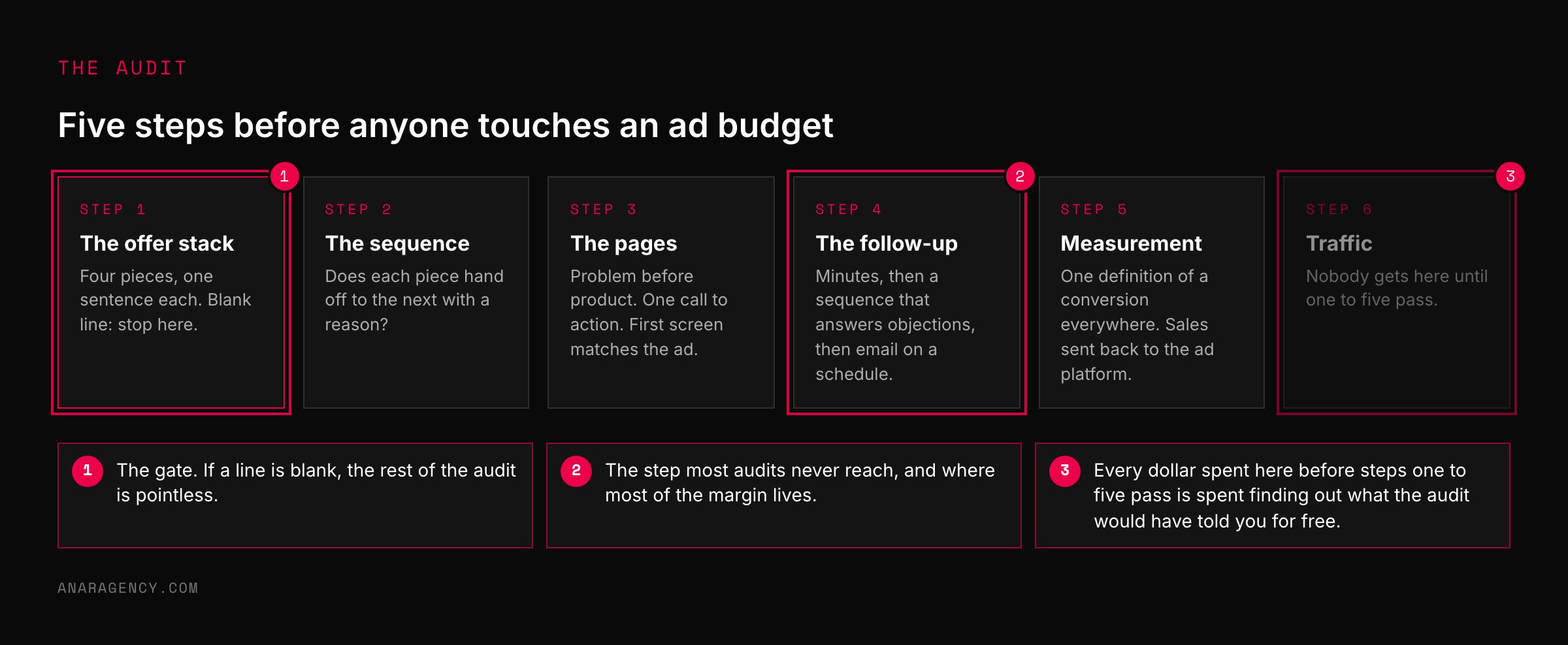
That system has four pieces: a lead magnet, an entry offer, a core offer, and a high-value offer, in that order. If you cannot name all four in one sentence each, buying more traffic only finds the gap faster. Our audit checks the stack, the sequence, the pages, the follow-up, and the measurement, in that order, before anyone touches an ad budget.
The traffic costume
The request almost always arrives the same way. Leads are slow, so we need more traffic. More budget, a new channel, a bigger audience.
It is a reasonable instinct, and it is nearly always wrong. Traffic is the one input any business can buy in unlimited quantity on any afternoon. Google and Meta will sell you a million impressions by dinner.
If more traffic were the answer, the problem would have been solved by the first credit card.
What cannot be bought is what happens after the click. Whether the page makes the visitor feel understood or sold to. Whether there is something small to say yes to before the large thing.
Whether the phone rings back in five minutes or five days. Whether the sale is ever recorded where the ad platform can learn from it.
Those are the conversion system. Pouring traffic onto a broken one does not fix it. It finds the break faster, at a higher price.
So the first thing we do with a new account is not touch the ads. We run an audit in a fixed order, and the first question decides whether there is anything to audit at all.
The Four-Piece Gate: name them or do not buy traffic
Every funnel that works has four pieces, and they do four different jobs.
The lead magnet solves one specific problem the prospect already knows they have, in a way that makes them feel smart instead of sold. The entry offer is a small first purchase or commitment, a paid diagnostic, a low-priced tool, a 15-minute call with an agenda. Its job is to turn a reader into a buyer, not to make money.
The core offer is the service you actually sell. The high-value offer is what your best customers buy next: the retainer, the expanded scope, the annual program.
Write all four on one page, one sentence each. That page is the gate. If any line is blank, the blank is where your ad spend will leak.
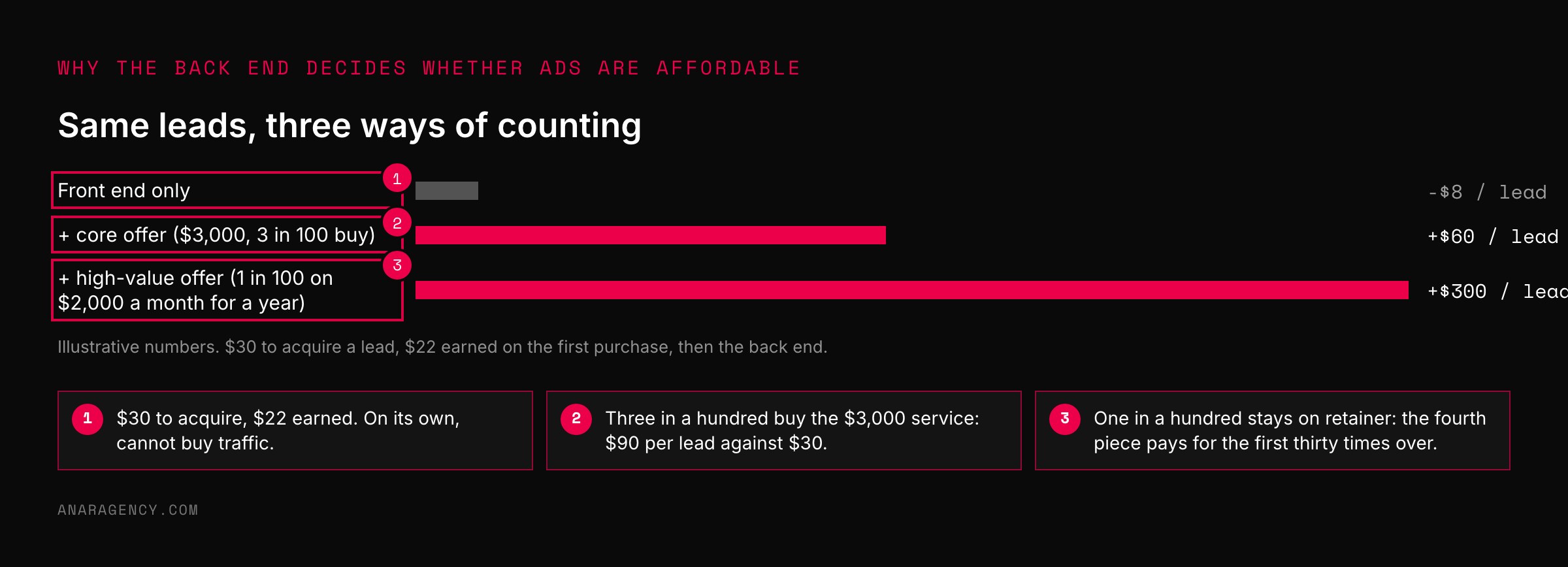
A funnel with a lead magnet and a core offer but no entry offer asks a stranger to make a large decision on the first visit, and most will not. A funnel with no high-value offer has to make its margin on the first sale, which means the ads have to be cheap enough to be profitable on day one, which almost none are.
The gate also stops a common mistake: copying a funnel you saw somewhere else. A funnel that works for a creator with a large audience and a team of closers is built on inputs you do not have.
A funnel that fits your business matches how you actually sell: through systems and pages if you prefer not to be on calls, through content and authority if you teach well, through conversations if you close well. The four pieces are constant. The shape they take is yours.
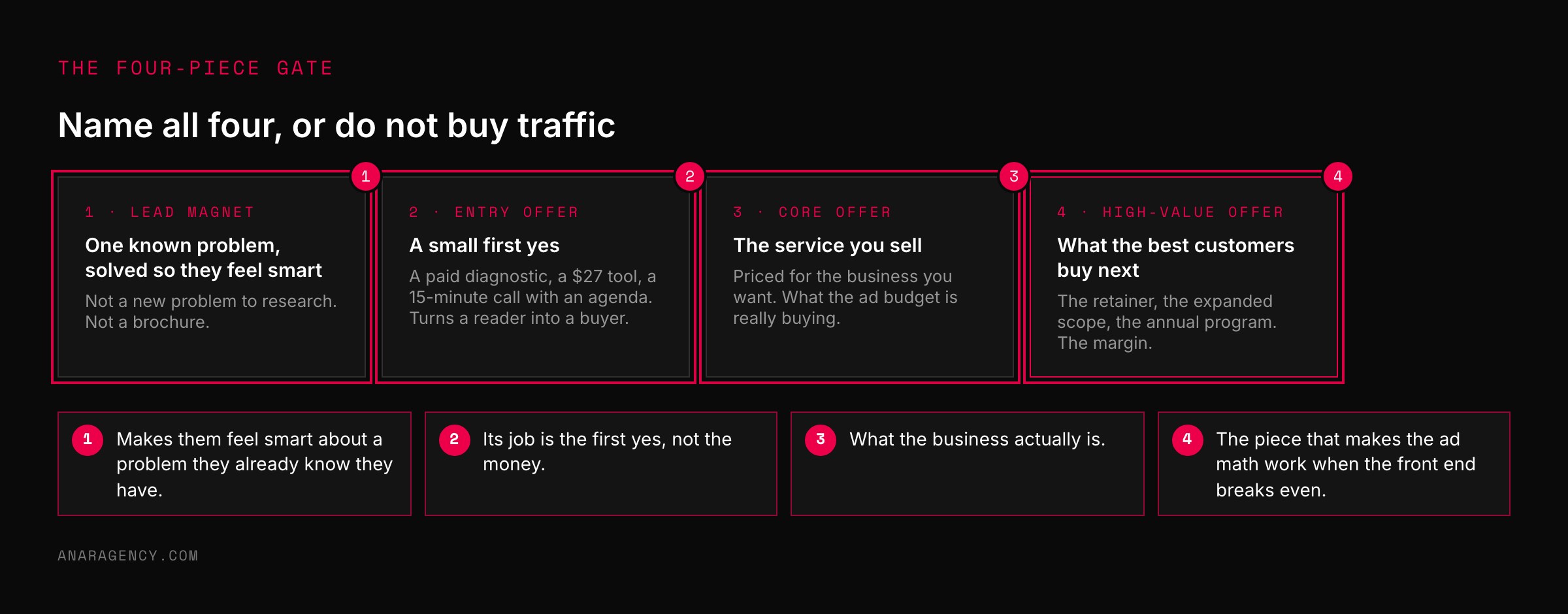
Before any ad budget, write the lead magnet, the entry offer, the core offer, and the high-value offer on one page, one sentence each. If any line is blank, do not buy traffic; fill the line. Then audit in order: sequence (does each piece hand off to the next with a reason), pages (problem before product, one call to action), follow-up (minutes, then a sequence that answers objections, then email on a schedule), and measurement (one definition of conversion in every system, sales sent back to the ad platform).
Traffic is step six.
Sequence is the variable most people skip
The right four offers in the wrong order fail like a recipe with the ingredients added out of order. Each piece has to hand off to the next with a reason.
The lead magnet's aha should point at the method the entry offer sells. The entry offer should surface the problem the core offer solves. The core offer should create the appetite the high-value offer feeds.
When the handoffs are there, a buyer who says yes to a small thing becomes measurably more likely to say yes to the next thing within the month, because each step made the next one feel consistent.
The sequence also decides how long the funnel should be. A high-consideration purchase, moving a retirement account, hiring a firm, a $5,000 program, needs a bridge: a page or a video that builds context and desire before the ask.
A low-friction purchase, a $7 tool, a $27 template, should skip the preamble and go straight to checkout, because a bridge in front of a small decision adds friction without adding confidence. Match the length of the path to the weight of the decision at the end of it.
One sequencing rule saves money on the first day. If the ad itself delivers the aha, skip the opt-in page and send the click straight to the entry offer.
An opt-in step in front of a low-priced offer roughly doubles the effective cost of getting someone to the offer, because half the clicks stop at the form. When the ad has already done the lead magnet's job, the form is a toll with no road behind it.
Pages that talk about the problem
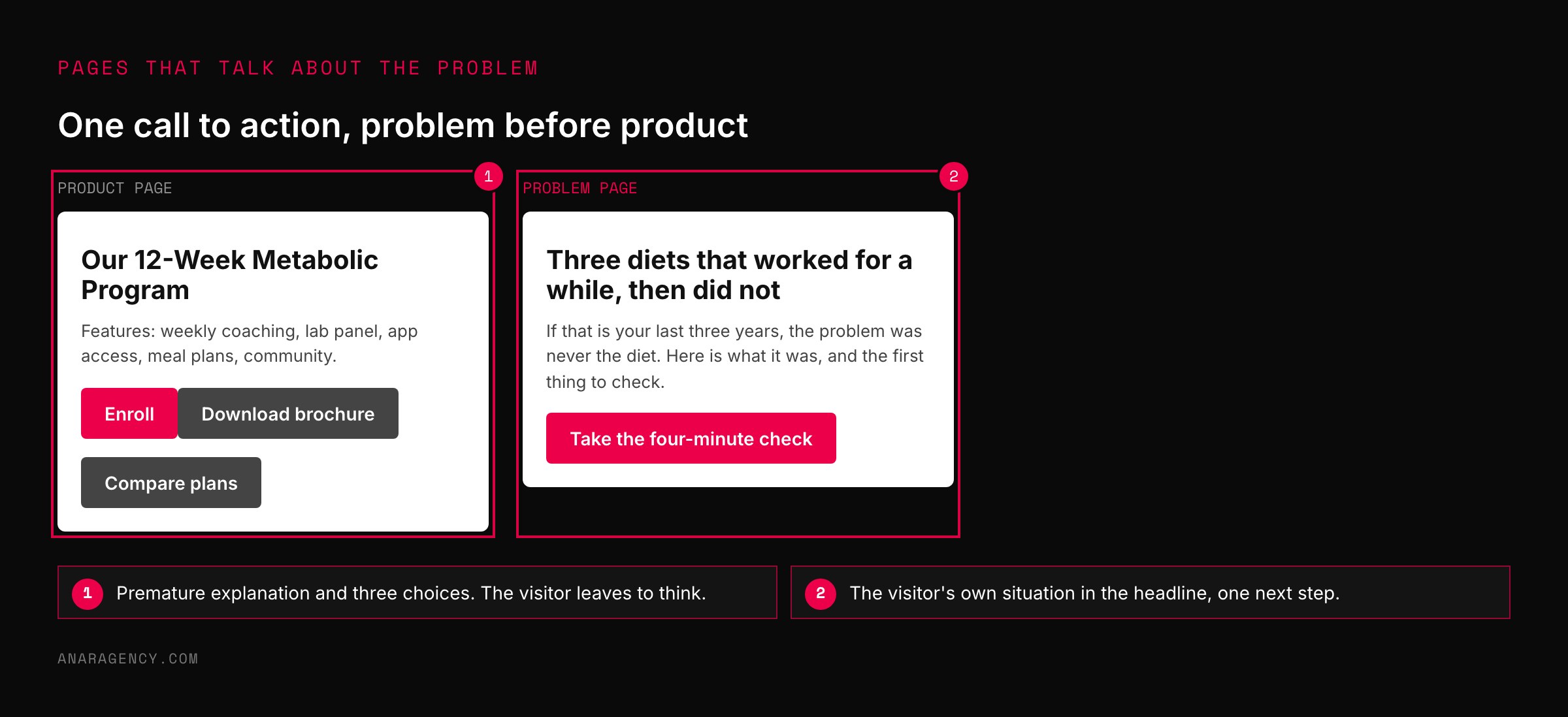
The third audit step is the pages, and the test is one question. Does this page talk about the problem the visitor feels, or about the product?
Pages that lead with the product explain what something is before the visitor knows why it matters. Pages that lead with the problem meet the visitor where the ad left them, which is the whole subject of our article on ad-to-page alignment.
Three faults show up on almost every page we audit. A headline generic enough to belong to any business in the category. More than one call to action, which turns a decision into a choice and loses the visitor to the choosing.
And a first screen that reveals the method before the visitor has felt the problem, which hands them the answer and removes the reason to act.
Each one is a structure fix, not a copy fix. And each one shows up in engagement rate and scroll depth before anyone reads a word for style.
The page audit ends at the ask. Baymard's long-running research on abandonment is the reminder that a page can do everything right and still lose most of its buyers at the form. So the last check is the form itself: how many fields, how much friction, what happens the instant it is submitted.
Follow-up is where the money actually is
The fourth step is the one most audits never reach, and it is where most of the margin lives.
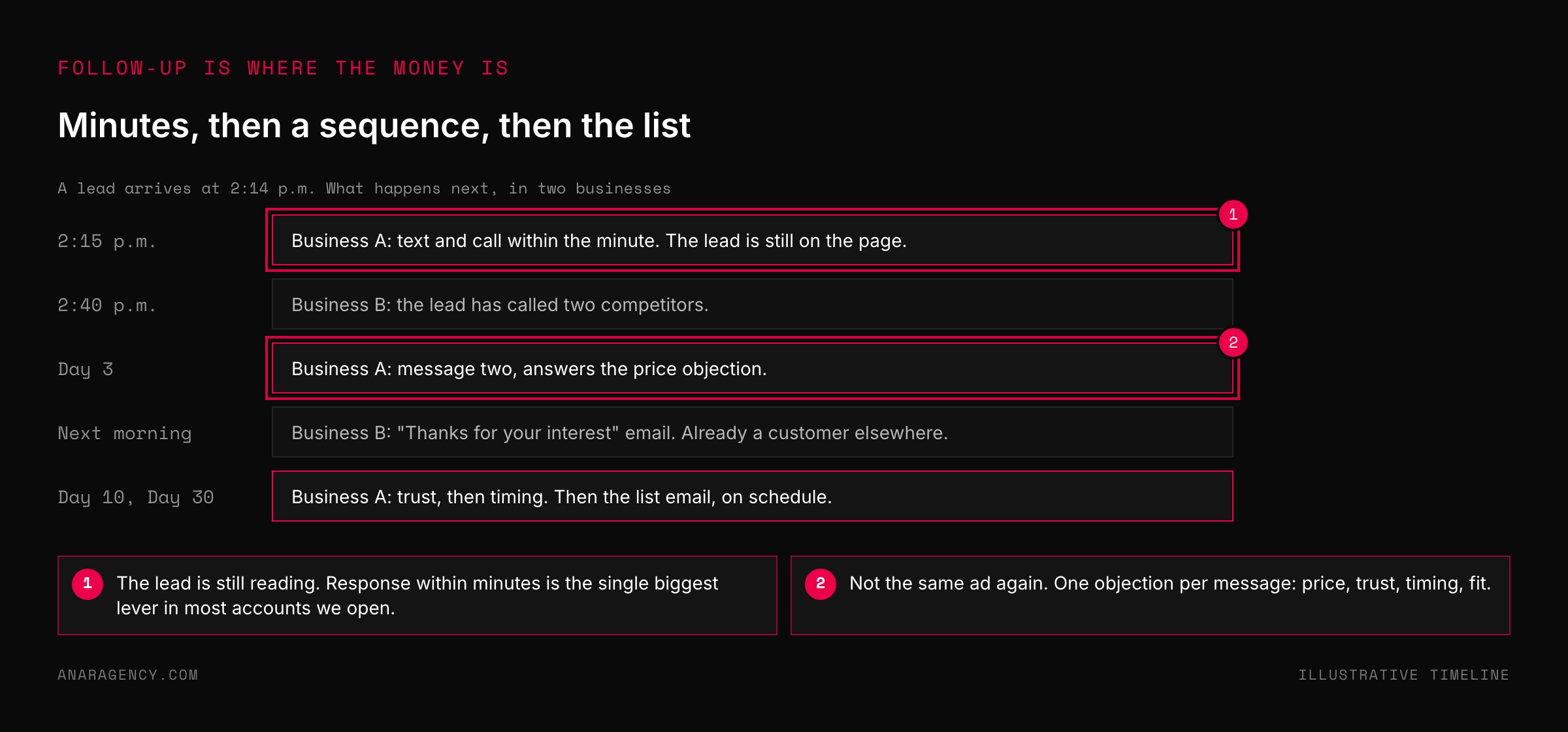
A lead that arrives at 2:14 p.m. and hears nothing until the next morning has, in the meantime, called two competitors. The Harvard Business Review's study of online lead response found that firms responding within an hour were far more likely to qualify the lead than those that waited, and that most companies did not respond that fast.
Meta publishes its own best practices for responding to leads, and the first one is speed.
Then the long tail. What goes out on day three, day ten, day thirty, to the lead who did not book? Non-converters should not see the same ad again, and they should not see random content.
They should see a sequence, each message answering one specific objection: price, trust, timing, fit. That is not a nurture campaign in the vague sense. It is a list of the reasons people say no, turned into a list of messages.
And email to the existing list is the hidden profit engine of most businesses we have opened the books on. Paid traffic on its own often runs near break-even. The margin arrives when the list is emailed, because the list already trusts you and costs nothing to reach.
An account that is not emailing its leads and customers on a schedule is leaving the cheapest revenue it has on the table. No traffic budget replaces it.
Measurement that tells the truth
The last step before traffic is measurement, and it is the one that quietly breaks the others.
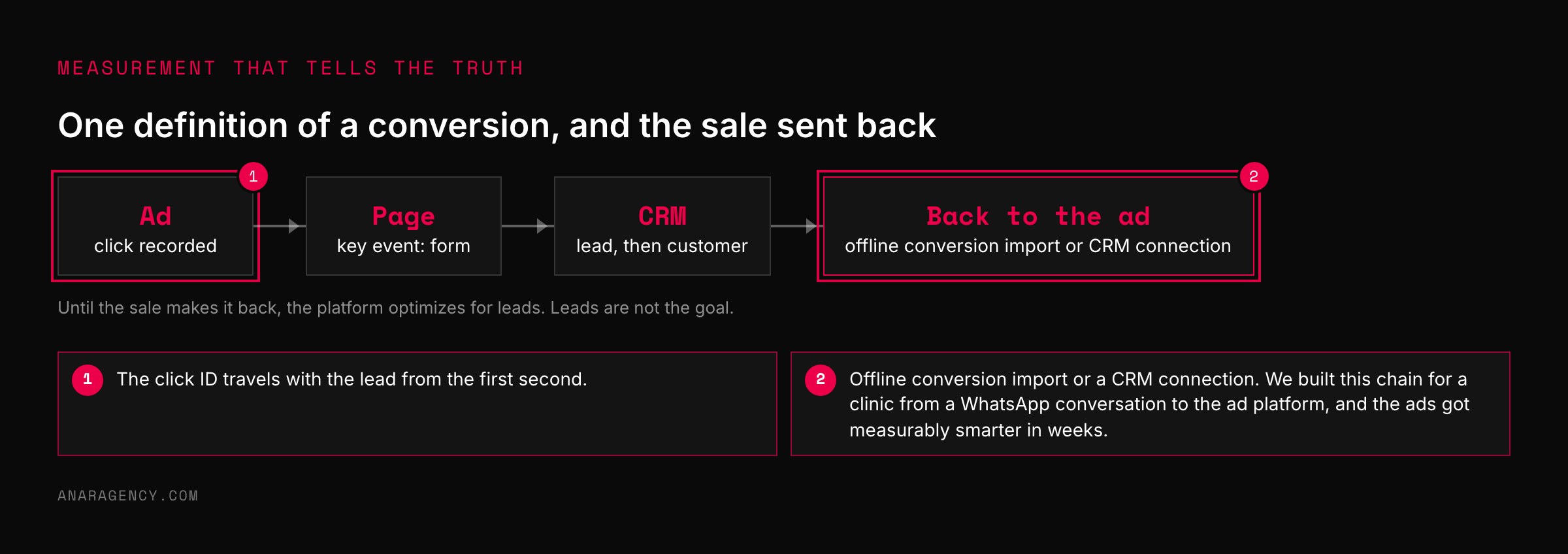
Decide which event counts as a conversion. A form fill, a booked call, a call over 60 seconds, a sale. Define it once, as a key event in analytics and as the same conversion in the ad platform, so the two systems are counting the same thing.
In our audits they usually are not. The owner has been optimizing toward a number that means something different in each place.
Then close the loop. A lead that becomes a customer two weeks later is invisible to the ad platform unless you send it back. Google documents how to import offline conversions against the click that started them, and Meta documents how to connect a CRM so that booked and closed leads feed the account.
Until the sale makes it back, the platform is optimizing for leads, and leads are not the goal. We built exactly this loop for a clinic, from a WhatsApp conversation to the CRM to the ad platform's conversion API, and the ads got measurably smarter within weeks because they were finally being told which leads were worth something.
Google's funnel exploration report then shows the whole path, step by step, with the drop at each one. That report is the audit's scoreboard.
When every step is defined and the sale flows back, the question "should we buy more traffic" finally has an honest answer. It is usually yes.
Questions executives ask
Why aren't my ads converting?
Usually because the system behind the ad is incomplete, not because the traffic is wrong. Check four things in order: can you name a lead magnet, an entry offer, a core offer, and a high-value offer; do your pages talk about the visitor's problem before the product; does follow-up start within minutes; and is a conversion defined the same way in analytics and the ad platform.
What is an offer stack?
The four things a business sells, in order: a lead magnet that solves a known problem, a small entry offer that turns a reader into a buyer, the core service, and a high-value next step for the best customers. The order matters as much as the pieces, because each one has to create the appetite for the next.
Do I need a lead magnet if I run ads?
You need the job a lead magnet does, which is to give the prospect an aha about a problem they already have. If the ad itself delivers that aha, you can skip the opt-in page and send the click straight to a small entry offer, which avoids losing half the clicks at a form.
How fast should I follow up with a new lead?
Within minutes. Research on online lead response found that firms responding within an hour were far more likely to qualify the lead, and most firms were slower than that. After the first contact, non-converters should get a sequence that answers one objection per message, not the same ad again.
How do I know if my conversion tracking is right?
Define one event as the conversion, set it up identically as a key event in analytics and a conversion in the ad platform, and compare the counts weekly. Then send closed sales back to the ad platform through offline conversion import or a CRM connection, so the platform optimizes for customers rather than leads.

Filip Kovacevic is the founder of Anar Agency in Phoenix. He spent five years running SEO, Meta ads, email, and content for medical practices across the United States, and now does the same work for healthcare, home-service, legal, and professional-service businesses, alongside AI implementation. More from Filip →
Talk it through in 15 minutes
Bring one AI question from this article. We will tell you what we would do, whether or not you hire us.
Book a 15-Min Chat →