Reading Ad Data: Which Metric Is Broken and What to Fix

Every ad number sits at one step between a stranger seeing your ad and that stranger paying you. Read the steps in order: cost to be seen, clicks, page loads, people who stay, people who start to buy, people who finish, and money per customer. The first number that is clearly off is the one to fix, because everything after it is a symptom.
Check whether the problem is in the words before you test prices or layouts. And remember that a number can look good and still be wrong about cause, which is what eBay found when it switched its search ads off.
Forty numbers, and you are watching one
Open an ad account and count the columns. Reach, impressions, frequency, clicks, link clicks, cost per click, landing page views, cost per result. It goes on.
Most owners look at one of them. Usually cost per lead, or return on ad spend. If it is good they relax.
If it is bad they change something, more or less at random.
That is like a doctor who only takes your temperature. A fever tells you something is wrong. It does not tell you what.
The other numbers are the rest of the examination. Each one sits at a particular step, and once you know which step, the account starts telling you where to look.
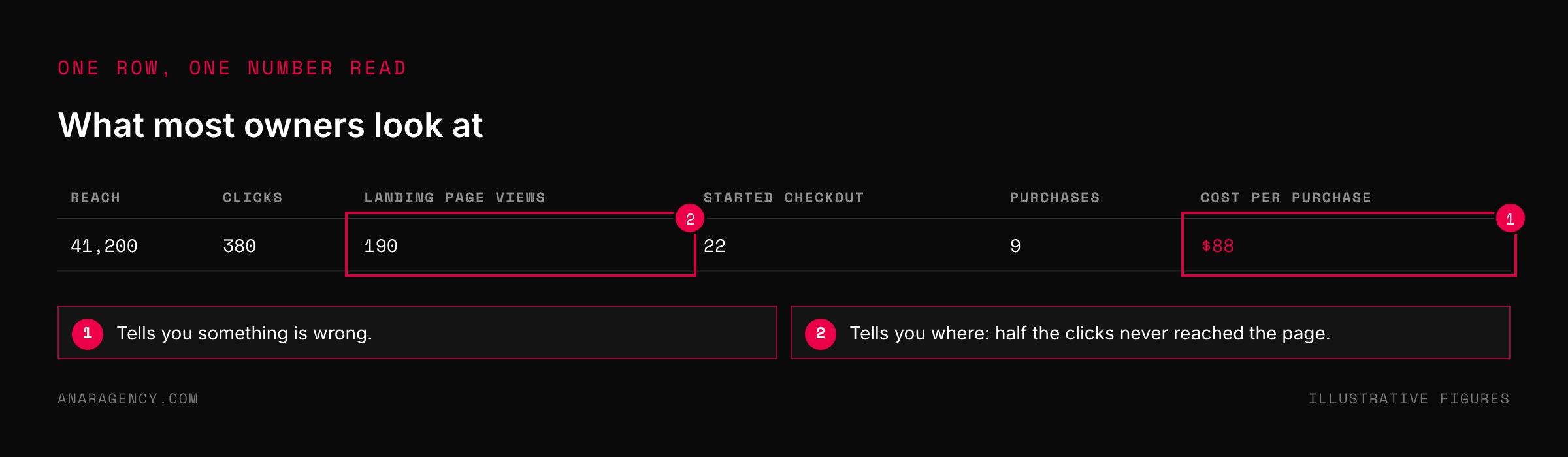
Per-Metric Diagnosis
Picture the walk a stranger takes. They are shown the ad. They stop.
They click. The page loads. They read.
They start to buy. They finish. Each step has a number.
If it costs a lot to be seen, the problem is upstream of everything. The audience may be too small or too contested, or people are not responding to the ad. Meta's auction weighs how people respond to an ad, not only what you bid.
If people see it and do not click, the ad gave them no reason. That is the opening line or the picture.
If people click and the page does not load, you will see it in one comparison. Meta counts a landing page view only when a click results in the page successfully loading. Many clicks and far fewer landing page views means a slow page or accidental taps.
If they land and leave, the page did not carry on the conversation the ad started. We cover that in ad-to-page alignment.
If they start to buy and stop, look at the last step: the price, a fee that appeared late, a long form.
If they buy and you still lose money, the ads are fine. The offer does not earn enough per customer, and no ad will fix that.
Read from the top and stop at the first number that is clearly off. Fixing step five when step two is broken is how people spend a quarter going nowhere.
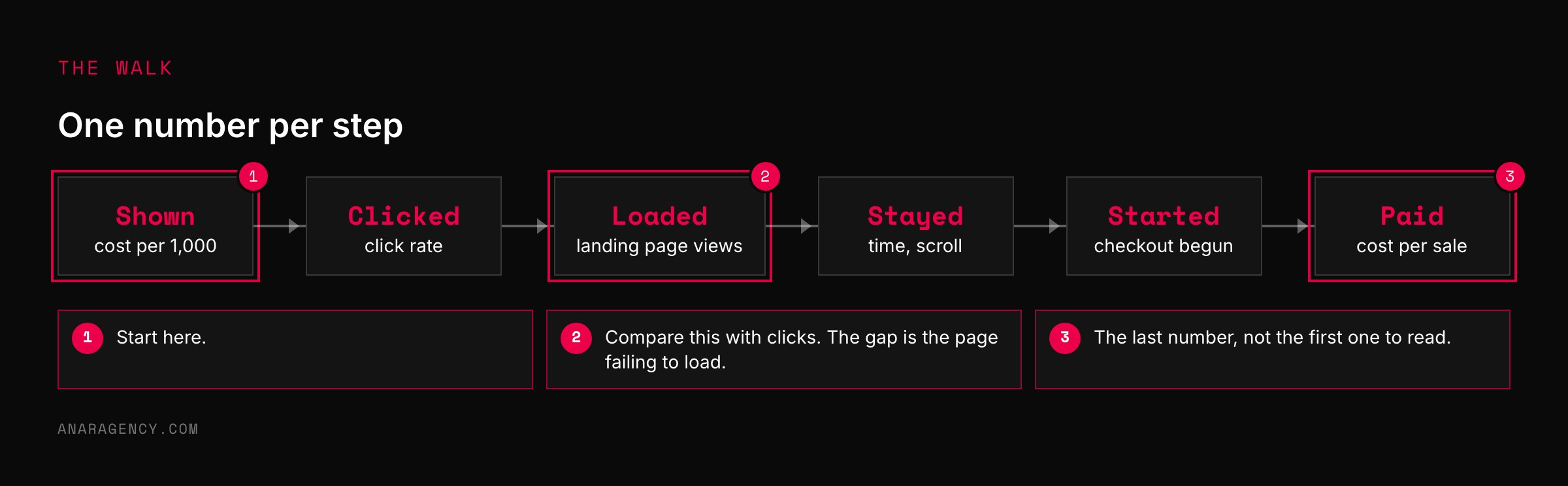
Read the numbers in the order a stranger experiences them: cost to be seen, clicks, landing page views, people who stay, people who start to buy, people who finish, and money per customer. Stop at the first one that is clearly off and fix that step. Before testing prices or layouts, check whether the problem is in the words: reader, promise, tone, order.
Then sanity-check the result against your total sales, and pause something now and then to see what would have happened anyway.
Words first, numbers second
Once you know which step is broken, there is a second question. What kind of problem is it?
Some problems are about words. The wrong reader, the wrong promise, the wrong tone. A page written for a 30-year-old shown to a 60-year-old.
Others are about settings. The price. How many fields are on the form.
Where the button sits.
People love to test the second kind, because it is easy. You can run two prices against each other this afternoon.
But if the words are wrong, the settings do not matter. A page that talks past its reader will lose at $49 and at $29. You can test numbers all year when the problem was never a number.
So check the words first. Read the ad and then the page out loud, as the person you are targeting. A free tool like Microsoft Clarity will show you recordings of real visitors, and where they stop reading is usually where the words lost them.
The number that looked great and meant nothing
Here is the part nobody likes. A number can be accurate and still fool you.
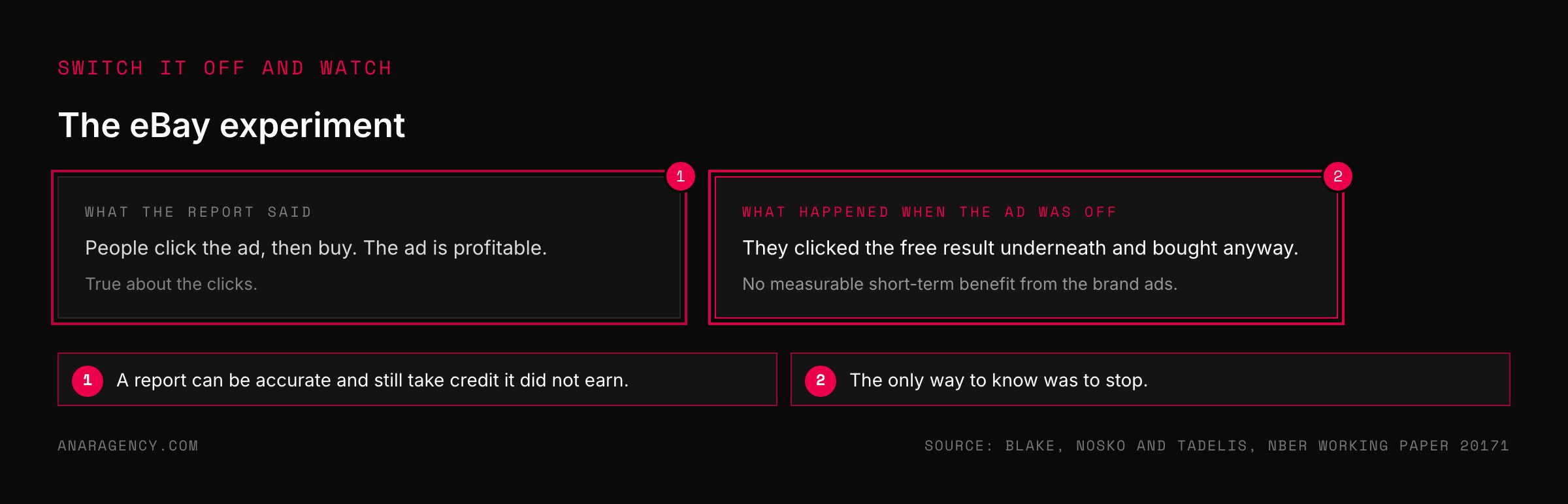
Around 2012, eBay was one of the biggest buyers of search ads in the world. The reports looked excellent. People clicked the ads and bought things, and the return on that spending looked high.
Three economists working with eBay did something unusual. They switched the ads off in some places and watched what happened to sales.
For ads on eBay's own name, almost nothing happened. People who searched "ebay shoes" and saw no ad simply clicked the regular result underneath. The published paper reports that brand-keyword ads had no measurable short-term benefit.
For other keywords, the ads did help with new and infrequent customers. But most of the spending went to frequent buyers who would have purchased anyway, and the paper found average returns were negative.
The reports had not lied about the clicks. They had taken credit for sales that were already going to happen.
There is an old warning about this called Goodhart's law: when a measure becomes a target, it stops being a good measure. An ad system told to maximize reported sales will find the people most likely to buy, and many of those were coming anyway.
"So I cannot trust any of it."
You may be thinking that if eBay could be fooled, your little account has no hope. It is the other way around. Small accounts have simpler ways to check.
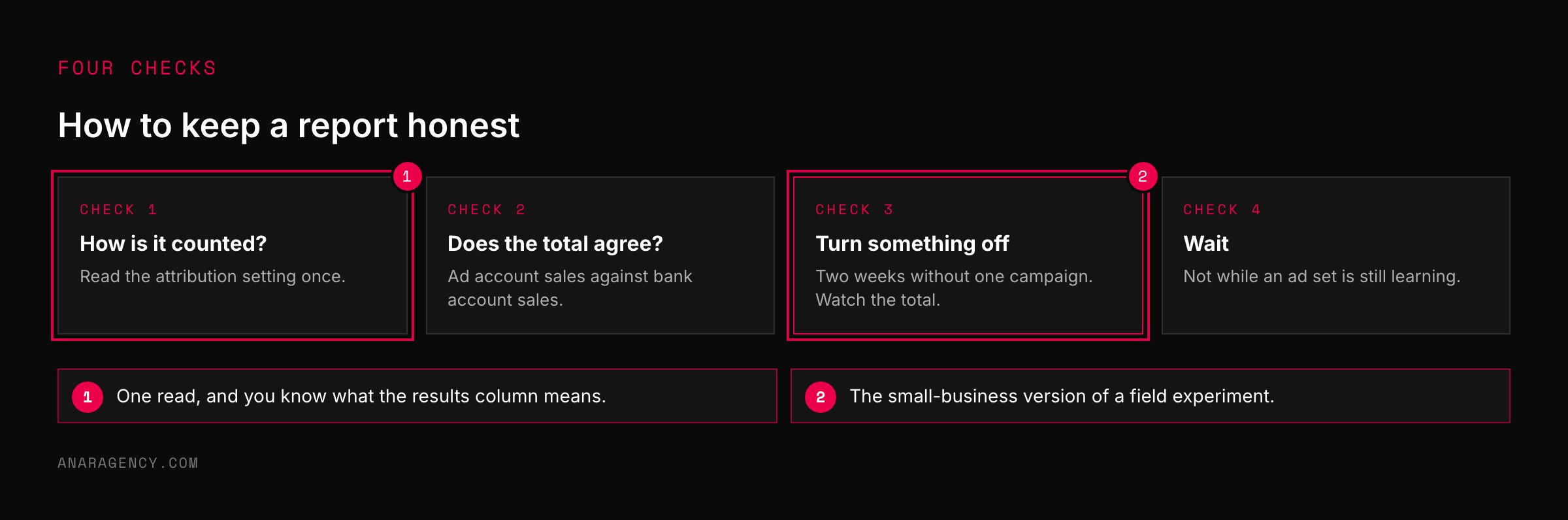
Know how results are counted. Meta's attribution setting decides which sales an ad gets credit for. A sale within a day of someone merely seeing an ad is a different kind of evidence from a sale after a click.
Look at the total. If the ad account says it produced 40 sales this month and your bank account shows the same number of sales as last month, the ads did not produce 40 sales.
Turn something off. You do not need a research team. Pause your ads on your own brand name for two weeks and watch total sales.
That is eBay's experiment at the scale of a small business.
Do not judge too early. Meta says results are less stable while an ad set is still learning. A bad Tuesday is not a diagnosis.
None of this needs new software. It needs the habit of asking what would have happened anyway. Our piece on book-a-call math shows the same habit applied to a sales team.
What to read next, and why
Consumer Heterogeneity and Paid Search Effectiveness (research paper): The eBay experiments. The summary is one paragraph, and it will change how you read every ad report.
Landing page views (Meta documentation): The definition, and why it differs from a click. The gap between the two is one of the most useful numbers in the account.
About attribution settings (Meta documentation): How Meta decides which ad gets credit. Read it once so you know what your results column is really counting.
Goodhart's law (encyclopedia entry): A short read on why a target stops measuring what it used to.
So the simple takeaway is this: do not ask whether the ads are working. Ask which step is broken. Then ask what would have happened if the ad had never run.
Questions executives ask
Which Facebook ads metrics should I watch?
Watch them in the order a person moves through them: cost to reach people, click-through rate, landing page views, what happens on the page, checkout or form completion, and revenue per customer. One headline number such as cost per lead tells you something is wrong but not where.
What does a low click-through rate mean?
People are being shown the ad and not finding a reason to click. The usual cause is the first line or the image, not the offer or the page, because the reader has not seen those yet.
What is the difference between link clicks and landing page views?
A link click is counted when someone clicks the ad. Meta counts a landing page view only when that click results in the destination page successfully loading. A large gap between the two points to a slow page or accidental clicks.
Can ad platform reports overstate results?
Yes. Reports credit ads with sales from people who clicked, including people who would have bought anyway. In field experiments at eBay, researchers found brand-keyword search ads had no measurable short-term benefit, even though conventional reporting made them look profitable.
Should I test price or copy first?
Copy first. If the page is speaking to the wrong reader or making the wrong promise, changing the price will not help. Confirm the message fits the audience, then test settings such as price, form length, and layout.

Filip Kovacevic is the founder of Anar Agency in Phoenix. He spent five years running SEO, Meta ads, email, and content for medical practices across the United States, and now does the same work for healthcare, home-service, legal, and professional-service businesses, alongside AI implementation. More from Filip →
Talk it through in 15 minutes
Bring one AI question from this article. We will tell you what we would do, whether or not you hire us.
Book a 15-Min Chat →