The Three-Layer Ad: Why, What and How in One Post
An ad shown to someone who was not looking for you has one job: move them from scrolling past a problem they have not named to wanting the result you sell. The Three-Layer Ad does that in a fixed order and a fixed proportion. About 60 percent of the words explain why the problem exists and what it has cost them, 30 percent describe what changes, and the last 10 percent hint at how, leaving the method for the landing page.
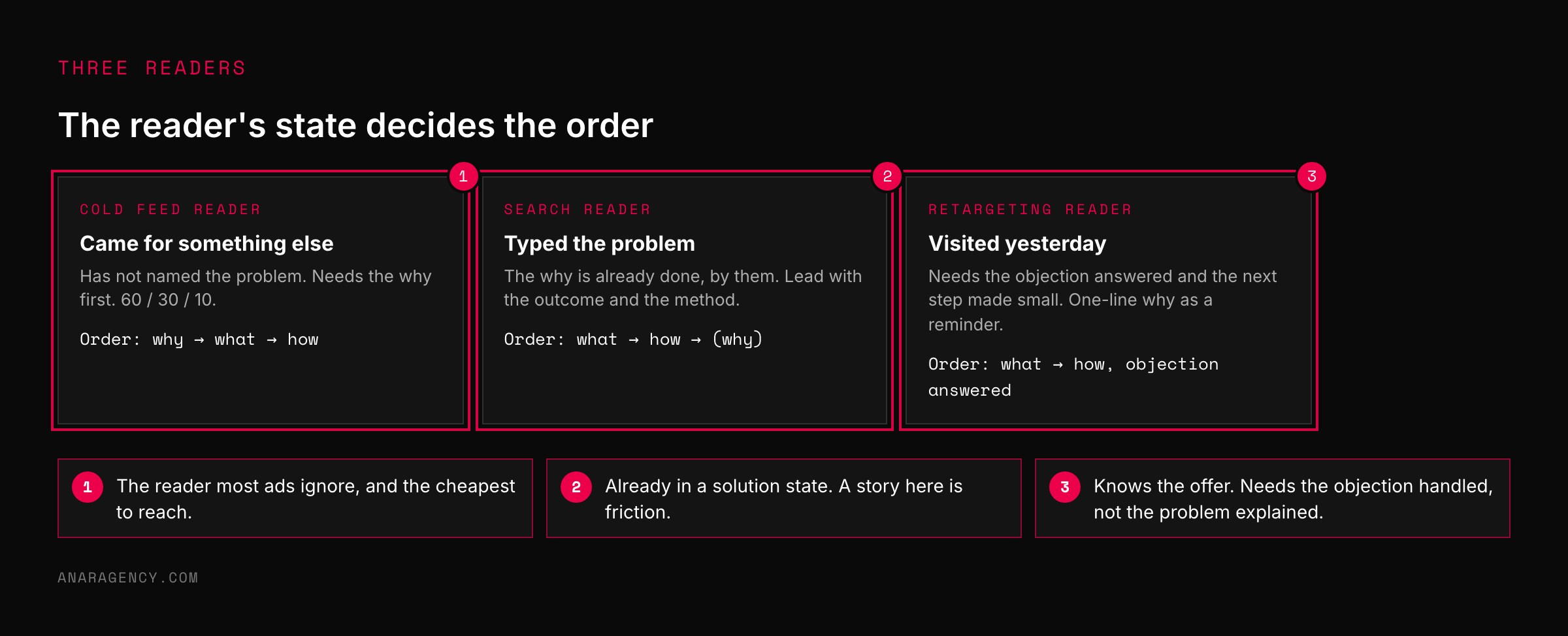
Reverse the proportions for a search ad or a retargeting ad, where the reader already wants the thing and only needs to be told what and how.
Why most ads talk to the wrong person
Open any ad library and most of what you see is a pitch: the offer, the discount, the features, the button.
That copy makes sense to one reader, the one who already knows they have the problem, already knows a solution exists, and is comparing options. On a search engine that reader is common, because typing the query is the act of knowing. On Facebook, Instagram, TikTok, and YouTube that reader is rare.
Most of the feed is people who came for something else.
In our client accounts the cold audience that has not yet put a name to its problem is the large majority of impressions. It is also the cheapest to reach, because almost nobody is writing for it.
An ad that opens with a price or a feature is invisible to that reader. It answers a question they have not asked. An ad that opens with the moment the problem showed up gets read, because it is about them.
That is the whole argument for structure. The reader has to be walked from one state to another inside a few hundred words, and the walk has an order: first the problem, then the result, then a hint of the method. Skip the first step and the other two have nothing to stand on.
The three layers and the 60/30/10 split
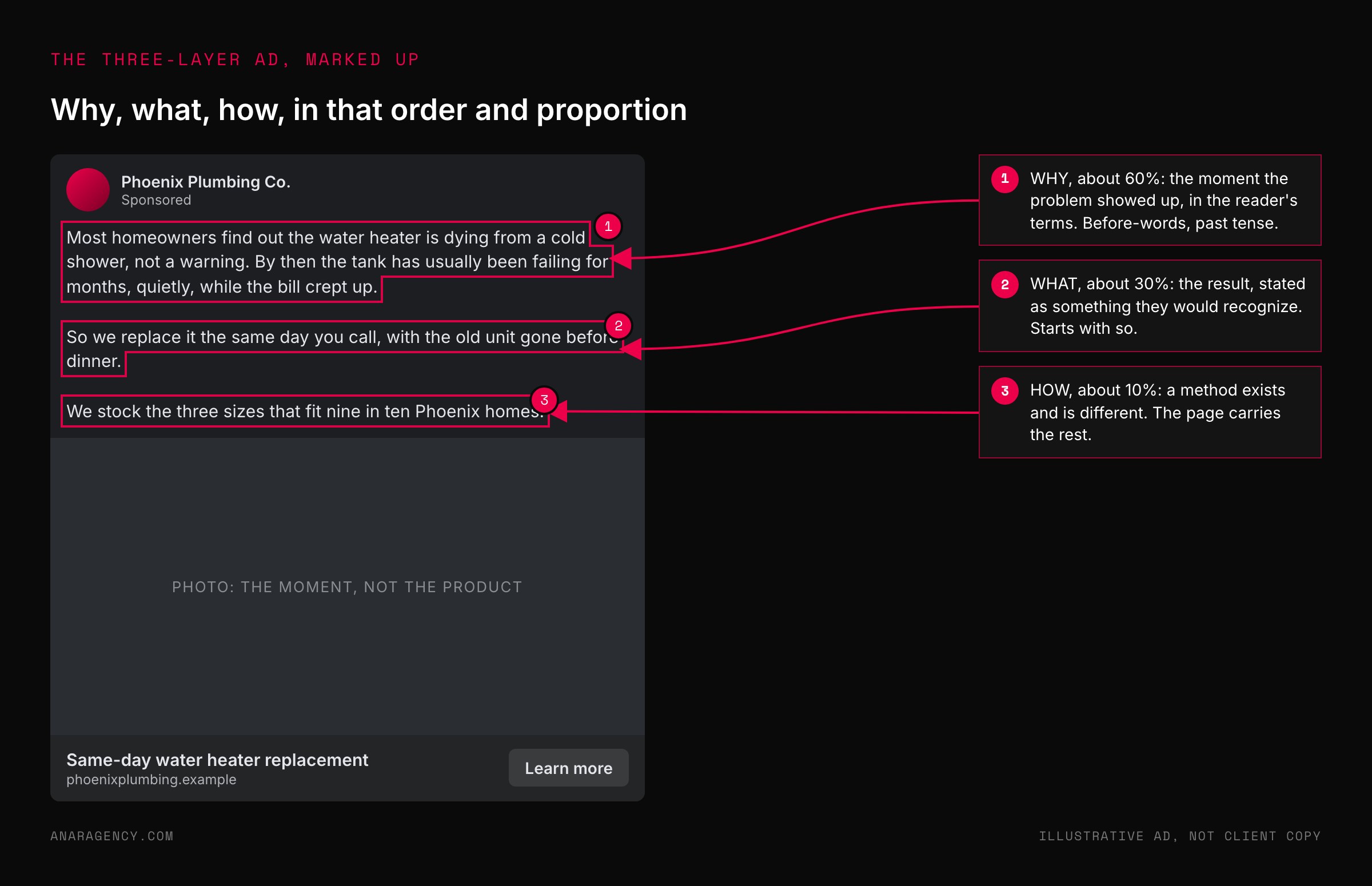
Why, about 60 percent. The first and largest layer names the problem in the reader's own terms and shows why it exists and what it has been costing them. It is reflective and specific.
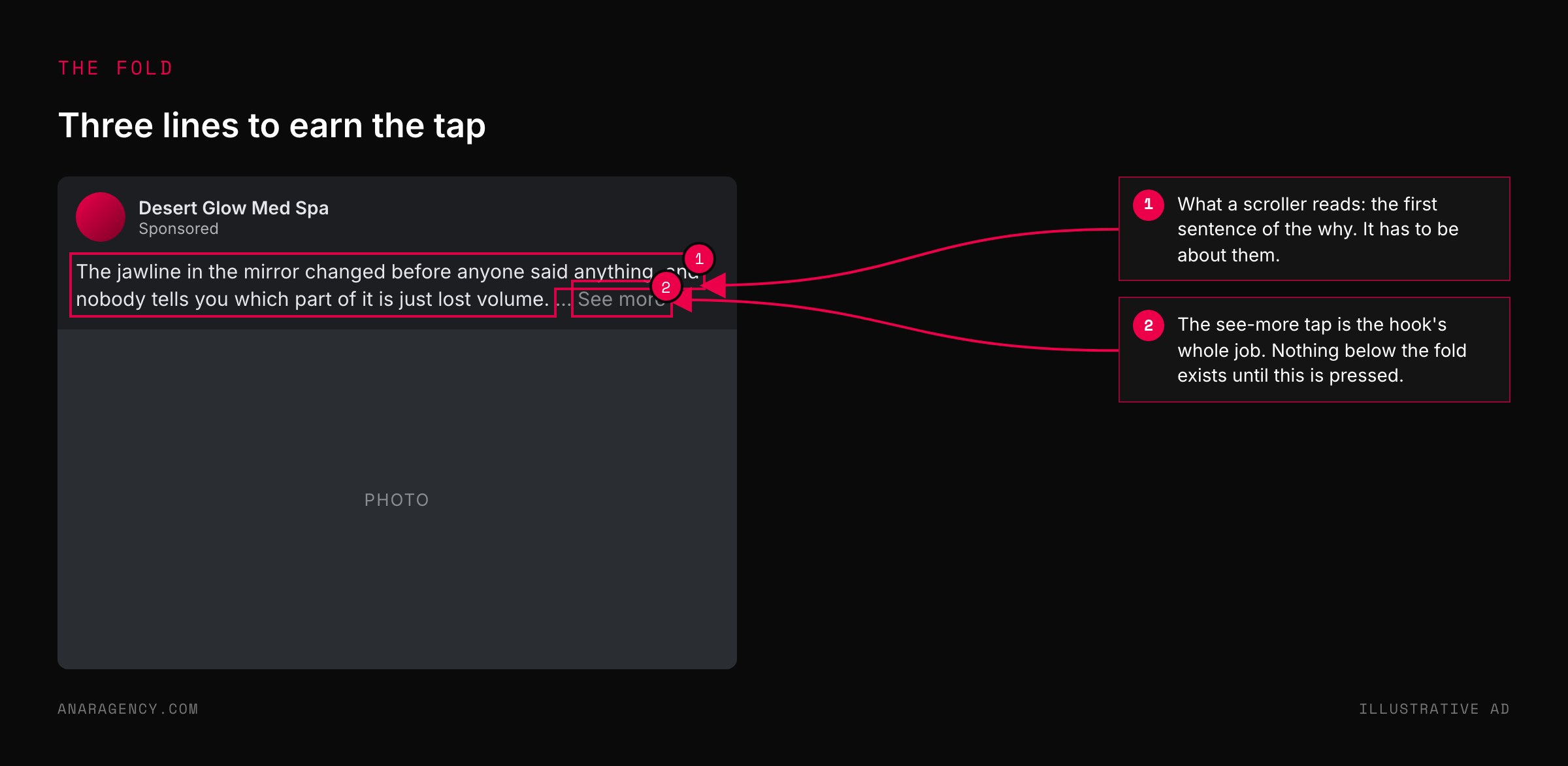
For a homeowner it is the cold shower, not "water heater issues." For a med spa prospect it is the thing they noticed in the mirror before anyone said it.
The word why does most of the work on its own, because it presupposes the problem is real. Asking "why does this keep happening" assumes it keeps happening. Linguists call that a presupposition, and ad copy runs on it.
What, about 30 percent. The second layer states the outcome as a result the reader would recognize: hot water today, a jawline they can see on screen before committing, a case reviewed by an attorney within the hour. It motivates, it does not educate.
Features belong on the landing page, and the ad sells the after.
How, about 10 percent. The last layer is a single line that says a method exists and is different, and no more. Nine tenths of the how lives on the page the ad links to.
Give the full method in the ad and two things happen: the reader has no reason to click, and the ad gets long enough that the platform truncates it. Meta's ads guide publishes the text limits and recommended lengths per placement, and the primary text of a feed ad shows about three lines before "see more", which is roughly where the why has to have done its job.
The proportions are a guide for cold traffic, not a law. What matters is the order and the emphasis: the problem gets the most room, the method gets the least.
Names the problem the reader has not put into words yet. Reflective, past-tense, specific. This is the part that stops the scroll, because it is about them.
The outcome, stated as a result they would recognize, not a feature list. Motivating, not educating.
One line that hints the method exists and is different. The landing page carries the rest. Give it all away here and there is no reason to click.
For cold traffic, spend about 60 percent of the words on why the problem exists and what it has cost the reader, 30 percent on what changes, and 10 percent on how, leaving the method for the landing page. Use before-words (why, when, still, used to) in the first layer and after-words (what, how, now, next) in the last two, joined by a so. For search and retargeting, where the reader already wants the thing, invert the proportions and lead with what and how.
Before-words and after-words
There is a mechanical way to check a draft against the structure, and it works because the two halves of an ad use different vocabulary.
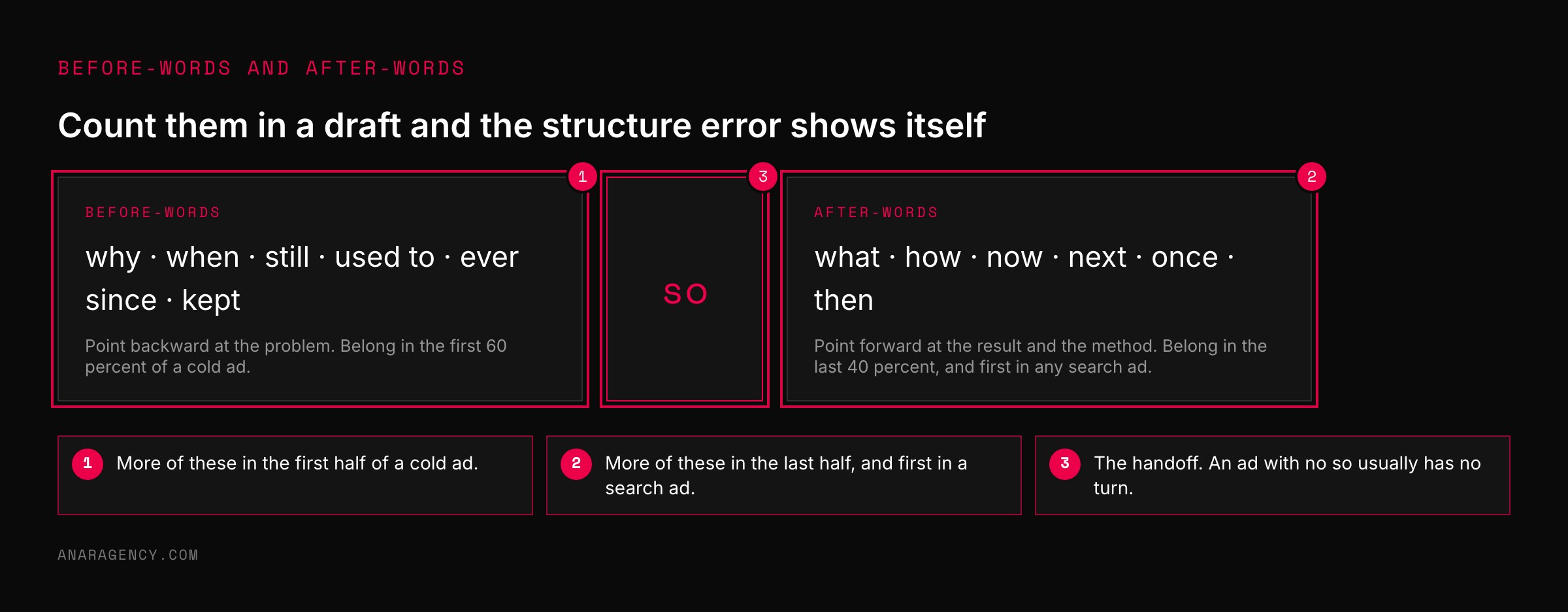
Words that point backward at the problem, why, when, still, used to, ever since, put the reader in the moment it showed up. Words that point forward, what, how, now, next, once, then, put the reader in the result.
The first set belongs in the why layer. The second set belongs in the what and how layers, and in the opening line of any ad aimed at someone who already searched.
Count them. A cold-traffic ad with more forward-words than backward-words is pitching before it has made the reader feel the problem, and it will read as a sales message to someone who was not shopping. A search ad with a long run of backward-words is making a buyer sit through a problem they already typed into the box.
Both are structure errors, not writing errors, and both show up in the click-through rate before anyone reads the copy for style.
The turn between the two halves usually rides on one word: so. "Most homeowners find out from a cold shower, so we stock the three sizes that fit nine in ten homes." If a draft has no so, or no sentence doing its job, it usually has no turn, and reads as either all complaint or all pitch.
When to invert it: search and retargeting
The split assumes the reader was not looking for you. When they were, flip it.
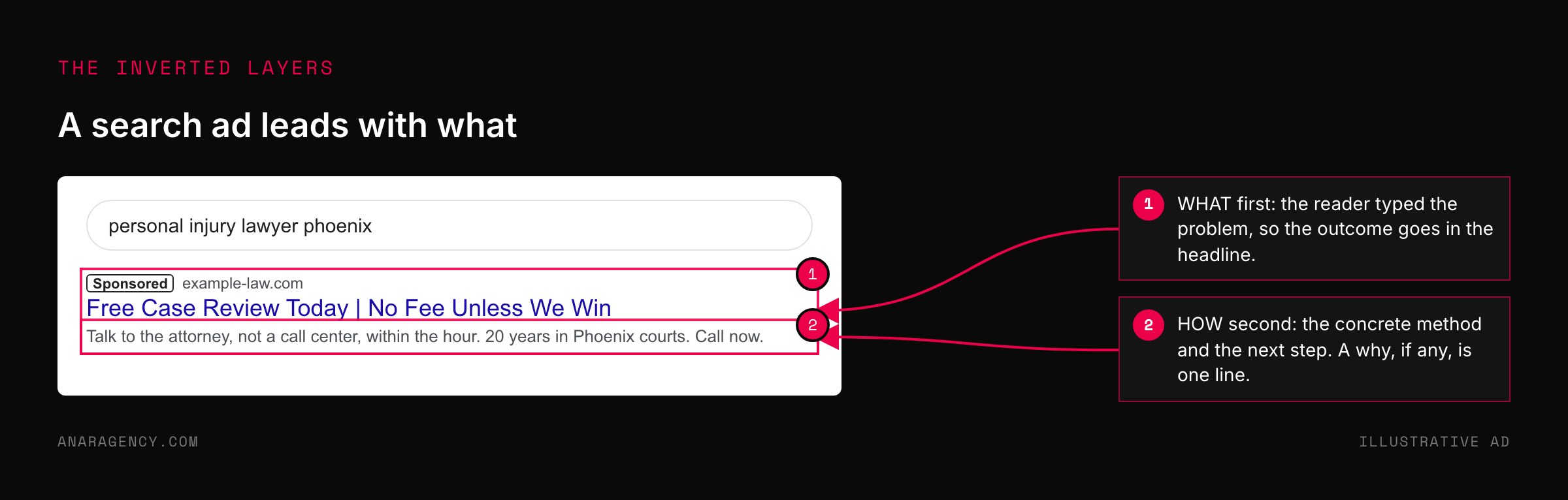
A Google search ad is read by someone who typed the problem. The why is already done, by them. Google's guidance on text ads and the mechanics of responsive search ads push the same way: headlines that match the query, a clear what, a concrete how, and no room for a story.
Retargeting works the same way for a different reason. Someone who visited the pricing page yesterday does not need the problem explained again. They need the objection answered and the next step made small.
Lead with what and how, and use the why only as a one-line reminder of why they came in the first place.
The failure in both directions is the same: writing one ad and running it everywhere. Cold feed traffic and warm search traffic are two readers in two states, and an ad that is right for one is wrong for the other.
Our worked examples in the figure above show the same plumbing offer in both orders.
What the structure does to the numbers
A well-built why layer changes which metric you watch.
A cold ad that leads with the problem earns reads from people who would never have clicked a pitch, so its click-through rate can look modest while its cost per lead drops, because the clicks it does get come from people who have just recognized themselves. The opposite ad, a pitch to a cold audience, often shows a fine click-through rate from the small slice who were already shopping and a poor cost per lead from everyone else.
That is why we judge ad structure on cost per lead and lead quality, not on click-through rate alone. Google's own definition of click-through rate is explicit that it describes how often people who see an ad click it, which says nothing about whether they were the right people.
Behavioral research on how people read on screens, from the Nielsen Norman Group, found most readers scan instead of reading, which is a second argument for putting the recognizable problem in the first line where a scanner will land.
Their later work on the F-shaped reading pattern shows the same thing: the first words of the first lines get the attention. Spend them on the why.
The structure also keeps copy honest. A why layer built on a real, specific problem is easier to substantiate than a headline claim, and advertisers are required to have evidence for the express and implied claims a reasonable reader takes from an ad.
The FTC's advertising FAQ for small business lays out the standard in plain language, and Meta's advertising standards add the platform's own rules on top. An ad that spends most of its words describing the reader's situation accurately has fewer claims to prove than one that spends them on promises.
How to write one in twenty minutes
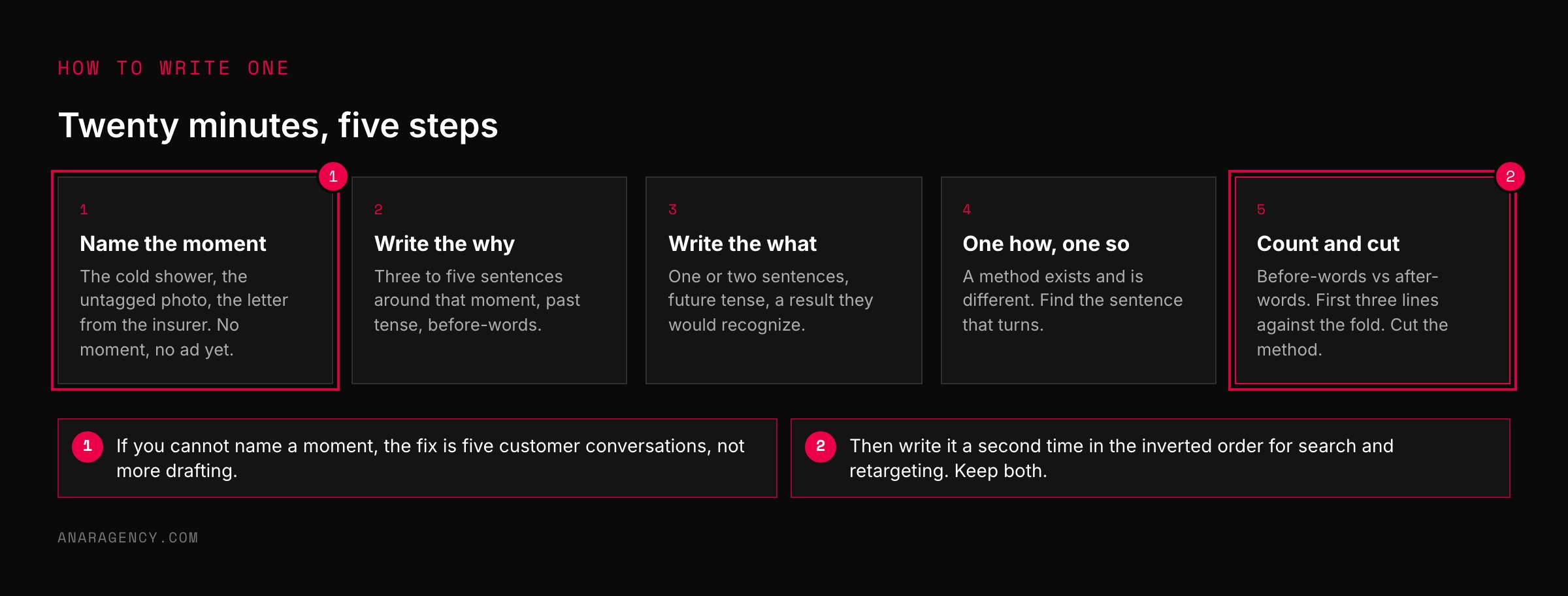
Start with the moment. Write down the specific moment the reader finds out they have the problem: the cold shower, the photo they untagged, the letter from the insurer.
If you cannot name a moment, you do not know the audience well enough to write the ad yet. The fix is five customer conversations, not more drafting.
Write the why layer as three to five sentences around that moment, in the past tense, using before-words. Then write the what layer as one or two sentences in the future tense describing the result they would recognize. Then write one how sentence that says a method exists and names the one thing that makes it different.
Then find the so.
Read it back and count the before-words and after-words. Check the first three lines against the platform's truncation point. Cut anything that explains the method.
Then write the same offer a second time in the inverted order for search or retargeting, and keep both. Two ads, two readers, two states. The structure is the same.
Only the proportions moved.
Questions executives ask
How do you structure a Facebook ad?
For an audience that was not looking for you: open with why the problem exists, in the reader's own terms, for about 60 percent of the copy; describe what changes for about 30 percent; and give one line of how, saving the method for the landing page. Lead with the problem because the reader has to recognize themselves before any offer makes sense.
How long should a Facebook ad be?
Long enough to walk the reader from the problem to the result, which for cold traffic is usually 100 to 250 words of primary text. The first three lines show before the see-more fold, so the why layer has to land there. A search ad is far shorter and leads with the outcome because the reader already typed the problem.
What is the difference between a cold ad and a retargeting ad?
The reader's state. A cold reader has not named the problem and needs the why first. A retargeting reader already visited and needs the what and how, plus the objection answered.
Running one ad for both wastes money on whichever reader it was not written for.
Should an ad explain how the product works?
Only in one line. The job of the ad is to make the reader want the result and click to learn the method; the landing page carries the how. An ad that gives away the whole method removes the reason to click and usually runs past the platform's truncation point.
Why does my ad have a good click-through rate but expensive leads?
Usually because the ad is a pitch, and the clicks come from the small slice of the audience that was already shopping while everyone else scrolls past. Rebuilding the ad to open with the problem tends to lower the click-through rate slightly and lower the cost per lead more, because the clicks now come from people who just recognized themselves.

Filip Kovacevic is the founder of Anar Agency in Phoenix. He spent five years running SEO, Meta ads, email, and content for medical practices across the United States, and now does the same work for healthcare, home-service, legal, and professional-service businesses, alongside AI implementation. More from Filip →
Talk it through in 15 minutes
Bring one AI question from this article. We will tell you what we would do, whether or not you hire us.
Book a 15-Min Chat →