What They Say No To Is What They Want
The fastest way to design your next offer is to study what your market refuses. Markets say no to six things: price, time, effort, risk, uncertainty, and the pitch itself. Collect every no from lost deals, refunds, objections, and competitors' reviews, tag each one, and count.
The biggest pile is your master metric. Build or change the offer so that one no disappears. When competitors copy you and the offer becomes a commodity, the market will find a new no.
Start the loop again.
Netflix and the per-rental model
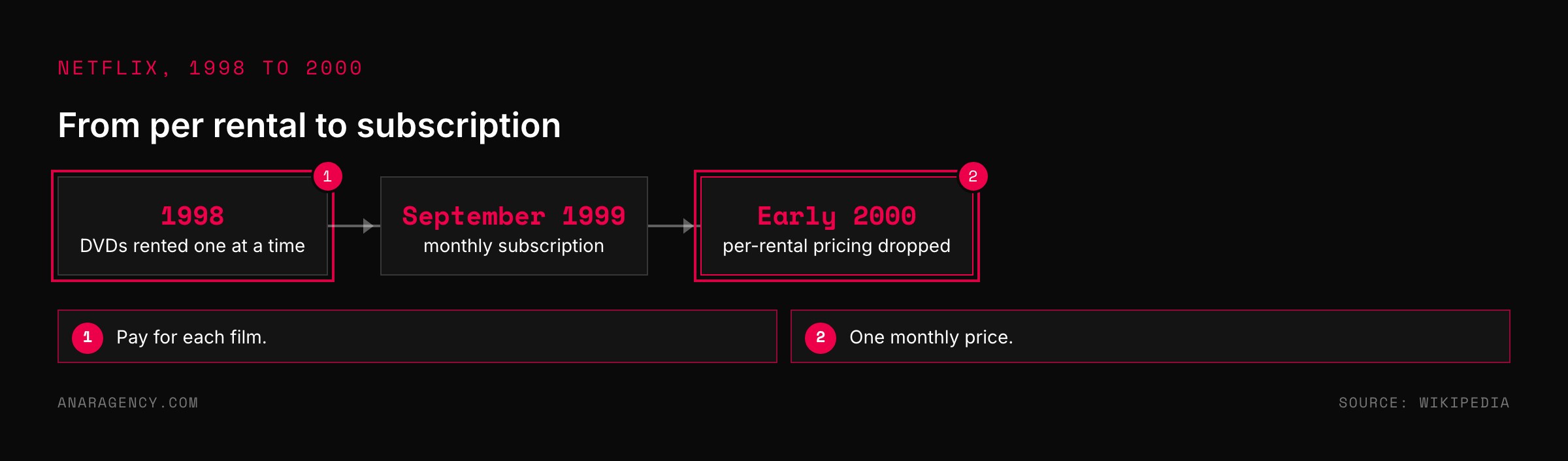
Netflix launched in April 1998 renting DVDs by mail, one rental at a time. In September 1999 it introduced a monthly subscription, and by early 2000 it had dropped per-rental pricing altogether.
Think about what the subscription removed. Deciding whether each film was worth a separate payment, and the friction of paying again and again.
The company did not invent a better DVD. It changed how customers paid, and removed a small decision and payment from every single rental.
Many winning models look like that up close. Not a new product, but an old product without the thing people disliked.
So instead of asking what your market wants, a sharper question is: what does it keep saying no to?
Six kinds of no
Almost every objection a market raises falls into one of six piles.
Price: it costs too much up front. Time: it takes too long to see a result. Effort: I would have to do too much myself.
Risk: what if I pay and it does not work? Uncertainty: I do not understand how it works.
The pitch: I can tell I am being sold to, and I am tired of it.
Each pile points to a different kind of offer. A price no suggests payment plans or smaller first steps, a time no suggests a quick early result, and an effort no suggests doing more of the work for the buyer.
Risk points to guarantees, uncertainty to showing exactly how it works, and the pitch to a format that teaches first, as in hide the pitch.
Markets say no to six things: price, time, effort, risk, uncertainty, and the pitch. Collect every no from lost deals, refunds, objections, and competitors' reviews, tag each, and count; the biggest pile is your master metric. Change the offer itself to remove that no, and test it against the old one.
When competitors copy you and the offer commoditizes, compete on efficiency or terms, or find the next no and start again.
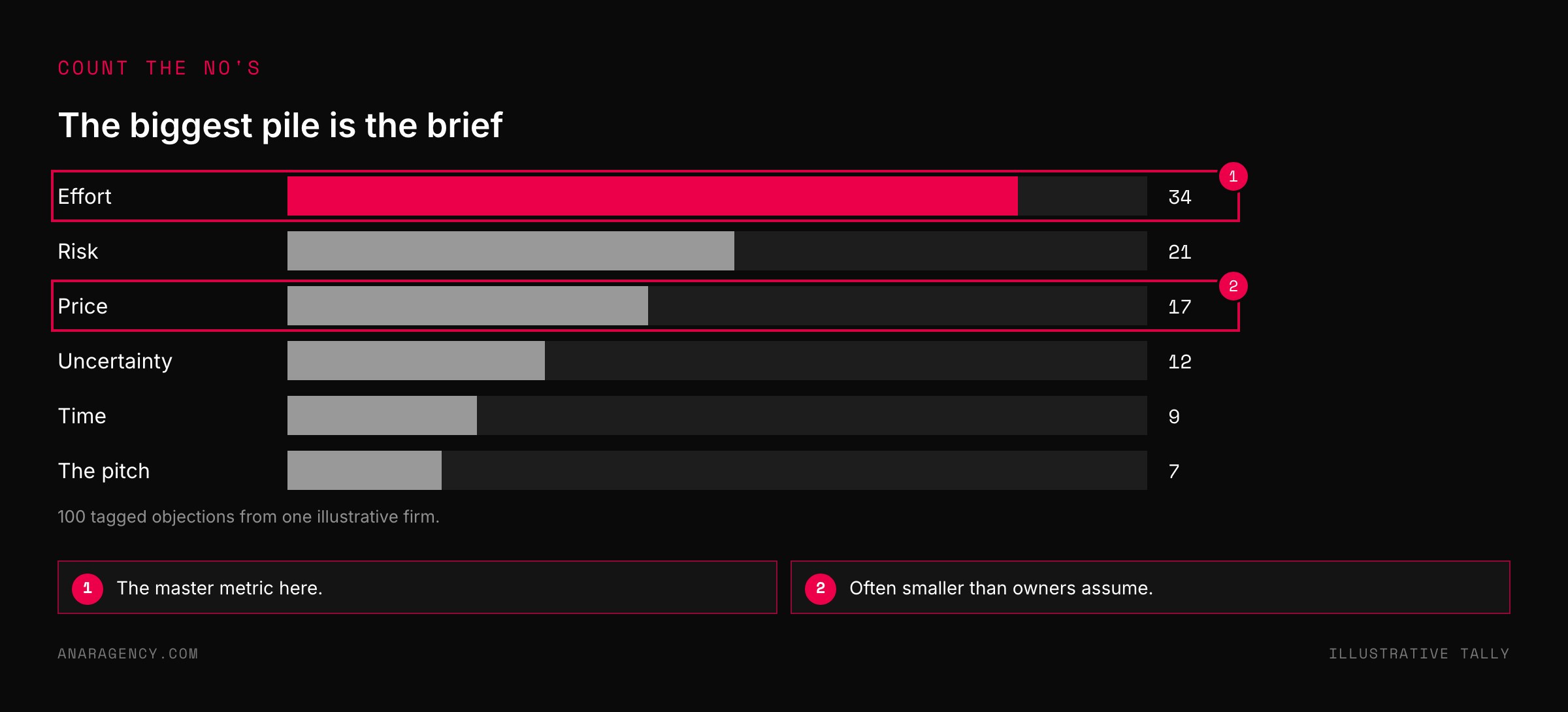
Count the no's
Most businesses hear objections every day and never write them down. That is the most valuable data they own, thrown away.
Collect every no you can find. Lost-deal notes from sales calls, refund reasons, unanswered proposals, and the complaints in your competitors' reviews.
Tag each one with one of the six piles. Do not overthink it; pick the closest.
After fifty or a hundred, one pile will usually stand out. That pile is your master metric: the single biggest reason the market does not buy.
Our rule of thumb: the competitor reviews matter as much as your own notes. Two- to four-star reviews in particular tend to say exactly what buyers wish had been different.
Build the offer that removes it
Once you know the biggest no, design for it directly. Not a new headline, but a change to the offer itself.
If the pile is effort, ask what you could do for the buyer that they now do themselves. If it is time, ask what result you could deliver in the first week.
If it is risk, ask what you could guarantee honestly, and price that in. If it is uncertainty, show the process step by step before anyone pays.
Then test it on a small budget against the old offer. The test is whether more people say yes, not whether the new offer sounds better.
For a structured way to check the result, see the offer review grid.
Here is an illustrative example. A bookkeeping firm tags its lost deals and finds that effort is the biggest pile: owners hate gathering receipts.
Instead of a new headline, it changes the offer. It connects directly to the client's bank and card accounts so receipts are matched automatically.
The price stays the same. The effort no disappears, and the firm now says so on every page.
When the model becomes a commodity
Every model that works gets copied. When enough sellers remove the same no, the market stops noticing it.
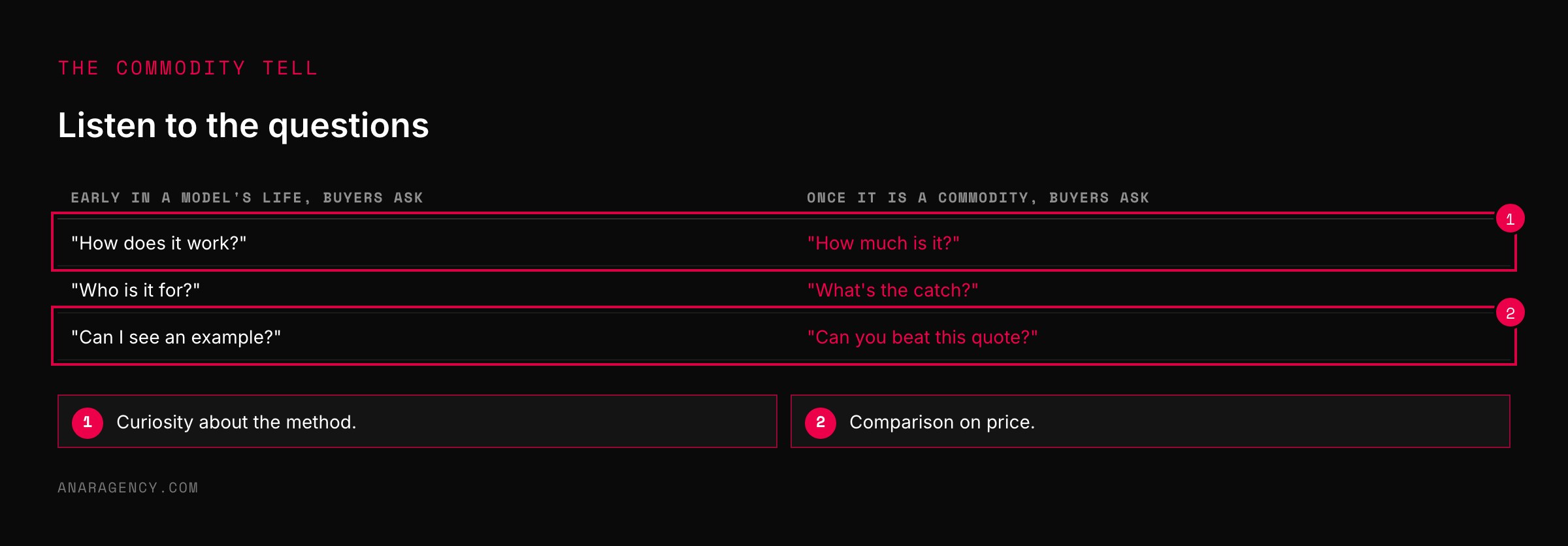
You can hear the moment it happens. Buyers stop asking how it works and start asking how much it costs and what the catch is.
That is commoditization: the offer has become interchangeable, so buyers compare on price.
At that point there are two common responses. Compete on efficiency, doing the same thing faster and cheaper, or on terms, such as financing or paying from results.
Or go back to the loop. A commoditized market always has a new no forming, and the first seller to remove it starts the next cycle. For the bigger cycle, see the maturity ladder.
"Our customers just say it is too expensive."
"Too expensive" is often a stand-in. It can mean the price is too high, but it can also mean the buyer does not trust the result, cannot see how it works, or does not want to do the work.
Ask one more question before you tag it. "Is it the total, or is it whether this will work for you?"
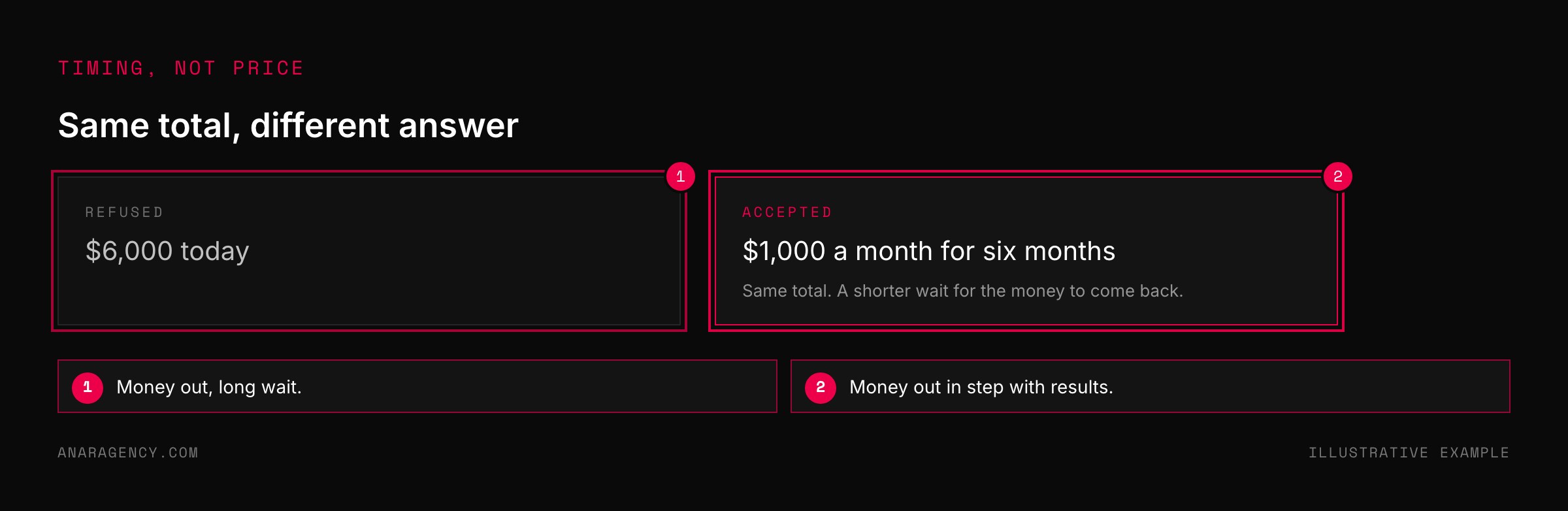
If it really is price, look at when the money is paid, not only how much. A buyer who would pay $6,000 over six months may refuse $6,000 today.
That timing question has a name in finance, the cash conversion cycle: how long money is out before it comes back. Many buyers say no to a long cycle, not a high price.
And if it is not price at all, you have just found your real master metric. For more on stand-in objections, see the take-away close.
What to read next, and why
Netflix (encyclopedia entry): The switch from per-rental to subscription in 1999.
Commoditization (encyclopedia entry): What happens when every seller removes the same no.
Cash conversion cycle (encyclopedia entry): Why the timing of payment can matter more than the price.
Outcome-driven innovation (encyclopedia entry): A formal method for designing around what customers are trying to get done.
So the simple takeaway is this: write down the last twenty reasons people did not buy from you, tag each with one of the six, and build your next offer around the biggest pile.
Questions executives ask
What is a marketing model?
A repeatable way of finding and selling to customers. Many successful models are an existing product with the market's biggest objection removed.
How do I find out why customers do not buy?
Collect lost-deal notes, refund reasons, unanswered proposals, and complaints in competitors' reviews, then tag each objection as price, time, effort, risk, uncertainty, or the pitch.
What does "too expensive" really mean?
Sometimes price, but often doubt about the result, confusion about how it works, or reluctance to do the work. Ask one more question before assuming it is price.
How do I know my offer has become a commodity?
Buyers stop asking how it works and start asking how much it costs and what the catch is, and competitors offer nearly the same thing.
What did Netflix change in 1999?
It introduced a monthly subscription for DVD rentals in September 1999 and dropped its per-rental model by early 2000.

Filip Kovacevic is the founder of Anar Agency in Phoenix. He spent five years running SEO, Meta ads, email, and content for medical practices across the United States, and now does the same work for healthcare, home-service, legal, and professional-service businesses, alongside AI implementation. More from Filip →
Talk it through in 15 minutes
Bring one AI question from this article. We will tell you what we would do, whether or not you hire us.
Book a 15-Min Chat →