The FTC Risk Drivers in Marketing Claims
In the US, advertising must be truthful, not misleading, and backed by evidence. In practice, five things drive most risk: results and earnings claims (specific outcomes are read as typical), who you sell to (vulnerable buyers raise the stakes), how you handle refunds and complaints, how clearly you bill for recurring charges, and whether reviews and endorsements are real and disclosed. Check each one: prove every result you show, honor your guarantee as written, make renewals and cancellation clear, and use only genuine reviews.
This is a general guide, not legal advice.
A letter to 1,100 businesses
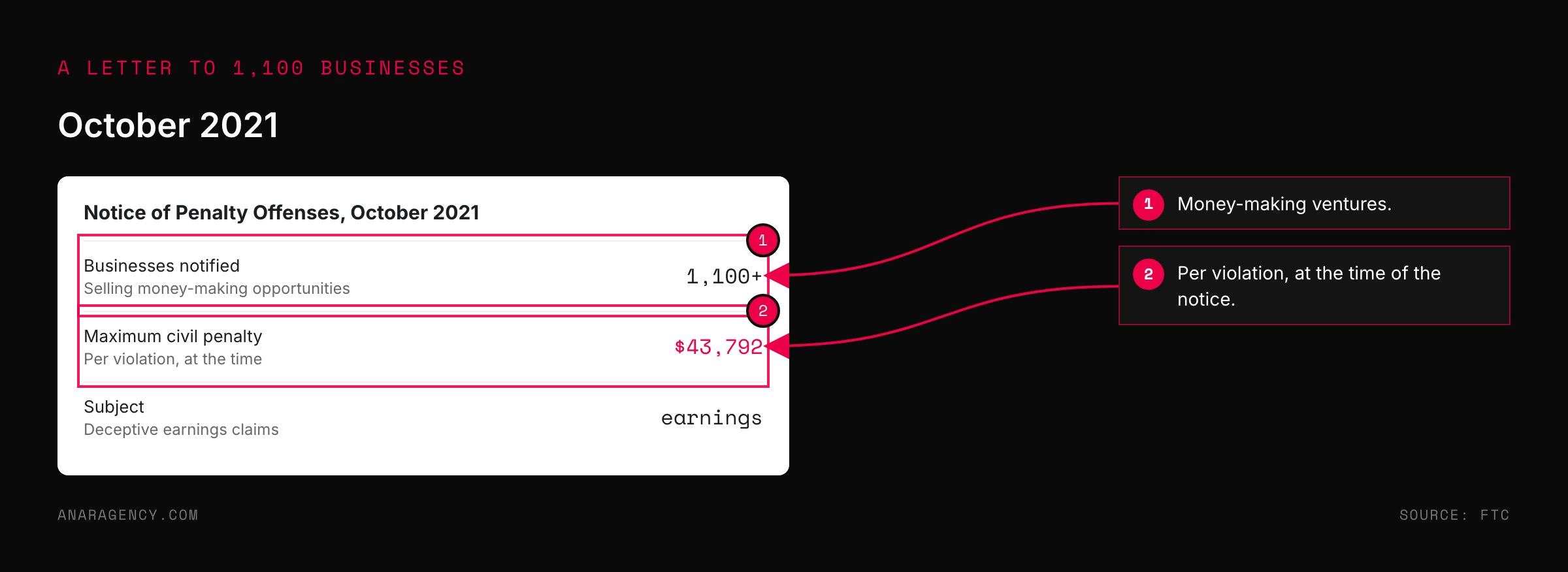
In October 2021 the Federal Trade Commission sent a Notice of Penalty Offenses to more than 1,100 businesses that pitch money-making ventures.
The notice warned that if they deceived consumers about potential earnings, they could face civil penalties of up to $43,792 per violation.
Most service businesses will never receive a letter like that. But the habits that worried the FTC are not limited to get-rich-quick offers.
A testimonial showing an unusually good result, a guarantee that is hard to claim, a renewal buried in small print. These show up in ordinary marketing every day.
This article maps the five drivers of risk in plain English. It is a general guide, not legal advice, and a lawyer should review anything you are unsure about.
The basic rule
The FTC's basic standard is short. Advertising must be truthful and not misleading, and advertisers must have evidence to back up their claims before they make them.
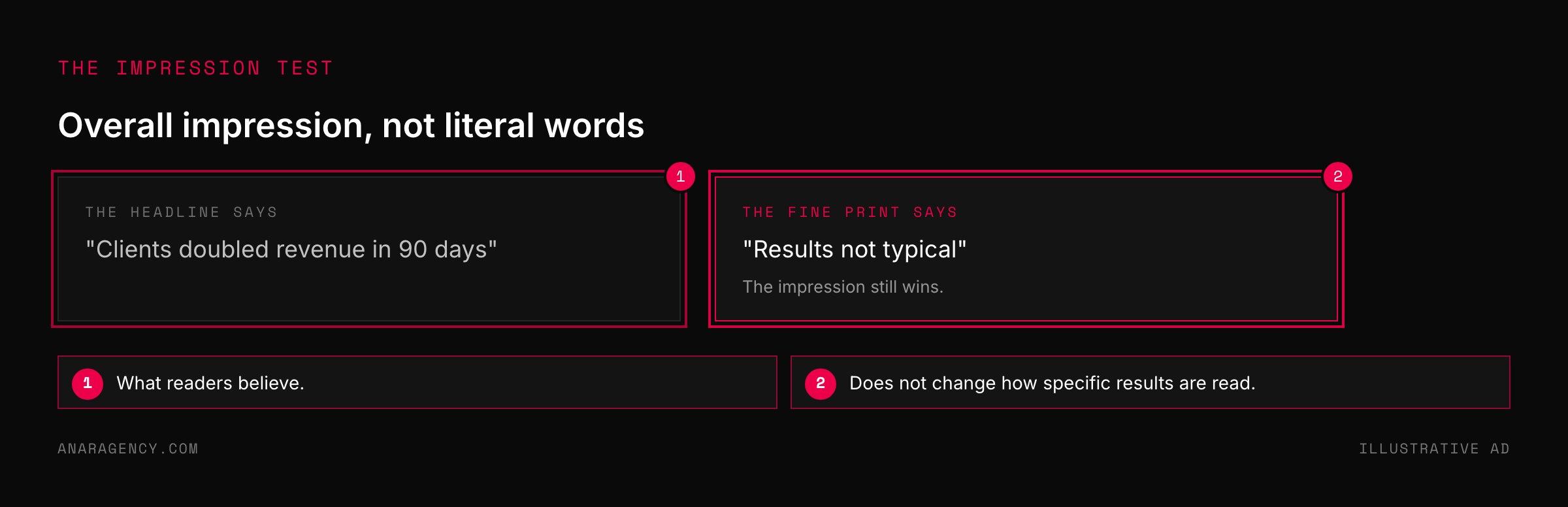
The FTC also looks at the overall impression an ad gives, not just the literal words. An ad can be misleading even if every sentence is technically true.
That is why fine print rarely rescues a misleading headline. If the big words promise one thing and the small words take it back, the impression is what counts.
Everything that follows is that rule, applied to the places where businesses most often get it wrong.
Keep the rule in mind as you read. Truthful, not misleading, and backed by evidence before you publish.
US advertising must be truthful, not misleading, and backed by evidence, judged by the overall impression. Five things drive most risk: results and earnings claims (read as typical), who you sell to (vulnerable buyers raise the stakes), refunds and complaints (honor guarantees as written), recurring charges (clear terms, easy cancellation), and reviews and endorsements (genuine, with connections disclosed). Risk grows when drivers stack.
Run a one-hour self-check and have a lawyer review the rest. Not legal advice.
Five risk drivers
1. Results and earnings claims. When an ad shows a specific result, people assume it is typical.
The FTC says "results not typical" does not change that. You need proof the result is typical, or you must state what people generally achieve.
2. Who you sell to. Selling a dream to people who are desperate, in debt, or otherwise vulnerable raises the stakes.
Claims that might pass with experienced buyers can do real harm to people who cannot afford to lose the money.
3. Refunds and complaints. A guarantee is a promise.
Under FTC guides, terms like "satisfaction guaranteed" or "money back guarantee" should only be used if you refund the full price on request, with any conditions clearly disclosed.
4. Recurring charges. Subscriptions, auto-renewals, and free trials that turn into payments need clear terms and easy cancellation.
Confusing billing turns into complaints and chargebacks quickly.
5. Reviews and endorsements. Fake reviews are banned under the FTC's 2024 rule, and endorsers with a connection to you must disclose it.
How the drivers combine
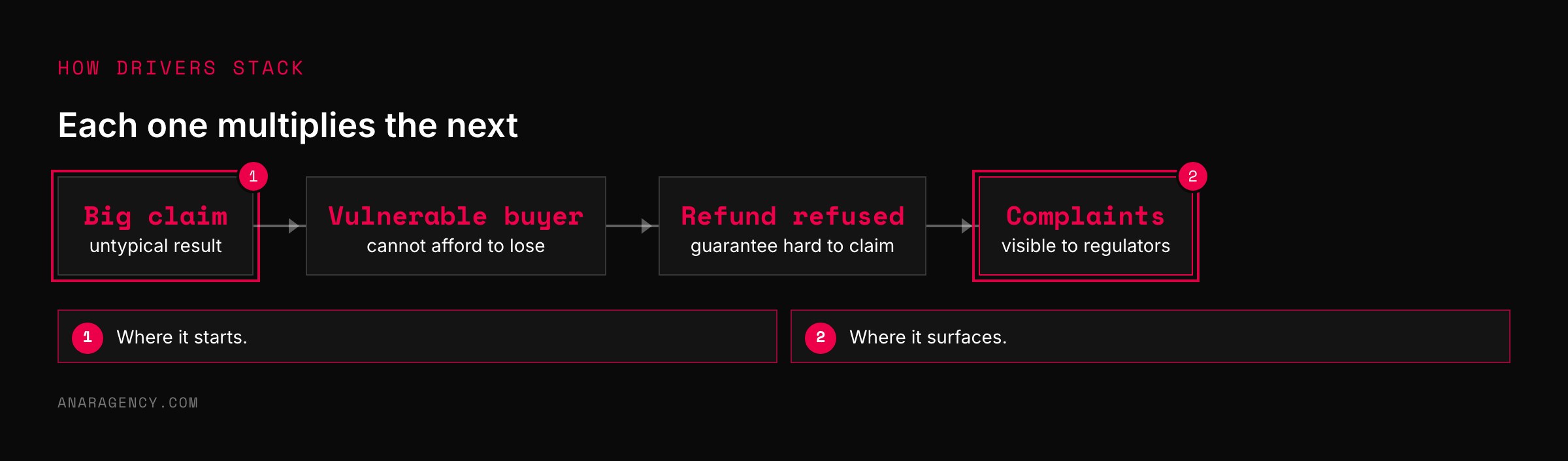
Each driver alone is manageable. The trouble usually starts when they stack.
Picture a big earnings claim, sold to people in financial trouble, with a guarantee that is hard to claim and a renewal they did not notice.
Every piece multiplies the others. Unhappy buyers ask for refunds, refunds are refused, complaints and chargebacks follow, and complaints are visible to regulators and payment processors in a way ad copy is not.
The opposite also holds. Honest claims, buyers who can afford it, refunds honored quickly, and clear billing make the whole business harder to complain about.
So the cheapest protection is often not in the ad copy at all. It is in how you treat people after they pay, as in every sale spends trust.
Here is a quick way to see your own stack. Score each of the five drivers from low to high risk for your business.
A firm with modest, typical claims, buyers who can afford it, a guarantee it honors, simple billing, and real reviews scores low everywhere.
A firm with one high score should fix that driver first. A firm with three or more high scores should talk to a lawyer before running more ads.
A one-hour self-check
Claims. List every result, number, and earnings figure on your site, ads, and sales pages. For each one, can you show it is typical, or do you state what is typical next to it?
Guarantee. Read your guarantee as a buyer would. Does it say exactly what is refunded and how?
Do your records show you actually honor it?
Billing. Can a customer see what renews, when, and for how much, and cancel without a fight?
Reviews. Are all reviews from real customers, unedited in meaning, and are any paid or connected endorsers disclosed?
If any answer is "no" or "not sure," fix that one first. Then have a lawyer who knows advertising law look at the rest.
"Our claims are true, so we are fine."
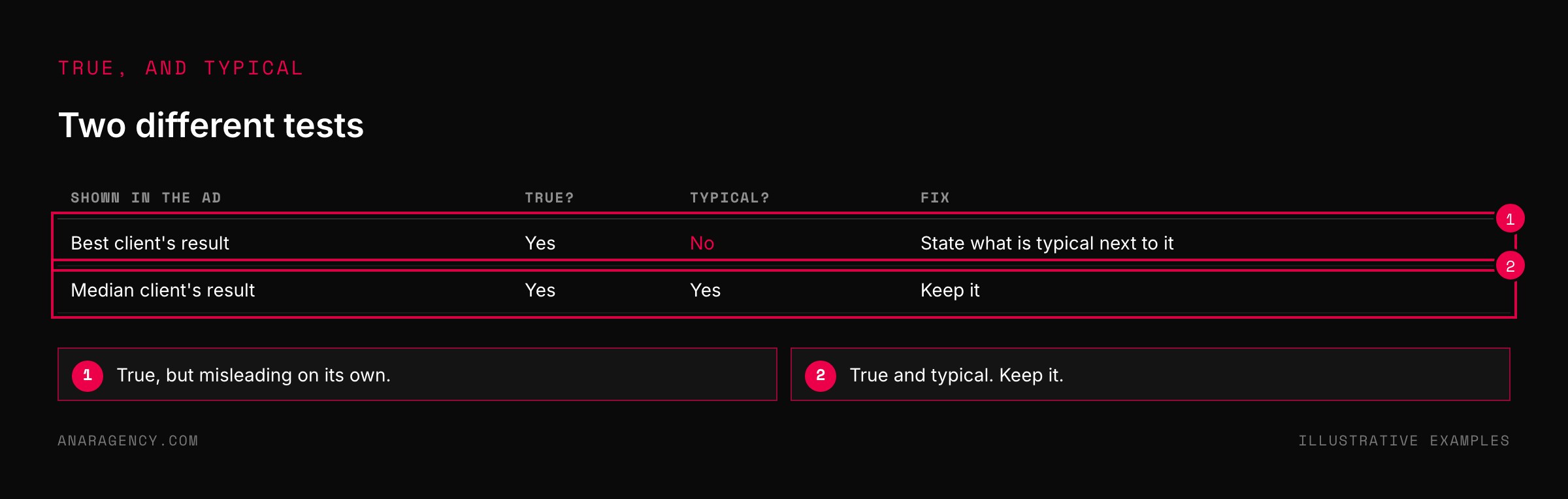
True is necessary, not sufficient. A true result from your best customer can still mislead if most customers get far less.
The test is the impression, not the sentence. What would an ordinary reader believe they will get?
If the honest answer is "more than most people get," add what is typical, or choose a more typical example.
This often makes marketing stronger, not weaker. A believable result next to a clear method persuades buyers who have seen too many inflated promises, as in four sources of credibility.
And it lets you sleep. A business built on claims it can prove has one less thing to worry about every time a new customer signs up.
What to read next, and why
FTC notice on money-making claims (FTC press release): The 2021 warning and the penalties involved.
Advertising FAQs: A Guide for Small Business (FTC guide): The basic rules in plain language.
FTC's Endorsement Guides: What People Are Asking (FTC guide): Typical results, testimonials, and disclosures.
Guides for the advertising of warranties and guarantees (US federal regulation): When you may say "money back guarantee."
So the simple takeaway is this: spend one hour this week listing every result you show in your marketing, and next to each one, write the evidence that it is typical.
Questions executives ask
What are the FTC rules for marketing claims?
Advertising must be truthful, not misleading, and backed by evidence before the claim is made. The FTC judges the overall impression an ad creates, not just its literal words.
Can I use testimonials with exceptional results?
Under FTC guidance, specific results are usually read as typical. You need proof they are typical, or you must clearly state what people generally achieve. "Results not typical" is not enough.
When can I advertise a money-back guarantee?
FTC guides say terms like "satisfaction guaranteed" or "money back guarantee" should be used only if you refund the full purchase price on request, with any conditions clearly disclosed.
Are fake reviews illegal?
Yes. The FTC's 2024 rule bans fake reviews and testimonials, including those that misrepresent who wrote them.
What did the FTC's 2021 money-making notice say?
It warned more than 1,100 businesses that deceptive earnings claims about money-making opportunities could bring civil penalties of up to $43,792 per violation.

Filip Kovacevic is the founder of Anar Agency in Phoenix. He spent five years running SEO, Meta ads, email, and content for medical practices across the United States, and now does the same work for healthcare, home-service, legal, and professional-service businesses, alongside AI implementation. More from Filip →
Talk it through in 15 minutes
Bring one AI question from this article. We will tell you what we would do, whether or not you hire us.
Book a 15-Min Chat →