Offer Economics Before Launch: Velocity Cap and Allowable Cost

Before spending on ads, work out four numbers for one customer: what they pay you, including any add-ons, what it costs to deliver, the margin left over, and what you can afford to pay to win them, which is your allowable cost. If advertising in your market costs more than that, the offer needs to change, not the ads. For recurring offers, add one more: the customer count settles where the number arriving each month equals the number leaving, which is new customers divided by monthly churn.
Use cautious assumptions, and keep one source of truth for each figure.
A ticket a day for 9.95 dollars
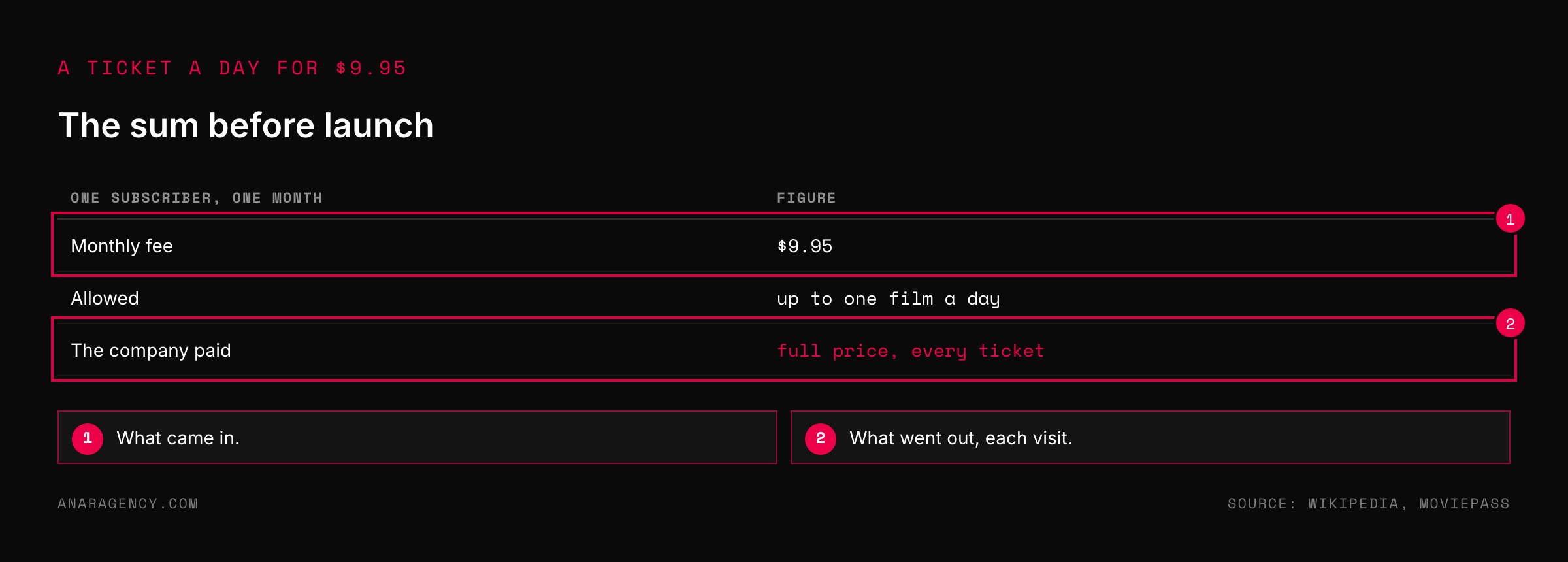
In 2017 a cinema subscription service cut its price to 9.95 dollars a month. Subscribers could see one film in a cinema every day.
The way it worked was simple. When a subscriber checked in at a cinema, the company loaded the cost of the ticket onto a payment card, and the subscriber used the card to buy the ticket at the normal price.
So the company paid full price for every film watched. One visit could cost more than the whole month's fee.
People signed up in huge numbers. Membership grew to over three million by June 2018. The service ran into financial trouble and shut down in September 2019.
Nothing about that was a surprise in hindsight. A single line on a spreadsheet, fee minus the cost of a typical member's tickets, said it on the first day.
Most offers are launched without the sum
Small businesses rarely lose money that dramatically. They lose it quietly, by launching an offer whose numbers were never written down.
The ads go live. Leads come in. Some sales happen.
It feels like it is working, until the bank balance says otherwise in month three.
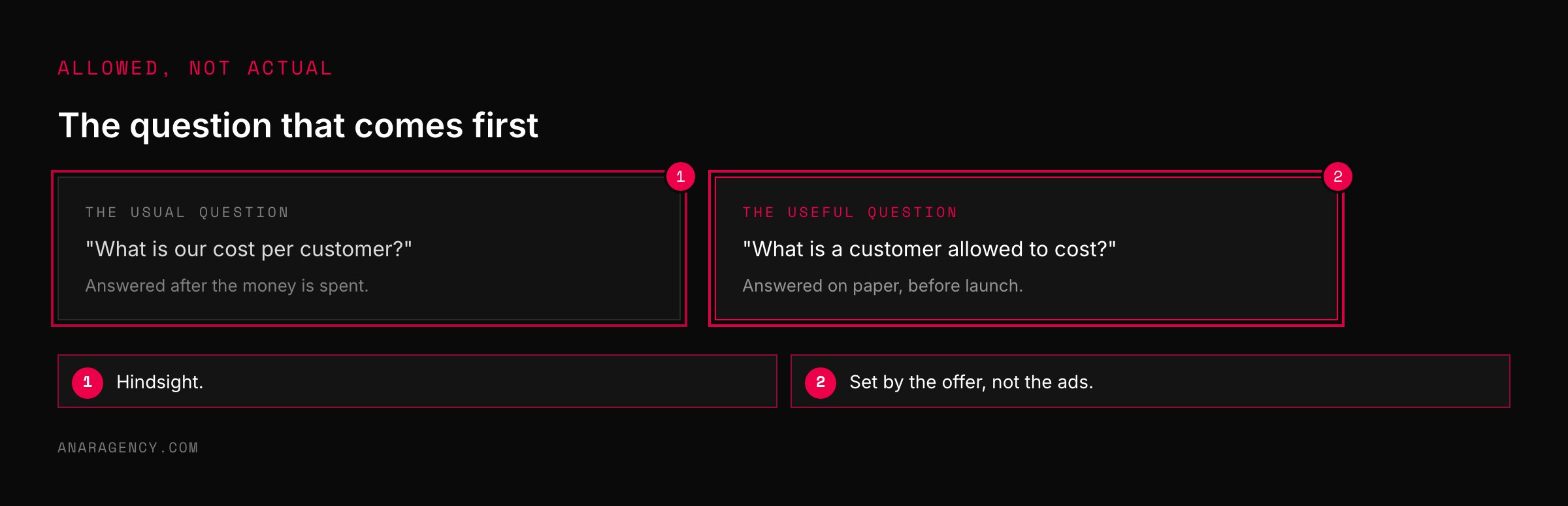
The cause is nearly always the same. Nobody decided in advance what a customer was allowed to cost.
Marketers call the figure customer acquisition cost: what you spend, on average, to win one customer. The useful question is not what it is. It is what it is allowed to be.
That ceiling comes from the offer, not from the ads. It is set by what a customer pays and what serving them costs, which is why it can be worked out before any ad runs. We cover the reading of it once ads are live in your maximum allowable cost.
Before launch, fill four lines for one customer: what they pay, including add-ons times take rate; what it costs to deliver; the margin; and the allowable cost after the profit you want to keep. If that is below what customers cost in your market, change the offer. For recurring offers, the customer count settles at new customers per month divided by monthly churn.
Plan with cautious conversion rates, pick one source of truth per number, raise assumed costs as spend grows, and review monthly.
The four-line sheet
Here is the sheet, and it fits on one page.
Line one: what a customer pays you. The first sale, plus each add-on multiplied by the share of buyers who take it.
Line two: what it costs to deliver. Materials, labor, payment fees, and a realistic allowance for refunds.
Line three: what is left. Line one minus line two. Accountants call it the contribution margin.
Line four: what you can pay to win one. The margin, less the profit you want to keep. That is your allowable cost.
Now compare line four with what clicks and leads actually cost in your trade. If line four is lower, stop.
The fix is in the offer: a higher price, a cheaper way to deliver, an add-on that more people want, or a reason for customers to come back. More creative will not close a gap that sits in the arithmetic.
Velocity Planners: the ceiling and the habits
Some owners are never surprised by their own results. They planned the numbers before launch and revisit them every month. We call them Velocity Planners.
They know the ceiling. In a recurring business, some customers leave every month. The share who leave is the churn rate.
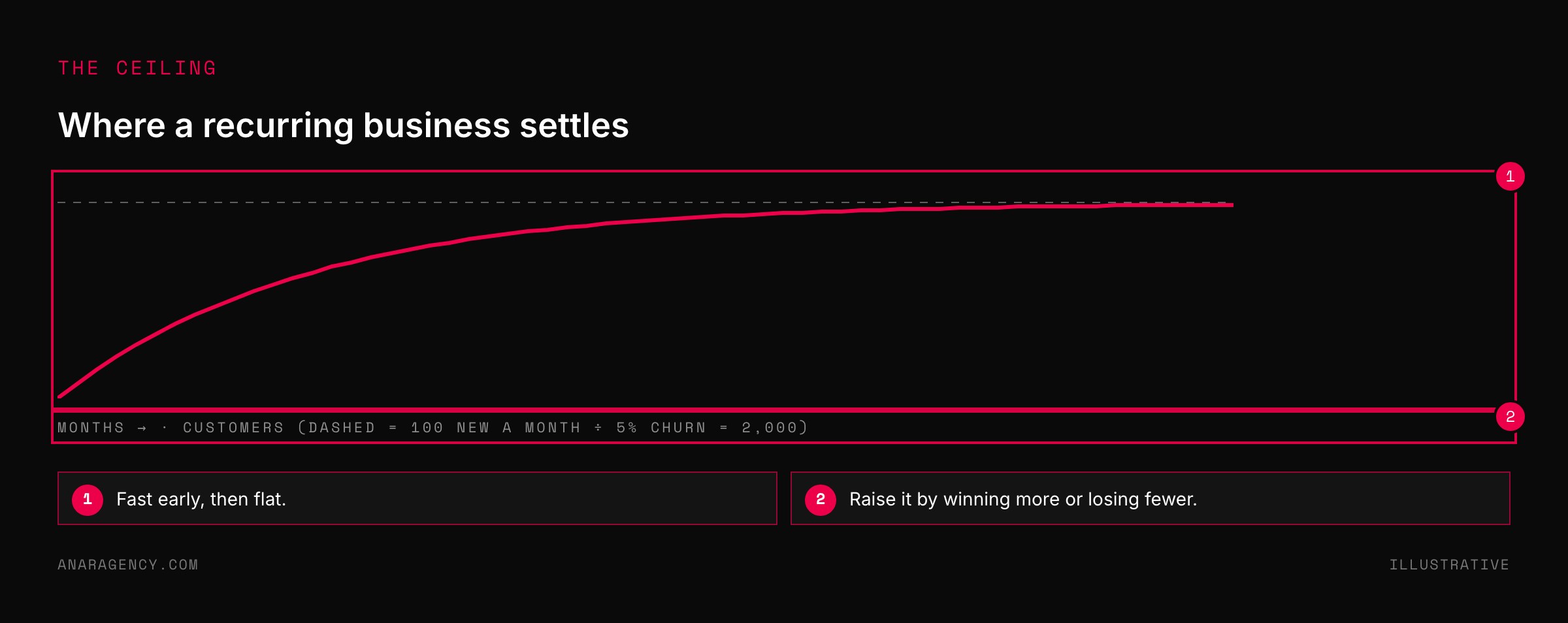
Divide new customers a month by monthly churn and you get the size the business settles at.
A hundred new customers a month at five percent churn settles at about two thousand. To grow past it, you must either win more or lose fewer. Spending more on ads at the same churn only raises the ceiling slowly.
We call that limit the Velocity Cap.
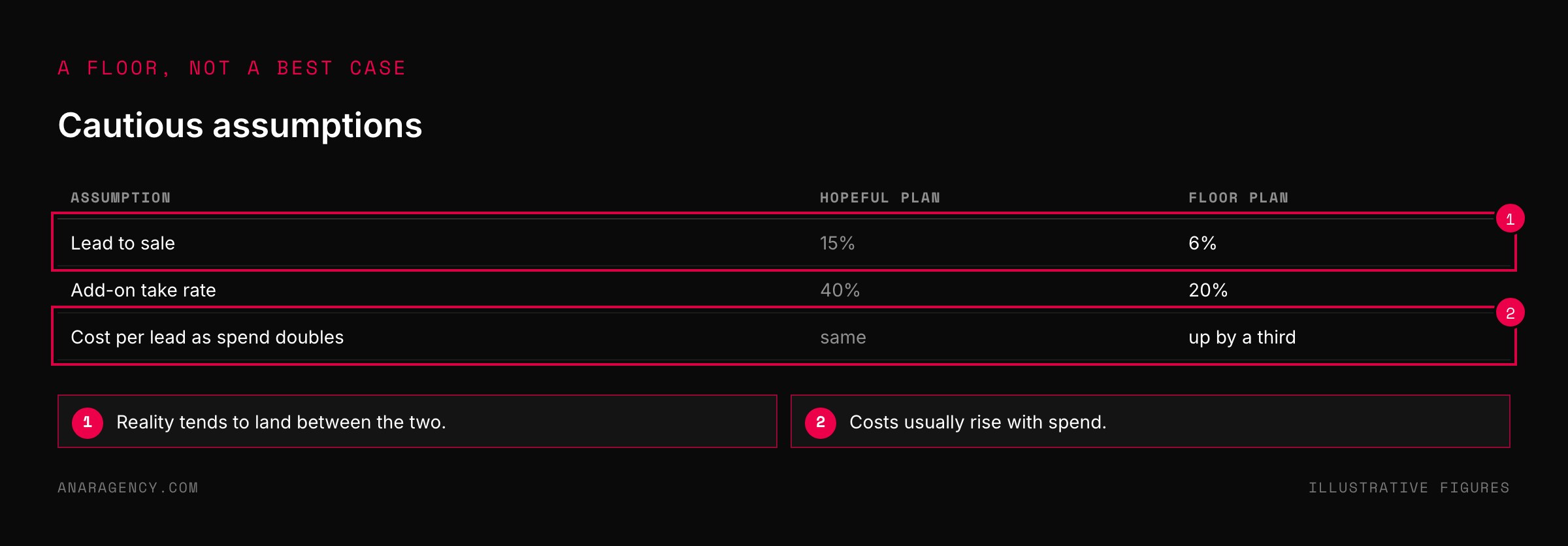
They assume less. People are reliably too hopeful about their own results, a tendency researchers call optimism bias. So they plan with a lower conversion rate than they expect.
The plan becomes a floor, not a best case.
They pick one source for each number. The ad platform, the analytics tool, and the bank will all disagree. Choose which one counts for spend, which for sales, which for refunds, and do not switch when one is more flattering.
They plan for rising costs. As spend increases, each extra customer usually costs more. So they raise the assumed cost per lead in the sheet as the budget grows.
They hold a monthly review. A few hours with the sheet and the real numbers side by side. The point is not the arithmetic.
It is finding the one line that moved.
"I am a service business, not a subscription"
You may sell one-off jobs and think the ceiling does not apply. Part of it does not. The sheet does.
A plumber, an accountant, or a consultant has a price, a cost to deliver, and a margin. The allowable cost follows from those as surely as for any software company.
Repeat business matters too. If a quarter of customers come back within a year, the real value of a customer is higher than the first job, and the allowable cost rises with it.
Be careful with that, though. Count only repeat business you have seen, not business you hope for.
And do the sum before you build the offer, not after the ads disappoint. Changing a price on paper costs nothing. Changing it after launch costs a lot.
When the sheet says the offer cannot work at current prices, the most useful next read is offers start with principles.
What to read next, and why
MoviePass (encyclopedia entry): The pricing, the growth, and the collapse.
Customer acquisition cost (encyclopedia entry): How the cost of winning a customer is measured.
Contribution margin (encyclopedia entry): The accountant's term for what is left after the cost of delivering a sale.
Churn rate (encyclopedia entry): The figure that sets the ceiling on any recurring business.
So the simple takeaway is this: write the four lines for your main offer on one page today. If you cannot fill in line two, find out before you spend another dollar on ads.
Questions executives ask
What is allowable cost per acquisition?
The most you can spend to win one customer and still make the profit you want. It is the margin on a customer, meaning what they pay minus what it costs to serve them, less your target profit.
How do I work out offer economics before launch?
Write down what a customer pays including any add-ons, what it costs to deliver, and the margin left. Subtract the profit you want to keep. The result is what you can afford to pay for a customer.
Compare it with what advertising actually costs in your market.
What is the velocity cap?
Our name for the size at which a recurring business stops growing. When the number of customers leaving each month equals the number arriving, the total stops rising. It equals new customers per month divided by the monthly churn rate.
Why should I use conservative assumptions?
Because people tend to overestimate their own results. Planning with a lower conversion rate than you expect makes the plan a floor, so reality is more likely to beat it than to fall short.
What happened to MoviePass?
In 2017 the service cut its price to 9.95 dollars a month for up to one film a day, while paying cinemas full price for each ticket. Membership passed three million by June 2018, and the service shut down in September 2019 after financial problems.

Filip Kovacevic is the founder of Anar Agency in Phoenix. He spent five years running SEO, Meta ads, email, and content for medical practices across the United States, and now does the same work for healthcare, home-service, legal, and professional-service businesses, alongside AI implementation. More from Filip →
Talk it through in 15 minutes
Bring one AI question from this article. We will tell you what we would do, whether or not you hire us.
Book a 15-Min Chat →