Price by Income Share: The 1% Monthly, 10% Annual Rule
A price is felt as a share of the buyer's income, not as a number of dollars. As a working rule of thumb, a recurring charge near 1 percent of the buyer's monthly income is paid without much thought, and a one-time purchase near 10 percent of annual income becomes a considered decision that needs proof and usually a conversation. For a US household at the median income of $83,730, those thresholds are about $70 a month and about $8,400.
Price from the buyer's income down, not from your costs up, and match how you sell to which side of each threshold you land on.
Is $600 expensive?
Someone asks whether $600 a month is a lot to charge. There is no answer.
To a freelancer bringing in $6,000 a month it is a tenth of everything. They will think about it for a week, ask a friend, and probably say no.
To a firm bringing in $80,000 a month it is under one percent. The owner will approve it between two other emails.
Same service. Same price. Two completely different decisions.
The price did not change. What it was a share of did.
People judge prices as shares
This is one of the better-established facts about how people handle money.
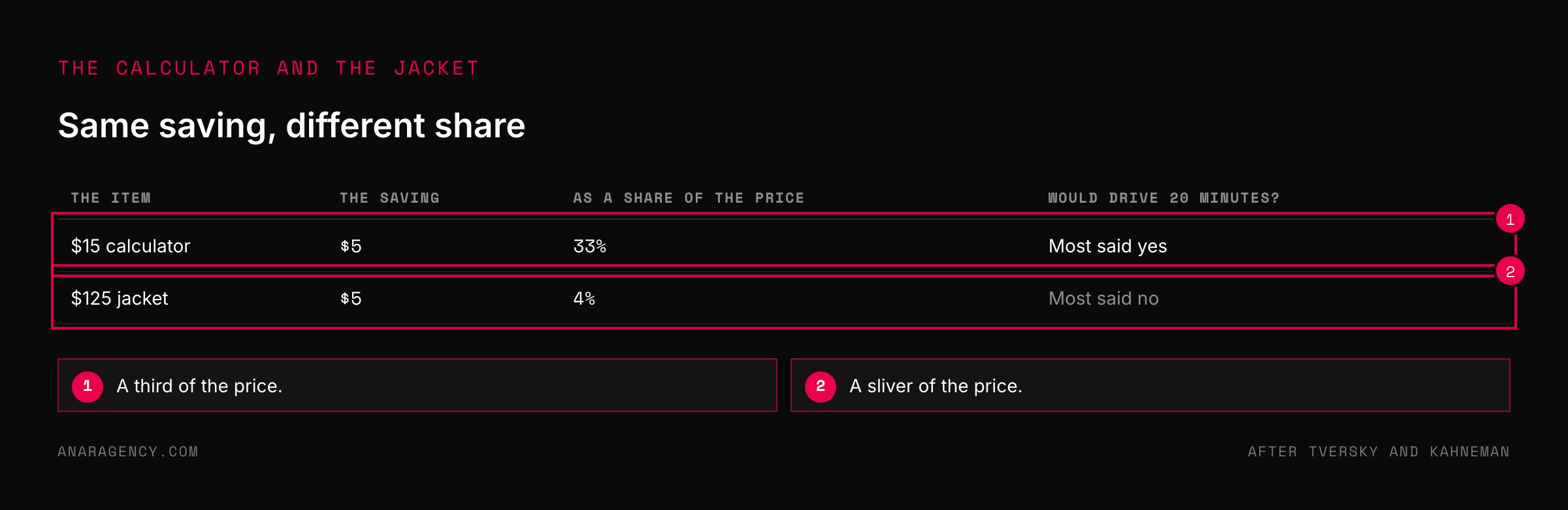
In a famous experiment, people were asked whether they would drive twenty minutes to save $5. Most said yes when the item was a $15 calculator, and most said no when it was a $125 jacket. Same five dollars.
Same twenty minutes.
The saving was a third of one price and a sliver of the other. People were not weighing dollars. They were weighing a proportion.
The idea is far older than marketing. In the 1800s researchers studying the senses found that whether you notice a change depends on how big it is relative to what was already there. A candle is obvious in a dark room and invisible at noon.
A price works the same way. It is noticed, or not, against the size of the income it comes out of.
Judge a price as a share of the buyer's income, not in dollars. Two working thresholds: near 1 percent of monthly income, a recurring charge is paid without much thought; near 10 percent of annual income, a purchase becomes a considered decision that needs proof and a conversation. Price from the buyer's income down, match the sales process to the threshold, pick buyers for whom your price is a small share, and state totals plainly when you split a payment.
For business buyers, use revenue and approval limits.
Two thresholds
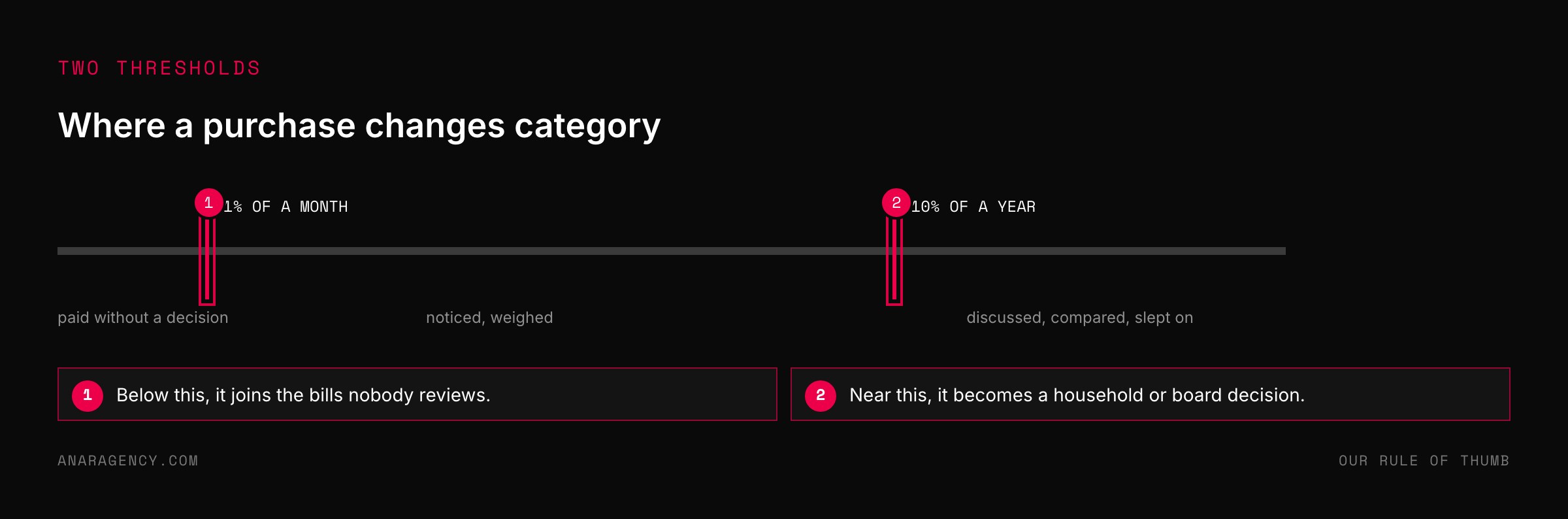
If price is felt as a share, the useful question is which shares matter. We work with two.
About 1 percent of a month's income. A recurring charge near this size tends to be decided alone and quickly, and then left running. It joins the bills nobody reviews.
About 10 percent of a year's income. A purchase near this size is a different animal. It gets discussed with a spouse or a partner.
It gets compared. It needs proof, and usually a person to talk to.
Put numbers on it. The Census Bureau reports that median household income in the United States was $83,730 in 2024. One percent of a month of that is about $70.
Ten percent of the year is about $8,400.
We want to be straight about what these are. They are a rule of thumb we find useful, not a law and not the result of a study. The exact lines move with the buyer and the product.
What does not move is the shape. There is a size of charge that slips through without a decision, and a size that triggers one.
Share Setters: how to use it
Some businesses seem to price by instinct and get it right. They are doing one thing differently. They start from the buyer.
We call them Share Setters.
They price from the buyer's income down. Most businesses add up their costs and put a margin on top, which is cost-plus pricing. It tells you the least you can charge.
It says nothing about what the buyer will feel.
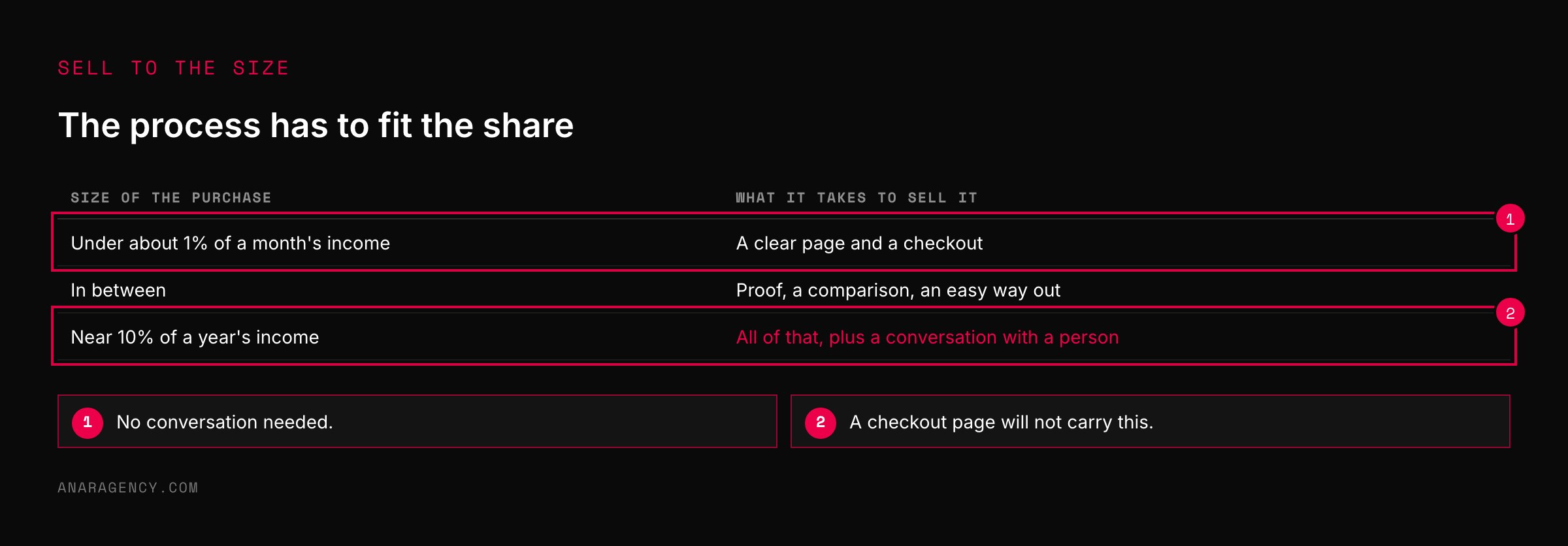
They match the selling to the threshold. Under the first line, a checkout page is enough. Near the second, you need proof, a guarantee of some kind, and a conversation.
Selling a ten-percent purchase with a one-percent sales process is why it does not convert.
They choose the buyer who makes the price small. If your service must cost $600 a month to be worth doing, the answer is not a discount. It is a buyer for whom $600 is under one percent.
They split big prices on purpose. A purchase that would cross the second line as one payment may sit under the first as twelve. That is honest when the total is stated plainly, and deceptive when it is hidden.
This is the practical side of value-based pricing. The value is not abstract. It is measured against a real person's real income.
"My buyers are businesses, not households."
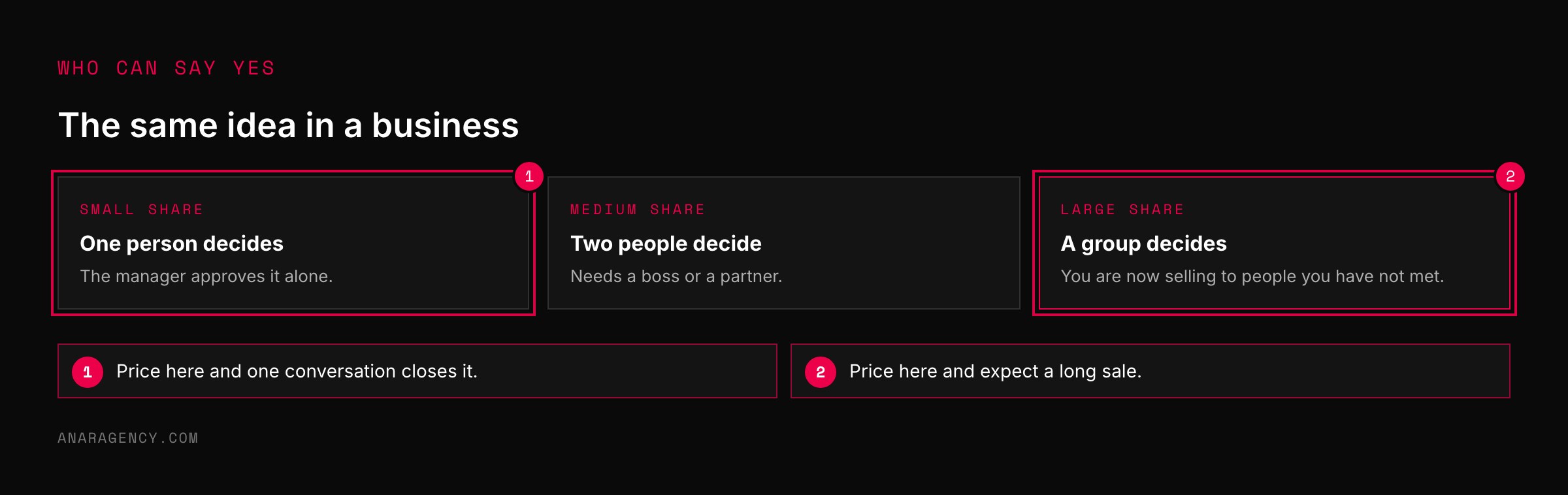
You may be thinking this is for consumer products. It works the same way for a business buyer, with one substitution. Use what the business brings in, and who is allowed to spend it.
A manager can usually approve a small monthly charge alone. Above some line, it needs a boss, a second signature, or a committee. That line is the first threshold in a suit.
So the same test applies. Is your price a share the person in front of you can approve by themselves? If not, you are now selling to people you have not met.
The second objection: is charging richer buyers more unfair? You are not charging more for the same thing. You are choosing which buyers the thing is priced for.
A price that is a bargain to one firm and a strain to another is simply the wrong fit for the second one. Saying so is kinder than discounting until the work is not worth doing.
Before any of this, know the most you can pay to win that buyer. That sum is in max allowable CPA. And for what makes the price feel worth it, see selling outcomes.
What to read next, and why
Income in the United States: 2024 (US Census Bureau): The source for the median income figure, with breakdowns by household type and region.
Mental accounting (encyclopedia entry): The research behind the calculator and the jacket, and much else about how people file their money.
Value-based pricing (encyclopedia entry): The formal version of pricing from the buyer's side.
Cost-plus pricing (encyclopedia entry): What most businesses do instead, and what it leaves out.
So the simple takeaway is this: stop asking whether your price is high. Ask what share of your buyer's income it is, and whether you are selling it the way a purchase that size needs to be sold.
Questions executives ask
How should I price a service?
Start from the buyer, not your costs. Work out what share of the buyer's income or revenue your price represents. A small share can be sold with a simple checkout.
A large share needs proof, a way to reduce risk, and a conversation. Your costs only tell you the lowest price you can accept.
What is the 1 percent and 10 percent pricing rule?
A rule of thumb, not a research finding. A recurring charge near 1 percent of the buyer's monthly income tends to be paid without much deliberation, while a one-time purchase near 10 percent of annual income tends to be discussed, compared, and decided slowly.
What is the median household income in the United States?
The US Census Bureau reports that median household income was $83,730 in 2024. One percent of a month at that income is about $70, and 10 percent of the year is about $8,400.
Why do people judge prices relatively?
Research on mental accounting shows people weigh a saving or a cost against the size of the purchase, not in absolute dollars. In a well-known experiment most people would travel to save $5 on a $15 calculator, and most would not to save $5 on a $125 jacket.
Should I discount if buyers say my price is too high?
Usually the better move is a different buyer. If the price is a large share of this buyer's income, a discount big enough to change that may make the work unprofitable. A buyer with more income or revenue experiences the same price as small.

Filip Kovacevic is the founder of Anar Agency in Phoenix. He spent five years running SEO, Meta ads, email, and content for medical practices across the United States, and now does the same work for healthcare, home-service, legal, and professional-service businesses, alongside AI implementation. More from Filip →
Talk it through in 15 minutes
Bring one AI question from this article. We will tell you what we would do, whether or not you hire us.
Book a 15-Min Chat →