Straight-to-Quiz Lead Gen and the Catalog Model
Two ideas shape a modern lead funnel. First, match the first step to how the visitor arrived. Someone who searched will read a full page.
Someone who tapped an ad in a social feed often will not, so send them straight to a short quiz or form with trust signals and a clear payoff at the top. Second, build a catalog behind one front-door offer. Use a single offer to win the customer, then map the problems they will meet across the year and match a service to each.
The front door acquires, and the catalog earns.
Why a warehouse sells chicken
Costco is a membership warehouse. It sells tyres, televisions, and pallets of bottled water. It also sells roast chicken.
A shopper who comes in for the chicken walks past a great deal else on the way.
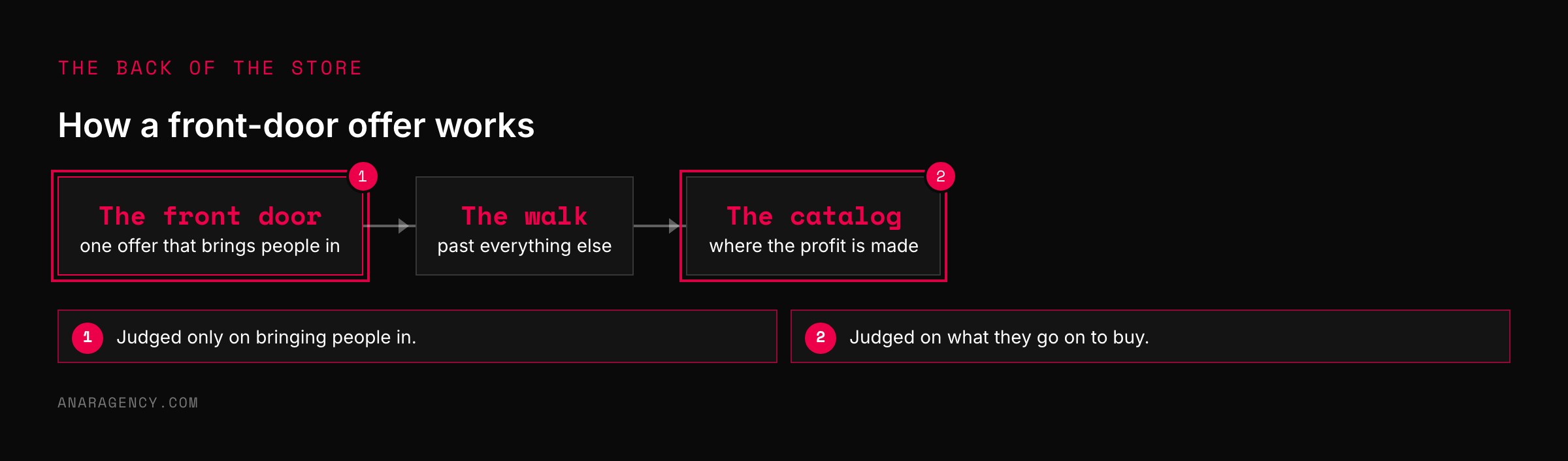
Retailers have a name for a product priced to bring people in instead of to make money. They call it a loss leader. The profit is made on what else goes in the trolley.
A service business can use the same structure without losing money on anything. One offer whose only job is to open the door. A catalog behind it.
Straight to the quiz
Start with the door. Most lead funnels send every click to a landing page, where the visitor is expected to read, be persuaded, and then fill in a form.
That suits a person who searched. They typed the problem. They are looking for an answer and will read to find one.
It suits a social feed visitor less well. They were looking at a friend's photos. An ad caught their eye.
Their interest is real and thin.
Ask that person to read nine hundred words before the first step and many leave. So for that traffic, skip the page. Send the click straight to a short quiz or form.
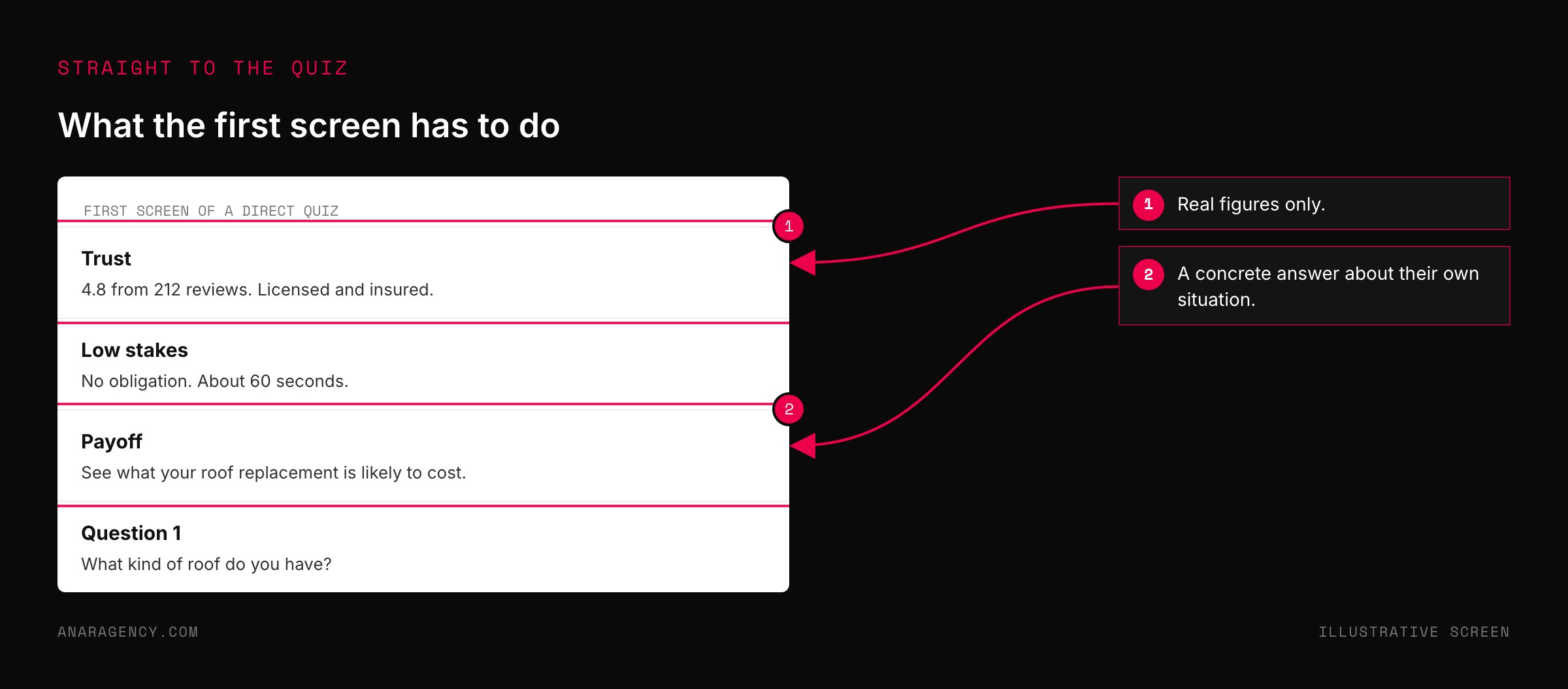
The first screen has to do three jobs. Show a few trust signals: reviews, a rating, a recognizable logo. Lower the stakes: no obligation, sixty seconds.
And state the payoff in concrete terms: "see what your roof replacement is likely to cost."
The questions themselves are the subject of quiz funnels that make the visitor feel the problem. Treat the routing rule as something to test. Run the page and the direct quiz side by side for each traffic source and compare booked jobs, not form starts.
Match the first step to the source: search traffic to a full page, feed traffic straight to a short quiz or form with trust signals, low stakes, and a concrete payoff on the first screen. Behind it, use one front-door offer judged only on acquisition, and a catalog of services mapped to the problems customers meet across the year. Build the catalog before scaling, time each offer to the need, qualify inside the quiz, and measure cost per booked job.
Follow the rules on what forms may ask.
The Catalog Model
Now the part behind the door. A business with one service sells to a customer once and goes looking for another.
A business with a catalog has a reason to speak to that customer again. The method for building one is simple.
Choose a front-door offer. One service judged only on whether it wins customers at a cost you can bear. A check-up, a tune-up, a first return, a starter package.
List what customers need next. After the first job, what do they meet? Many of these needs follow the calendar.
Businesses see regular rises and falls across the year, which economists call seasonality.
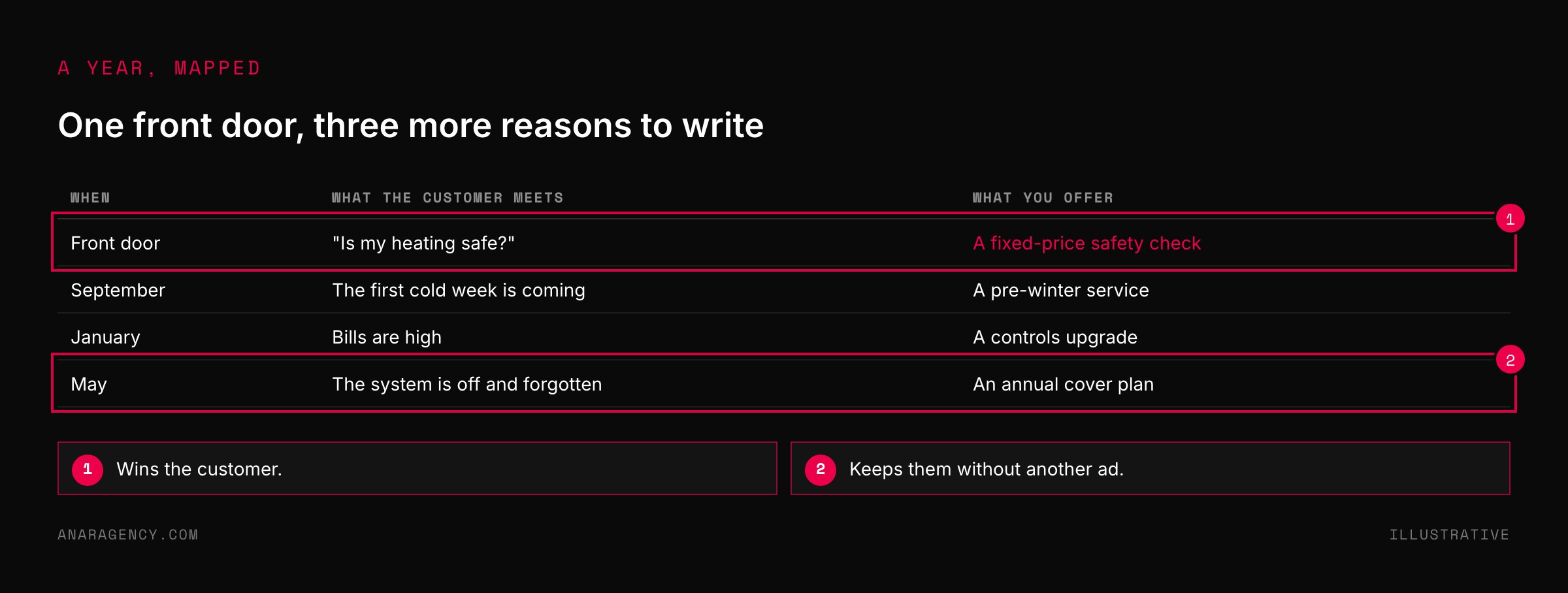
Map a year. For each season, write the problem the customer faces then and the service that answers it. An accountant has a year-end, a filing season, a mid-year review.
A heating firm has the first cold week.
Write to the map. Each season, the message is the problem, then the answer, then a useful tip or a common mistake. That gives a year of follow-up that is about the customer's life, not your sales target.
It is the same reasoning as the funnel decision timeline, stretched over twelve months.
Front-Door Firms: how they make it work
Some firms seem to grow without spending more on ads each year. Their second and third sales cost them almost nothing. We call them Front-Door Firms.
They judge the front door on acquisition alone. It may break even. That is fine if the catalog behind it is real.
How much it can cost is in your maximum allowable cost.
They build the catalog before they scale. Pushing more traffic at a front door with nothing behind it multiplies break-even sales.
They keep the door narrow. One clear offer. A front door that lists eight services is a brochure.
They time the next offer to the need. The service for the first cold week is offered a fortnight before it, not in July.
They match the first step to the source. Search traffic to a full page. Feed traffic to the quiz.
The ad platforms reward the fit as well, since landing page experience is part of how Google rates an ad.
They follow up by email. The catalog only earns if someone tells the customer about it. See email as the profit center.
"Does skipping the page hurt lead quality?"
It can. A form that is very easy to start will be started by people who are not serious. That is the trade.
You manage it inside the quiz. A couple of questions about timing and budget sort the serious from the curious, as we set out in qualify before the call.
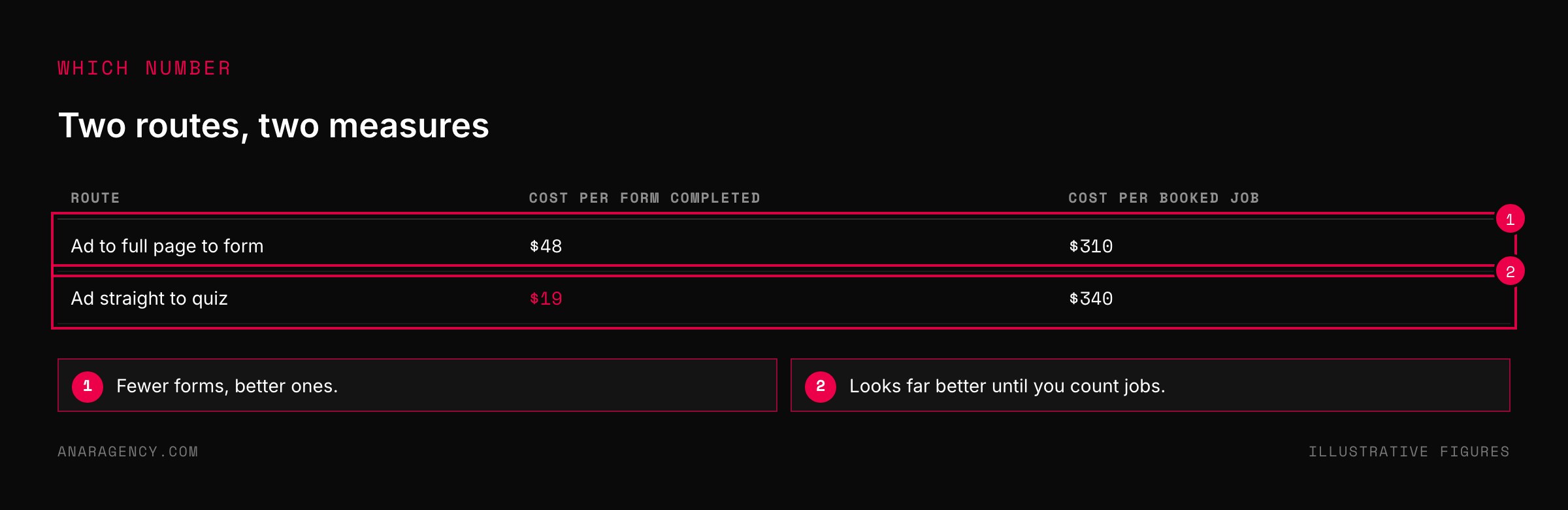
And you measure the right thing. Cost per form completed will almost always favor the direct quiz. Cost per booked job is the number that counts, and it sometimes favors the page.
Mind the rules on the questions. In regulated fields such as insurance, lending, and health, there are limits on what you may ask and how you may use the answers. On Meta, ads and forms must not assert or imply personal attributes.
Keep the trust signals honest. Real reviews, real ratings, logos you have the right to show.
One caution on the catalog. It is a plan for serving a customer over time, not a licence to sell them things they do not need. The next offer should answer a problem they really have that season.
What to read next, and why
Costco (encyclopedia entry): The warehouse model, including the role of the rotisserie chicken.
Loss leader (encyclopedia entry): The retail practice of pricing one item to bring customers in.
Seasonality (encyclopedia entry): The regular yearly patterns a catalog can be mapped to.
About Quality Score (Google Ads Help): Why the fit between ad and destination affects what you pay.
So the simple takeaway is this: write down the one offer that brings you new customers, then list four things those customers need over the following year. If the list is empty, that is the work.
Questions executives ask
Should ads go to a landing page or straight to a quiz?
It depends on where the visitor came from. People who searched for the problem usually want a full page. People who tapped an ad in a social feed often respond better to a short quiz or form.
Test both for each source and compare booked jobs.
What is the catalog model?
A way of structuring a business around one front-door offer that wins customers and a catalog of further services matched to the problems those customers meet over time. The first offer acquires and the catalog provides most of the profit.
What is a front-end offer?
The single offer a business uses to win new customers. It is judged on how many customers it brings in at an acceptable cost, and it may make little profit itself if later sales are reliable.
Does sending traffic straight to a form lower lead quality?
It can, because an easy first step attracts less committed visitors. Add one or two qualifying questions inside the form and judge the approach on cost per booked job instead of cost per form completed.
How do I plan follow-up offers for the year?
List the problems your customers face in each season after their first purchase and match a service to each. Send the relevant message shortly before the need arises, framed as the problem, the answer, and a useful tip.

Filip Kovacevic is the founder of Anar Agency in Phoenix. He spent five years running SEO, Meta ads, email, and content for medical practices across the United States, and now does the same work for healthcare, home-service, legal, and professional-service businesses, alongside AI implementation. More from Filip →
Talk it through in 15 minutes
Bring one AI question from this article. We will tell you what we would do, whether or not you hire us.
Book a 15-Min Chat →