Funnels Are Decision Timelines: Market-Based Funnel Architecture

A funnel is a timeline of decisions, not a sequence of pages. Every solution you sell creates the customer's next problem, so the right second offer is whatever fixes the problem your first offer just created, and the third is what keeps it going. Lay those three out by when the customer meets them: today, the next 30 to 90 days, and the next year.
Build the timeline from your own market's problems, because one borrowed from a different market will not fit, and judge each step by the money it adds per buyer, not by how many people say yes.
Dinner makes dishes
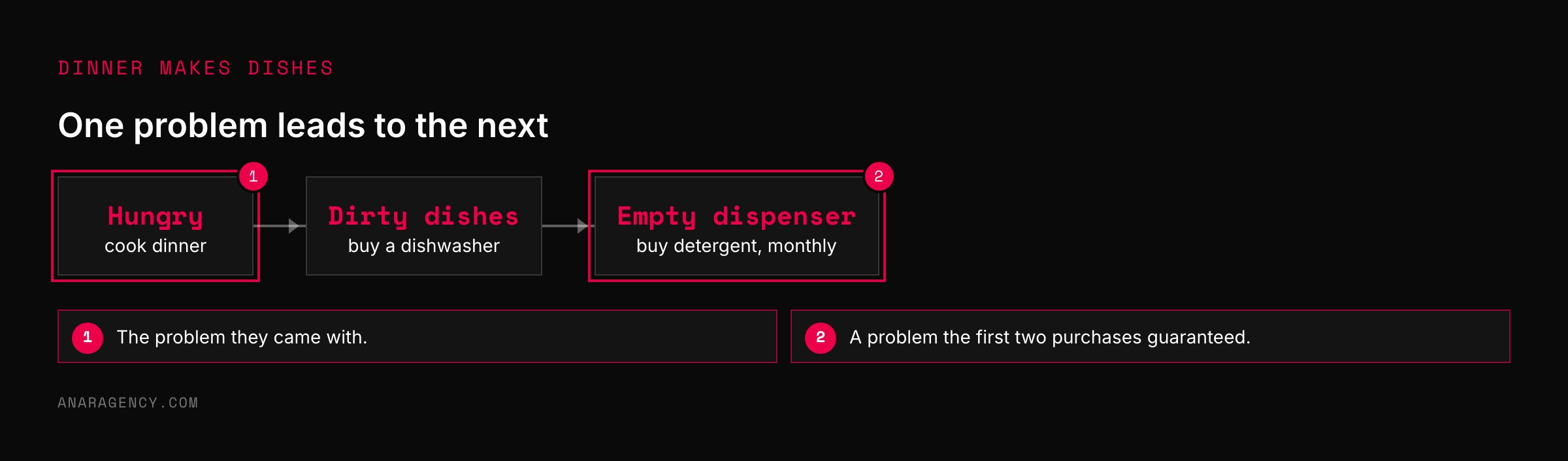
You cook dinner. That solves hunger. It also makes a sink full of dishes.
So you buy a dishwasher. That solves the dishes. Now you need detergent, every month, for as long as you own the machine.
Nobody planned that as a sales funnel. It is just what happens. Every time a problem gets solved, a new and smaller one shows up behind it.
A funnel that works is built on that fact. A funnel that does not is usually three unrelated things somebody wanted to sell.
Pages are not the point
Most people draw a funnel as boxes. The classic picture is a wide top narrowing to a sale. Then an order form, an upsell page, a second upsell page, a thank-you page.
Then they argue about the boxes. Should the upsell be a video? Should there be two or three?
Those are layout questions. The real question sits underneath: what is on each page, and why would this person want it right now?
Think of it as a timeline instead. What problem does this customer have today? What problem will they have in a month, because of what they just bought?
What about in a year?
Each of those is a decision they are going to face anyway. The funnel simply puts the answer in front of them at the moment the question becomes real.
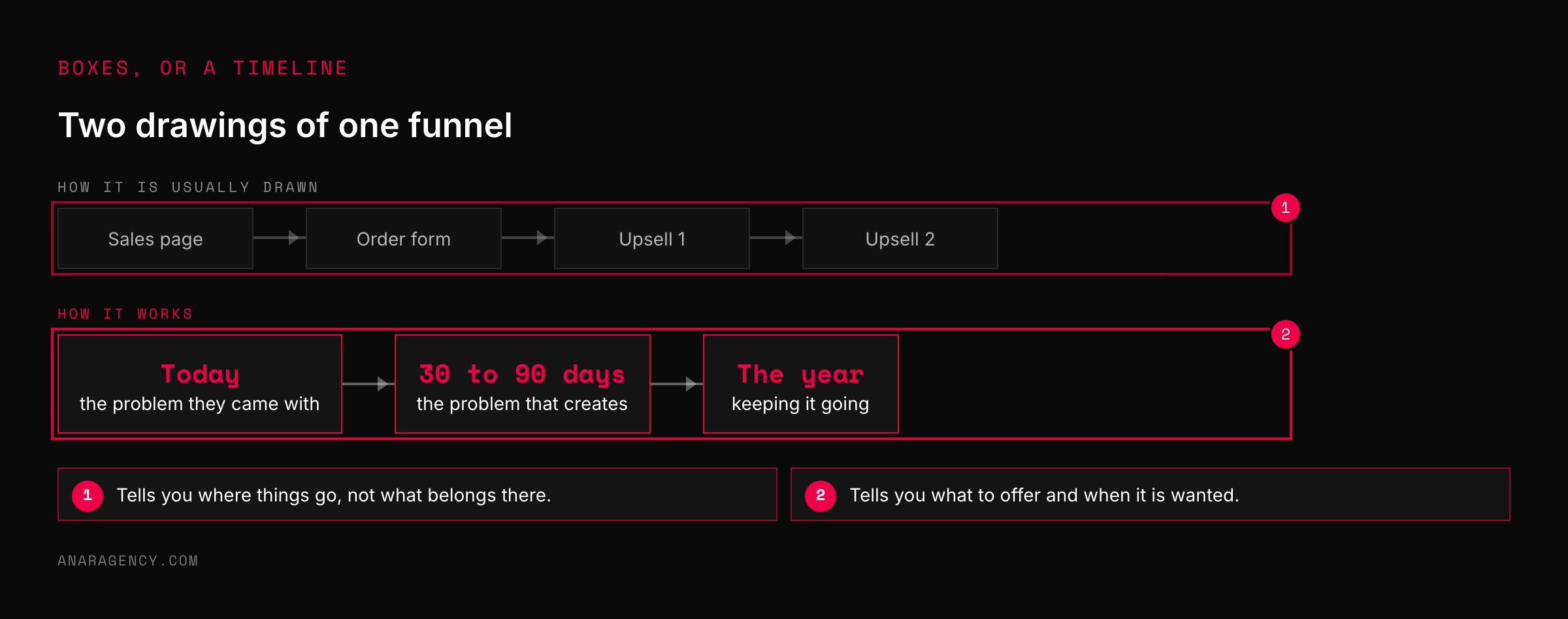
Map three points for your own market. Today: the problem the customer arrives with, and one offer that fixes it. The next 30 to 90 days: the problem that fix creates, offered right after the first purchase.
The next year: what it takes to keep the result going. Build it from what your customers say came next, not from another industry's funnel. Judge each step by price times the share who accept, finish one sale before offering the next, and keep no easy.
The Decision Timeline
Three points on the line.
Today. The problem they arrived with. Your first offer fixes that and only that.
The next 30 to 90 days. The problem your first offer creates. They bought the puppy kit, and now there is a puppy chewing the furniture.
The second offer is training.
The next year. The problem of keeping it going. Holidays, vet visits, the next size of crate.
The third offer is whatever makes the long run easy.
Companies have built empires on this. The razor-and-blades model is the best-known version: the handle solves today's problem, and the blades solve the one that comes back every few weeks.
Notice that nothing in it is a trick. The second problem is real, and it was created by the first purchase. Offering the fix at that moment is service.
The harm comes from offers that are not on the timeline. A random add-on that answers no problem the buyer has is what makes upselling feel like being hustled.
Native Builders: what good funnels have in common
Some funnels feel like a helpful shop assistant. Others feel like a toll road. The first kind share three habits.
We call their makers Native Builders.
They build from their own market. The most common mistake is copying a famous funnel from another industry. A three-step funnel that sells marketing courses will not sell weight loss or dog training, because the problems come in a different order.
They ask customers what came next. Clayton Christensen and his coauthors described a homebuilder whose condos for retirees were not selling. Adding features did nothing.
Sales took off when the builder saw that its business was not construction but helping people through a move. It added services for the move itself and for deciding what to keep. That is a second offer found by studying the customer's timeline, not the product.
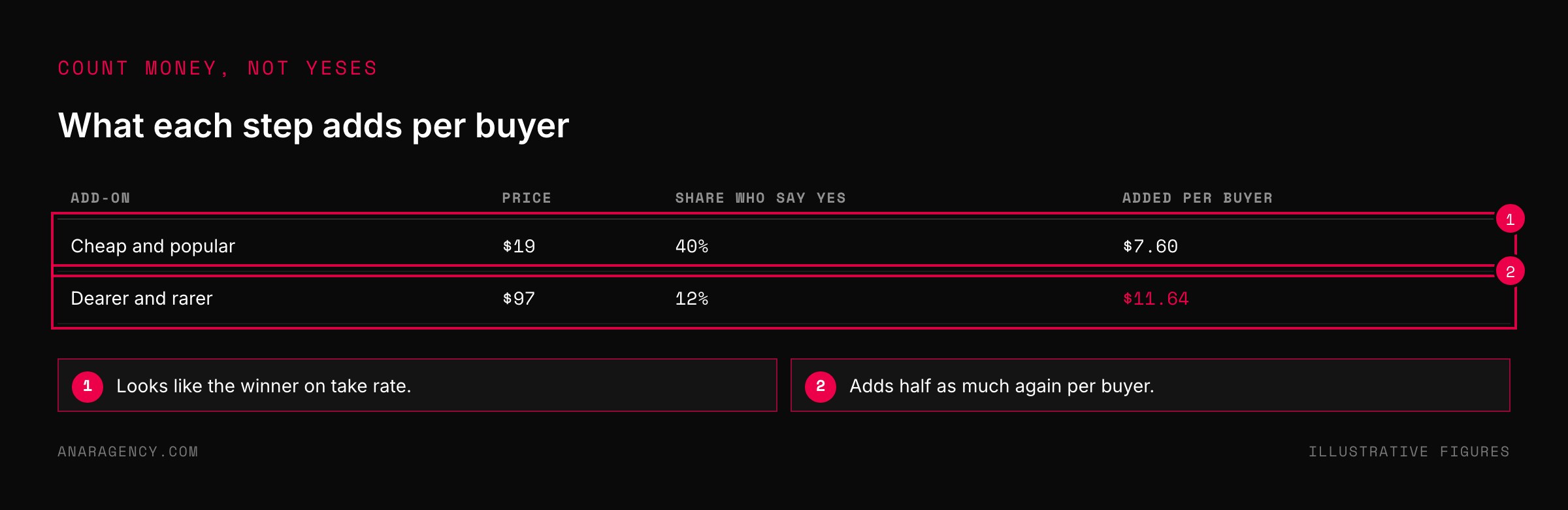
They count money, not yeses. A cheap add-on that 40 percent of buyers take can add less than a dearer one that 12 percent take. Multiply the price by the share who say yes.
That is what the step contributes per buyer.
A $19 add-on taken by 40 percent adds $7.60 per buyer. A $97 one taken by 12 percent adds $11.64. The "worse" take rate is the better step.
"Upsells annoy people."
You may be thinking that offers after the sale make customers feel squeezed. Bad ones do. Here is the difference.
An offer annoys when it shows up before the first purchase is finished, when it is unrelated, or when it hides a charge. The checkout research is blunt on the last point.
The Baymard Institute finds that extra costs appearing late are the most-cited reason shoppers abandon a purchase. An add-on that is quietly pre-ticked is a surprise cost with a nicer name.
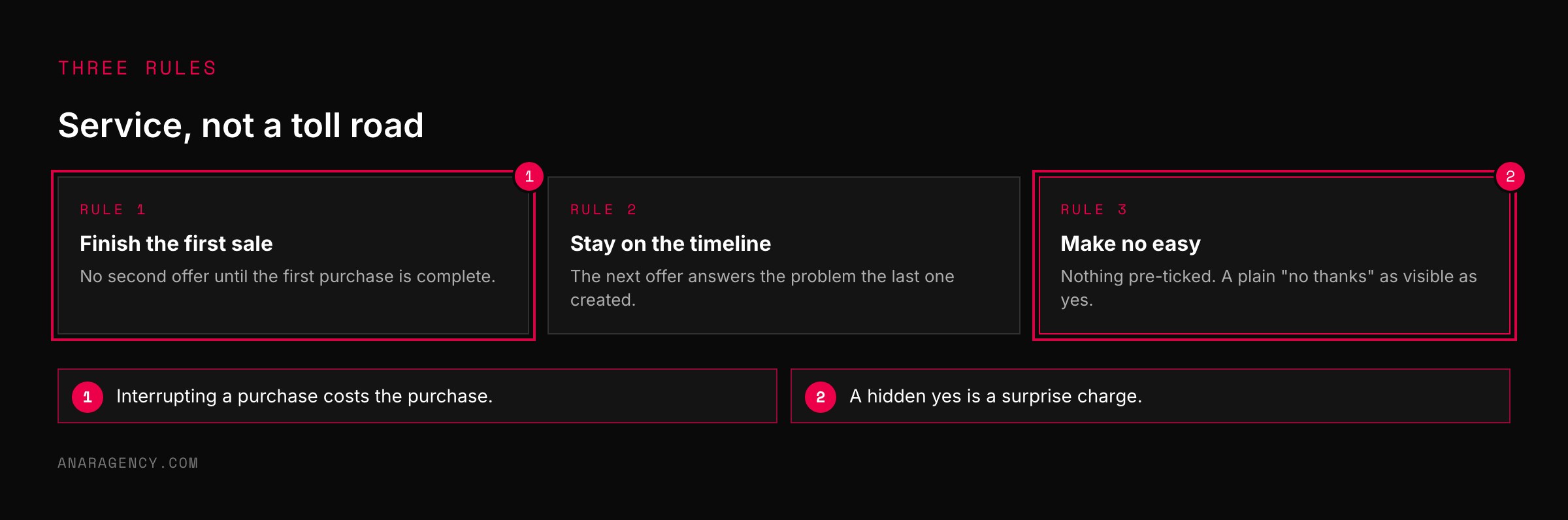
So three rules. Finish the first sale before offering the second thing. Make the second thing answer the problem the first one creates.
And make no the easiest button on the page.
There is also a limit. Stack six add-ons on one order form and you have asked for seven decisions when the buyer came to make one. More decisions is not more money past a point.
Done properly, the timeline is the most honest way to grow. Customer lifetime value is just the sum of the problems you were there for. To judge each step in money, use the measure in earnings per session.
What to read next, and why
Know Your Customers' "Jobs to Be Done" (Harvard Business Review): The condo story, and the idea that people hire a product to make progress in their lives.
Razor and blades model (encyclopedia entry): The oldest timeline funnel there is, including the parts of the legend that are not quite true.
Customer lifetime value (encyclopedia entry): The arithmetic of a customer over years instead of over one order.
Cart Abandonment Rate Statistics (research collection): What makes buyers quit at the last step. Read it before you add anything to an order form.
So the simple takeaway is this: stop asking what else you could sell. Ask what your customer's next problem is, and when it arrives.
Questions executives ask
What is a decision timeline in a sales funnel?
It is a way of planning a funnel around when the customer meets each problem, instead of around pages. The first offer fixes today's problem, the second fixes the problem the first one creates in the next 30 to 90 days, and the third covers what it takes to keep the result going over the next year.
What should my upsell be?
Whatever solves the problem your first product creates. Someone who buys a puppy kit will need training within weeks. An upsell that answers a problem the buyer does not have yet, or will never have, is what makes upselling feel pushy.
Why does copying a successful funnel not work?
Because the order of problems differs by market. A funnel is built on what a specific buyer needs next, and a sequence that fits buyers of marketing courses will not match the timeline of someone buying a fitness plan or a home service.
How do I measure an upsell?
Multiply its price by the share of buyers who accept it. That gives its contribution per buyer. A $19 add-on taken by 40 percent adds $7.60 per buyer, while a $97 add-on taken by 12 percent adds $11.64, so the lower take rate is the better step.
Do upsells hurt conversion?
They can if they interrupt the first purchase, are unrelated, or add a charge the buyer did not expect. Baymard Institute research finds late extra costs are the most-cited reason for abandoning a checkout. Offer the next thing after the first sale is complete and make declining easy.

Filip Kovacevic is the founder of Anar Agency in Phoenix. He spent five years running SEO, Meta ads, email, and content for medical practices across the United States, and now does the same work for healthcare, home-service, legal, and professional-service businesses, alongside AI implementation. More from Filip →
Talk it through in 15 minutes
Bring one AI question from this article. We will tell you what we would do, whether or not you hire us.
Book a 15-Min Chat →