Desire Is a Gap: How Words Become Pictures Become Feelings
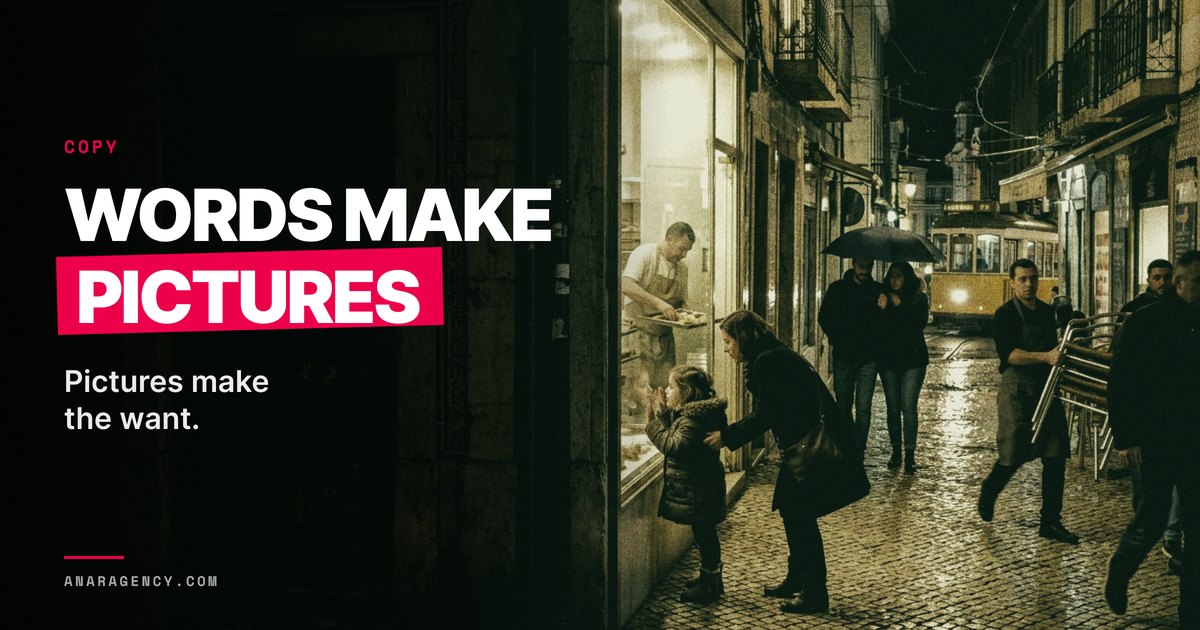
Desire is the gap a person notices between where they are and where they could be. Copy cannot create that gap with claims, because people do not feel claims. They feel pictures.
So the chain runs in one direction: words make pictures, pictures make feelings, and the feeling is the distance between the picture of now and the picture of after. Write both scenes in concrete detail the reader can see, in their own vocabulary, and leave the conclusion to them. Abstract words like "freedom" and "growth" make no picture and so create no want.
One child, or three million
A group of researchers once ran a simple test with charity appeals.
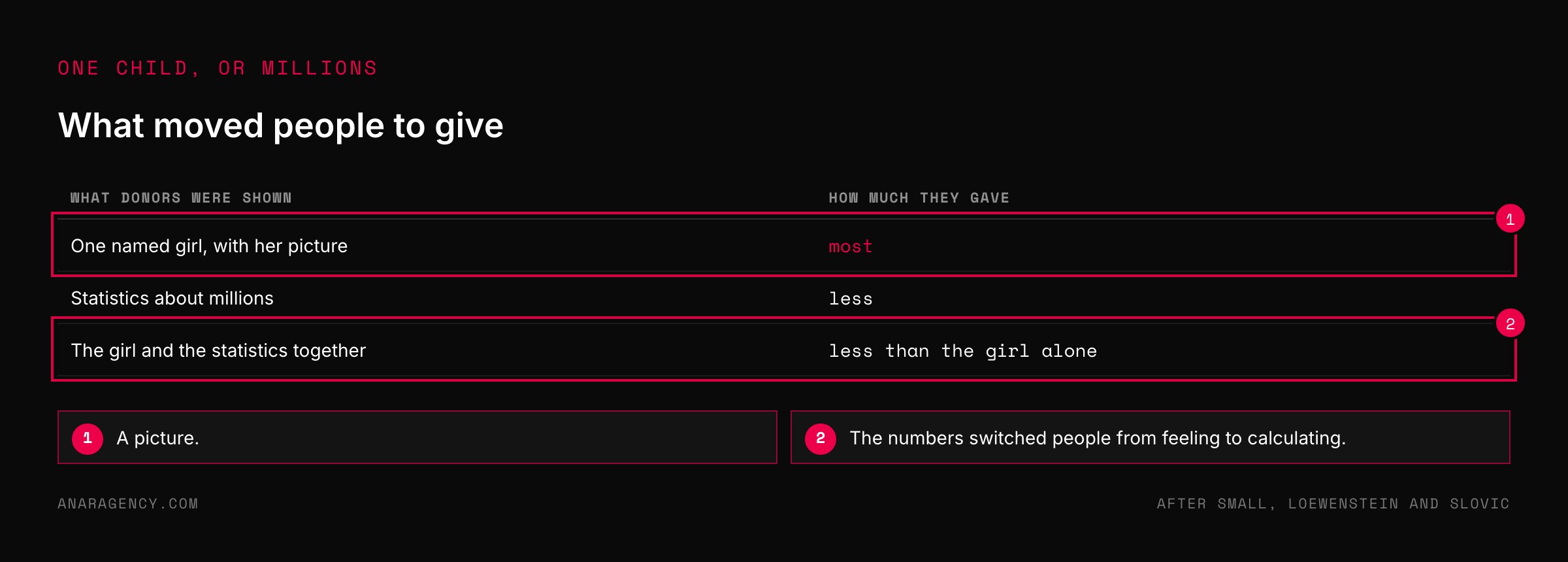
Some people read about a single seven-year-old girl in Mali who was desperately poor and facing hunger. They were told her name and shown her picture.
Others read the statistics: millions of people in several African countries facing severe food shortages. The same crisis, described accurately and at scale.
People gave more to the one girl. And when a third group was shown the girl together with the statistics, they gave less than the people who saw her alone.
The numbers were larger, truer, and more urgent. They did not make a picture. Psychologists call this the identifiable victim effect, and it is the most important fact a writer can know about readers.
You cannot write a feeling
Here is the mistake almost all copy makes. It tries to state the feeling.
"Feel confident." "Enjoy peace of mind." "Experience true freedom."
A reader reads those words and feels nothing, because a feeling cannot be handed over in a sentence. It has to be caused.
What causes it is a picture. Memory researchers have shown for decades that people remember pictures far better than words. One explanation, dual-coding theory, is that a concrete word gets stored twice, once as language and once as an image, while an abstract word gets stored once.
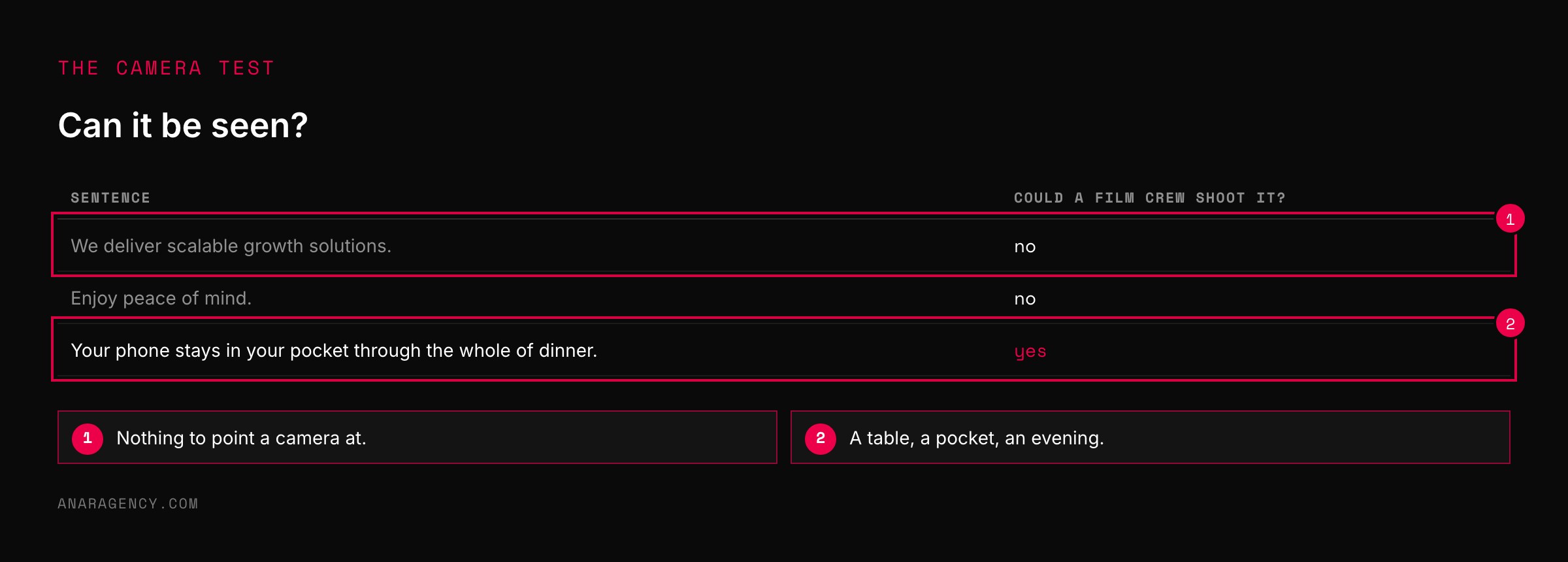
"Peace of mind" is stored once. "Your phone stays in your pocket through the whole of dinner" is stored twice, and the second time it comes with a table, a face, and a feeling.
So the job is never to describe the emotion. It is to describe the scene and let the emotion show up by itself.
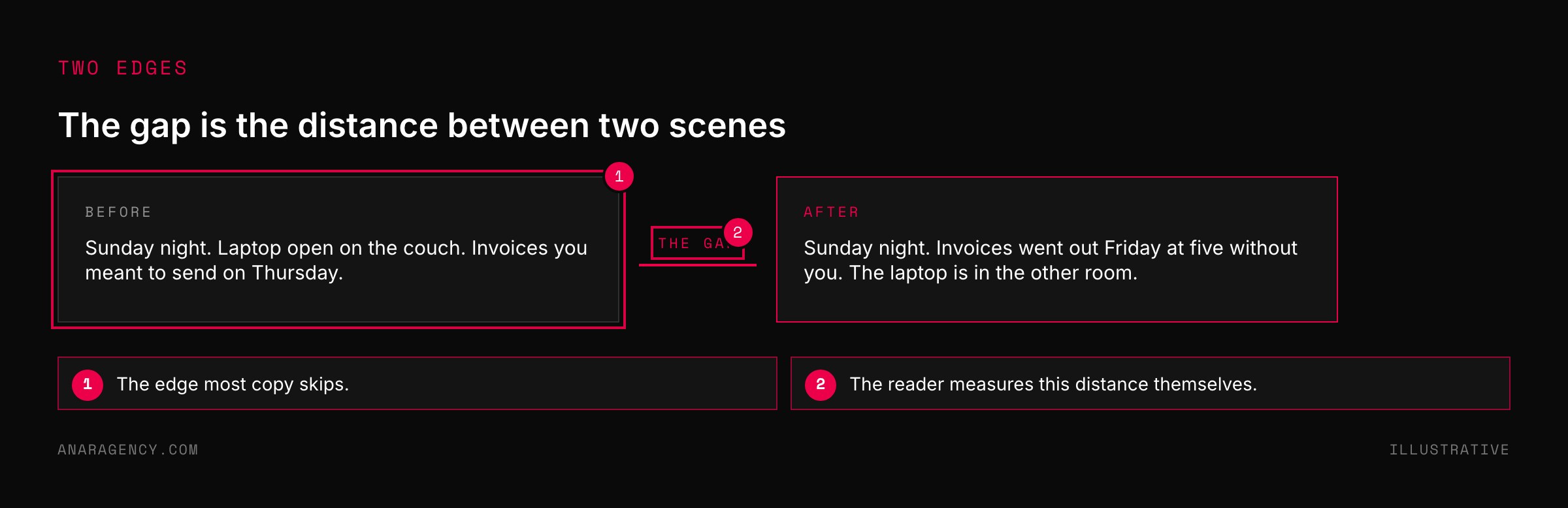
Four rungs: words make pictures, pictures make feelings, and the feeling is the gap between the scene the reader is in and the scene you drew. Write the before as concretely as the after, so the gap has two edges. Use things and moments, not ideas.
Use the reader's own vocabulary. Stop before the conclusion and let them reach it. Test each sentence by asking whether a film crew could shoot it.
Put numbers after the picture, as justification, and use only scenes that are true.
The Gap Ladder
Put those two ideas together and you get four rungs.
Words. What you write.
Pictures. What the words make the reader see.
Feelings. What the picture makes them feel.
The gap. The distance between the scene they are living in and the scene they just saw.
That gap is desire. It is not a thing you pour into a reader. It is a difference they notice, between two pictures, both of which you drew.
The same idea explains curiosity. One well-known account of curiosity is that it arises when a person becomes aware of a gap between what they know and what they want to know. Wanting a thing and wanting to know a thing are built the same way.
Scene Painters: how to draw both sides
Some copy makes you want the thing before you have decided to. Its writers do three plain things. We call them Scene Painters.
They draw the before as carefully as the after. Most copy rushes to the dream. But a gap needs two edges.
"Sunday night, laptop open on the couch, invoices you meant to send on Thursday." Now the after has something to be far from.
They use things, not ideas. A couch. A phone.
A Tuesday. Every abstract word is a place where the picture goes blank. "Growth," "freedom," "success," "solutions."
You cannot see any of them.
They use the reader's own words. A plumber does not have "inbound lead flow." He has a phone that rings or does not.
A picture only forms if the words are ones the reader already owns.
They stop before the conclusion. Draw the two scenes and leave. A reader who works out for themselves that they want the second one believes it far more than one who is told.
A test for any sentence: could a film crew shoot it? If there is nothing to point a camera at, rewrite it until there is.
This is the engine under the long ad, where the story is told in scenes, and under the choice of opening in hooks that work.
"My buyers are rational. They want numbers."
You may sell to engineers, accountants, or purchasing managers and think this is for consumer products. Those buyers want numbers, yes. They want them second.
The charity study is the proof. Adding statistics to the picture did not help. It hurt.
The numbers switched people from feeling to calculating.
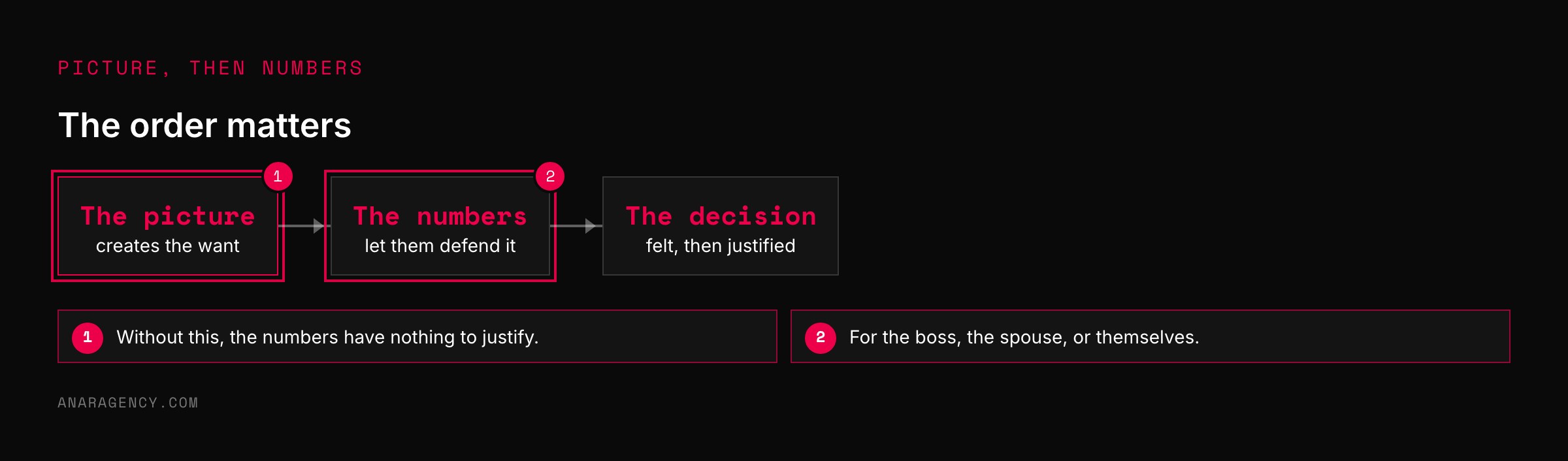
So the order matters. The picture creates the want. The numbers let the buyer defend the want to a boss, a spouse, or themselves.
A business buyer still has a Sunday night. It just involves a spreadsheet that does not reconcile and a meeting at nine on Monday.
There is one firm rule. The scenes must be true. The before has to be something your buyers really live, and the after has to be something your customers really got.
An invented scene is worse than a dull claim, because a reader who lives in that world will spot the false detail at once. Go and collect real ones. How to do that is in all content is about change.
What to read next, and why
Identifiable victim effect (encyclopedia entry): The research on why one named person moves people more than a million unnamed ones.
Picture superiority effect (encyclopedia entry): The evidence that pictures are remembered better than words.
Dual-coding theory (encyclopedia entry): Why a concrete word is worth two abstract ones.
Curiosity (encyclopedia entry): Includes the idea that wanting to know comes from noticing a gap.
So the simple takeaway is this: take your best sentence about what you do and ask whether a camera could film it. If it could not, you have written a claim. Write the scene.
Questions executives ask
How do you create desire in copy?
By making the reader notice a gap between where they are and where they could be. Describe both scenes in concrete detail they can picture, using their own words, and let them draw the conclusion. Stating a feeling directly, such as "feel confident," does not produce it.
Why does concrete language work better than abstract language?
Concrete words produce mental pictures, and pictures are remembered and felt far more than concepts. Dual-coding theory suggests a concrete word is stored both as language and as an image, while an abstract word is stored only as language.
What is the identifiable victim effect?
The finding that people respond more strongly to one specific, named individual than to a large group described statistically. In charity experiments, donors gave more to a single identified child than to appeals based on numbers, and adding statistics to the child's story reduced giving.
Should B2B copy use emotion or data?
Both, in order. A concrete scene creates the want, and numbers let the buyer justify it to others. Leading with statistics tends to put readers in a calculating frame, which research on charitable giving found reduces response.
How do I make abstract benefits concrete?
Ask what the benefit looks like at a specific moment. "Work-life balance" becomes "home in time to cut the grass before dinner." If a film crew could not shoot the sentence, keep rewriting until there is something to point a camera at.

Filip Kovacevic is the founder of Anar Agency in Phoenix. He spent five years running SEO, Meta ads, email, and content for medical practices across the United States, and now does the same work for healthcare, home-service, legal, and professional-service businesses, alongside AI implementation. More from Filip →
Talk it through in 15 minutes
Bring one AI question from this article. We will tell you what we would do, whether or not you hire us.
Book a 15-Min Chat →