Recurring Models That Stick: Buy vs Stay

A recurring offer depends on a different decision from a one-off sale. Buying is a single choice made against every other use of the money. Staying is a choice made each month, usually by default, in which the member weighs what they would lose by leaving.
A recurring model sticks when there are honest things to lose: a result that keeps arriving, records and history that have built up, a regular habit, and people. Build those in, make cancelling easy, and measure the share of members who leave each month. Relying on members forgetting to cancel is fragile and increasingly illegal.
Seventeen dollars a visit
In the early 2000s two economists got hold of the records of three American health clubs.
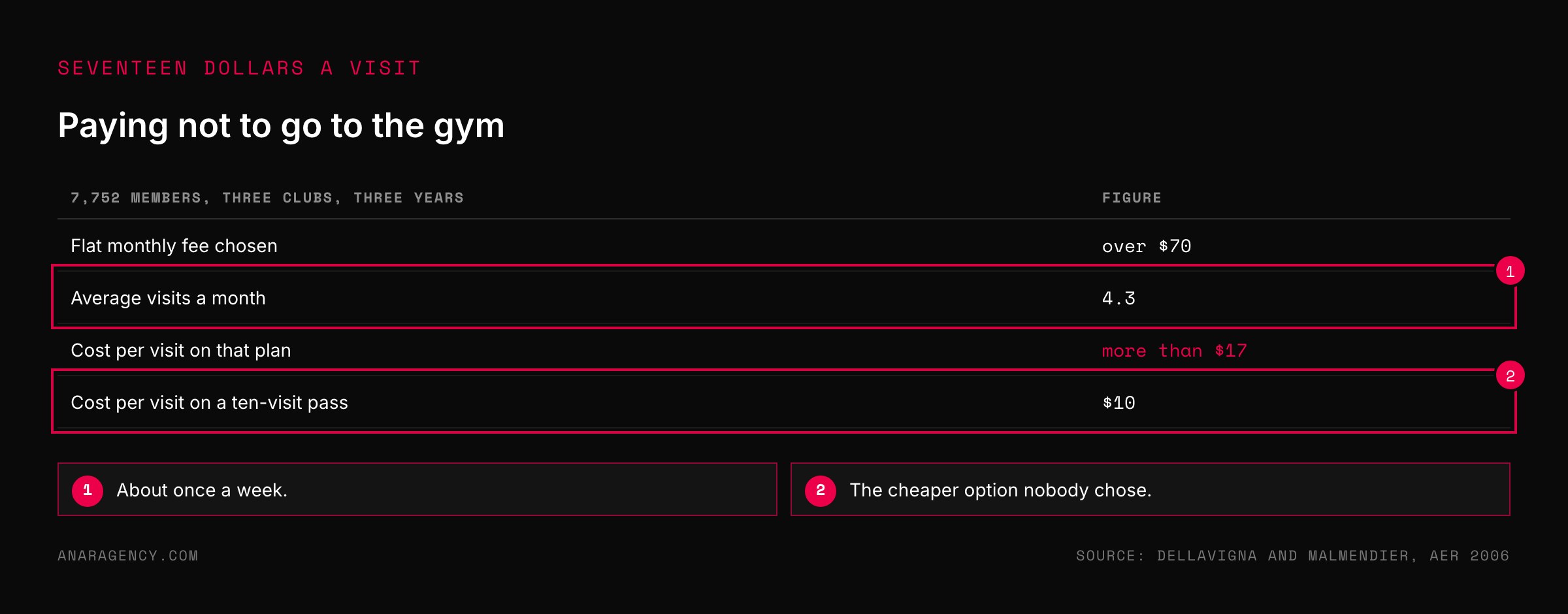
They had the contract each member chose and a log of every visit. In all, 7,752 members over three years.
Members could pay a flat monthly fee of over 70 dollars, or buy a ten-visit pass at 10 dollars a visit.
The people on the monthly plan went, on average, 4.3 times a month. That worked out at more than 17 dollars a visit. They would have saved about 600 dollars over their membership by buying passes.
The paper was titled "Paying Not to Go to the Gym." It is usually cited as proof that people are foolish. It is more useful as a lesson in how different staying is from buying.
Two different decisions
Think about what a one-off sale asks of a customer. A decision, made now, in competition with everything else they could spend on.
Next month you need another sale. So you go and win that decision again, from someone new or from the same person.
A recurring offer changes the question. The buying decision is made once. After that, each month, the member is not deciding whether to buy.
They are deciding whether to stop.
Those feel very different. People place more value on what they already have than on the same thing before they owned it, which psychologists call the endowment effect.
There is also the cost of leaving itself. Moving to something else means learning it, setting it up, and losing what has built up. Researchers call these switching barriers.
So in a one-off business you work against the customer's reluctance to decide. In a recurring one, that same reluctance works in your favor. Which raises the question of what you do with the advantage.
Buying is one decision made against every alternative. Staying is a monthly decision made by weighing what would be lost. Give members four honest things to lose: a result that keeps arriving, their own accumulated history, a regular habit, and people.
Sell the first ninety days carefully, report the value delivered each month, watch usage as well as payments, track churn monthly, make cancelling easy, and ask leavers why. Never rely on inertia or awkward cancellation, which is fragile and can breach the law.
The Stay Model
There are two ways to run a recurring business, and they look the same in month one.
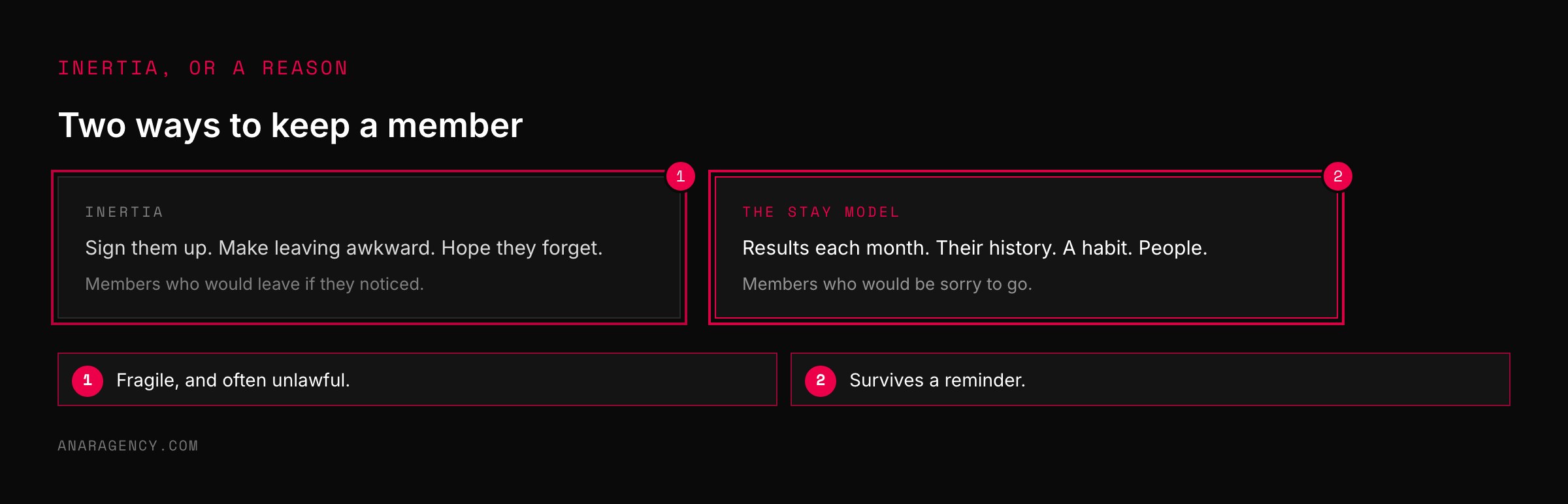
The first relies on inertia. Sign people up, make leaving awkward, and hope they forget. It is the gym in the study.
The second gives members something they would be sorry to lose. We call that the Stay Model, and it has four parts.
It keeps working. A result the member can see this month. Not a big win in week one and silence after.
It holds their things. Reports, history, records, settings, work in progress. The longer they stay, the more of theirs is in it.
It is a habit. Something they use on a regular day for a regular task. A report every Monday.
A call on the first of the month.
People are in it. A named person who knows their business, or other members they have come to know. People leave products.
They are slower to leave people.
Keepers: what low-churn businesses do
Some recurring businesses lose very few members and never play games with the cancel button. They earn the stay every month. We call them Keepers.
They sell the first ninety days carefully. Most cancellations come early, from people who never got started. A new member needs one clear result quickly, as in quick-win offers.
They show the value they delivered. A short monthly note: here is what was done, here is what it produced. Members cannot value what they cannot see.
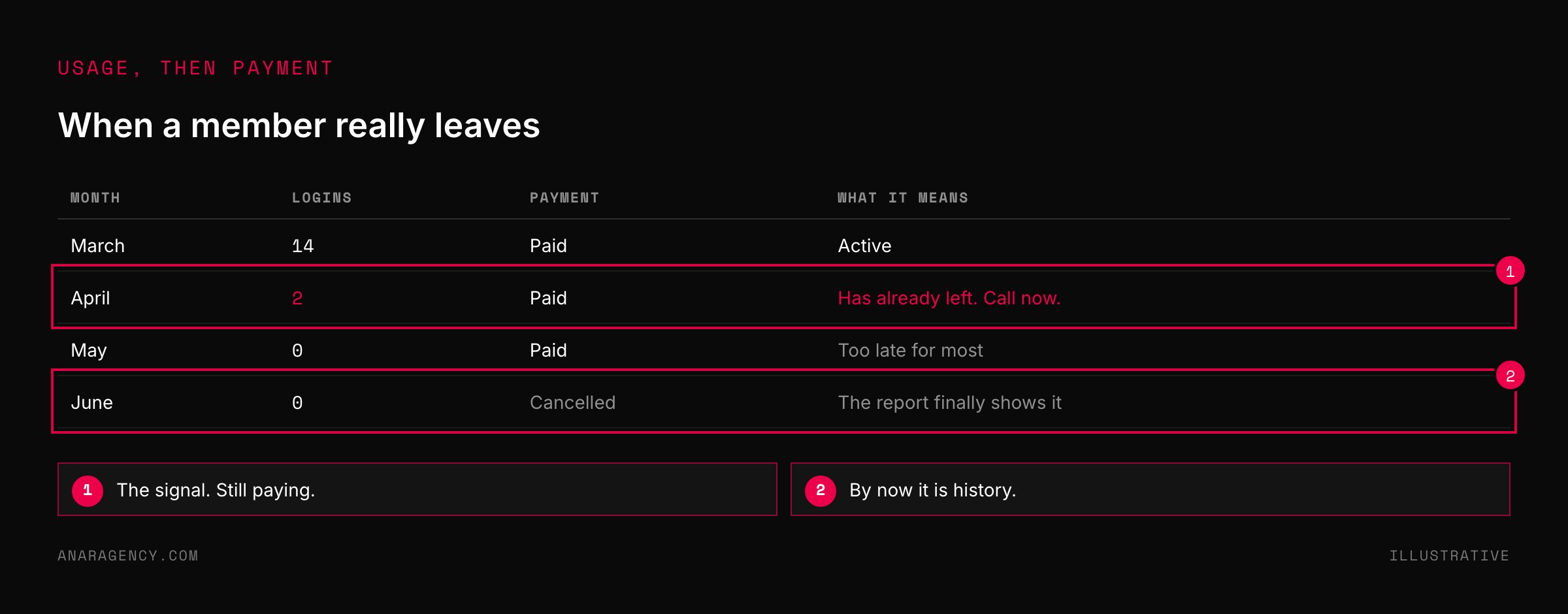
They watch usage, not just payments. A member who has stopped using the service has already left. The payment has simply not caught up.
A call at that point saves more accounts than any discount at the end.
They measure it. The share of members lost in a period is the churn rate. Track it monthly, and by how long members had been with you when they left.
They make leaving easy. A clear way to cancel, in the same place you signed up. It sounds like it would raise cancellations.
It mostly raises trust, and people who leave on good terms come back and refer others.
They ask why. One question on the way out. The answers are the cheapest research you will ever get, and they feed straight into what buyers fear losing.
"Why not just make it hard to cancel?"
Because it is wrong, it does not last, and in the United States it can be against the law.
The federal Restore Online Shoppers' Confidence Act requires online sellers of recurring plans to disclose the terms clearly, get the customer's express consent before charging, and provide a simple way to stop the charges. Regulators have brought cases under it, and many states have their own rules.
The business case is as strong as the legal one. Revenue from members who would leave if they noticed is not revenue you can plan on.
It turns into refund demands, card disputes, and reviews that put off the next customer.
Look again at the gym study. Those members were not happy customers. They were people paying for something they had stopped using and had not got round to ending.
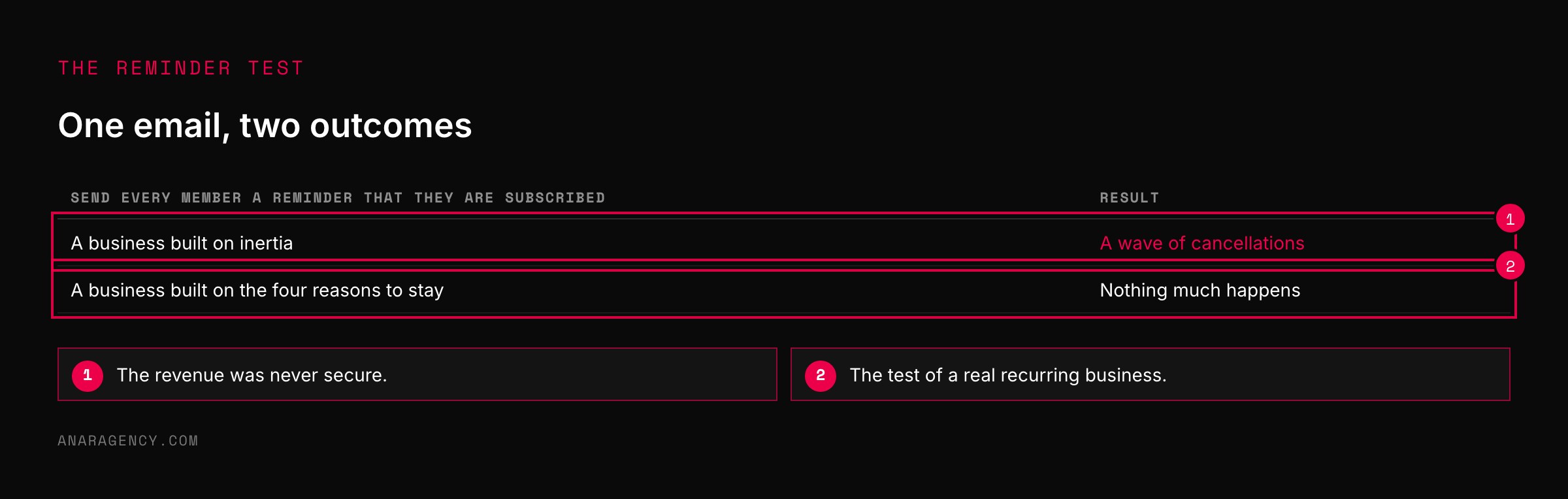
A recurring business built on that is one reminder email from collapse. One built on the four reasons to stay does not fear the reminder. Whether a recurring price is set right in the first place is covered in income-share pricing.
What to read next, and why
Paying Not to Go to the Gym (American Economic Review): The study. The abstract alone is worth reading.
Endowment effect (encyclopedia entry): Why people value what they already have above the same thing unowned.
Switching barriers (encyclopedia entry): The costs, real and felt, of moving to an alternative.
Restore Online Shoppers' Confidence Act (encyclopedia entry): The US law on disclosure, consent, and cancellation for recurring charges.
So the simple takeaway is this: ask what a member would lose if they cancelled today. If the honest answer is "nothing much," fix that before you sell another subscription.
Questions executives ask
How do you improve membership retention?
Give members reasons to stay that they would endorse: visible results each month, their own history and records held in the service, a regular habit of use, and a relationship with a person or community. Then report the value delivered and contact members whose usage drops.
What is churn rate?
The share of customers or members who leave during a period, usually a month. Tracking it monthly, and by how long members had been subscribed when they left, shows where a recurring business is losing people.
Why do customers cancel subscriptions?
Most often because they stopped using the service or could not see what it was doing for them. Many early cancellations come from members who never got properly started. Price is given as the reason more often than it is the cause.
Should I make it hard to cancel?
No. In the United States the Restore Online Shoppers' Confidence Act requires a simple way to stop recurring charges, along with clear disclosure and consent. Difficult cancellation also produces refund demands, card disputes, and bad reviews.
What is the difference between recurring and one-time revenue?
One-time revenue requires winning a new buying decision for every sale. Recurring revenue requires one buying decision followed by a monthly decision to stay, which members usually make by default if the service continues to be worth keeping.

Filip Kovacevic is the founder of Anar Agency in Phoenix. He spent five years running SEO, Meta ads, email, and content for medical practices across the United States, and now does the same work for healthcare, home-service, legal, and professional-service businesses, alongside AI implementation. More from Filip →
Talk it through in 15 minutes
Bring one AI question from this article. We will tell you what we would do, whether or not you hire us.
Book a 15-Min Chat →