Write the Landing Page Before the Ad
Write the landing page first, then make the ads out of it. An ad sets an expectation, and the page has to meet it in the first screen: the same promise, the same words, the same picture, the same mood. When ads are written separately to win clicks, they promise things the page does not deliver, and visitors leave.
The order of work is the page body, then the page headline drawn from the body, then ads lifted from the page, then ad headlines. High click rates with poor conversion usually mean the ad and the page were written apart.
Following a scent
In the early 1990s two researchers at Xerox's research center in California were studying how people look for information on a computer.
Peter Pirolli and Stuart Card noticed that the patterns looked familiar. People moved between sources the way animals move between patches of food.
An animal follows a scent. If the scent gets stronger, it keeps going. If it fades, it turns away and tries elsewhere.
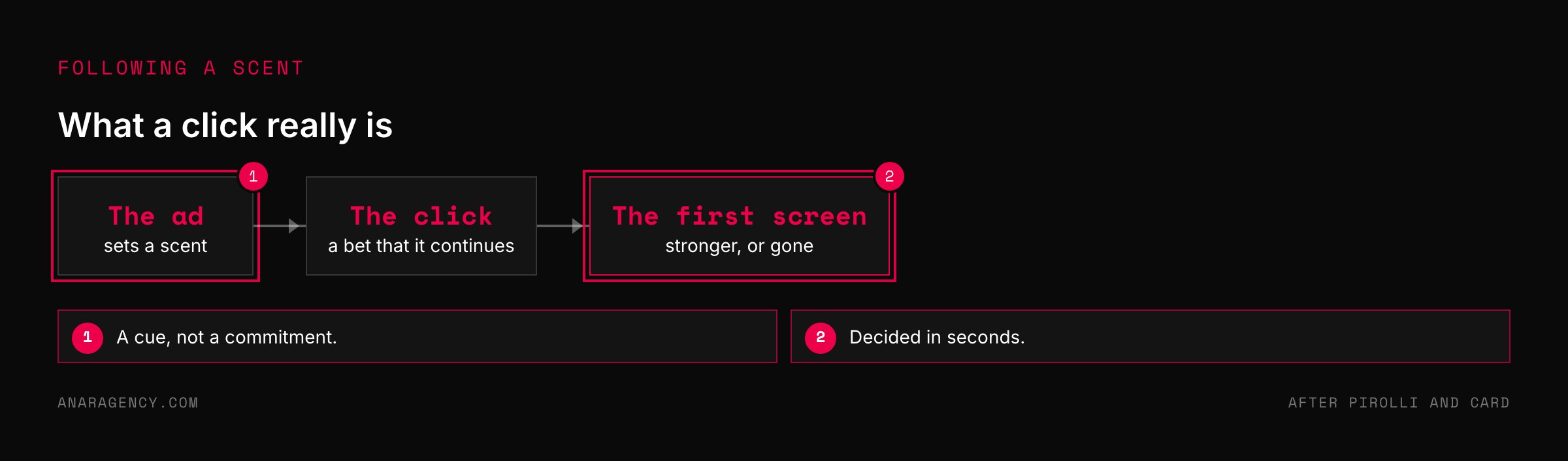
People do the same with links. Each click is a bet that the next page holds what the last one promised. The researchers called the cues that guide the bet information scent.
The theory has a blunt implication for advertising. A click is not interest in your business. It is a visitor following a scent, and the first screen of your page either continues it or ends it.
The ad that wins the click and loses the sale
Here is how most campaigns are built. Someone makes the landing page. Later, someone else writes ads to send people to it.
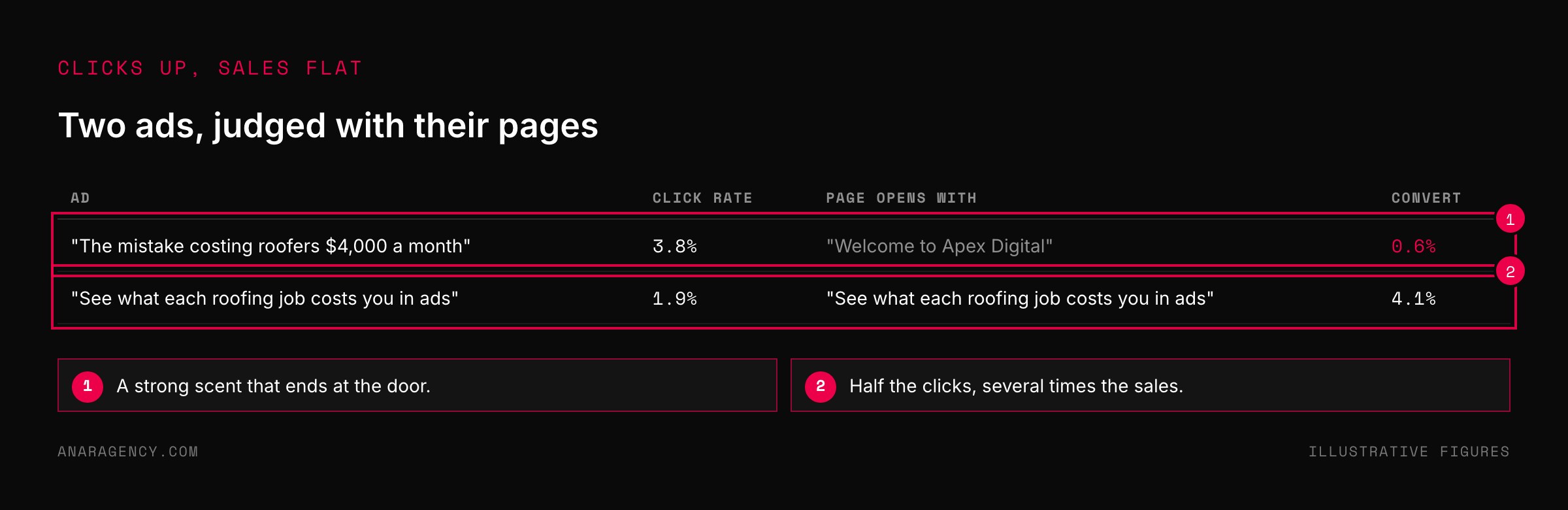
The ad writer is judged on clicks. So the ads get sharper, more curious, more provocative. Click rates rise.
Sales do not. The ad promised one thing and the page opens with another.
Usability research describes what the visitor experiences. When the words on the destination do not match the words that brought them there, people conclude they are in the wrong place and leave.
The ad platforms measure it too. Google's Quality Score rates ads partly on landing page experience and on how closely the ad matches what the searcher wanted. A mismatch costs you in ad price as well as in sales.
A high click rate with a low conversion rate is the signature of this. It usually gets diagnosed as a bad page. It is more often two good pieces of work that were never introduced.
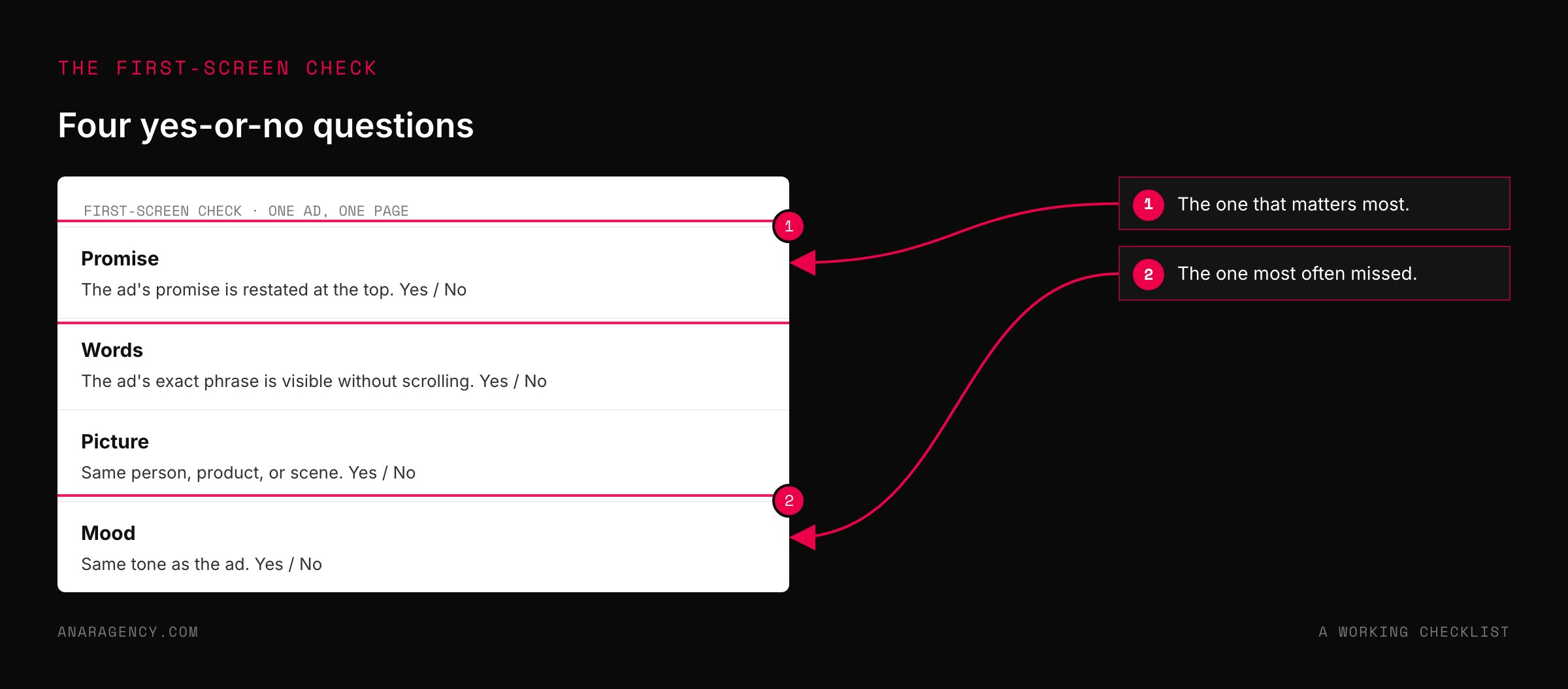
A click is a visitor following a scent, and the first screen of the page must continue it. Work in this order: page body, page headline drawn from the body, ads lifted from the page, ad headlines last. Four things must carry across the click: the promise, the exact words, the picture, and the mood.
Give each distinct promise its own first screen. Judge an ad and its page together, on sales. High clicks with low conversion usually means they were written apart.
Continuity of Intent
We call the fix Continuity of Intent. Whatever the visitor intended when they clicked has to be honored on arrival.
The reliable way to get it is to change the order of work.
Write the page body first. The whole argument. The problem, its cause, the answer, the proof, the offer.
Then write the page headline. Pull it out of what you wrote. A headline written first boxes the page in.
One drawn from the finished body summarizes something real.
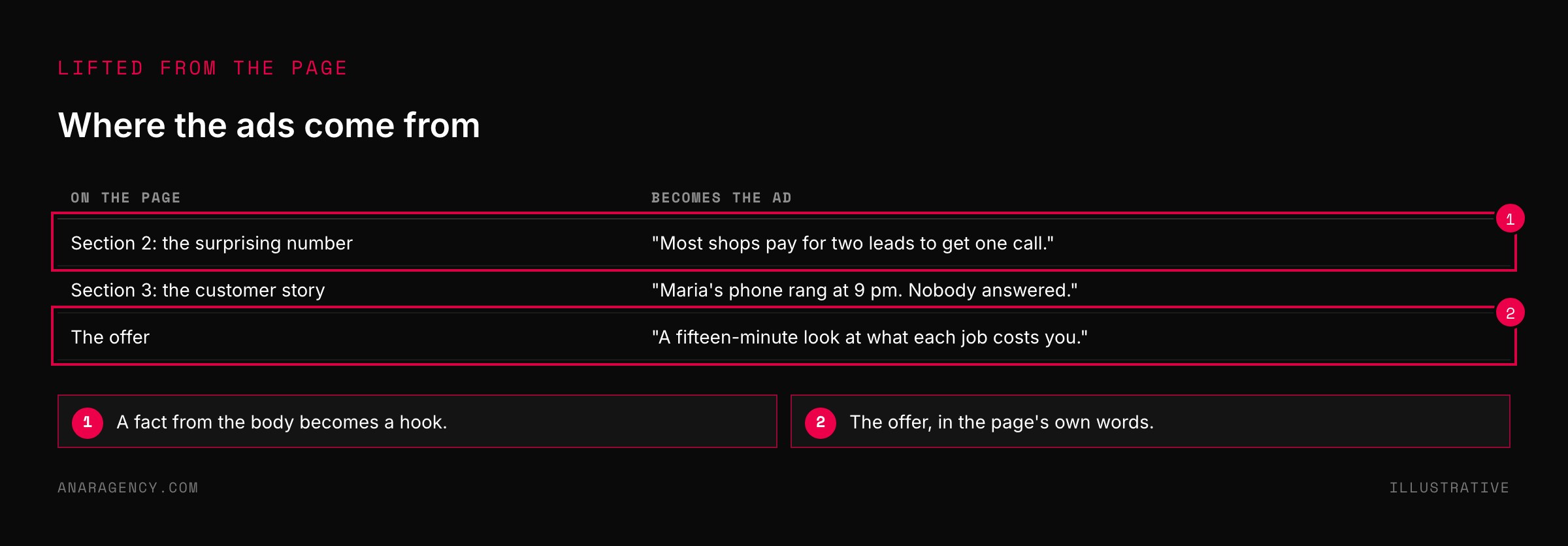
Then make the ads. Each ad is a sentence, a scene, or a claim lifted from the page. The customer story in section three becomes one ad.
The surprising number in section two becomes another.
Last, the ad headline. The page's promise, in the page's words.
Done this way, every ad is a true sample of the page. The visitor clicks on a piece of something and lands on the rest of it.
Thread Keepers: four things that carry
Some advertisers get modest click rates and strong sales. They care more about the thread than the click. We call them Thread Keepers.
The promise carries. If the ad said "see what each job costs you in ads," the first screen says the same thing. Not "welcome to our agency."
The words carry. The exact phrase from the ad appears on the page without scrolling. People scan for the words they just read.
The picture carries. The same person, the same product shot, the same scene. A new image reads as a new place.
The mood carries. A calm, plain ad that lands on a page of countdown timers feels like a trap. Matching the emotional register is the subject of ad-to-page alignment.
One ad, one page. If three ads make three different promises, they need three first screens. Sending them all to one generic page breaks two of the threads.
They judge the pair. An ad is never a winner alone. It is a winner with its page, measured on sales.
See earnings per session.
"But curiosity ads get cheaper clicks"
They do. A vague, intriguing ad will often beat a plain one on cost per click. That is the trap.
Clicks are not what you pay for in the end. You pay for customers, and a cheap click that leaves in four seconds was the expensive kind.
Curiosity itself is fine. An ad can raise a question, as long as the page answers that question at the top. The failure is raising one question and answering another.
At the far end, a deliberate mismatch is not a tactic. Advertising one thing to draw people in and then pushing something else has a name: bait-and-switch. It is treated as a deceptive practice.
You may already have the page and the ads, written apart. Then run the check in reverse. Open each ad, then open its page, and read only the first screen.
If the promise, the words, the picture, and the mood are not all there, fix the page top or rewrite the ad. It is usually an hour's work, and it is often the cheapest improvement available in an account. How a visitor reads that first screen is in the unasked questions.
What to read next, and why
Information foraging (encyclopedia entry): The theory that people hunt for information the way animals hunt for food.
Information scent (Nielsen Norman Group): The usability research on why people leave when the trail goes cold.
About Quality Score (Google Ads Help): How ad relevance and landing page experience are rated.
Bait-and-switch (encyclopedia entry): Where a mismatch between ad and offer becomes deception.
So the simple takeaway is this: open your best-clicking ad and its landing page side by side. If the first screen of the page does not repeat the ad's promise in the ad's words, you have found your leak.
Questions executives ask
Should I write the landing page or the ad first?
The landing page. Once the full argument exists, ads can be lifted from it as true samples. Ads written first, or separately, tend to promise things the page does not deliver.
Why do my ads get clicks but no conversions?
Often because the ad and the page were written apart. The ad sets an expectation and the first screen of the page does not meet it, so visitors conclude they are in the wrong place and leave.
What is message match?
Keeping the promise, wording, imagery, and tone consistent between an ad and the page it leads to, so the visitor sees at once that they have arrived where they meant to go.
What is information scent?
A term from information foraging theory for the cues that tell a person whether a link or page will lead to what they want. Strong scent keeps them going. When the destination does not match the cue that brought them, they turn back.
Do I need a separate landing page for every ad?
You need a separate first screen for every distinct promise. Ads that make the same promise can share a page. Ads that make different promises should each land on a top section that repeats their own.

Filip Kovacevic is the founder of Anar Agency in Phoenix. He spent five years running SEO, Meta ads, email, and content for medical practices across the United States, and now does the same work for healthcare, home-service, legal, and professional-service businesses, alongside AI implementation. More from Filip →
Talk it through in 15 minutes
Bring one AI question from this article. We will tell you what we would do, whether or not you hire us.
Book a 15-Min Chat →