Max Allowable CPA: The One Number That Decides Your Ad Budget

Max allowable CPA is the most you can pay to win one customer before the sale loses money. Take the price, subtract what it costs to deliver, and multiply what is left by the share you are willing to spend on getting customers. A $400 job that costs $160 to deliver leaves $240, and at half of that your ceiling is $120.
Any ad or channel that costs more than the ceiling gets fixed or stopped. Count repeat business only if you have measured it, and set this number before you set a budget.
The question behind the question
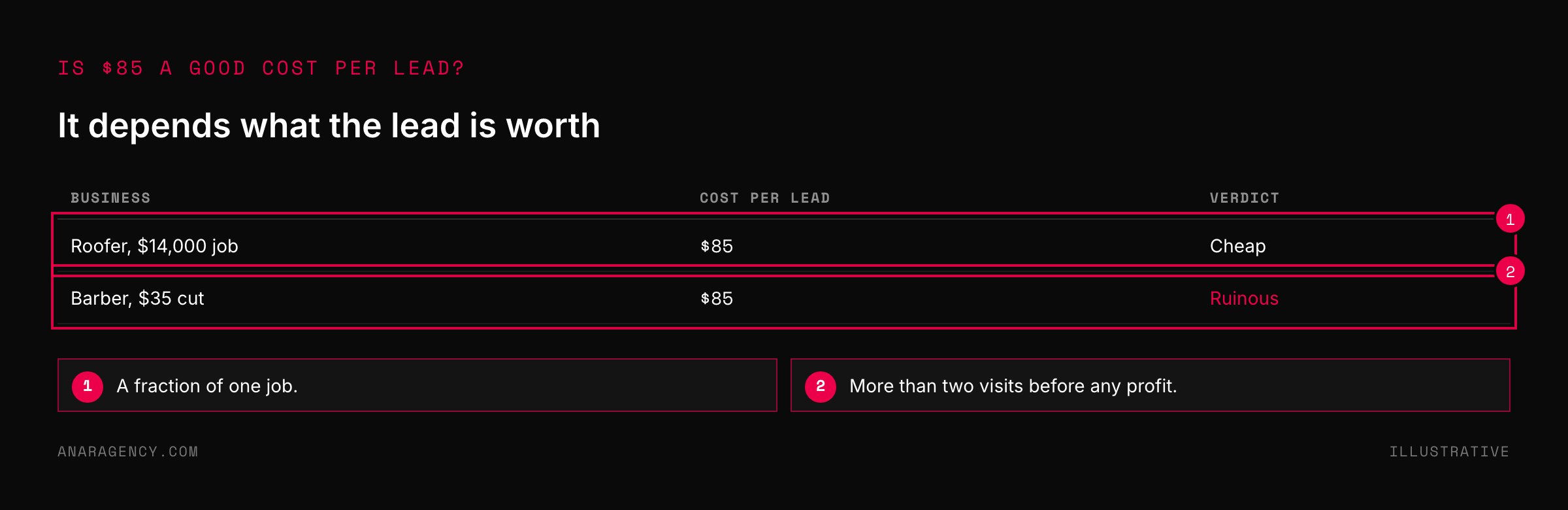
Every owner who runs ads asks the same thing. Is $85 a good cost per lead?
There is no answer to that, and anyone who gives you one is guessing. Eighty-five dollars is cheap for a roof and ruinous for a haircut.
The real question sits underneath. What is the most I can pay for a customer and still be glad I got them?
That number has a name. Once you know it, every other number in your ad account has something to be measured against.
Five lines of arithmetic
Start with the price. Say a first job is $400.
Subtract what it costs to deliver that job. Labor, materials, card fees, anything that exists only because the job happened. Say $160.
Accountants call what remains contribution margin. Here it is $240.
Now the line people skip. How much of that $240 are you willing to spend to win the customer?
That is not a calculation. It is a decision. You still have rent, salaries, and a profit to make out of the same $240.
Half is a common place to start.
Half of $240 is $120. That is your max allowable cost per customer.
If you buy leads and not customers, take one more step. If one lead in four becomes a customer, the most you can pay for a lead is $30. This is the same back-solve we use in sizing a Google Ads budget.
Price, minus the cost to deliver, equals what is left per sale. Multiply by the share you are willing to spend on winning a customer, often half to start. The result is the most a customer may cost.
Divide by your close rate to get the most a lead may cost. Add repeat business only where your records show it. Set this before the budget, hold every channel to it, and stop or fix anything that runs above it.
The company with no ceiling
It helps to see what happens when nobody does this sum.
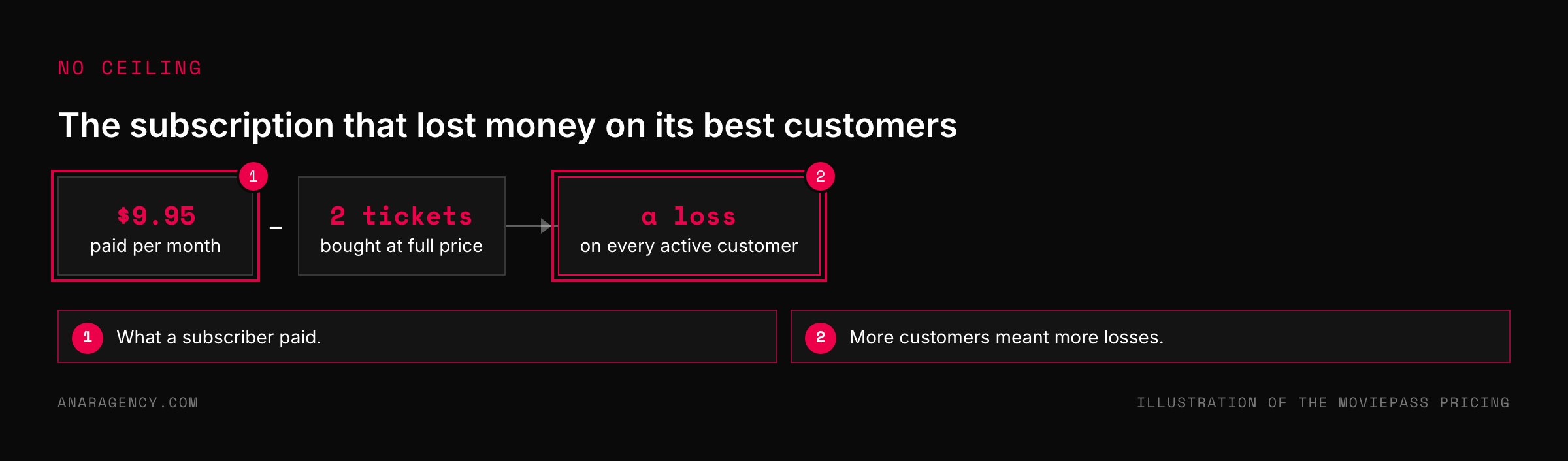
In 2017 a company called MoviePass cut its price to $9.95 a month. For that, a subscriber could see a movie in a theater every day.
A single ticket often cost about that much. MoviePass paid the theaters full price for each one.
So a customer who went to the movies twice a month cost the company more than they paid. The more customers it signed, and it signed millions, the more it lost.
Growth looked spectacular. The arithmetic underneath was a sale that lost money every time it was made. The service shut down in 2019 and the company went bankrupt.
No small business would do that on purpose. Plenty do a quieter version by accident: paying $150 for a customer who leaves $120 behind, and calling the campaign a success because the leads keep coming.
Ceiling Setters: how careful advertisers use the number
Some owners can look at any campaign and say in ten seconds whether to keep it. They are not better at ads. They set one number first.
We call them Ceiling Setters.
They set it before the budget. The ceiling tells you what a customer may cost. The budget is just how many customers you want times that.
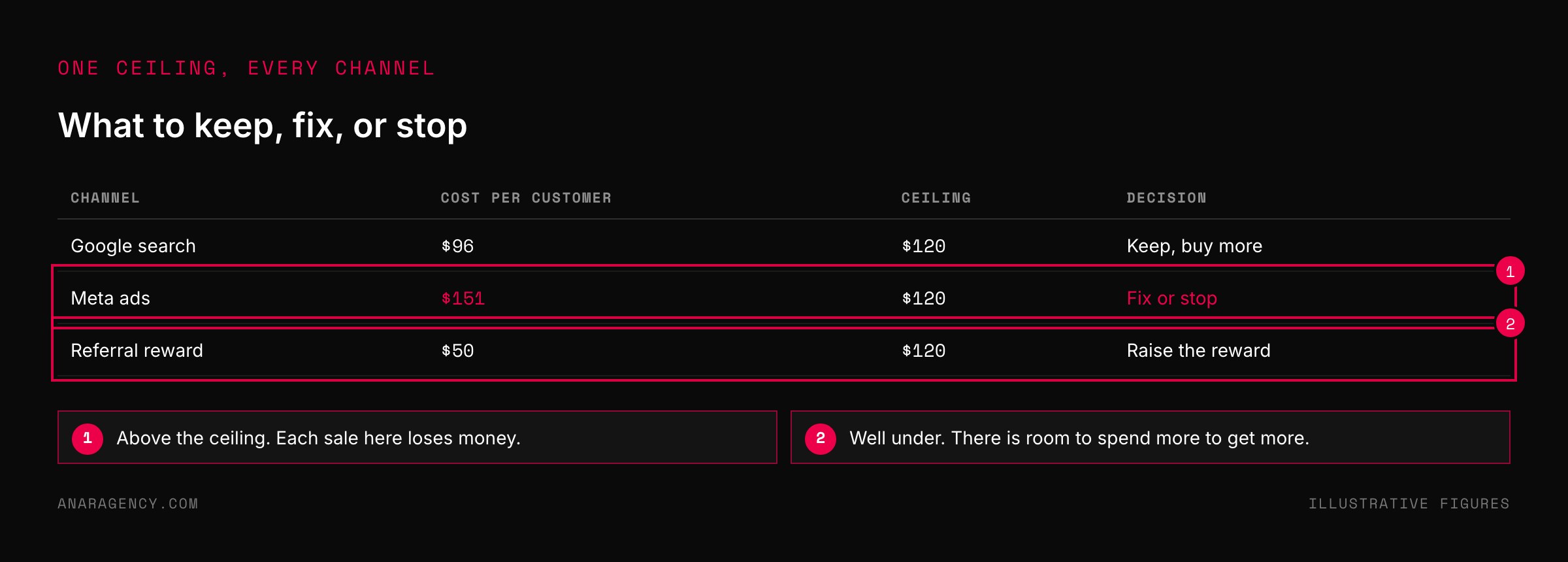
They hold every channel to it. Search, social, referrals, a trade show. Each has a cost per customer, and each is compared with the same ceiling.
They only count repeat business they have measured. A customer who returns is worth more than the first job, and that raises the ceiling. This is customer lifetime value, and it is where owners fool themselves most.
Counting a year of repeat jobs that you hope for is how you talk yourself into overpaying. Count what your records show.
They give the number to the machine. Google lets you set a target cost per action and bid toward it. That setting is only as good as the number you type in.
"I do not know my numbers that precisely."
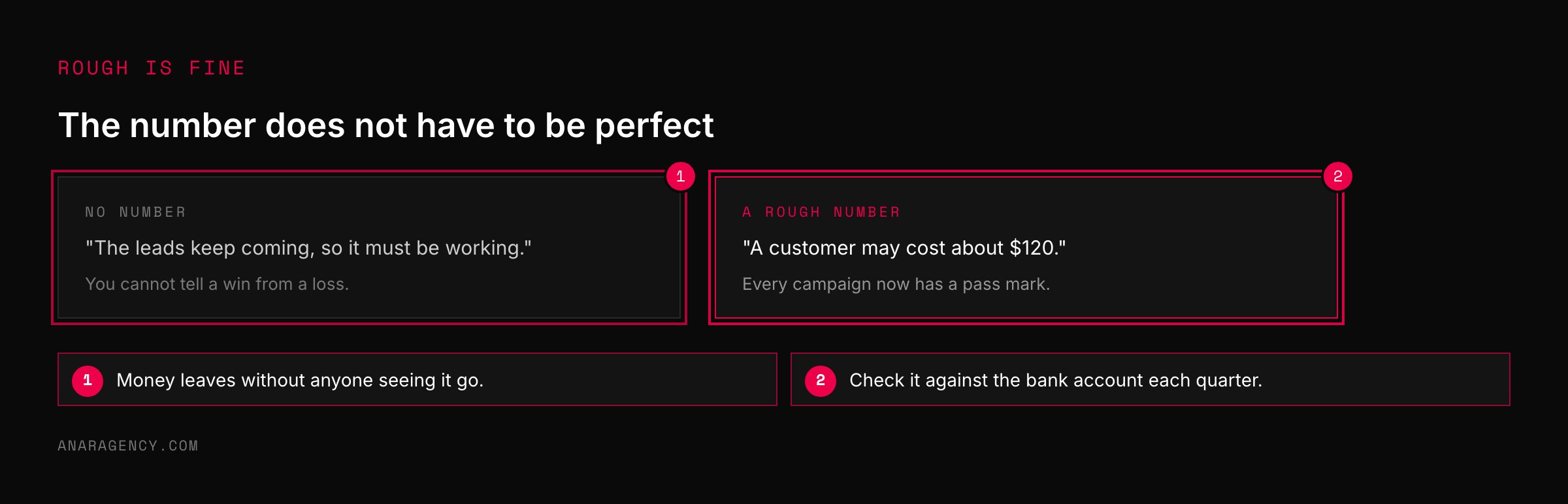
You may be thinking this needs an accountant and a clean set of books. It needs neither. It needs an honest rough guess, written down.
A rough ceiling beats no ceiling. If you think delivery costs somewhere between $140 and $180, use $180. Being a little too careful costs you some growth.
Having no number costs you money you never see leave.
Then check it against the bank account once a quarter. If the sum says you earn $120 a customer after ads and the account does not agree, a cost is missing from your list.
The second objection is the opposite one: growth matters more than profit right now. Sometimes that is true. Then choose to spend more than half, on purpose, for a set time, knowing what it costs.
What you must not do is spend past the ceiling without knowing where it is. That is not a growth strategy. It is the same thing MoviePass did, at a smaller size.
Once the ceiling is set, the next question is which step of the path is eating the money. That is the subject of reading ad data.
What to read next, and why
MoviePass (encyclopedia entry): The whole story of a subscription priced below what it cost to serve. Read it once and you will never skip this sum.
Customer acquisition cost (encyclopedia entry): The plain definition, and what belongs in the total.
Customer lifetime value (encyclopedia entry): How to count repeat business, and the assumptions hiding inside every version of the formula.
About Target CPA bidding (Google Ads Help): How Google uses the number once you give it one.
So the simple takeaway is this: before you ask whether a lead is cheap, write down the most a customer may cost. Everything else is measured against that.
Questions executives ask
What is max allowable CPA?
The highest cost per acquired customer at which a sale still makes sense. It is the money left after delivering the product or service, multiplied by the share of that money you are willing to spend on acquiring the customer.
How do I calculate max allowable CPA?
Subtract the cost of delivering a sale from its price, then multiply the remainder by the share you will spend on acquisition. For a $400 job that costs $160 to deliver, $240 remains. At 50 percent, the max allowable cost per customer is $120.
What is a good cost per lead?
There is no universal answer. A good cost per lead is one that stays under your ceiling once you account for how many leads become customers. If one lead in four closes and a customer may cost $120, a lead may cost up to $30.
Should I include lifetime value in my CPA target?
Only the repeat business your own records show. Lifetime value legitimately raises what you can pay for a customer, but using hoped-for repeat purchases is the most common way businesses talk themselves into overpaying.
What happened to MoviePass?
In 2017 it cut its subscription to $9.95 a month for a movie a day while paying theaters full price for tickets, so frequent users cost more than they paid. It grew to millions of subscribers, lost money on that growth, shut the service down in 2019, and went bankrupt.

Filip Kovacevic is the founder of Anar Agency in Phoenix. He spent five years running SEO, Meta ads, email, and content for medical practices across the United States, and now does the same work for healthcare, home-service, legal, and professional-service businesses, alongside AI implementation. More from Filip →
Talk it through in 15 minutes
Bring one AI question from this article. We will tell you what we would do, whether or not you hire us.
Book a 15-Min Chat →