Qualify Before the Call: Questions That Flip the Lead

Qualifying before the call means making sure the people who book are people you can help and who can decide. Two things do it. First, offer an evaluation the buyer wants, such as what their leads cost or what their idea is worth, instead of a vague strategy session.
They book to get an answer, and after it they ask the next question themselves: how do I fix it? Second, put up to four short questions before the calendar, covering the problem, what they have tried, who decides, and budget range. The evaluation must be real, or the method is a trick.
The queue for the valuation
Since 1979 a British television program has travelled the country with a team of antiques experts.
People turn up in large numbers and wait their turn, holding a vase, a painting, a box of medals from the attic.
They are not there to buy or sell. They come to be told what the thing is and what it is worth.
The show has run for decades and been copied around the world. The pull is simple. People badly want an expert's verdict on something that is theirs.
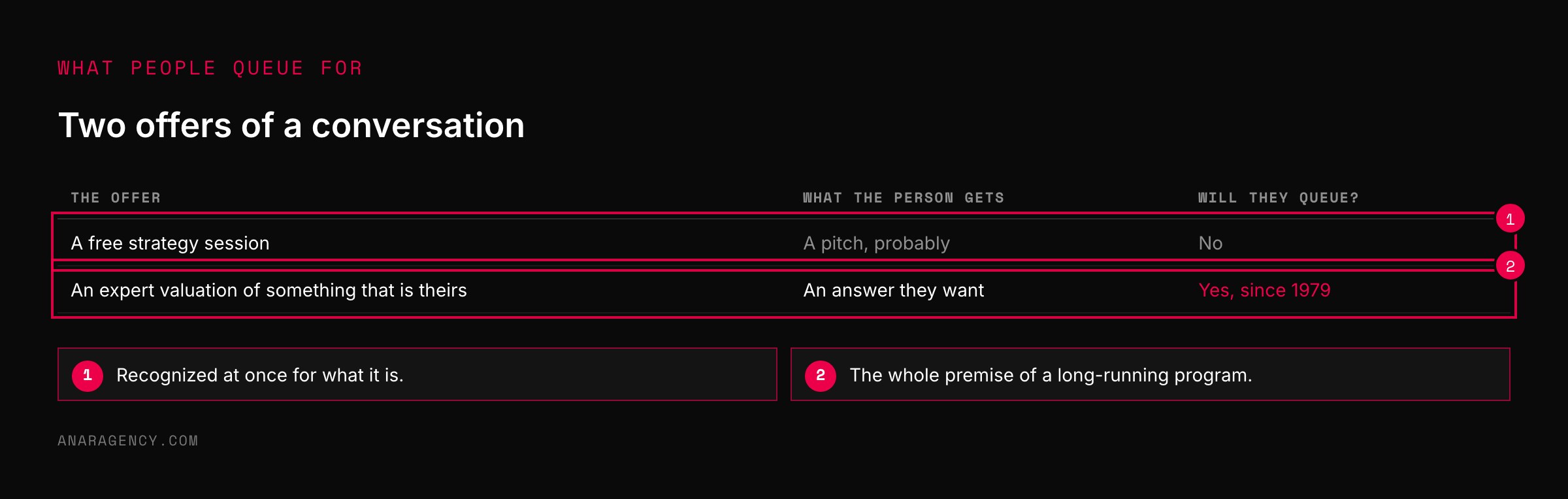
Now think about how most service businesses ask for a conversation. "Book a free strategy session." Nobody has ever queued for one.
Why nobody wants a strategy session
The trouble with a strategy session is that everyone knows what it is. It is a sales call with a kinder name.
A private call is where larger sales get made, because the buyer's full attention is on one thing. That is also why buyers avoid it. They can feel the pitch coming.
So the format with the most value for the seller has the most resistance from the buyer. Hiding the pitch behind a soft label does not remove the resistance. It adds distrust.
The way through is to offer something the buyer wants more than they fear the call.
An evaluation does that. What is my house worth? What are my leads costing me?
Is my website the reason the phone is quiet? Those are answers about the buyer's own situation, and the call is how they get one.
Offer a real evaluation of the buyer's own situation instead of a strategy session. Deliver it fully on the call. Then wait for the buyer to ask how to fix what you found, and answer.
In front of the calendar, ask up to four questions: what they want fixed, what they have tried, who else decides, and budget range. The evaluation must be complete and usable without you, the wording must not assume a fault, and if bookings drop sharply, remove a question.
The Flip Question
Here is the mechanism, in three steps.
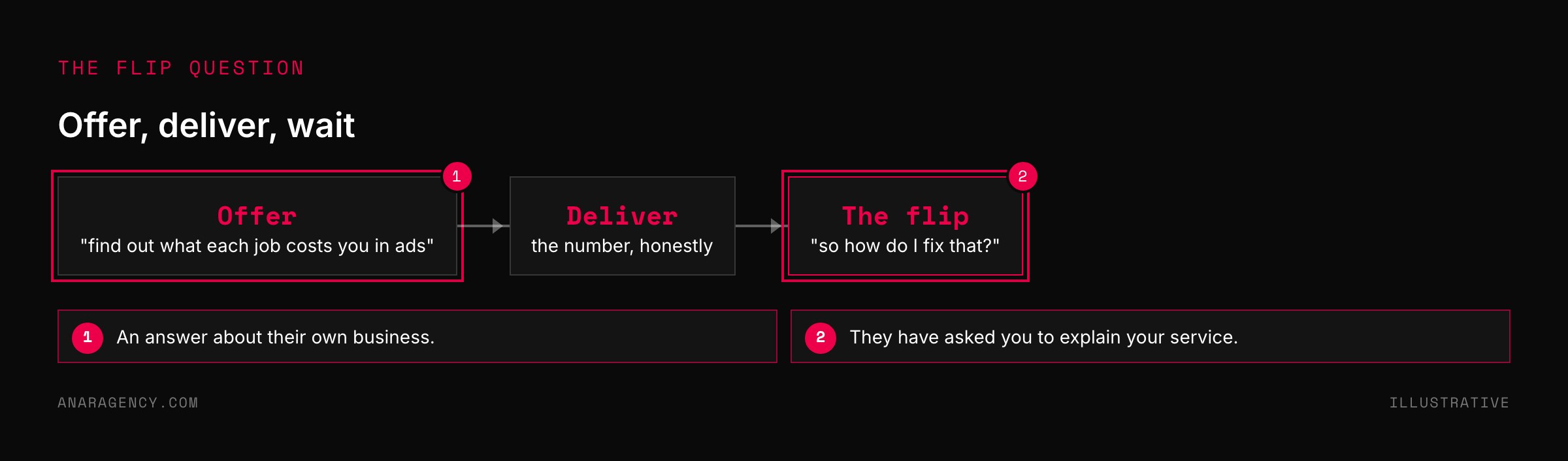
Offer the evaluation. One specific answer about their business. "Find out what each booked job is costing you in ads."
Deliver it. On the call, do the work. Give the number, the finding, the honest verdict, even when the verdict is that things are fine.
Wait. Having heard that each job costs them 340 dollars and should cost 150, almost everyone asks the same thing. "So how do I fix that?"
That is the Flip Question. The buyer has asked you to describe your service. You did not pitch.
You answered.
A request the buyer makes is received differently from an offer the seller pushes. It also follows a well-studied pattern. People who agree to a small step are more likely to agree to a larger related one, which researchers call the foot-in-the-door technique.
We build the evaluation itself in audits as lead magnets.
Gatekeepers: four questions before the calendar
Some firms have full diaries and close most of the calls on them. Their diaries are full of the right people. We call the firms that manage this Gatekeepers.
They ask before they book. A short form sits in front of the calendar. Not twenty fields.
Up to four.
What are you trying to fix? In their words. It tells you whether you can help and gives you the first line of the call.
What have you tried? It shows how far along they are and what not to suggest.
Who else is involved in the decision? If there is a partner, invite the partner. A call with half the decision makers is half a call.
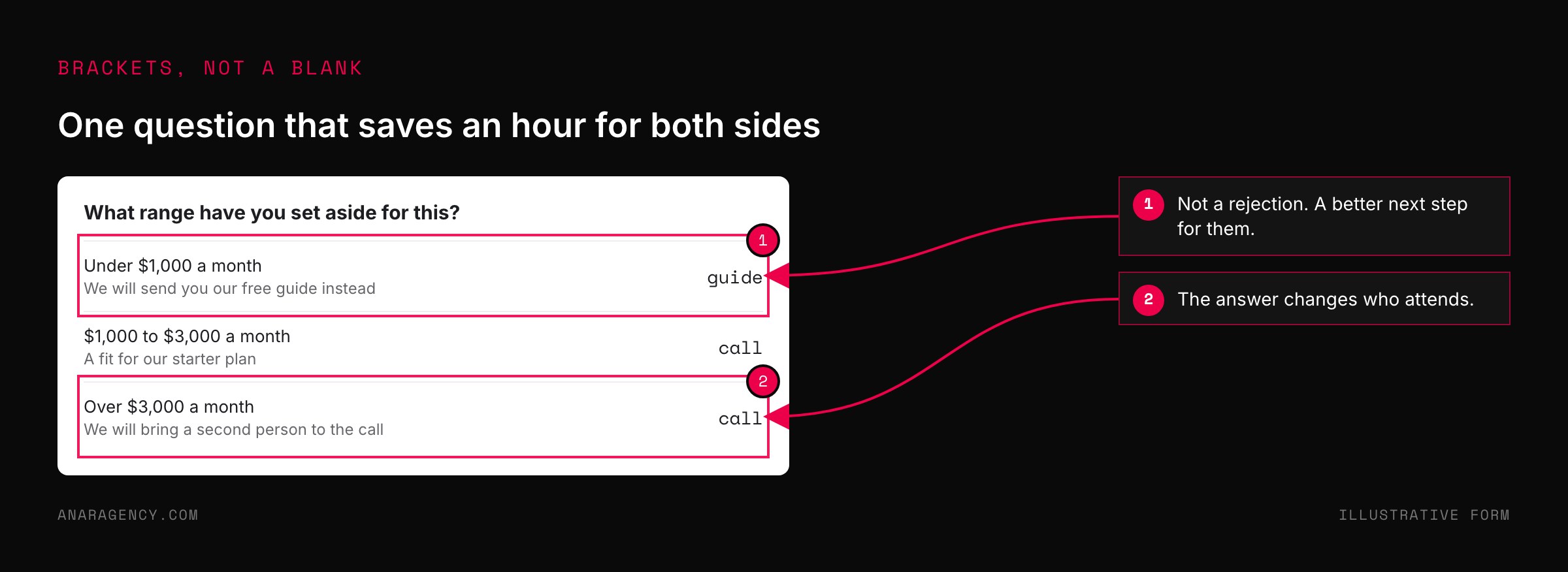
What range have you set aside? Offer brackets. Someone far below your floor can be sent a useful guide instead of an hour of both your time.
The form does a second job. People value what they have put effort into, an effect psychologists call effort justification. Someone who answered four questions is more likely to turn up, which we cover in the show-rate article.
"Is this not just a trick to get people on a sales call?"
It can be, and you have probably been on the receiving end. The free audit that turns out to be a forty-minute pitch with a chart at the start.
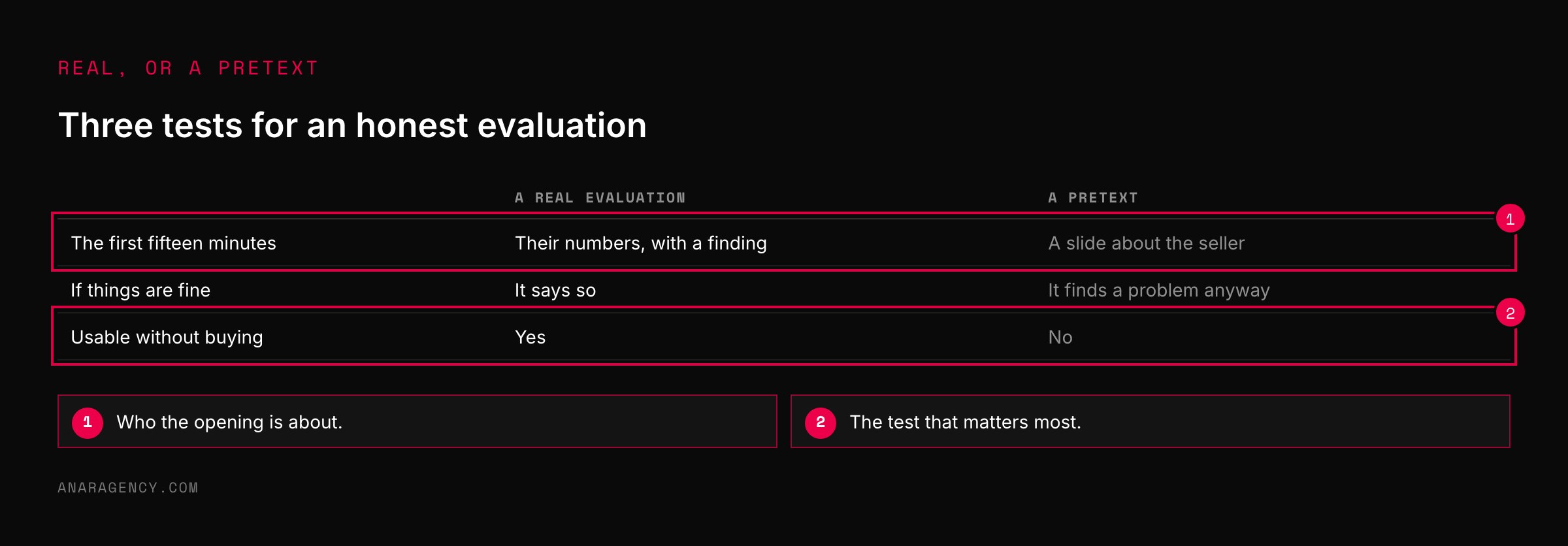
The line is simple. The evaluation has to be real and complete in itself.
If someone leaves the call with a true answer they can act on without you, you have kept your word. Some will act alone. That is the cost of doing this honestly, and it is small.
The wording has to be straight too. Promise the evaluation you will deliver, and say that you will explain how you can help if they ask. Advertising must not mislead about what is being offered.
Do not build the offer on a false premise. "Find out what you are doing wrong" assumes a fault before you have looked. "Find out whether your ads are costing more than they should" leaves room for the answer to be no.
And keep in mind who the form filters out. Questions select for people willing to answer them, a form of self-selection. If bookings fall sharply, drop a question before you conclude that demand has gone.
What to read next, and why
Antiques Roadshow (encyclopedia entry): The long-running program built entirely on people wanting an expert valuation.
Foot-in-the-door technique (encyclopedia entry): The research on why a small yes makes a larger one more likely.
Effort justification (encyclopedia entry): Why people value what they worked for, including an appointment.
Self-selection bias (encyclopedia entry): What a screening form does to the group that gets through it.
So the simple takeaway is this: rename your call after the answer the buyer will get from it, then make sure the call delivers that answer in the first fifteen minutes.
Questions executives ask
How do you qualify leads before a sales call?
Put a short form before the calendar asking what the person wants fixed, what they have tried, who else is involved in the decision, and what budget range they have in mind. Use the answers to decide whether to take the call, who should join, and how to open it.
What is the Flip Question?
The question a buyer asks after receiving an honest evaluation of their situation: how do I fix this? At that point the buyer has asked the seller to explain the service, so the explanation is an answer and not a pitch.
How many questions should a booking form have?
As few as change what you will do. Up to four is a practical ceiling. Each extra field reduces bookings, so remove any question whose answer does not affect whether or how you take the call.
Why do people avoid booking strategy calls?
Because they recognize them as sales calls. A one-to-one call concentrates the buyer's attention, which makes it effective for selling and uncomfortable to enter. Offering a specific evaluation gives the buyer a reason of their own to book.
Is a free audit a legitimate way to get sales calls?
Yes, when the audit is real, complete, and useful even if the person never buys. It becomes deceptive when the audit is a thin pretext for a pitch or assumes a problem before anything has been examined.

Filip Kovacevic is the founder of Anar Agency in Phoenix. He spent five years running SEO, Meta ads, email, and content for medical practices across the United States, and now does the same work for healthcare, home-service, legal, and professional-service businesses, alongside AI implementation. More from Filip →
Talk it through in 15 minutes
Bring one AI question from this article. We will tell you what we would do, whether or not you hire us.
Book a 15-Min Chat →