The Stacked Close: Desire, Justification, Price
A video sales letter cannot answer questions, so objections must be removed in the opening and story, leaving the close mostly to justification. Desire is largely supplied by the market; your job is to give reasons to act now. A stacked close runs three closes in a row: first the offer, with the price shown after its value and with the guarantee; second the cost of waiting, set against the price; third an identity question with one small next step.
Viewers who are ready act at the first close, and the others stay for the next. Every guarantee and claim must be real.
Nobody can raise a hand
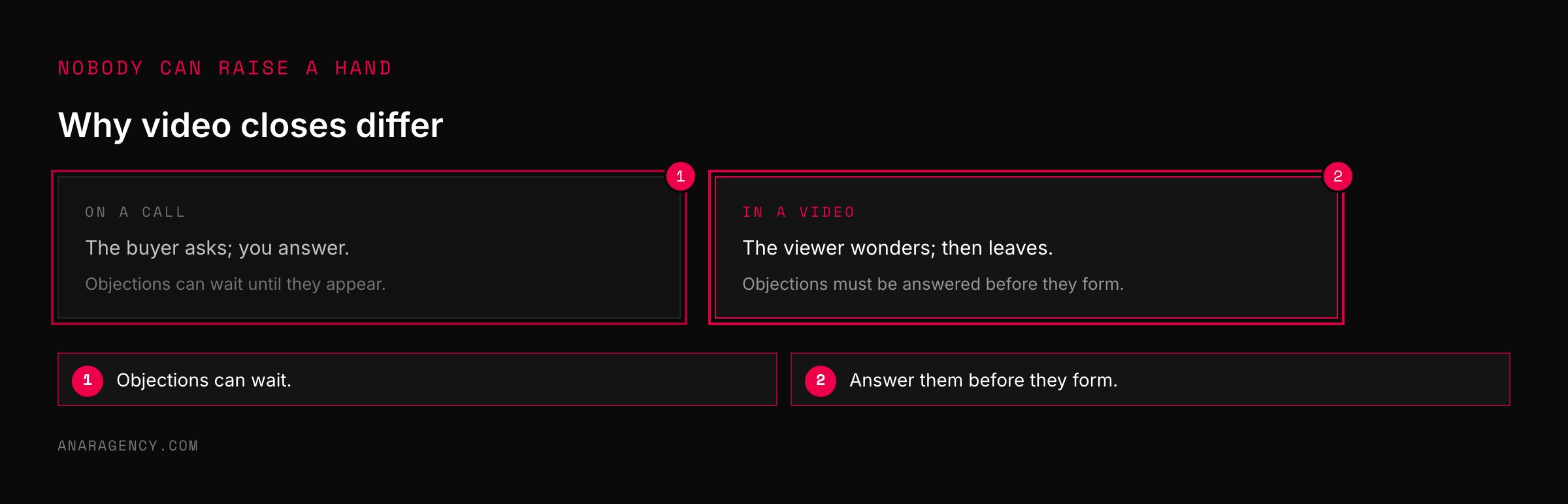
On a sales call, a buyer who doubts something can ask. A video sales letter has no one on the other end.
Every question a viewer has, they either answer for themselves or carry with them. Unanswered ones are a common reason to stop watching.
That changes when objections must be handled. In a conversation you can wait for them to come up. In a video you have to remove them before they form.
So the close of a sales video cannot be where objections get handled. By then it is too late.
The close has a different job: giving reasons to act now to people who already want what you offer.
Desire comes from the market, justification from you
Most sales videos spend their energy building desire. Bigger promises, louder benefits, more excitement.
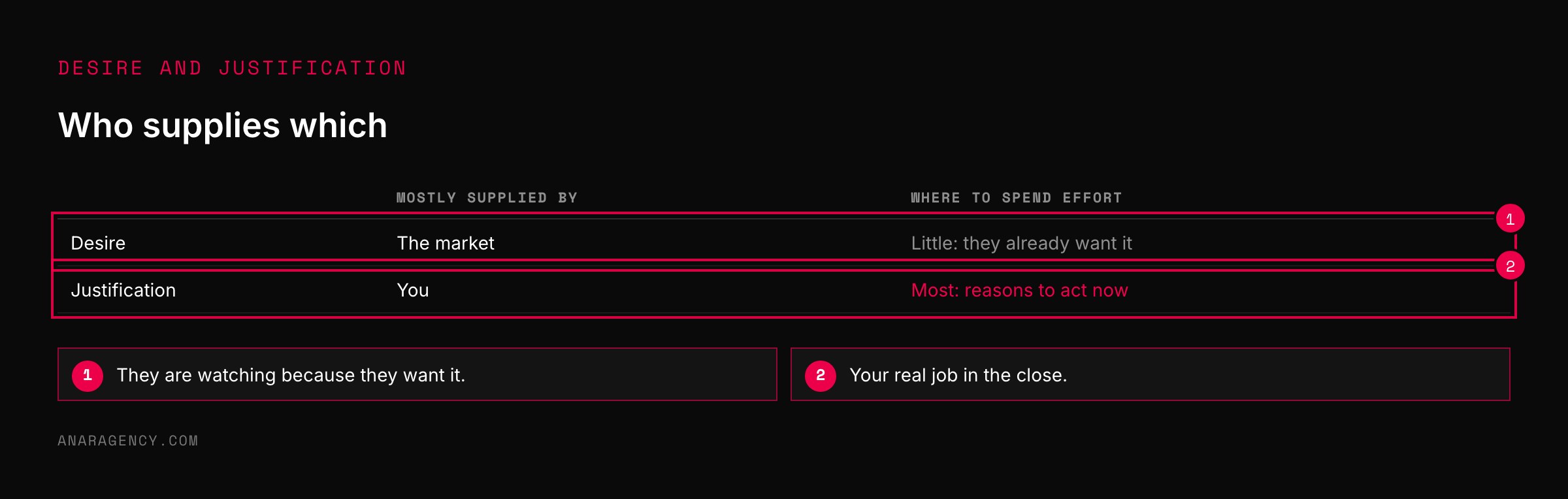
But desire is mostly supplied by the market. People who are watching a video about getting more patients already want more patients.
What they lack is justification: the reasons that make acting now sensible. Psychology calls building those reasons rationalization: the story a person tells themselves about why a choice makes sense.
So the close should spend most of its time on justification. Why this, why now, why it is safe, and why it is worth the money.
For the same split on a live call, see sale versus close.
A sales video cannot answer questions, so remove objections in the opening and story and spend the close on justification. Desire comes mostly from the market; you supply reasons to act now. Show the value before the price, compare honestly, and follow the price with a real guarantee.
Then run three closes in a row: the offer, the cost of waiting, and an identity question with one small next step, each a fresh reason for a different viewer. Never invent urgency.
Remove objections early
Our rule of thumb for a sales video is to front-load objection handling. Most of the opening and story removes objections; most of the close supplies justification.
Write down every objection your market raises. Then find a place in the story where each one is answered before the viewer thinks of it.
"I have tried this before" is answered by explaining why earlier attempts failed. "I do not have time" is answered by showing how little time it takes.
"Will it work for someone like me?" is answered by a story about someone like them.
If an objection first appears in the close, it usually means the story missed it. Go back and fix the story, not the close.
The price, in context
How the price is shown changes how it is judged. A number shown alone is compared with whatever the viewer has in mind.
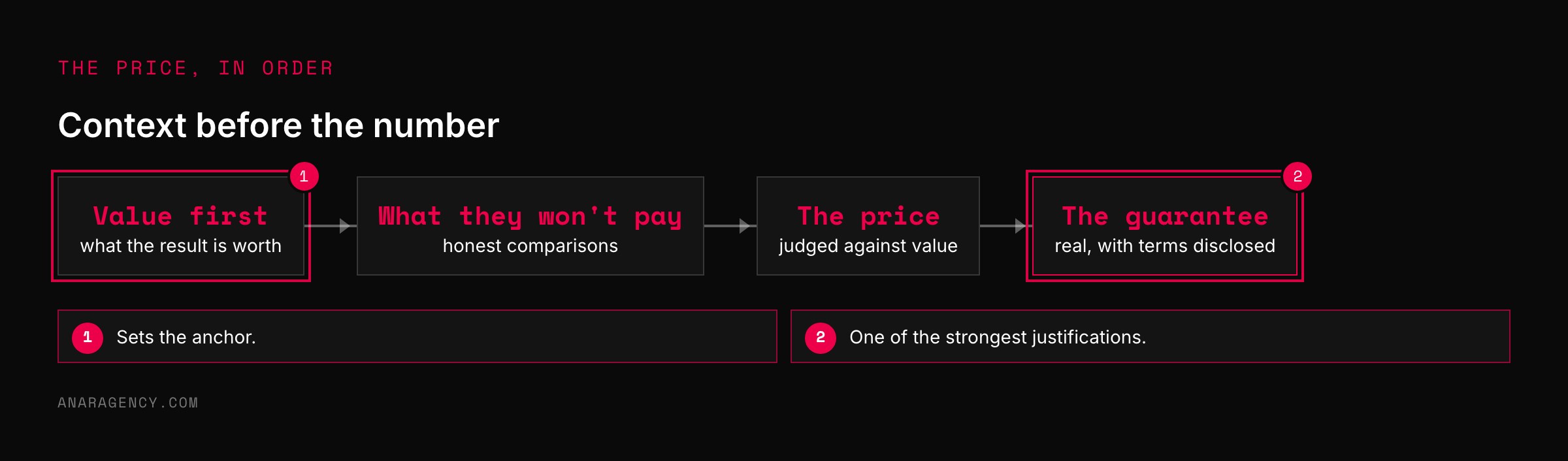
People tend to judge numbers relative to the first number they see, a pattern called the anchoring effect. Show the value of the result before the price, so the price is judged against it.
Then show what the viewer will not have to pay: the cost of hiring someone full time, or of a year without the result. Every comparison must be honest and checkable.
Follow the price with the guarantee. Under FTC guides, a "money back guarantee" should only be offered if you refund the full price on request, with any conditions disclosed.
A real guarantee is one of the strongest justifications there is. A fake one is a liability.
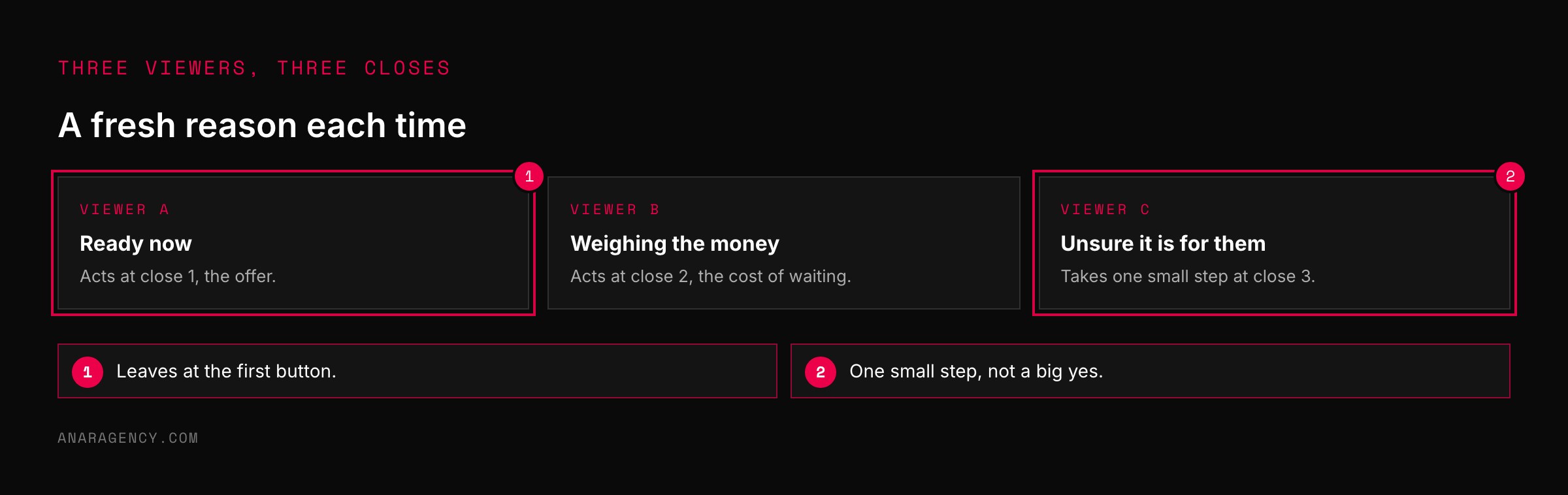
Three closes in a row
Viewers decide at different speeds. A single close catches only those ready at that moment.
Close 1, the offer. What it is, what it includes, the price after its value, and the guarantee. Then the button.
Viewers who are ready act here.
Close 2, the cost of waiting. What staying the same costs each month, set against the price. Viewers who were weighing the money act here.
Close 3, the identity question. Who do you want to be a year from now? Ask for one small next step, not a big yes.
Each close is shorter than the last. And each one is a fresh reason, not the same reason repeated louder.
For the opening of the same video, see the first 90 seconds of a VSL.
Here is how the three might sound for an illustrative bookkeeping service. Close 1: "Monthly books, done for you, for $400 a month, with a 60-day money back guarantee."
Close 2: "Right now you spend about six hours a month on this. At your hourly rate, that is more than the fee."
Close 3: "A year from now, do you want to be the owner who still does the books on Sunday night? If not, book a 15-minute check of your current setup."
Each one stands alone. A viewer who hears only one of them still gets a complete reason.
"Isn't three closes pushy?"
It can be, if each close repeats the same pressure. Done well, each one offers a different reason to a different viewer.
The viewer who was ready at the first close has already left the video. The rest are still watching because they are still deciding.
Keep every claim in each close true. Costs of waiting must be realistic, comparisons must be fair, and claims must be backed by evidence.
Never invent urgency. A deadline that is not real is a false claim, and viewers increasingly recognize it.
And let viewers leave with something even if they do not buy. A free resource at the end keeps the relationship going for the ones who need more time.
What to read next, and why
Sales letter (encyclopedia entry): The print format the sales video grew out of.
Anchoring effect (encyclopedia entry): Why the order of numbers changes how a price is judged.
Guides for the advertising of warranties and guarantees (US federal regulation): When a money back guarantee may be advertised.
Rationalization (encyclopedia entry): How people build the reasons that let them act.
So the simple takeaway is this: list the objections that first appear in your video's close, and move the answer to each one into the story.
Questions executives ask
How do you close a VSL?
Remove objections earlier in the video, then use the close for justification: the offer with the price shown after its value and a real guarantee, the cost of waiting, and an identity question with one small next step.
Where should objections be handled in a sales video?
Mostly in the opening and story, before viewers think of them. An objection that first appears in the close is usually too late to fix.
When should the price appear in a VSL?
After the value of the result has been shown, so viewers judge the price against it rather than against an unrelated number.
Can I offer a money back guarantee in a sales video?
Only if you will refund the full price on request, with any conditions clearly disclosed, according to FTC guides on guarantees.
Why use more than one close?
Viewers decide at different speeds. Each close gives a different reason, so viewers who were not ready at the first one may act at the second or third.

Filip Kovacevic is the founder of Anar Agency in Phoenix. He spent five years running SEO, Meta ads, email, and content for medical practices across the United States, and now does the same work for healthcare, home-service, legal, and professional-service businesses, alongside AI implementation. More from Filip →
Talk it through in 15 minutes
Bring one AI question from this article. We will tell you what we would do, whether or not you hire us.
Book a 15-Min Chat →