A Twelve-Beat Video Sales Letter Skeleton
A video sales letter can be built on twelve beats adapted from the hero's journey used in film. An ordinary day, a jolt, a doubt, a guide, a first step, trials, a turn, a low point, a discovery, proof, a changed life, and a handover to the viewer. Beats one to eight are the story, nine and ten are the argument, eleven and twelve are the offer.
Keep the body to about five ideas, since viewers cannot hold many more. Keep the story's broad shape relatable and skip odd personal detail. The story must be true.
A seven-page memo
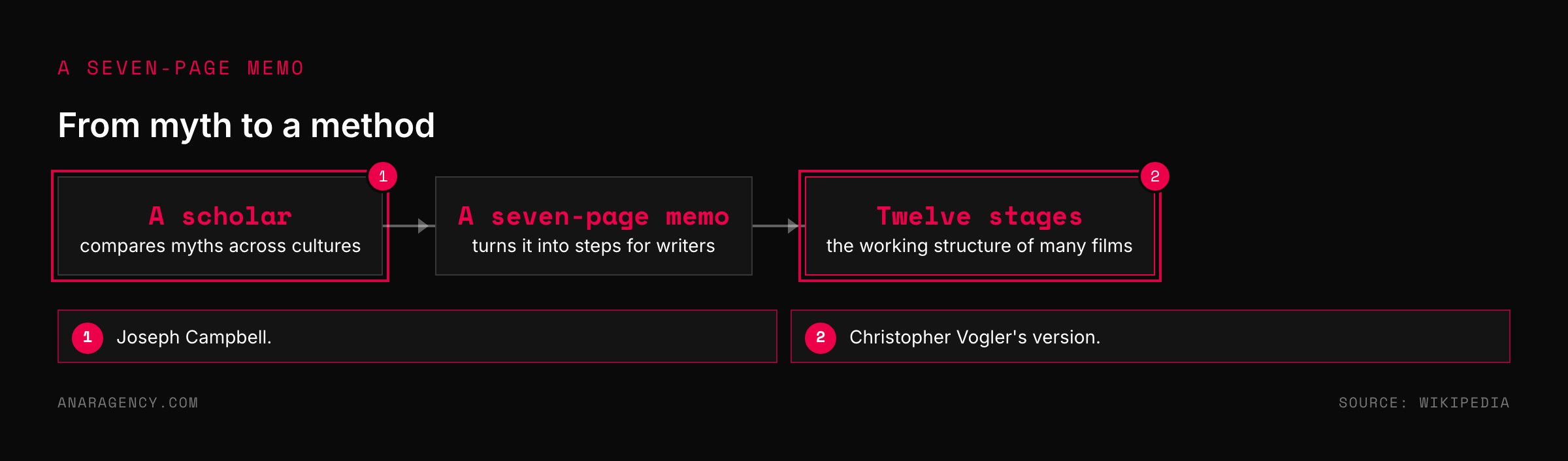
In the 1980s a story analyst at a film studio named Christopher Vogler wrote a memo for his colleagues.
It was seven pages long. It summarized the work of a scholar, Joseph Campbell, who had compared myths from cultures around the world and argued that they shared one underlying pattern.
A hero leaves an ordinary world, is tested, nearly fails, wins something, and returns changed. Campbell called it the monomyth. Most people now call it the hero's journey.
Vogler's memo boiled it down to practical steps for screenwriters. It was copied and passed around Hollywood, and he later expanded it into a book that set out twelve stages.
The structure is in a great many films you have seen. It also happens to be the most dependable skeleton for a sales video.
Why a story structure sells
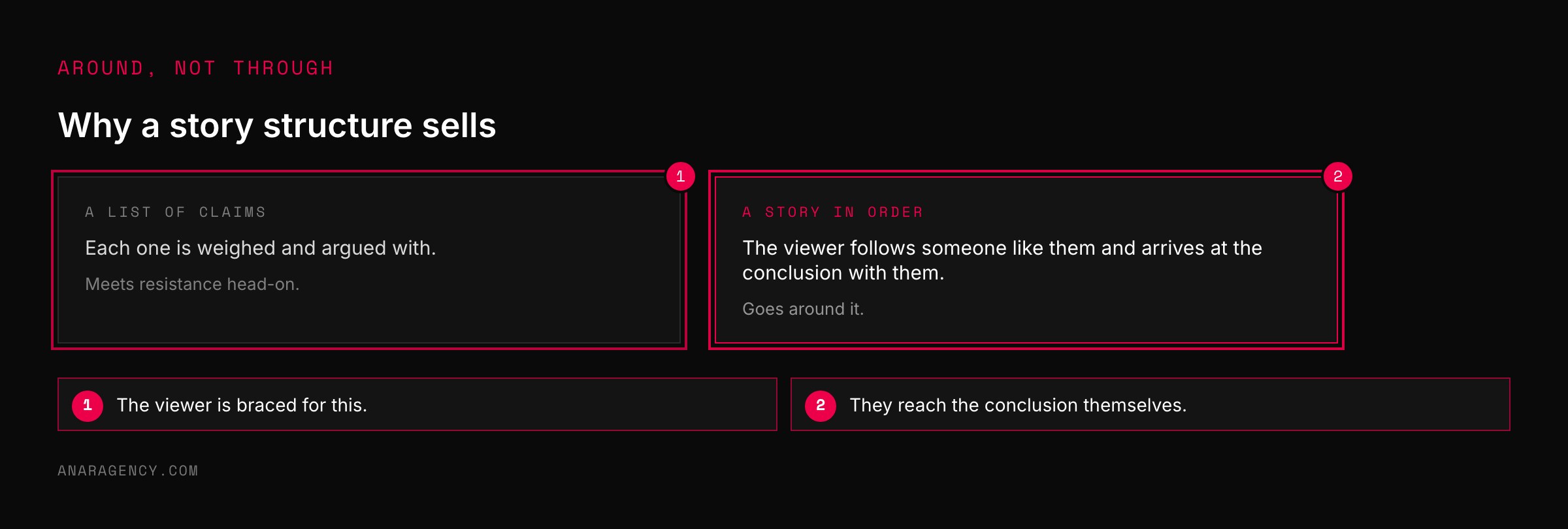
A sales video has a problem that a film does not. The viewer knows they are being sold to and is braced for it.
A list of claims meets that resistance head-on. Each claim is weighed and argued with.
A story goes around it. The viewer follows a person through a situation they recognize, and reaches the conclusion alongside them instead of being handed it.
The twelve steps matter because they are the order in which people expect a story of change to unfold. Leave one out and viewers feel something is missing, even if they cannot say what.
How to open before the story begins is a separate job, which we cover in the first 90 seconds.
Ordinary day, jolt, doubt, guide, first step, trials, turn, low point, discovery, proof, change, handover. Beats one to eight are the story, nine and ten the argument, eleven and twelve the offer. Never skip the ordinary day.
Give the hero the viewer's limits. Include the turn before the low point. Keep the broad shape and drop odd personal detail.
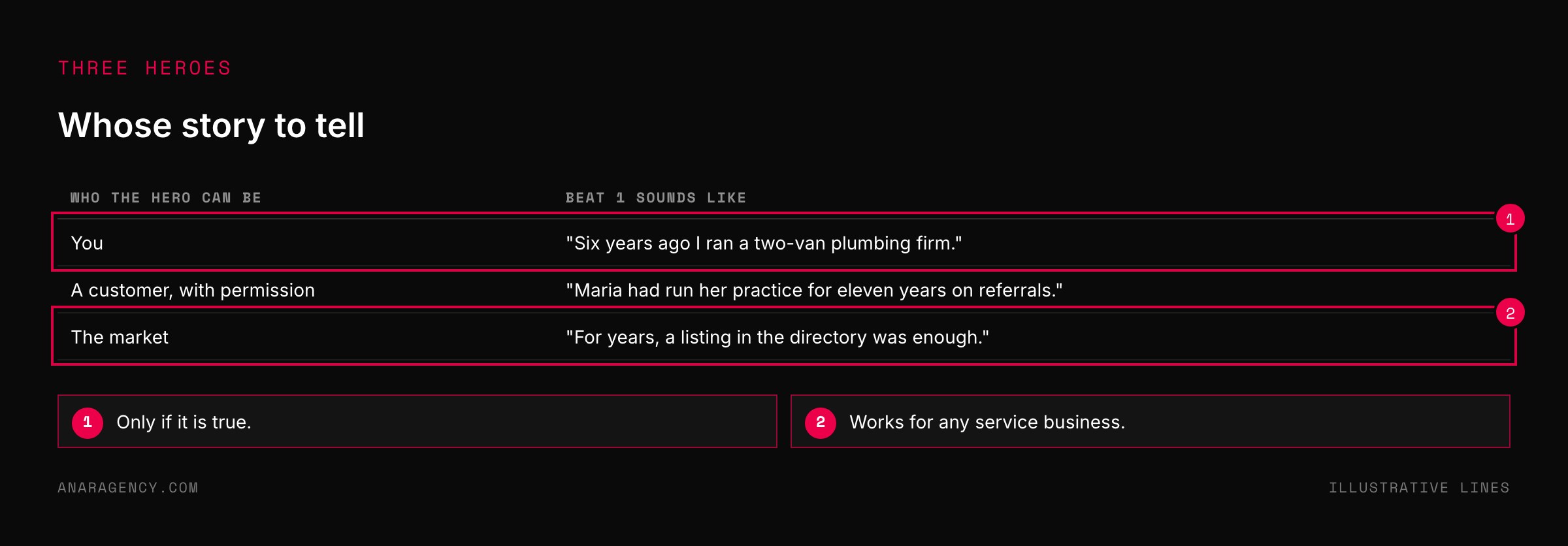
Carry about five ideas. The hero can be you, a customer, or the market, and the story must be true. Tell it whole once, then reuse single beats.
The Twelve Beats
Here is our adaptation for a sales video.
1. Ordinary day. Life before, which is the viewer's life now.
2. The jolt. The event that made the old way impossible to ignore.
3. The doubt. "It will not work for someone like me."
4. The guide. A person, a book, or a chance remark that pointed somewhere new.
5. The first step. Trying it, with the same limits the viewer has.
6. Trials. What went wrong.
7. The turn. The moment it became clear the usual advice was mistaken.
8. The low point. It nearly failed.
9. The discovery. What actually works, and why.
10. The proof. It worked again, and for other people.
11. The change. What life looks like now.
12. The handover. Here is how you can use it.
Beats one to eight are the story. Nine and ten are the argument. Eleven and twelve are the offer.
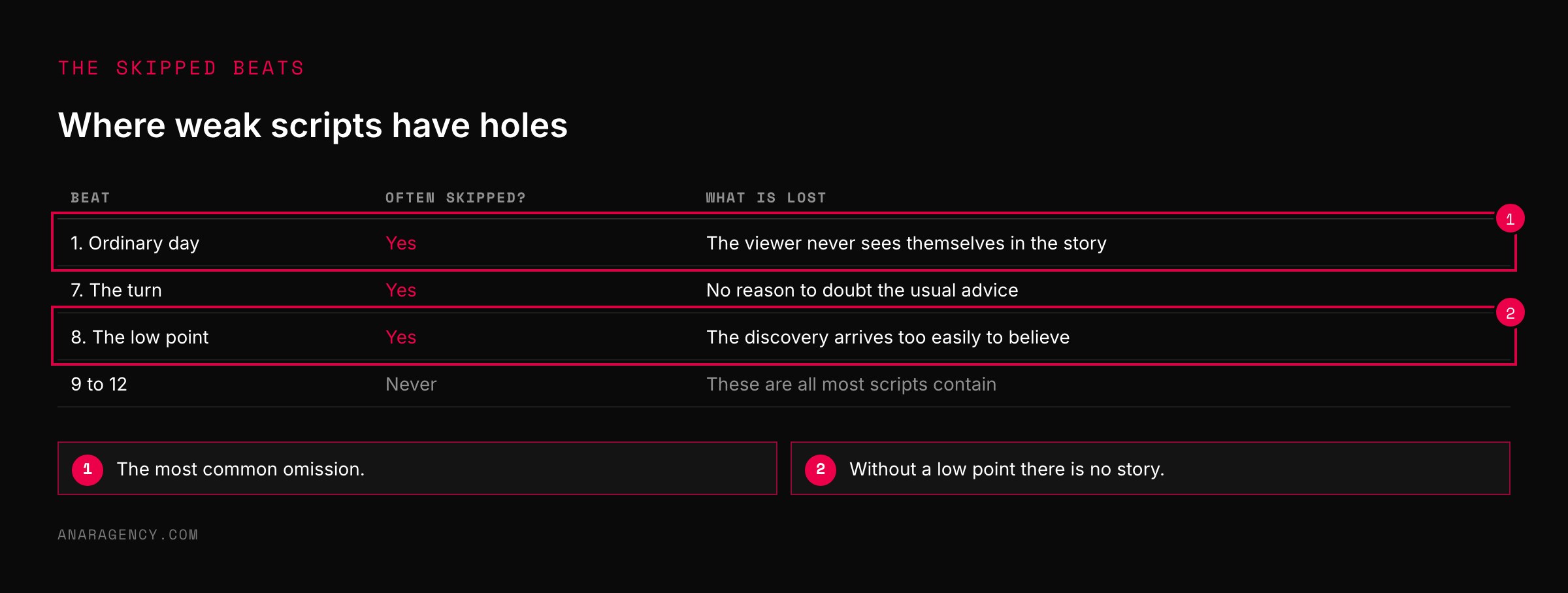
Most weak scripts are all nine to twelve with nothing before them.
Beat Keepers: what the good ones get right
Plenty of people know this structure and still write flat videos. The difference is in a few choices. We call the writers who make them Beat Keepers.
They do not skip beat one. Amateurs start at the jolt. Without the ordinary day, the viewer has not yet seen themselves in the story, and nothing after it lands.
They give the hero the viewer's limits. "I had no budget for ads either." It builds recognition and answers an objection before it is raised.
They include the turn. The moment before the low point where everything the hero believed proves wrong. It prepares the viewer to accept that their own assumptions may be too.
They keep the story's shape and drop the oddities. The broad beats of a struggle are shared by everyone. A peculiar personal detail invites the viewer to notice how different you are.
They carry about five ideas. A classic psychology paper proposed that people hold roughly seven items, plus or minus two, in short-term memory, and later work suggests fewer. One mechanism, three reasons, one offer.
They reuse the beats. Tell the whole story once. In emails and ads afterwards, refer to a single beat.
"Remember the month it nearly failed?"
"I do not have a dramatic story"
You may be a contractor or an accountant with no rags-to-riches tale, and no wish to invent one. Good. Do not.
The hero does not have to be you. It can be a customer, with their permission. It is often stronger that way, because the viewer is a customer too.
It can also be the market. "For years, a listing in the directory was enough. Then search changed."
The ordinary day, the jolt, and the trials all belong to the trade as a whole.
What it cannot be is false. A sales video is advertising, and advertising claims have to be truthful and supported. That includes the story.
An invented low point or a made-up customer is deception, however well it is structured. And viewers who live in your world will spot the false note.
A small true story told in order beats a large invented one. Where to find real ones is in collect, don't invent, and what proof to put in beat ten is in the Proof Grid.
What to read next, and why
Hero's journey (encyclopedia entry): Campbell's pattern, the versions that followed, and the criticisms of it.
Christopher Vogler (encyclopedia entry): The memo and the twelve-stage version that screenwriters use.
The Magical Number Seven, Plus or Minus Two (encyclopedia entry): The paper on how much people can hold in mind at once.
Advertising FAQs: A Guide for Small Business (FTC guide): The standard a sales story has to meet.
So the simple takeaway is this: write one true sentence for each of the twelve beats before you write anything else. If you cannot fill beat one or beat eight, that is what the script is missing.
Questions executives ask
What is a video sales letter template?
An outline for the order of a sales video. A dependable one follows twelve beats adapted from the hero's journey: an ordinary day, a jolt, a doubt, a guide, a first step, trials, a turn, a low point, a discovery, proof, a changed life, and a handover to the viewer.
What is the hero's journey in marketing?
A story pattern identified by Joseph Campbell and adapted for screenwriters by Christopher Vogler, in which a person leaves an ordinary situation, is tested, nearly fails, succeeds, and returns changed. In marketing it gives a sales story an order that audiences find natural.
How many points should a VSL make?
About five. Research on short-term memory suggests people hold only a handful of items at once. A script built on one mechanism, three reasons, and one offer is easier to follow than one listing every feature.
Does the story in a VSL have to be about the founder?
No. The hero can be a customer, with permission, or the market as a whole. What matters is that the viewer recognizes the starting situation as their own.
Can I make up a story for a sales video?
No. A sales video is advertising, and its claims, including the story, must be truthful and supportable. Invented struggles or customers are deceptive. A modest true story told in the right order is more effective and safe.

Filip Kovacevic is the founder of Anar Agency in Phoenix. He spent five years running SEO, Meta ads, email, and content for medical practices across the United States, and now does the same work for healthcare, home-service, legal, and professional-service businesses, alongside AI implementation. More from Filip →
Talk it through in 15 minutes
Bring one AI question from this article. We will tell you what we would do, whether or not you hire us.
Book a 15-Min Chat →