Sale vs Close: The Promise and the Justification
Selling and closing are two different jobs. The sale is when the buyer accepts the promise: this would get me what I want. The close is when the buyer finds the reasons to say yes now: it is worth the price, it is safe, the timing is right, and the people they answer to will agree.
Many stalled deals ask for money before the promise is accepted, or repeat the promise when the buyer needs a justification. Keep them apart. Sell the idea first, then close by supplying the specific reasons the buyer needs.
Four words from 1910
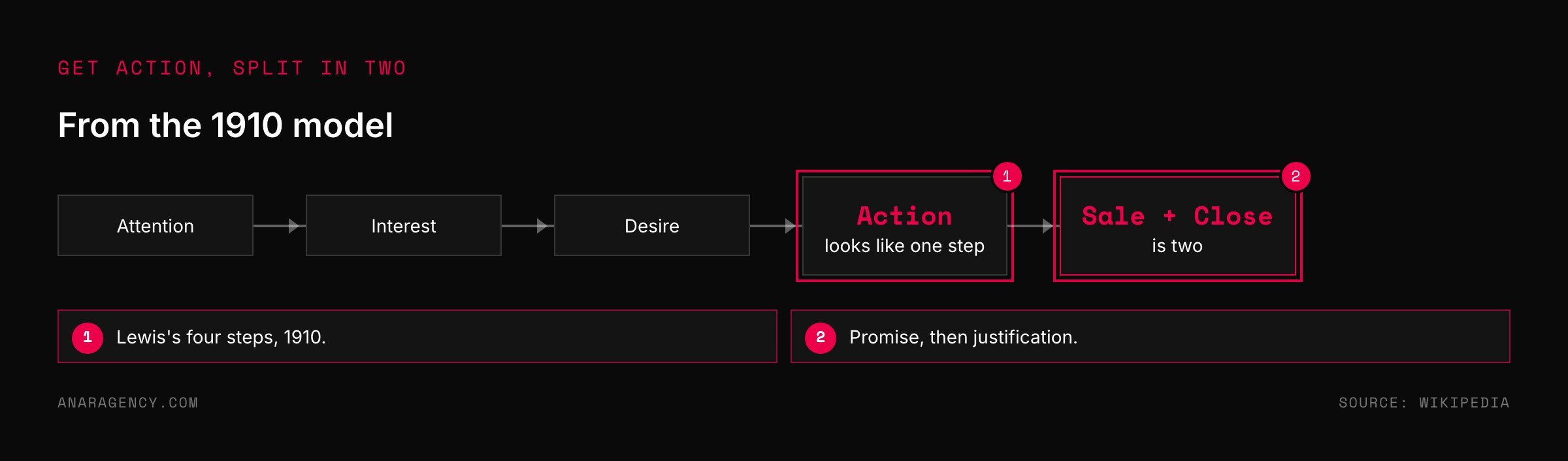
In January 1910 an advertising man named St Elmo Lewis gave a talk in Rochester. He said all advertising must attract attention, maintain interest, arouse desire, and get action.
Those four steps became the AIDA model, and marketers still draw it on whiteboards a century later.
Look closely at the last step. "Get action" sounds like one thing.
On a real sales call it is two. First the buyer has to believe the promise, and then they have to find a reason to act on it now.
Those are the sale and the close. Treat them as one step, and deals stall right at the end.
Five steps, not four
Here is a sales process with the last step split in two.
Awareness comes from difference. The buyer notices you because you are unlike the rest of the market.
Attention is focus held over time, usually because a question has opened in the buyer's mind.
Education answers that question: why the problem exists, and what kind of solution fixes it.
The sale is the buyer accepting the promise. Not paying, accepting: "this would get me what I want."
The close is the buyer finding the reasons to act now, and then paying.
Selling and closing are separate jobs. The sale is the buyer accepting the promise that this would get them what they want; you can hear it when they say it back in their own words. The close supplies the reasons to act now: value, safety, timing, and permission.
Do not ask for money before the promise is accepted, and do not repeat the promise when the buyer needs a justification. Ask which reason is missing and supply that one.
The sale: the promise
The sale happens in the buyer's head before any money moves. It is the moment they picture the outcome and believe this path leads there.
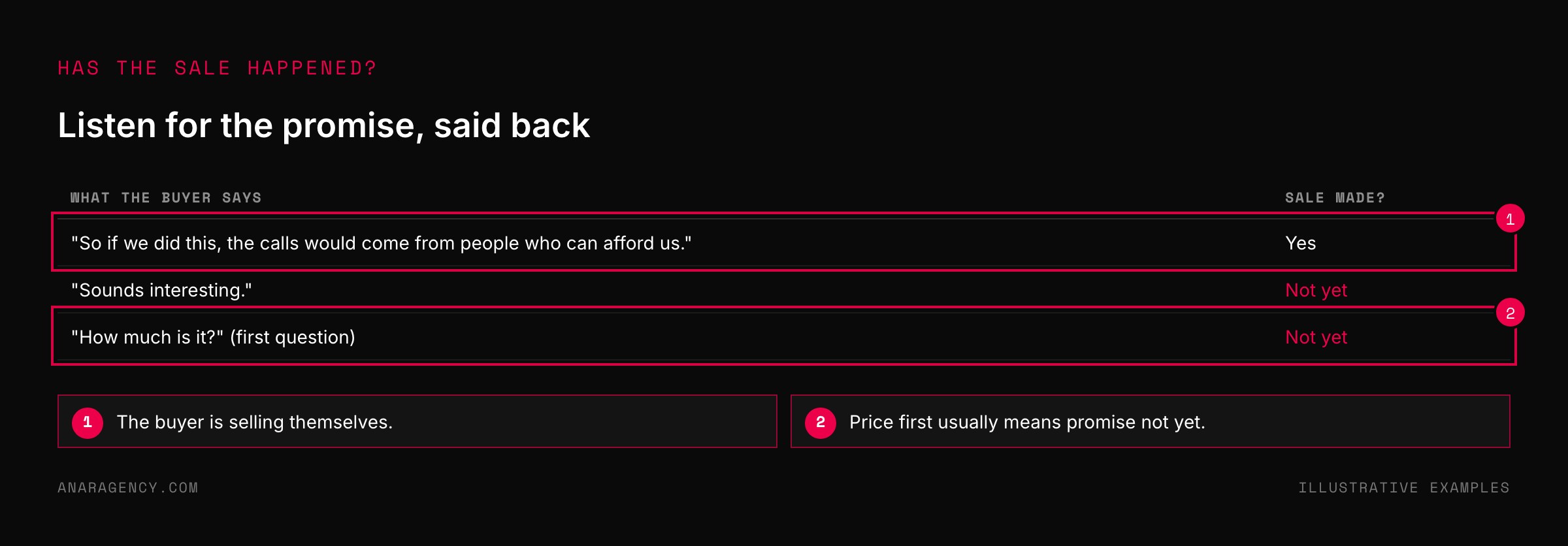
You can hear it. "So if we did this, the calls would come from the people who can actually afford us." That is a buyer selling themselves the idea.
If you have not heard something like that, you have not made the sale yet. Asking for money now will feel like pressure, to them and to you.
Go back to education. Ask what would need to be true for this to work for them, and answer that.
For how buyers come to own a claim, see let them say it.
The close: the justification
Once the promise is accepted, the buyer needs reasons. Not more promise, reasons.
There is an old saying in sales that people buy on emotion and justify with logic. Psychology describes a related habit, rationalization: building logical reasons for a choice already leaning one way.
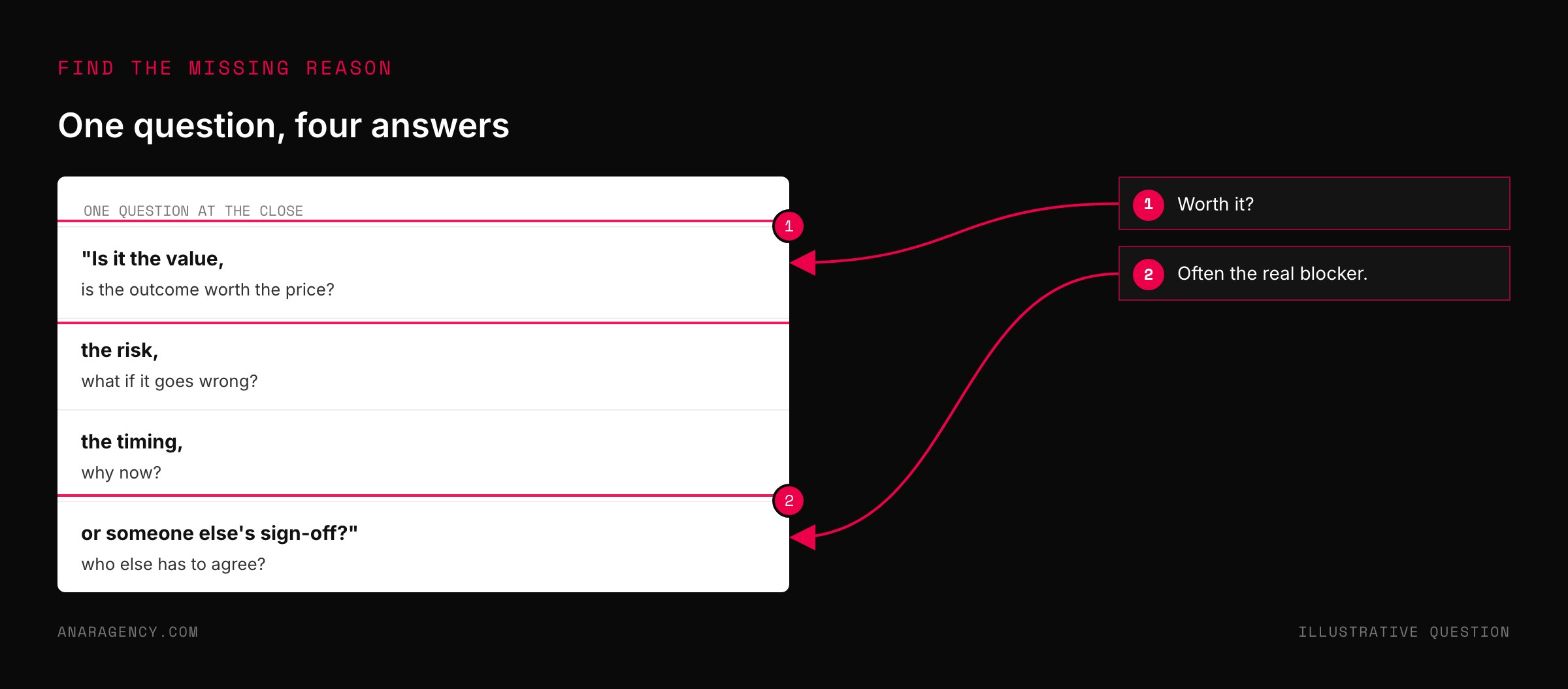
The close supplies four kinds of reason. Value: the outcome is worth more than the price. Safety: if it goes wrong, they are covered.
Timing: now is better than later, for a real reason. Permission: the partner, boss, or board they answer to will agree.
Ask which one is missing. "Is it the value, the risk, the timing, or someone else's sign-off?" Then supply that one.
For handling the objection itself, see the take-away close.
After the yes, keep supplying reasons. People tend to view their choices more favorably afterward, a pattern called choice-supportive bias, and a quick early result helps it along.
"My buyers just want the price."
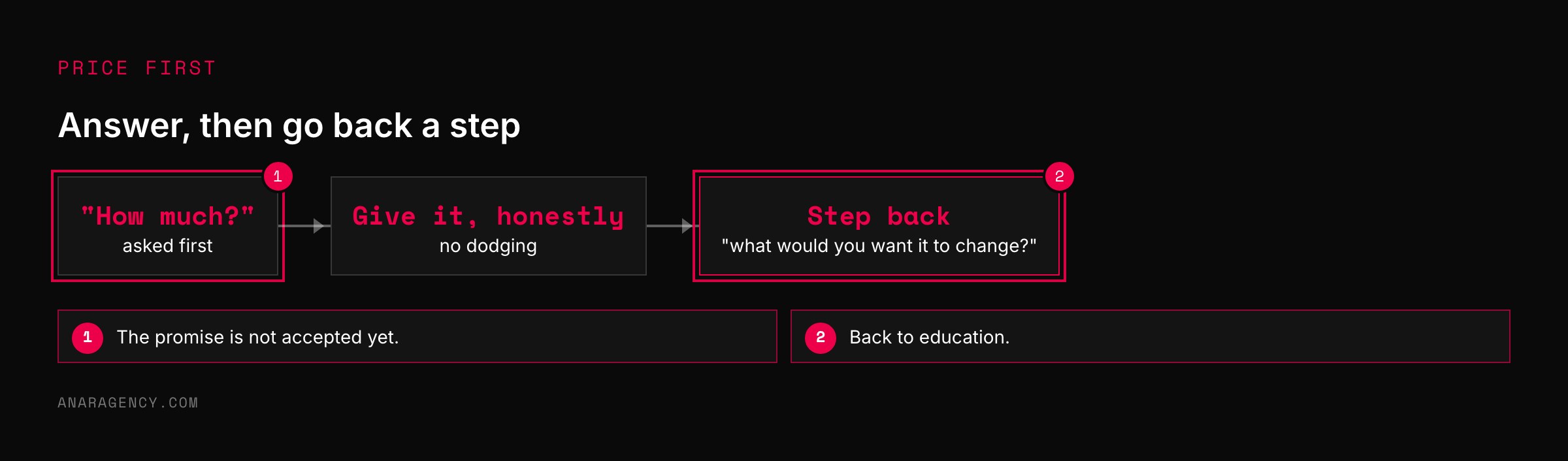
Some do, and that tells you where they are. A buyer who asks for the price first has usually not accepted the promise yet.
Give the price, honestly, and then go back a step. "That is the investment. Before it means anything, can I ask what you would want it to change?"
If they will not engage, they may be comparing quotes for something they see as a commodity. That is a different sale, often won on price alone.
Research on persuasion suggests people who are motivated and able to think it through weigh arguments carefully, while others lean on shortcuts like price, a view known as the elaboration likelihood model.
So the job is to make the outcome worth thinking about. Once they are thinking, they are not just asking the price.
A call, step by step
Here is how the two steps sound on an illustrative call with the owner of a small home-services company.
Education. The seller explains why the owner's ads bring calls that never book: the calls come in while the team is out on jobs, and nobody answers for hours.
The sale. The seller asks, "If every call was answered within five minutes, what would change for you?" The owner says, "We would book half the ones we lose now."
That is the promise, accepted in the buyer's own words. Nothing has been asked for yet.
The close. Now the seller supplies reasons, one at a time. Value: "You said a booked job is worth about $800.
Two extra a month covers the fee."
Safety: "It is month to month, so if it does not work you stop." Timing: "Your busy season starts in six weeks, and setup takes two."
Permission: "Does anyone else need to agree before you start?" The owner says his business partner will want to see the numbers, so the seller offers to send a one-page summary tonight.
Notice what did not happen. The seller never repeated the promise louder, and never asked for money before the owner had said what would change.
The numbers in this example are illustrative. Use your own buyer's numbers, in their words, every time.
What to read next, and why
AIDA (marketing) (encyclopedia entry): Where the four-step model came from, including the 1910 talk.
Rationalization (encyclopedia entry): How people build reasons for a choice they lean toward.
Elaboration likelihood model (encyclopedia entry): Why some buyers weigh arguments and others use shortcuts.
Choice-supportive bias (encyclopedia entry): What happens to a decision after it is made.
So the simple takeaway is this: on your next call, do not ask for money until you have heard the buyer say the promise back to you in their own words.
Questions executives ask
What is the difference between selling and closing?
Selling is getting the buyer to accept the promise that your offer would get them what they want. Closing is supplying the reasons to act now and completing the purchase.
What are the steps of a sales process?
One version uses five: awareness, attention, education, the sale (accepting the promise), and the close (justifying and completing the purchase).
What is the AIDA model?
A classic advertising model: attention, interest, desire, action. St Elmo Lewis described its steps in a 1910 talk.
Why do buyers stall at the end of a sales call?
Often because they were asked to pay before they accepted the promise, or because they need a specific reason such as value, safety, timing, or someone else's permission.
How do I close a buyer who only asks about price?
Give the price honestly, then ask what they would want it to change. A buyer who leads with price has usually not yet accepted the promise.

Filip Kovacevic is the founder of Anar Agency in Phoenix. He spent five years running SEO, Meta ads, email, and content for medical practices across the United States, and now does the same work for healthcare, home-service, legal, and professional-service businesses, alongside AI implementation. More from Filip →
Talk it through in 15 minutes
Bring one AI question from this article. We will tell you what we would do, whether or not you hire us.
Book a 15-Min Chat →