Risk Reversal Is Not a Guarantee: What Buyers Fear Losing
Risk, to a buyer, is whatever they trade and cannot get back. Money is only one of five things on that list, and usually the least feared. The others are time, effort, face, and the alternative they gave up.
A money-back guarantee answers the first and ignores the rest, which is why adding one often changes nothing. List what your buyer could lose that a refund would not return, and answer each loss with something specific: a deadline you keep, doing the switch for them, a small first step, an easy way back.
The guarantee that changed nothing
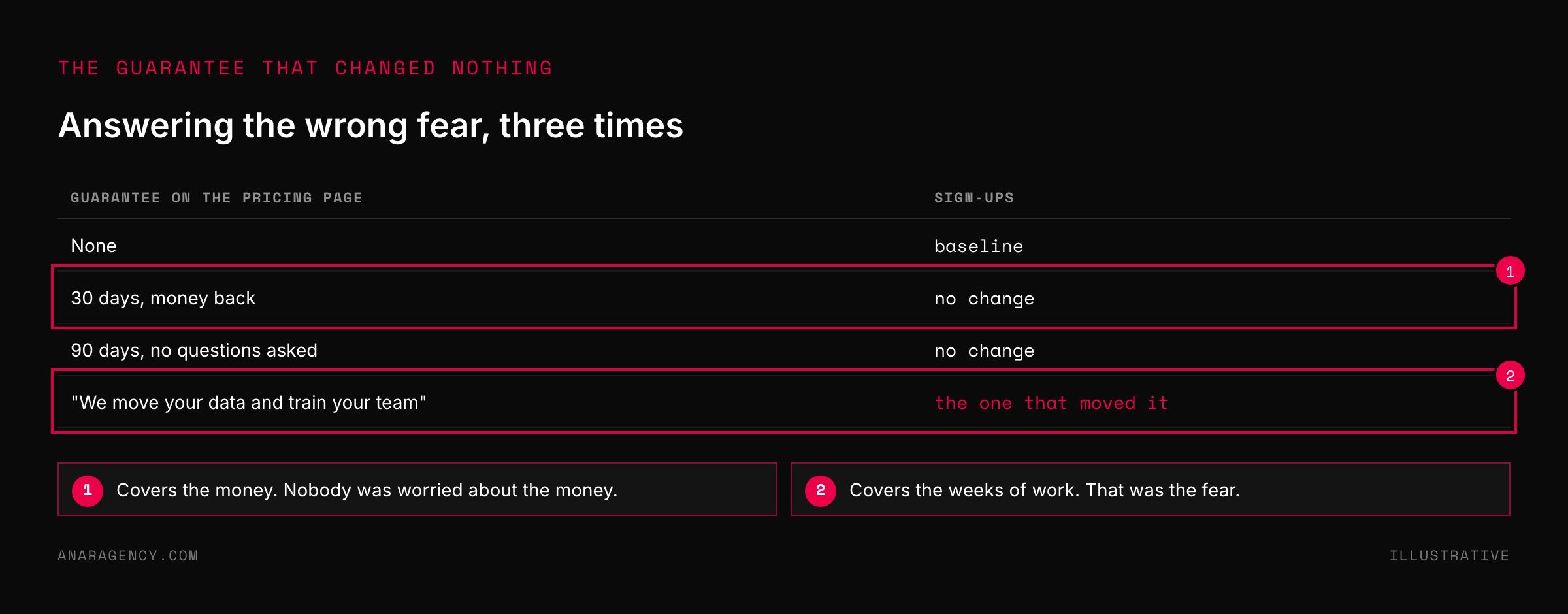
A software company adds a 30-day money-back guarantee to its pricing page. Big badge, gold seal, the works.
Sign-ups do not move.
So they make it 60 days. Then 90. Then "no questions asked."
Nothing.
The guarantee was fine. It was answering a question nobody was asking. The buyers were not afraid of losing $99.
They were afraid of losing the month it would take to move everything over, and of what they would say to the team if it failed.
What risk actually is
Here is a definition worth keeping. Risk is what a buyer trades and cannot get back.
Money can be refunded. That makes it the easiest loss to reverse, and often the smallest worry.
Now think about where your buyer is. They are not a no, or they would have left the page. They are not a yes, or they would have bought.
They are a maybe.
Behind every maybe is a quiet calculation about what could go wrong and stay wrong.
Psychologists have measured why this weighs so much. Loss aversion is the finding that a loss hurts more than a gain of the same size pleases. A buyer feels the possible loss of a month more sharply than the possible gain of a better tool.
So talking more about benefits does not move a maybe. Shrinking the loss does.
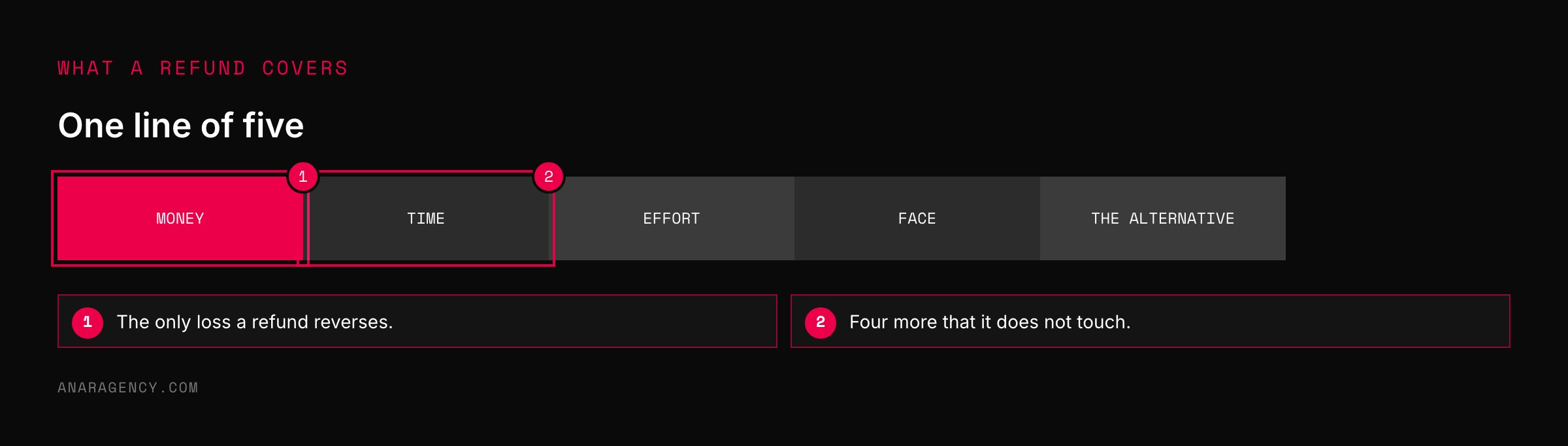
Five things a buyer can lose and not get back: money, time, effort, face, and the alternative they gave up. For each, write what a refund would not return and answer it with something specific. Time: a date you commit to.
Effort: you do the switch. Face: a small paid first step. The alternative: an easy, visible way back.
Put honest limits on every promise, and add no surprise costs at the end.
The Loss Ledger
List what your buyer could lose that would not come back. There are five lines.
Money. The one everyone covers.
Time. The weeks spent setting up, learning, waiting for results. A refund on day 60 does not return the 60 days.
Effort. The work of switching. Moving the data.
Retraining the staff. Telling customers about a new process.
Face. Having to tell a boss, a partner, or a spouse that it did not work. For many buyers this is the largest line and the one they will never say out loud.
The alternative. The other choice they gave up. Once someone owns a thing, they value it more than before, which researchers call the endowment effect.
Leaving the old option feels like a loss even when the new one is better.
Now look at your own offer and ask which of those five your guarantee touches. For most businesses the answer is one.
Ledger Keepers: answering each line
Some offers feel safe without a guarantee badge in sight. Their makers answered the other four lines. We call them Ledger Keepers.
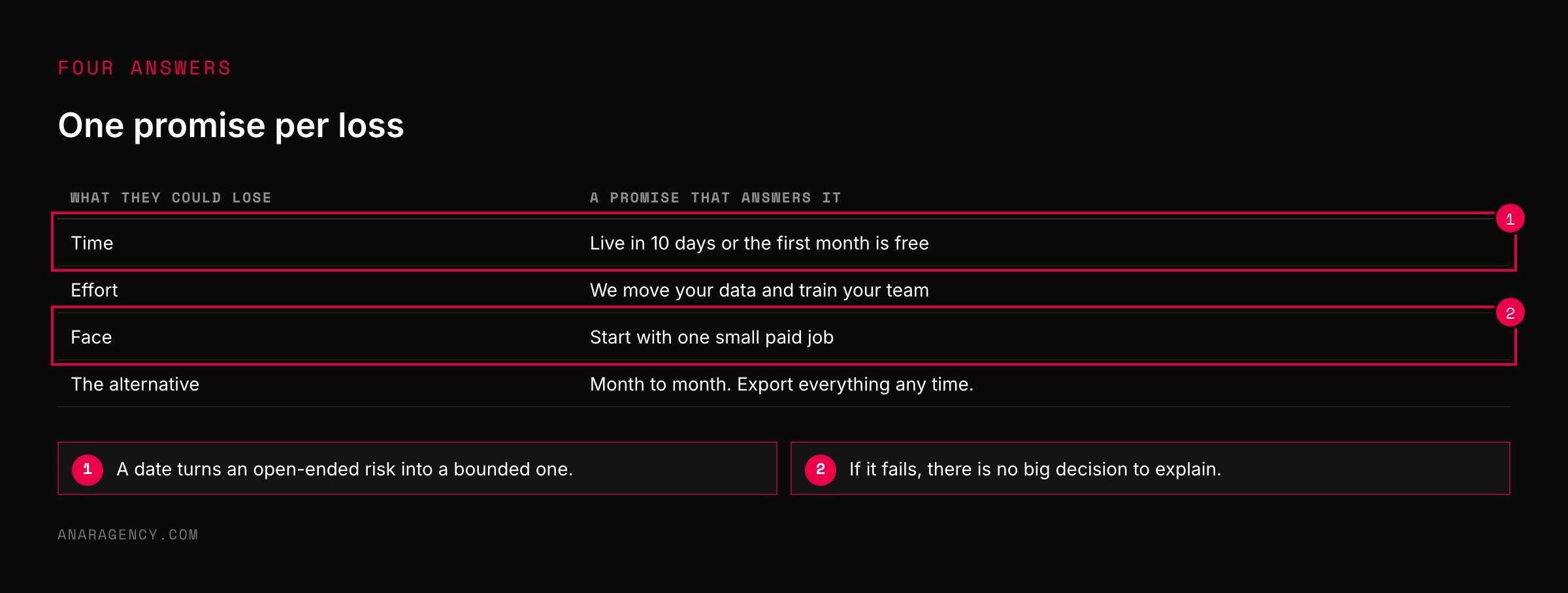
For time, they promise a date. "Live in 10 days or the first month is free" answers the fear of a project that drags.
For effort, they do the switch. "We move your data and train your team" removes the work, which is different from refunding it.
For face, they shrink the first step. A paid pilot on one small job. If it fails, nobody has to explain a big decision.
For the alternative, they leave the door open. Month to month, export your data any time. The way back is visible.
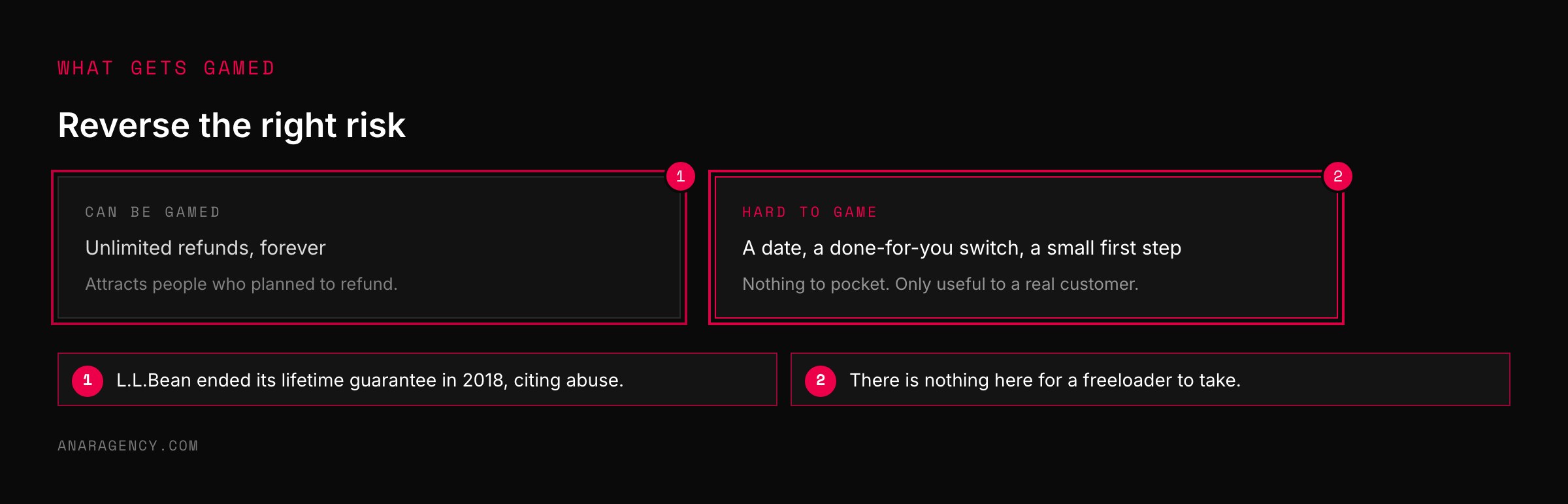
A warning from a company that went furthest. L.L.Bean offered an unconditional lifetime guarantee on what it sold for about a century. In 2018 it ended it and moved to one year, saying a growing number of customers were abusing the policy.
The lesson is not that generous guarantees fail. A promise with no limit attracts people who were never your customers. Answer the real fear, and put an honest boundary on it.
"A stronger guarantee will get abused."
You may be worried that removing risk invites freeloaders. Some will come. The fix is to reverse the right risk, not to offer less.
A longer refund window invites abuse, because it mostly attracts people who planned to refund. A promise about time or effort does not, because there is nothing to pocket.
Nobody games "we will do the migration for you." Nobody exploits "live in ten days."
There is also a risk running the other way that sellers forget. Checkout research from the Baymard Institute finds that surprise costs are the most-cited reason people abandon a purchase. A hidden fee is risk you added at the last second.
And notice who you are writing for. A buyer short on money fears the price. A buyer short on time fears the weeks.
The same offer needs a different promise for each.
Risk is also one of the six things every visitor silently checks. We cover the full list in the unasked questions.
What to read next, and why
Loss aversion (encyclopedia entry): The research on why a possible loss outweighs an equal gain. The reason benefits alone do not move a maybe.
L.L.Bean (encyclopedia entry): The history of the most famous guarantee in retail, and why it ended.
Endowment effect (encyclopedia entry): Why leaving what you have feels like a loss, even for something better.
Cart Abandonment Rate Statistics (research collection): The risks sellers add without noticing.
So the simple takeaway is this: write down the five things your buyer could lose. If your offer only answers the first, you have a guarantee, not a risk reversal.
Questions executives ask
What is risk reversal?
Removing or shrinking what a buyer stands to lose by saying yes. A money-back guarantee is one form, but it only covers money. Full risk reversal also answers the loss of time, effort, reputation, and the option the buyer gave up.
Why does my money-back guarantee not increase sales?
Usually because money is not what the buyer fears most. If the real worry is the weeks of setup, the work of switching, or having to explain a failed decision, a refund does not touch it.
What are examples of risk reversal besides a guarantee?
A committed go-live date, doing the migration or setup for the customer, a small paid pilot before a large commitment, month-to-month terms, and the ability to export data and leave at any time.
Will a stronger guarantee be abused?
Unlimited refund promises can be. L.L.Bean ended its century-old lifetime guarantee in 2018, citing abuse, and moved to one year. Promises about time and effort are much harder to exploit, because there is nothing to take.
What is loss aversion?
The research finding that people feel a loss more strongly than a gain of the same size. In buying decisions it means shrinking a possible loss often does more than adding another benefit.

Filip Kovacevic is the founder of Anar Agency in Phoenix. He spent five years running SEO, Meta ads, email, and content for medical practices across the United States, and now does the same work for healthcare, home-service, legal, and professional-service businesses, alongside AI implementation. More from Filip →
Talk it through in 15 minutes
Bring one AI question from this article. We will tell you what we would do, whether or not you hire us.
Book a 15-Min Chat →