The First 90 Seconds Decide the VSL
A video sales letter is won or lost in its opening, because the opening decides how many viewers are still there for the offer. The first 90 seconds should be entirely about the viewer: life before the problem, the situation today, the fix they keep trying, and the result that still has not come. Tell it as a scene, in the second person, with no product and no promise.
A claim invites doubt and a question invites a no. A story the viewer recognizes as their own holds attention without a fight.
Before the titles
For most of television's history a show began with its title sequence. Music, names, a logo. Then the story started.
At some point producers noticed a problem with that. The titles were the easiest moment to change the channel.
So they moved a scene in front. The cold open, also called a teaser, drops the viewer straight into the story before any titles run.
The logic is simple. A viewer who is already inside a scene wants to know how it ends. A viewer watching credits has no reason to stay.
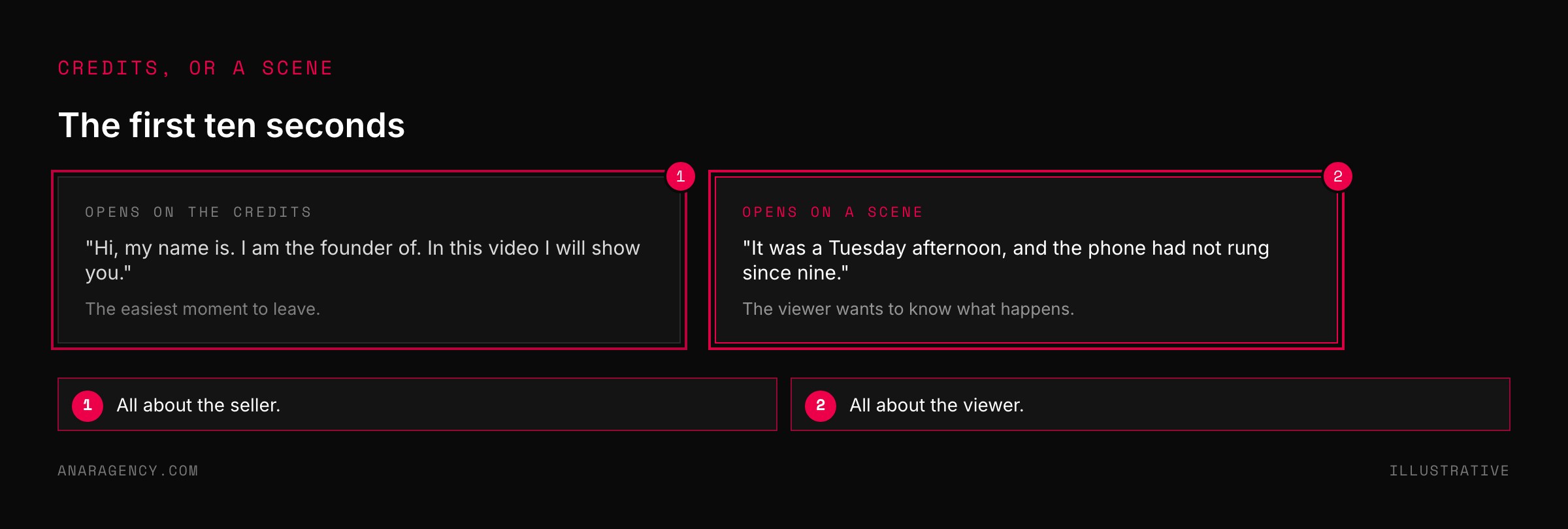
Most sales videos still open with the credits. "Hi, my name is. I am the founder of.
In this video I am going to show you." The viewer has been given every reason to leave and none to stay.
Where a sales video is lost
A sales video has three parts: the opening, the body, and the close.
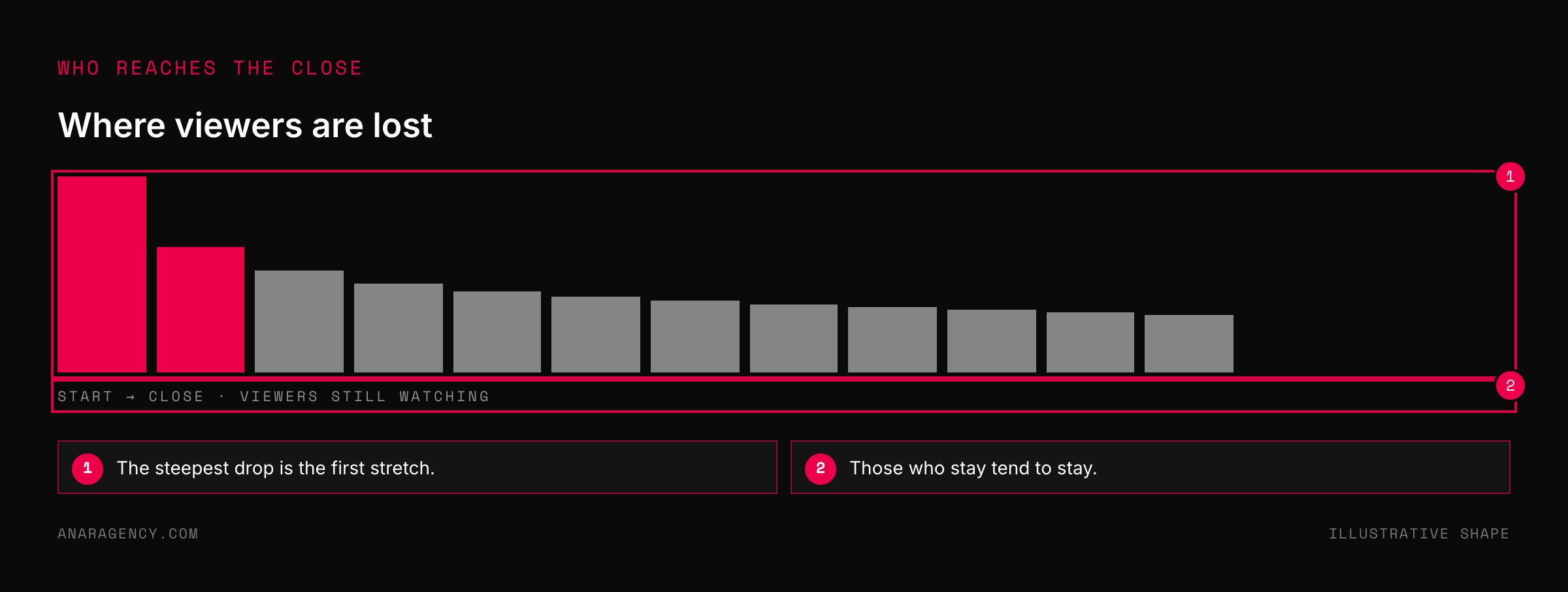
They do not matter equally. The close can only persuade the people who reach it, and the opening decides how many do.
Hosting data shows how steep the loss is. A study of more than 13 million business videos found that videos under a minute are watched about halfway on average, and that engagement declines after the five-minute mark.
The same analysis advises putting the most important material in the first half, because most viewers drop off around the midpoint.
A sales video is usually longer than five minutes. So it is working against the trend from the first second, and whatever keeps people must arrive early.
That is why the opening deserves most of the writing time. The middle of a script can be ordinary if the viewer is already absorbed. The start cannot.
The opening decides how many viewers reach the offer, so it gets most of the writing time. Open with a scene, not a claim or a question. Use four beats, all about the viewer: life before the problem, the situation today, the fix they keep repeating, and the result that still has not come.
Say "you" and soften specifics with "maybe." No product, promise, or introduction. Stay on the problem longer for a struggling audience and move on quickly for an ambitious one.
Describe only what is true, and describe situations, not the person.
Claim, question, or story
There are three ways to open, and each does something different to the person watching.
A claim. "This is the fastest way to get clients." The viewer's mind goes looking for evidence against it.
You have started an argument.
A question. "Are you tired of chasing leads?" A question demands an answer, and the viewer supplies one.
Often it is no, or not really.
A story. "It was a Tuesday afternoon, and the phone had not rung since nine." There is nothing to dispute and nothing to answer.
The viewer pictures it.
Psychologists have studied that third effect. When people are absorbed in a narrative they argue with it less, a state researchers call transportation.
So open with a scene. The claim and the proof come later, once the viewer has stopped guarding the door. The same choice applies to a short ad, as we show in the YouTube ad script.
Mirror Holders: the four-part opening
The openings that hold people have one thing in common. The viewer sees themselves in them. We call the people who write them Mirror Holders.
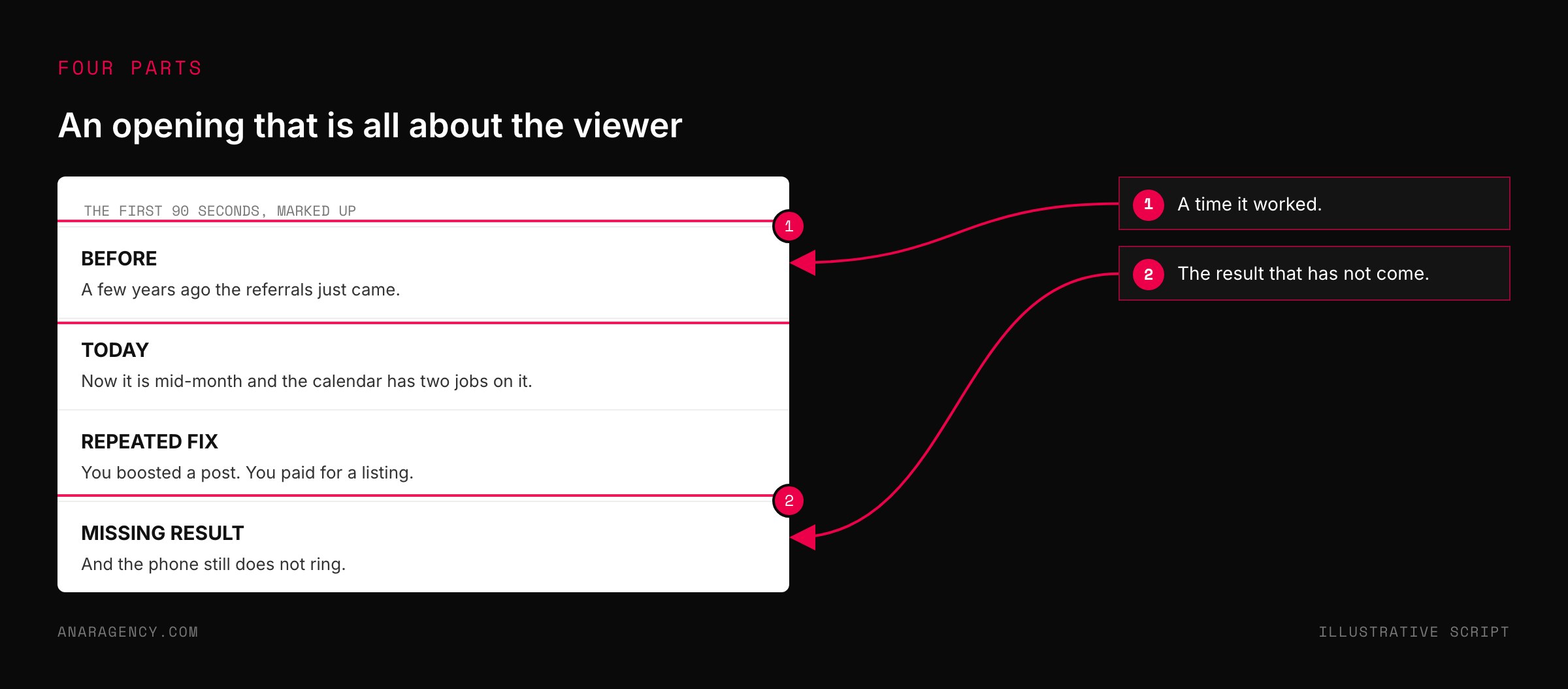
Before. A time ahead of the problem. "A few years ago the referrals just came."
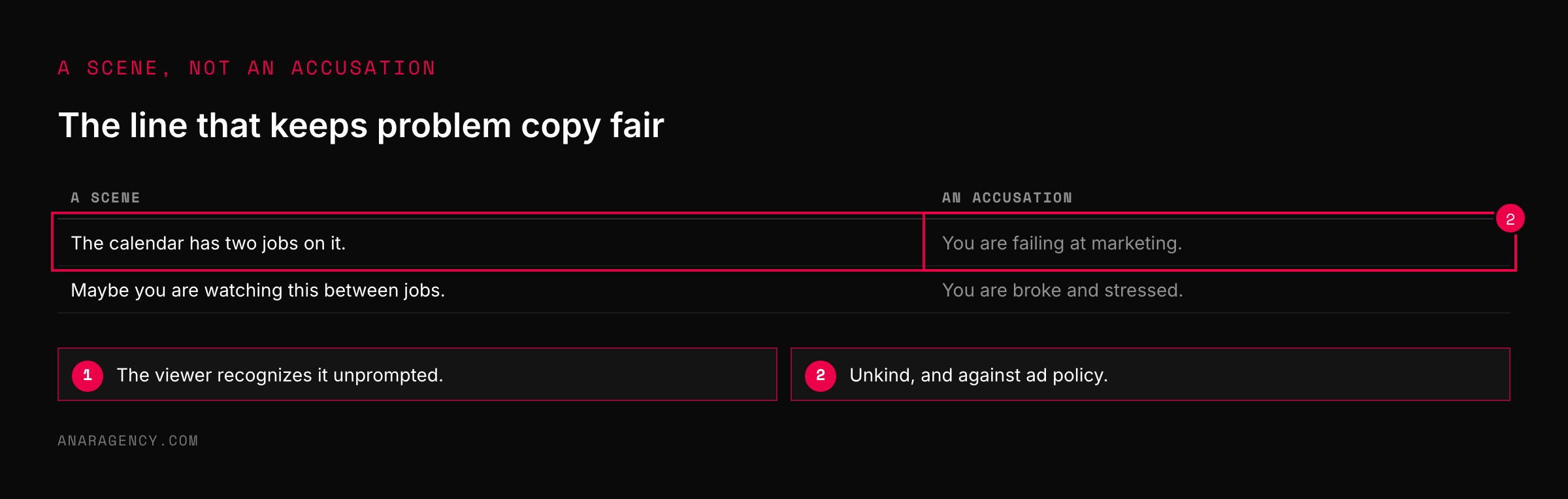
Today. The present, in details they recognize. "Now it is the middle of the month and the calendar has two jobs on it."
The repeated fix. What they have already tried. "You boosted a post.
You paid for a listing. You tried the agency your brother-in-law used."
The missing result. "And the phone still does not ring."
They say "you." Not a name, not "business owners." The word works on everyone who hears it.
They say "maybe." "Maybe you are watching this between jobs." It lets a detail land for the people it fits without being false for those it does not.
"Should I spend 90 seconds on the negative?"
You may worry that opening on the problem will depress people into leaving. For a viewer who is already struggling, the opposite is true.
Someone in a bad spot wants to be understood before being advised. A video that leaps to the good news has skipped the part where they felt heard.
How long to stay there depends on the viewer. People who are frustrated and stuck will stay with the problem for a minute or more. People who are doing well and want more should be moved to the goal quickly.
We covered that split in action is desire minus objections. Ninety seconds is our working figure for a struggling audience. It is not a law.
Two limits. Describe only what is true of your real buyers. An exaggerated picture of misery is manipulation, and viewers can feel it.
And if the video runs as an ad, describe the situation, not the person. Meta's advertising policy does not allow ads that assert or imply a viewer's personal attributes. "The calendar has two jobs on it" is a scene.
"You are failing" is an accusation.
What to read next, and why
Cold open (encyclopedia entry): How television came to start with a scene, and why.
How to choose the right marketing video length (Wistia): Viewing data from millions of business videos. Useful for seeing where people leave.
Transportation theory (encyclopedia entry): The research on why a story lowers resistance.
Meta's Personal Attributes advertising policy (policy): The line between describing a situation and describing the viewer.
So the simple takeaway is this: delete the first thirty seconds of your sales video script. If it is about you, the video starts better without it.
Questions executives ask
How should a video sales letter start?
With a scene the viewer recognizes as their own situation, told in the second person. Cover life before the problem, the situation today, what they have tried, and the result they are still missing. Leave the product and your introduction for later.
Why are the first 90 seconds of a VSL so important?
Because the close can only persuade people who are still watching. Viewing data shows most viewers leave early, so the opening determines the size of the audience for everything that follows.
Should a VSL open with a question?
It is risky. A question forces the viewer to answer, and the answer may be no. A short scene gives them nothing to disagree with and tends to hold attention better.
How long should a video sales letter be?
Long enough to make the case and no longer. Data from business video hosting shows engagement falls after about five minutes, so a longer video depends heavily on a strong opening and should place its most important material early.
Is it manipulative to open on the viewer's problem?
Not when the description is accurate. People who are struggling want to feel understood before they are offered a solution. It becomes manipulative when the problem is exaggerated or when the copy accuses the viewer personally.

Filip Kovacevic is the founder of Anar Agency in Phoenix. He spent five years running SEO, Meta ads, email, and content for medical practices across the United States, and now does the same work for healthcare, home-service, legal, and professional-service businesses, alongside AI implementation. More from Filip →
Talk it through in 15 minutes
Bring one AI question from this article. We will tell you what we would do, whether or not you hire us.
Book a 15-Min Chat →