The Patterns Behind the Offers That Sell
Offers that sell tend to pass six tests. A stranger can say in one sentence what they will have afterward. The offer answers what buyers are worried about now.
The seller carries some of the risk. The first step is small. There is proof a skeptic would accept.
And the price is compared with something the buyer already pays. Weak offers most often fail by listing deliverables instead of an outcome, by answering last year's worry, by leaving all the risk with the buyer, or by demanding a large first commitment.
Return it if you lose your job
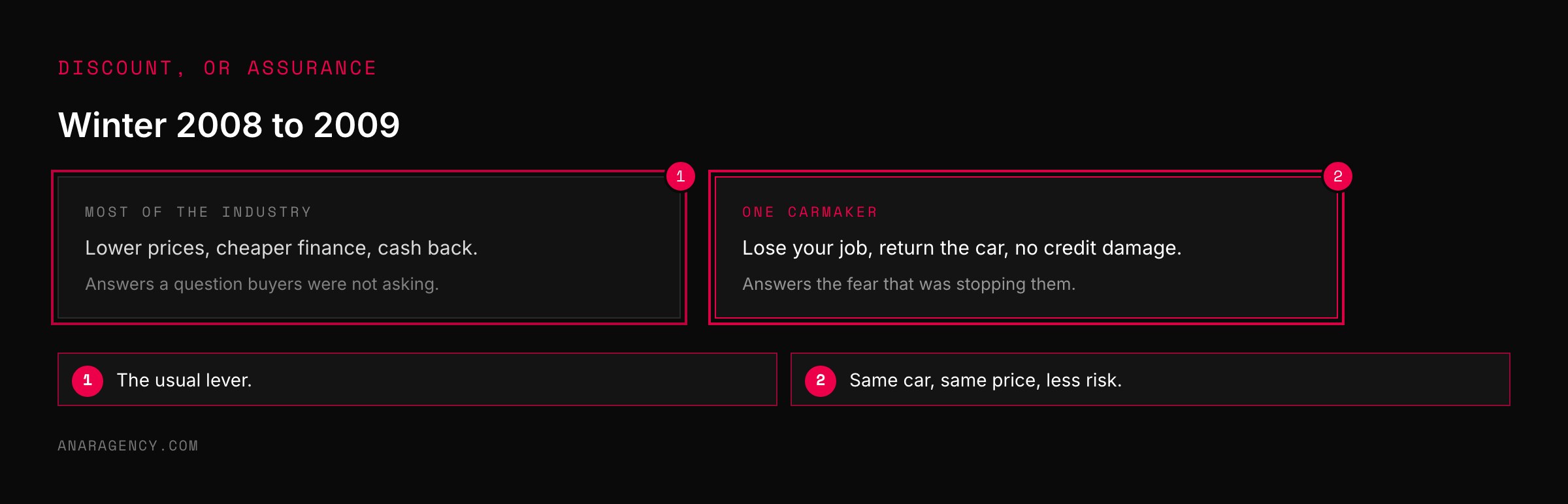
In December 2008 car sales in the United States were collapsing. One carmaker's sales that month fell to 24,037 vehicles, from 46,487 a year earlier.
Most of the industry answered with discounts. Lower prices, cheaper finance, cash back.
Hyundai did something else. It announced that anyone who bought one of its cars and then lost their job could return it, without the return damaging their credit.
The price was the same. The car was the same. What changed was the risk the buyer was carrying.
That month, the reason people were not buying cars was not price. It was fear of a payment they might not be able to make. The offer answered the real reason.
An offer is not the product
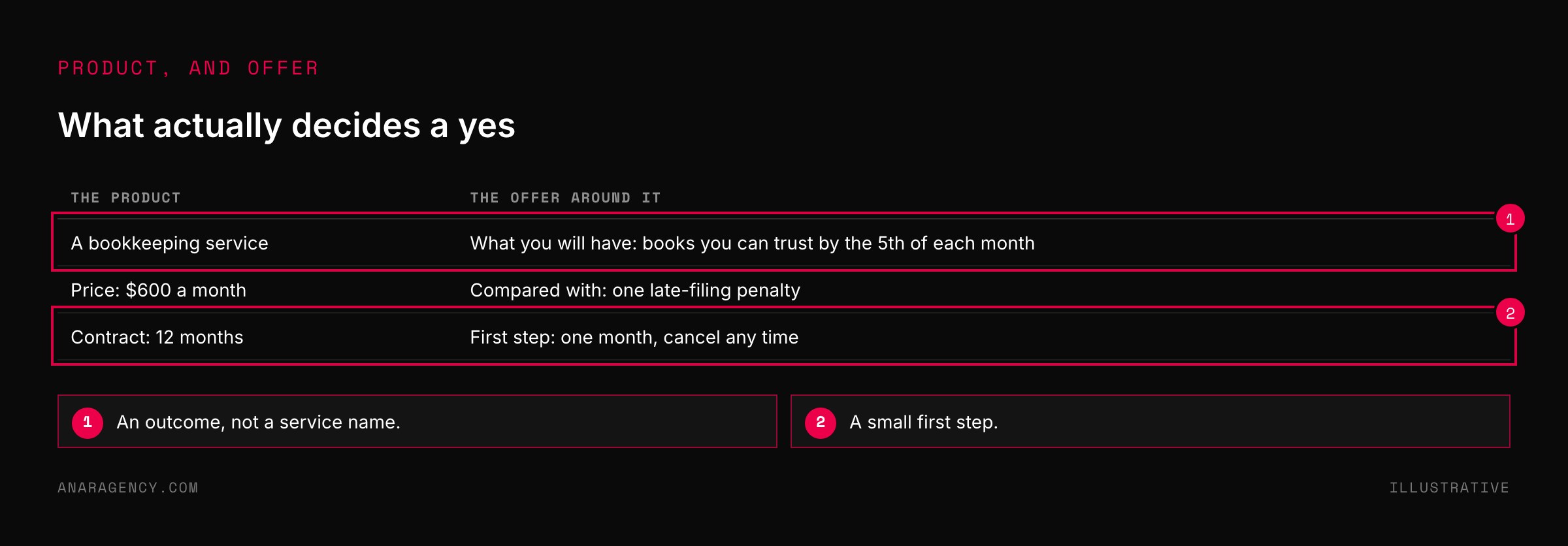
Most businesses think of an offer as the thing they sell and its price. That is the product.
The offer is everything around it that decides whether someone says yes now: what they are promised, what they risk, what they have to do first, and what it is compared with.
Two firms can sell the same service at the same price with completely different results, because one has thought about those things and the other has not.
The trouble is that owners look at their own offer from the inside. They know the work is good, so they cannot see why a stranger hesitates.
A review grid helps because it asks the questions a stranger would ask. It is how we look at offers, our own included.
Six tests for any offer: a stranger can state the outcome in one sentence; it answers what buyers worry about now; the seller carries some of the risk; the first step is small; there is proof a skeptic would accept; and the price is compared with something the buyer already pays. Common failures: listing deliverables, answering last year's worry, leaving all risk with the buyer, and demanding a large first commitment. Fix the offer around the service, keep every promise deliverable, and test it on someone outside the business.
The Offer Review Grid
Six questions, in order.
1. The outcome. Can a stranger say in one sentence what they will have afterward?
Not what they will receive, what they will have.
2. The fit to the moment. Does it answer what buyers are worried about now?
The car offer worked because it met that winter's fear exactly.
3. The risk. What does the buyer lose if it goes wrong, and who carries that loss?
People weigh losses more heavily than equal gains, a pattern known as loss aversion. An offer that leaves all the risk with the buyer is fighting that.
4. The first step. Is the first thing they must do small?
A short call, a sample, a single month.
5. The proof. Is there evidence a skeptical buyer would accept?
See the Proof Grid.
6. The price frame. Is the price set beside something the buyer already pays?
"Less than one missed job a month" means more than a figure on its own.
Offer Doctors: four common failures and their fixes
People who are good at fixing offers are not inventive. They recognize the same few failures over and over. We call them Offer Doctors.
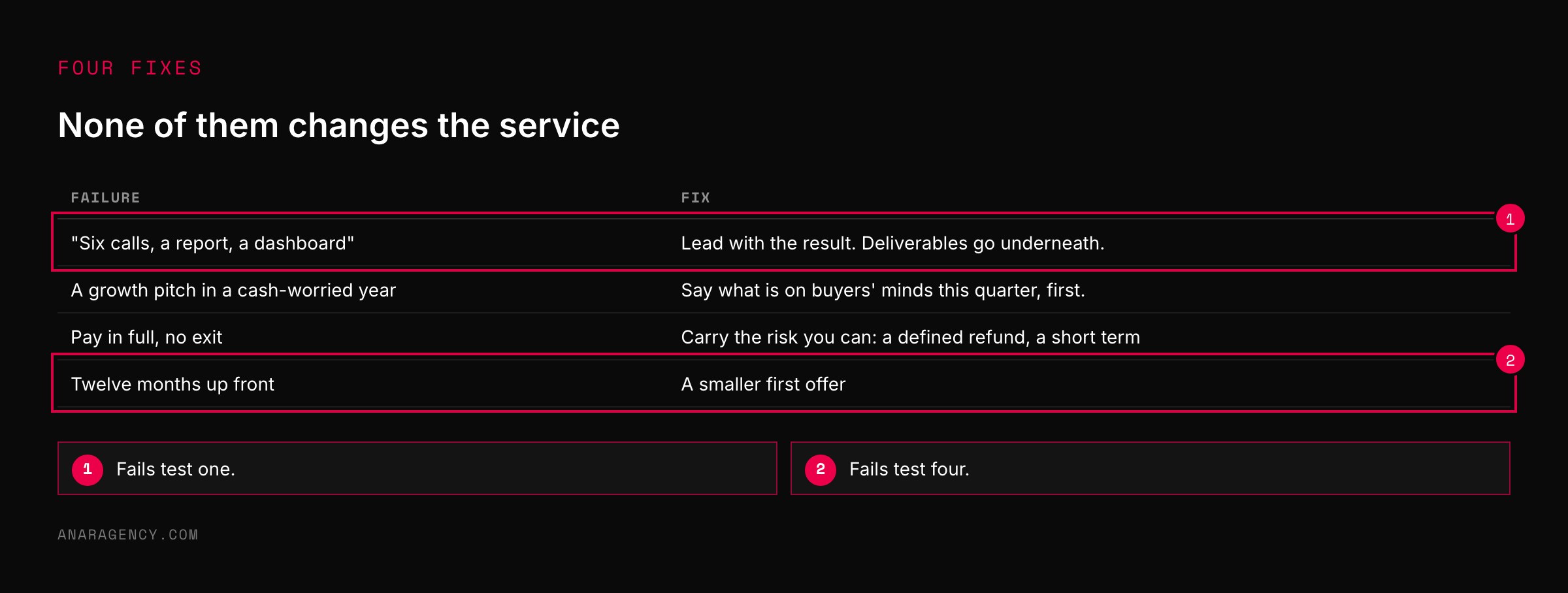
A list of deliverables. "Six calls, a report, a dashboard." It fails test one.
The fix is to lead with the result and put the deliverables underneath, as in sell outcomes, not deliverables.
Built for last year. A growth pitch to buyers who are now worried about cash. It fails test two.
The fix is to ask customers what is on their mind this quarter and say that first.
All the risk on the buyer. Pay in full, no guarantee, no exit. It fails test three.
The fix is to carry the part of the risk you can: a refund on a defined result, a short first term, payment after a milestone. Our guide is what buyers fear losing.
A big first step. A twelve-month contract before anything has been delivered. It fails test four.
The fix is a smaller first offer, which we describe in quick-win offers.
Notice that none of these fixes changes the service. They change what the buyer is asked to believe and to risk.
"My offer is fine. The leads are the problem."
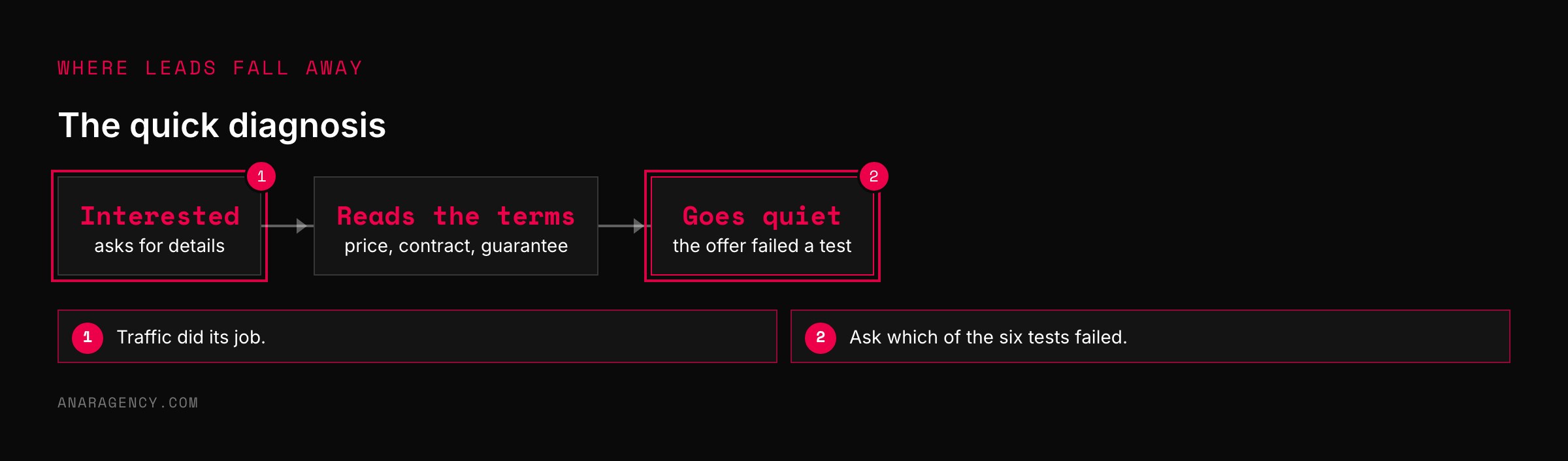
You may be sure the offer is sound and the trouble is traffic. Sometimes that is right. Often it is not, and there is a quick way to tell.
Look at what happens after someone shows interest. If people ask for details and then go quiet, or say they need to think about it, the offer is usually the issue.
Leads that fall away after reading the price, the terms, or the contract are telling you which of the six tests failed.
Then run the grid with someone who does not know your business. Read them the offer and ask them to repeat what they would get. If they cannot, test one has failed.
One caution on fixes. Anything you promise must be true and deliverable. A guarantee has to be honored as written, and claims and terms must be stated clearly.
A bold-sounding guarantee you cannot afford to honor is not risk reversal. It is a future dispute.
What to read next, and why
The definitive oral history of Hyundai's assurance program (Digiday): How the offer came about, told by the people involved.
Hyundai Motor America (encyclopedia entry): The sales figures around the launch.
Loss aversion (encyclopedia entry): Why risk weighs more than reward in a buying decision.
Advertising FAQs: A Guide for Small Business (FTC guide): The rules on stating offers, guarantees, and terms.
So the simple takeaway is this: read your offer to someone outside your business and ask them what they would get and what they would risk. If they hesitate on either, that is where to work.
Questions executives ask
What makes a good offer?
A clear outcome a stranger can repeat, a fit to what buyers are worried about now, some of the risk carried by the seller, a small first step, proof a skeptic would accept, and a price compared with something the buyer already pays.
What is an example of a strong offer?
In early 2009, during a sharp fall in car sales, Hyundai let buyers return a newly purchased car if they lost their job, without damage to their credit. It addressed the main fear stopping purchases at the time, instead of cutting the price.
Why is my offer not converting?
If interested prospects go quiet after seeing the price, terms, or contract, the offer is usually the problem. Common causes are an unclear outcome, all the risk resting on the buyer, and a large first commitment.
How do I review my own offer?
Read it to someone unfamiliar with your business and ask what they would get and what they would risk. Then check it against six tests: outcome, timeliness, risk, first step, proof, and price frame.
Should every offer include a guarantee?
Not necessarily, but every offer should consider who carries the risk. A guarantee, a short first term, or payment on a milestone can each shift some risk to the seller. Whatever you promise must be stated clearly and honored as written.

Filip Kovacevic is the founder of Anar Agency in Phoenix. He spent five years running SEO, Meta ads, email, and content for medical practices across the United States, and now does the same work for healthcare, home-service, legal, and professional-service businesses, alongside AI implementation. More from Filip →
Talk it through in 15 minutes
Bring one AI question from this article. We will tell you what we would do, whether or not you hire us.
Book a 15-Min Chat →