Rapport Openings: Why the Conscious Mind Rejects Pitches
People raise a guard the moment they recognize a sales pitch, and once it is up, every claim is weighed against them. So the opening of a sales letter, video, or email should not look like a pitch. It should come in by a side door: a scene the reader can picture, an observation about their world they share, a puzzle from their trade, or a small useful gift.
Each one earns the next sentence without asking for anything. The offer arrives once the reader is inside the story and wants to know how it ends.
Two young men
In 1975 a freelance copywriter named Martin Conroy wrote a subscription letter for a financial newspaper.
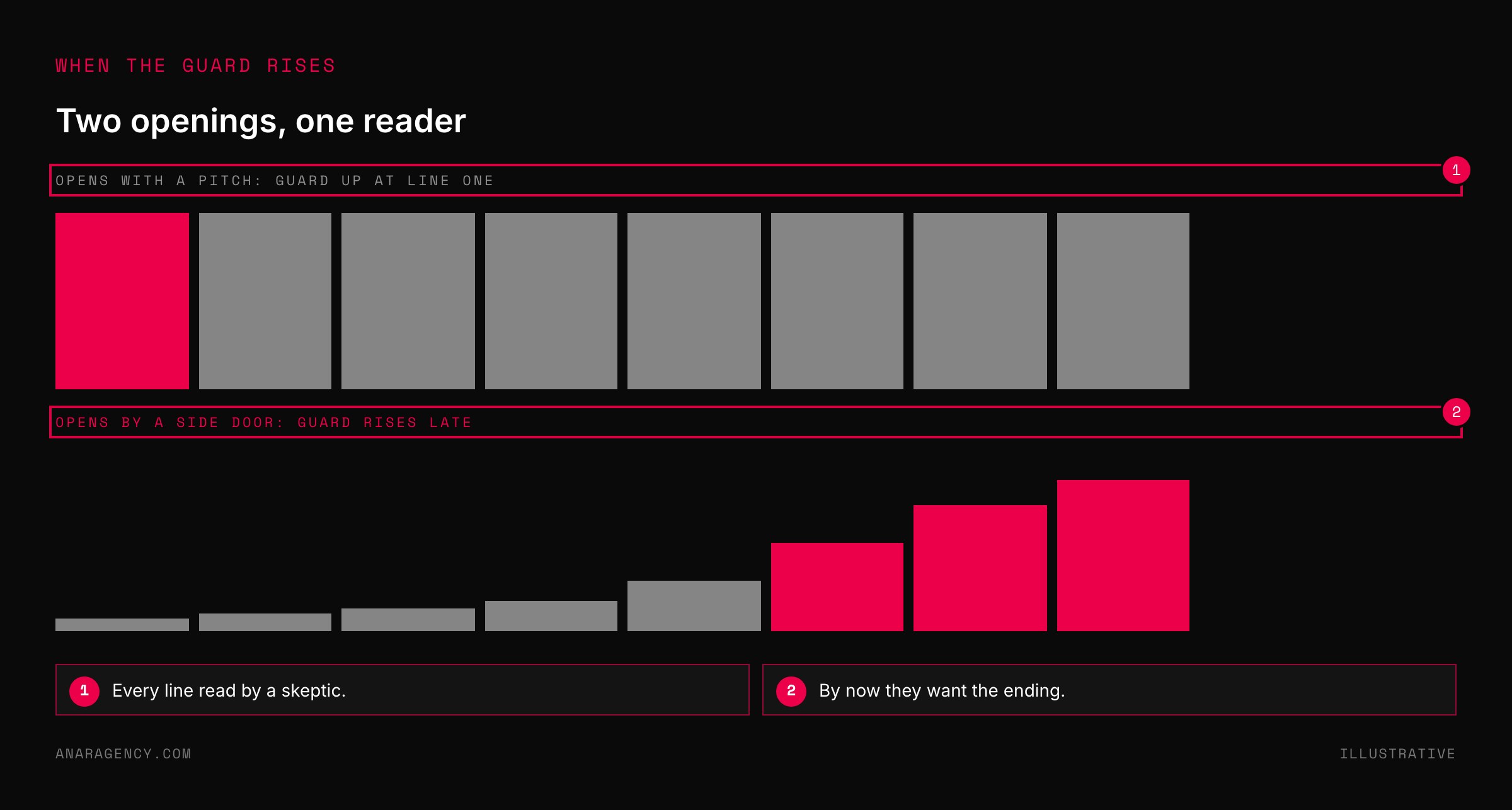
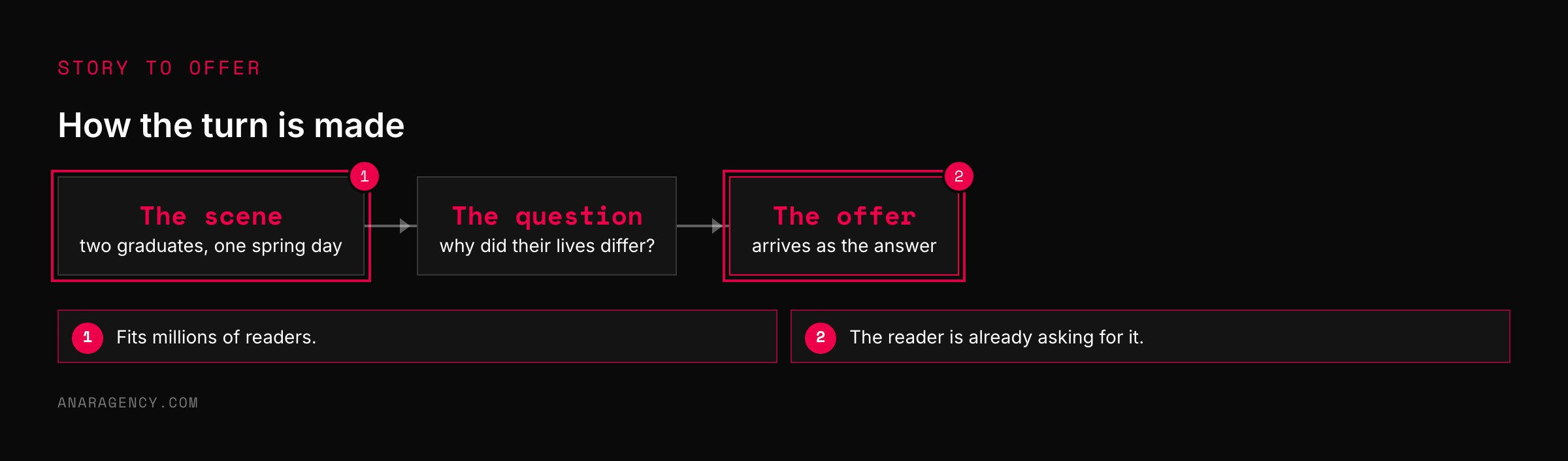
It began like this. "On a beautiful late spring afternoon, twenty-five years ago, two young men graduated from the same college."
The letter went on to describe how alike the two had been, and how differently their lives turned out. Only then did it turn to what one of them read each morning.
It is often called one of the most successful soft-sell advertisements ever written. Its opening sentence contained no offer, no price, and no product.
The guard goes up
There is a moment, early in any message, when the reader works out what it is. A friend's note. A news story.
A sales pitch.
If the answer is a sales pitch, something changes. The reader starts to weigh everything as a claim and to look for reasons it is not for them.
Psychologists have described a related response. When people feel their freedom to choose is being pushed, they push back, sometimes by doing the opposite. They call it reactance.
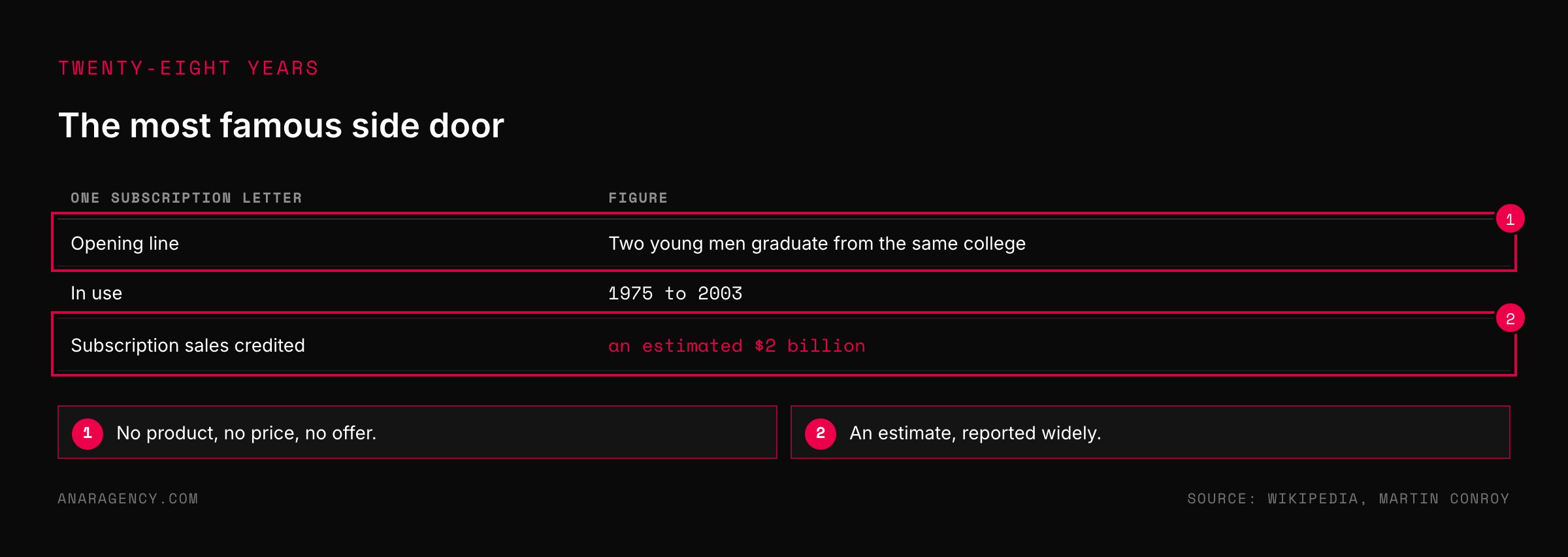
An opening that pitches triggers the guard at the first line. Everything after it is read by a skeptic.
An opening that does not look like a pitch delays that moment. By the time the reader realizes it is selling something, they already want to know how it ends.
People guard against anything they recognize as a pitch. Open by a side door instead: a scene with no product in it, an observation about the reader's world they share, a puzzle from their trade, or a small useful gift. Keep the opening connected to the offer, turn to the offer as a consequence of the story, leave details general enough to fit many readers, and state the offer, price, and seller plainly once the reader is inside.
Match the length of the opening to the medium.
The side door
We call it the Side-Door Opening. Instead of walking up to the front door and knocking with an offer, you come in by a way the reader does not guard.
There are four common side doors.
A scene. A moment with no product in it. Two graduates on a spring afternoon.
A contractor's phone at nine at night.
A shared observation. Something true about the reader's world that they have noticed too. Agreement in the first line is the start of rapport.
A question of interest. A puzzle about their trade, not about your product. "Why do some practices fill their diaries in January and others do not?"
A small gift. One genuinely useful thing, offered before anything is asked.
People absorbed in a story argue with it less, an effect researchers call transportation. A side door is a way in to that state.
Side-Door Writers: what they do after the opening
An opening only buys attention. Writers who use side doors well know what to do with it. We call them Side-Door Writers.
They keep the opening honest. The scene connects to the offer. The two graduates were about the newspaper.
An opening that has nothing to do with what follows is a bait.
They turn gradually. The move from story to offer comes as a consequence of the story, not a change of subject. "What made the difference?
It was not ability..."
They leave room. A scene with too much detail stops fitting the reader. "Two young men" fits millions of readers.
A named town and job would fit a few.
They name the offer plainly when it comes. The side door is for the opening. Once inside, they are clear about what is for sale and what it costs.
They match the opening to the medium. A letter can spend a paragraph on a scene. A short video ad gets a sentence.
The principle holds in both, as in the first 90 seconds and the first three seconds.
"Is a soft opening not just hiding the sale?"
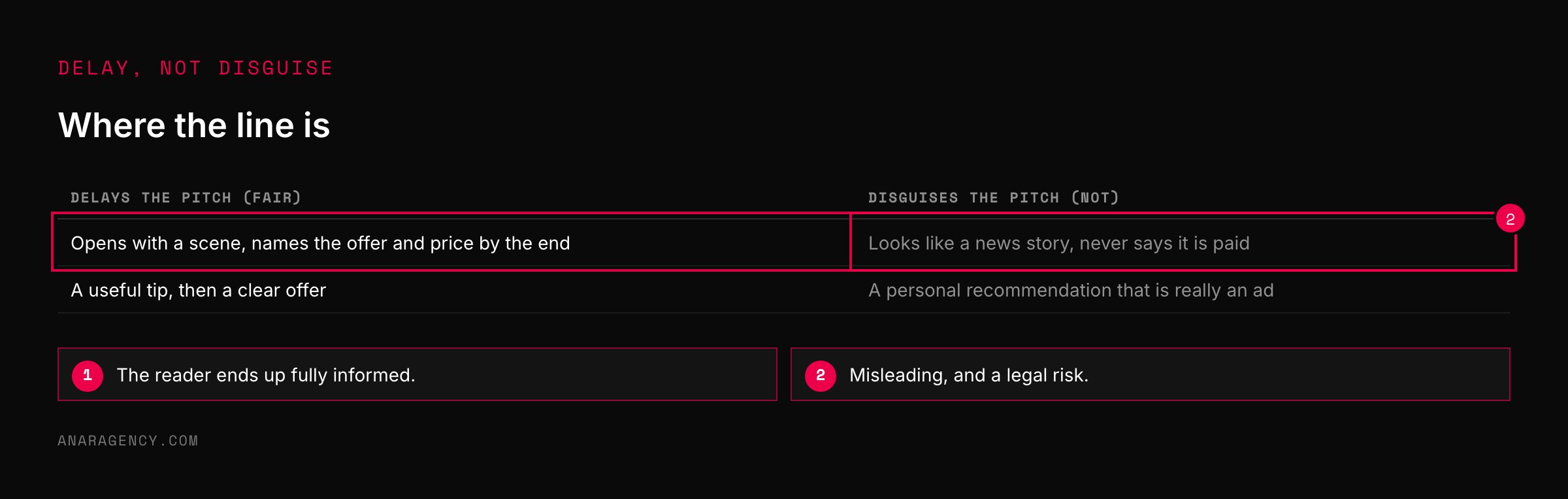
It would be, if the reader never found out it was a sale. The test is whether the offer is clear by the end.
A side door delays the pitch. It does not disguise it. The reader should finish knowing exactly what is offered, at what price, and by whom.
Advertising also has to be recognizable as advertising. Content that looks like independent news or a personal recommendation, but is a paid message, can mislead, and the FTC expects advertising to be truthful and not misleading.
Make sure the opening does not promise something the rest does not deliver. A story that implies a result the product cannot produce is a claim.
Done honestly, a side door respects the reader. It gives them something worth reading before asking them for anything.
Openings built on a cause the reader already accepts are covered in cause first.
What to read next, and why
Martin Conroy (encyclopedia entry): The copywriter and the letter that ran for 28 years.
Reactance (encyclopedia entry): Why people push back when they feel pushed.
Transportation theory (encyclopedia entry): How absorption in a story lowers resistance.
Rapport (encyclopedia entry): The research on how agreement and understanding are built.
So the simple takeaway is this: delete the first sentence of your next sales email if it mentions your product. Replace it with a scene, an observation, or a question the reader cares about.
Questions executives ask
How should I open a sales letter or video?
With something the reader wants to hear more of that does not look like a pitch: a scene they can picture, an observation about their world, a puzzle from their trade, or a useful tip. Bring in the offer once they are engaged.
Why do people ignore sales pitches?
Once a message is recognized as a pitch, readers become skeptical and look for reasons to reject it. Psychologists describe a related reaction, called reactance, in which people resist when they feel their freedom to choose is being pressured.
What was the Two Young Men letter?
A subscription letter written by Martin Conroy in 1975 that opened with two young men graduating from the same college. It ran for 28 years and is credited with an estimated two billion dollars in subscription sales.
What is a soft-sell opening?
An opening that delays the offer and leads with a story, observation, or useful information. The offer and its terms should still be clear by the end, so the reader is never misled about what the message is.
How long should the opening of a sales message be?
It depends on the medium. A letter can spend a paragraph on a scene, while a short video ad has only a sentence. The aim is the same: earn the next line without asking for anything.

Filip Kovacevic is the founder of Anar Agency in Phoenix. He spent five years running SEO, Meta ads, email, and content for medical practices across the United States, and now does the same work for healthcare, home-service, legal, and professional-service businesses, alongside AI implementation. More from Filip →
Talk it through in 15 minutes
Bring one AI question from this article. We will tell you what we would do, whether or not you hire us.
Book a 15-Min Chat →