Copy the Rules, Not the Ad: What Makes a Winning Ad Win
A winning ad wins because it gives its market the specific things that market needs to see before it acts: a kind of proof, a time frame, a way of framing risk. Those are the rules. The headline, the photo, and the layout are just the surface.
Copy the surface and you get an ad that looks right and fails. Pull the rules out with a seven-line sheet, check whether the market wants something new or something familiar, and then write your own ad that follows the same rules with different words.
The ad you copied did not work
Every advertiser has done this. You find a competitor's ad that has been running for months. You make your own version.
Same kind of headline, same kind of photo, same length.
It dies in a week.
The usual conclusion is that the competitor has a bigger budget, or a better pixel, or got lucky. Sometimes that is true.
More often the problem is simpler. You copied what the ad looked like. You never found out why it worked.
The planes that came back
There is a famous story about this mistake, and it has nothing to do with advertising.
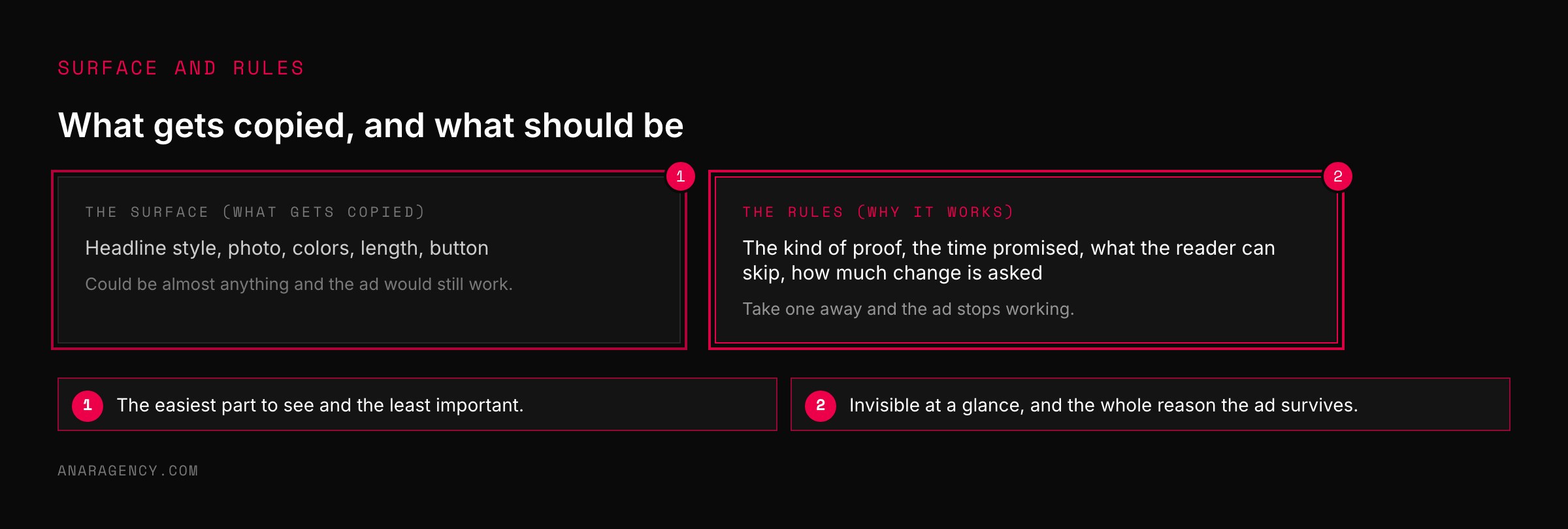
During the Second World War, the American military studied the bombers that returned from missions. They mapped where the bullet holes were. The plan was to add armor to the places that had been hit the most.
A statistician named Abraham Wald looked at the same data and said the plan was backward. The holes showed where a plane could be hit and still fly home. The planes hit anywhere else were not in the sample.
They were at the bottom of the sea.
So the armor belonged where the returning planes had no holes. The idea now has a name: survivorship bias.
When you study a winning ad, you are looking at a plane that came back. The parts you can see, the headline and the image, are the bullet holes. They are the parts that could be anything.
The reason it survived is in what you cannot see at a glance.
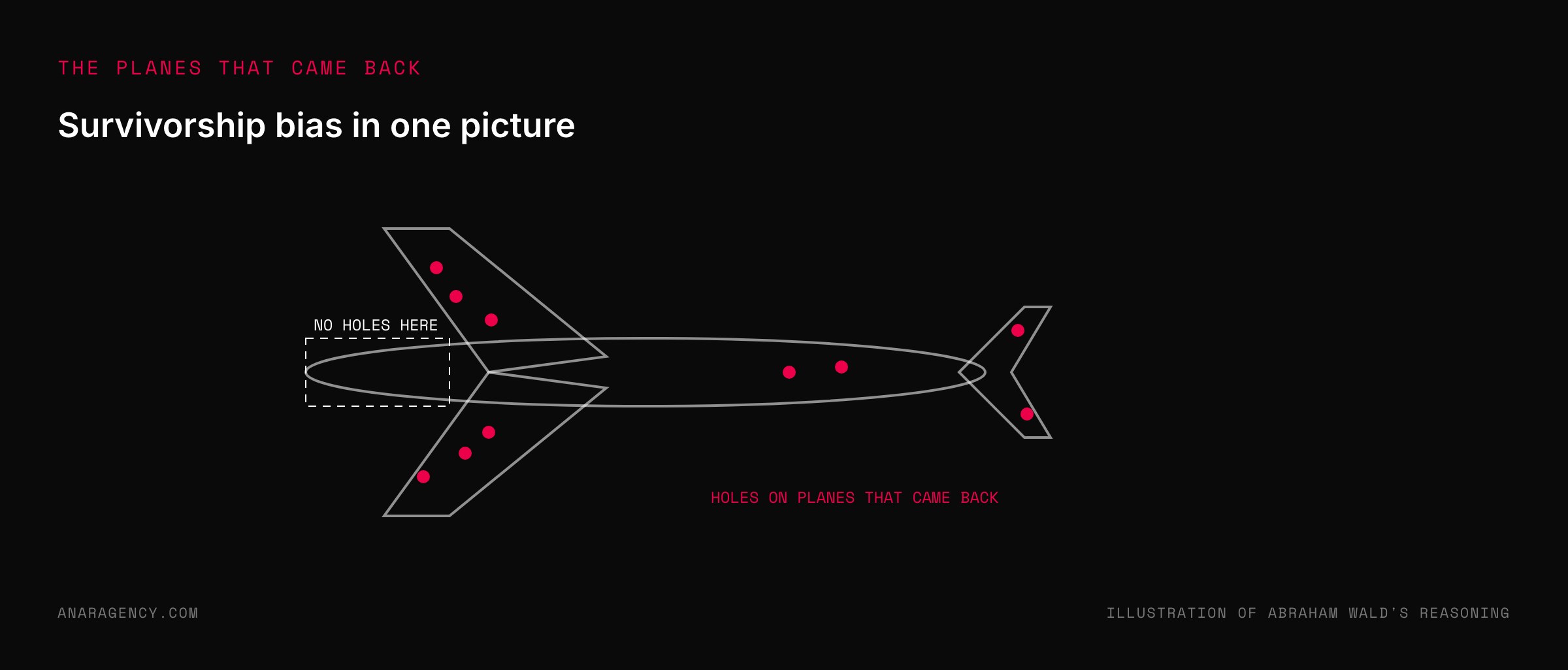
For each winning ad in your market, fill in seven lines and ignore the surface. Proof: what kind. Credibility: from where.
Time: what span. Process: how much is shown. Removals: what the reader can skip.
Risk and price: how cost is framed. Length and mood: how long, and how the reader feels at the end. Add an eighth: how much change the ad asks for.
Lines that match across three winners are the rules of that market. Write your own ad to those rules with your own words and proof.
Rule Readers: what people who learn from winning ads do
Some advertisers can look at a competitor's ad and come away with something they can use. They are not better at copying. They read a different layer.
We call them Rule Readers.
They look for what the ad gives the reader, not what it looks like. Every market has a short list of things it needs to see before it will act. One market needs a photo of a real result.
Another needs to hear how long it takes. Another needs to be told what it will not have to do.
They study ads that lasted. Meta's Ad Library shows the ads a page is running and when each one started. An advertiser does not usually keep paying for an ad that loses money, so an ad that has run for months is a reasonable bet as a winner.
That is our inference, not something the library tells you.
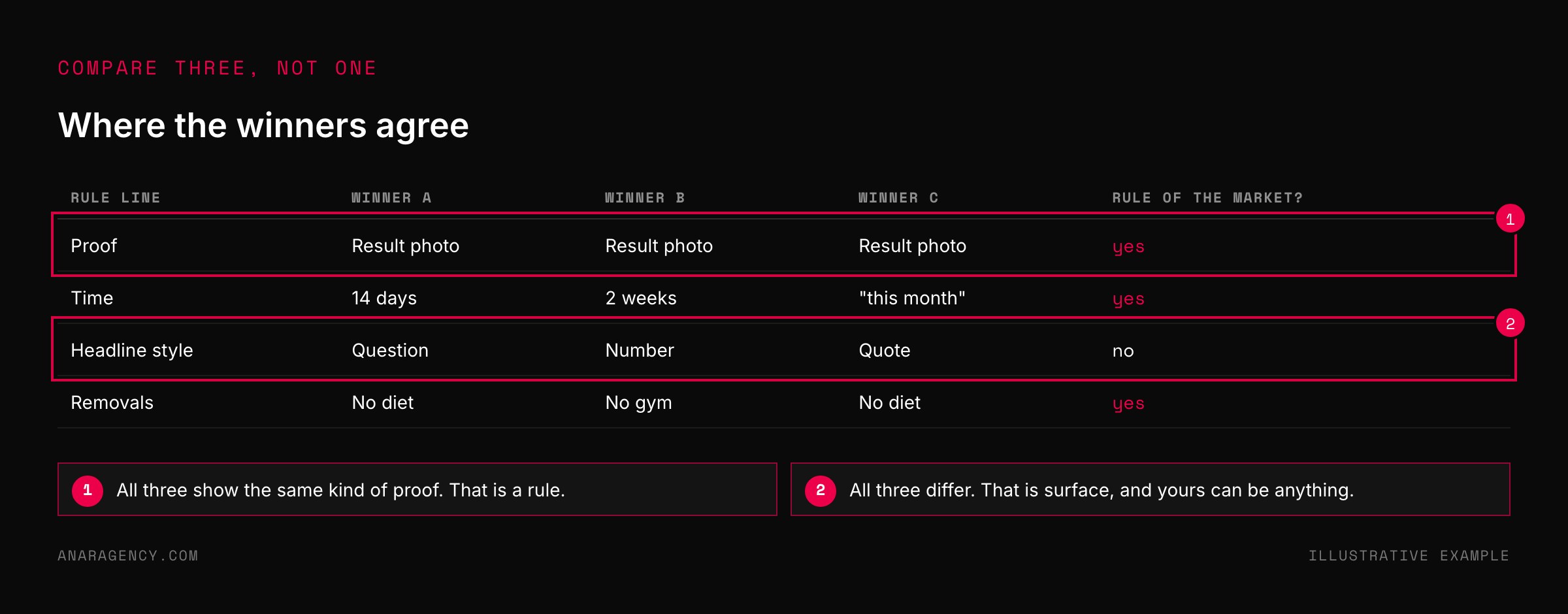
They compare three, not one. One winning ad could be an accident. Three winners from the same market that all promise a time frame is a pattern.
This is an old idea. Claude Hopkins wrote Scientific Advertising in 1923, arguing that advertising should be built on tested principles and measured results. A century later the principle has not moved.
The surface changes every season, and the rules underneath change slowly.
The Rules Sheet
Here is the sheet we fill in. Seven lines, one sheet per winning ad.
Proof: what kind. Credibility: where it comes from. Time: what span is promised.
Process: how much of the method is shown. Removals: what the reader is told they can skip. Risk and price: how the cost is framed.
Length and mood: how long it is, and how the reader feels at the end.
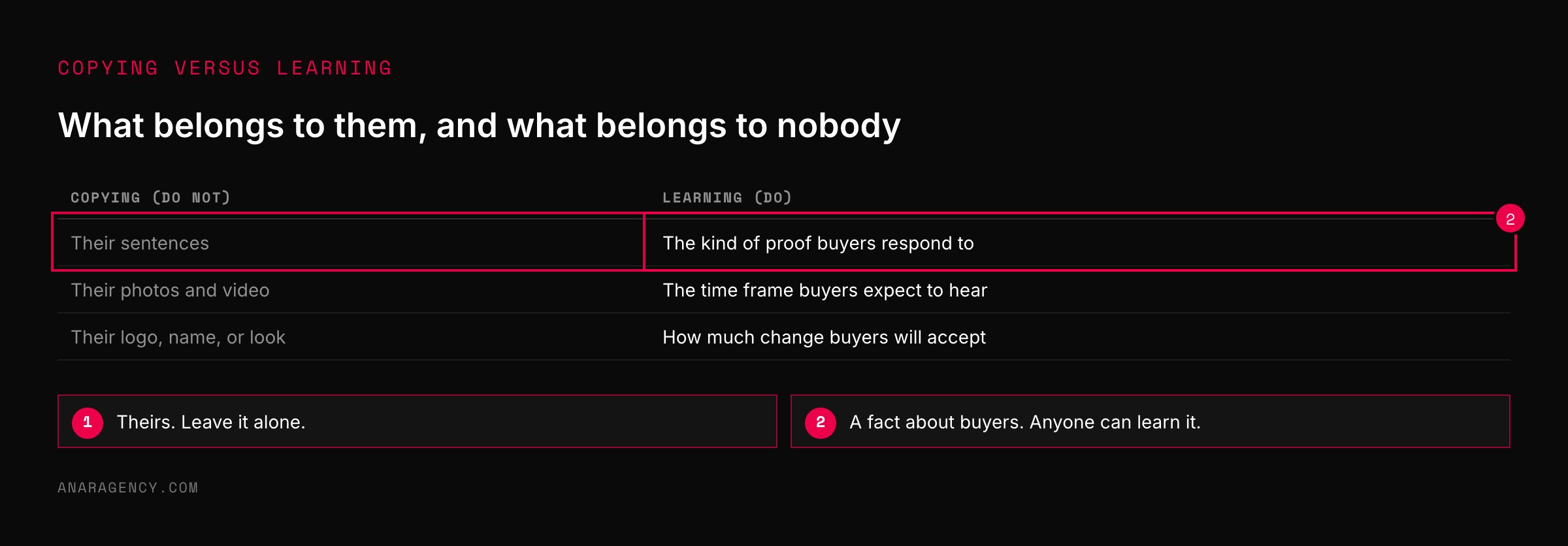
Do not write down the headline. Do not describe the photo. Those are the surface, and they are the parts you will replace.
When you have three sheets from the same market, lay them side by side. Any line where all three agree is a rule of that market. That is what your ad has to contain.
Then write your own ad from the rules, in your own words, with your own proof. If the market's rule is "show a real result photo and say how many days," you need your result photo and your number of days.
This is also why it is not copying. You are not taking anybody's sentences or pictures. You are learning what the buyer needs to see, which belongs to nobody.
The second layer: new, or familiar?
There is one more thing a winning ad gets right, and almost nobody checks it.
Some people like new things. Most do not. Everett Rogers spent a career measuring this and sorted every market into five groups by how fast they take up something new.
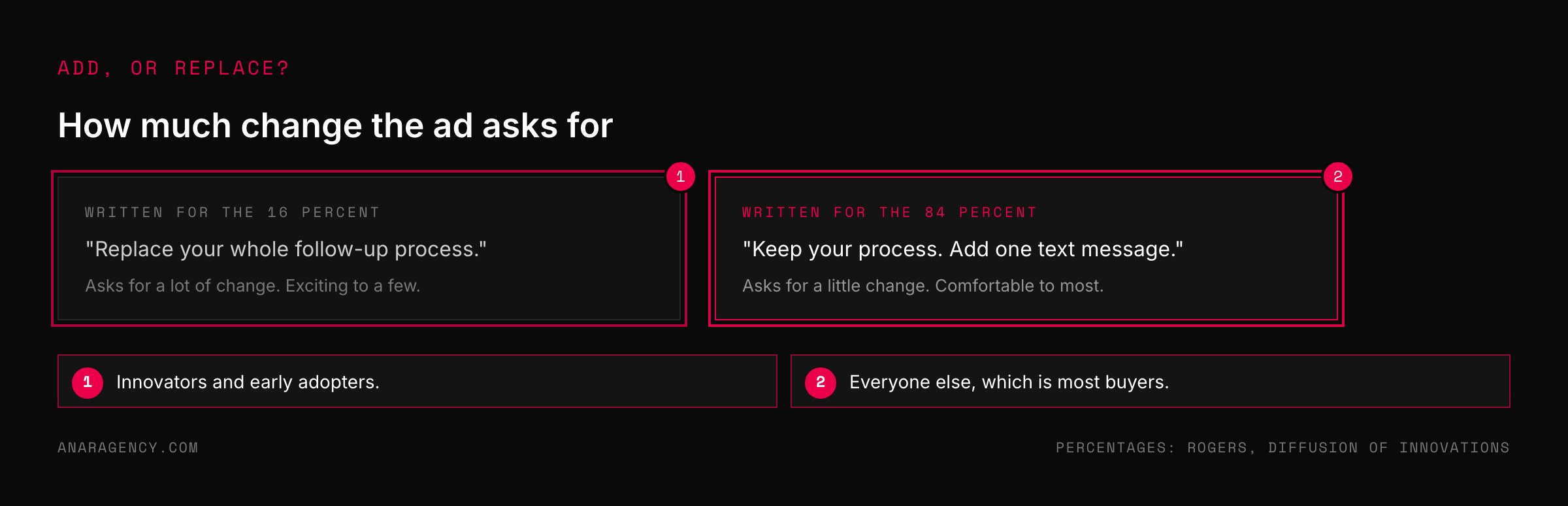
The two groups that reach for the new thing first make up 16 percent. The other 84 percent wait until it is proven, or until they have no choice.
Now read a typical ad. "A completely new way to." "Replace your whole."
"Forget everything you know about." That is written for the 16 percent.
The winning ad in a mature market usually says the opposite. Keep what you have. Add this one thing.
Same routine, better result. That is written for the 84.
So add an eighth line to the sheet: does this ad ask the reader to change a lot or a little? If your version asks for more change than the winner did, you have broken a rule you did not know was there.
This matters more as an ad reaches further. The first people to respond are often the ones who like new things. As the ad spreads to everyone else, a "brand new" message meets a crowd that wanted "the same, but better."
"Is this not just copying with extra steps?"
You may be thinking this is a polite way to steal. It is the opposite, and the platform now punishes the lazy version anyway.
Lifting a competitor's words, images, or brand is copying. It is also a legal problem, and we do not do it.
Learning that buyers in a market respond to before-and-after photos is not copying. It is the same as a restaurant noticing that people in this town eat dinner early.
And look-alike ads are worth less than they used to be. Meta's engineering team described a new system for choosing which ads to consider for each person, built to handle what it called exponential growth in the number of ad creatives.
Our read of that, and it is a read, is that many ads that all look alike compete with each other for the same people. The safer plan is the one this article describes: the same rules, expressed in ads that look different from each other and from everyone else's.
When you are ready to build those ads at volume, our piece on the three-layer ad covers the structure inside each one.
What to read next, and why
About the Meta Ad Library (Meta documentation): What the library shows and does not show. The start date of each ad is the detail to look for.
Survivorship bias (encyclopedia entry): The bomber story in full. Once you have read it, you will see the mistake in every "top ads" roundup.
Diffusion of innovations (encyclopedia entry): The five adopter groups and their percentages. The single most useful chart for deciding how much change to ask for.
Scientific Advertising (encyclopedia entry on the 1923 book): Short, and a reminder that testing rules instead of opinions is a hundred years old.
So the simple takeaway is this: do not ask what the winning ad says. Ask what it gives the reader. Then give your reader the same things in your own words.
Questions executives ask
How do I analyze a competitor's ads?
Find ads that have run for a long time, then record what each one gives the reader instead of what it looks like: the kind of proof, the source of credibility, the time promised, how much process is shown, what the reader is told they can skip, how price and risk are framed, and the length and mood. Patterns across three ads are the rules of that market.
Why does copying a winning ad not work?
Because the visible parts, the headline, image, and layout, are usually not the reason it won. The reason is the specific things it gives that market, such as a certain kind of proof or a time frame. Copying the surface without those is like armoring a plane where the surviving planes were hit.
Where can I see competitors' Facebook ads?
In Meta's Ad Library, which is public and free. It shows the ads a page is currently running and when each started. An ad that has been running for months is a reasonable candidate for a winner, though the library does not report performance.
How do I know if my market wants something new or familiar?
Assume familiar unless you have evidence otherwise. In Everett Rogers's adopter categories, innovators and early adopters make up 16 percent of a market and the remaining 84 percent prefer what is proven. Check whether the long-running ads in your market ask for a big change or a small addition.
Is it legal to copy a competitor's ad?
Reusing another company's wording, images, or brand elements can infringe their rights and is not something to do. Studying what kinds of proof and promises a market responds to, and then writing your own ad, is ordinary market research.

Filip Kovacevic is the founder of Anar Agency in Phoenix. He spent five years running SEO, Meta ads, email, and content for medical practices across the United States, and now does the same work for healthcare, home-service, legal, and professional-service businesses, alongside AI implementation. More from Filip →
Talk it through in 15 minutes
Bring one AI question from this article. We will tell you what we would do, whether or not you hire us.
Book a 15-Min Chat →