Launching Ads for a New Offer: Treat Ad Sets as Budgets, Not Audiences
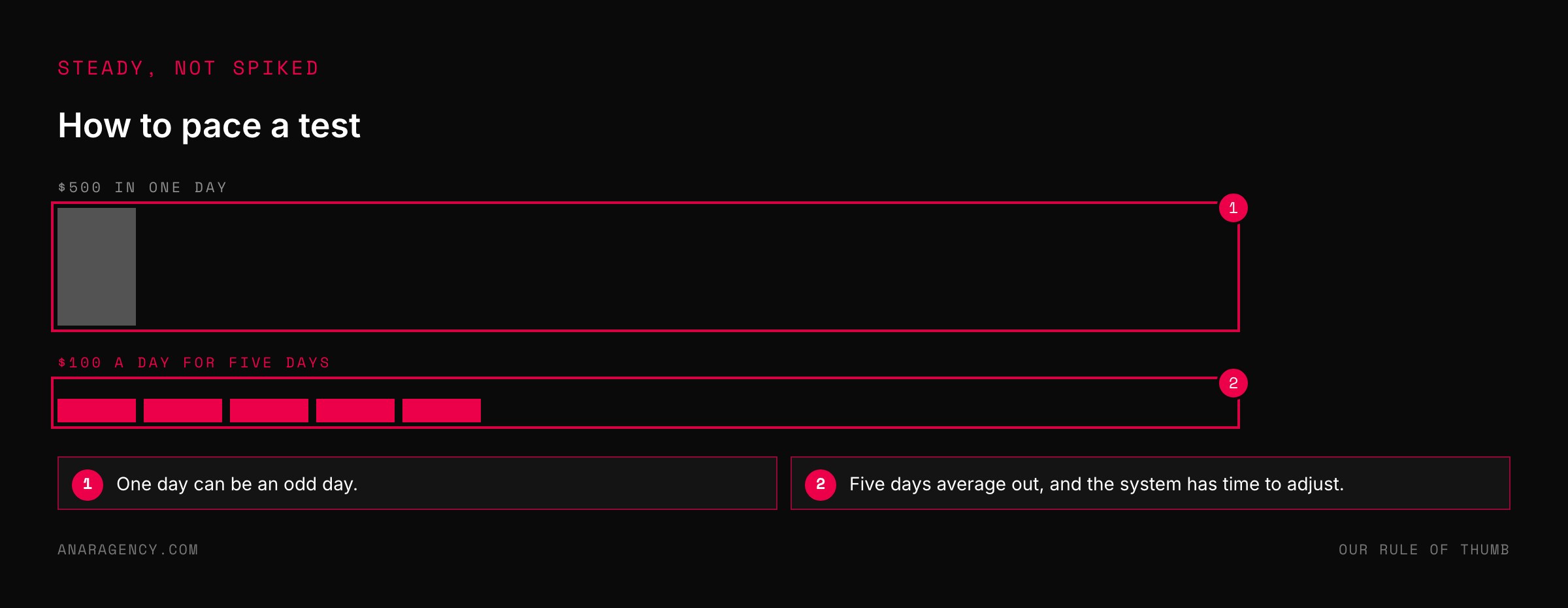
For a new offer, the job of the first campaign is to find out whether the offer sells, not which ad is best. Start with one number: daily budget divided by expected cost per sale. That gives you sales per day, and it decides how many ad sets you can run, because Meta says an ad set usually settles after about 50 results in a week.
Most small budgets can feed one. Put your variety inside it with a grid of different openers and different creatives, spend steadily for several days, and if it fails, check each step from impression to purchase before blaming the price.
The first question is not the one you think
You have a new offer and a little money to test it. So you open Ads Manager and start making decisions.
Which audience? Interests or broad? Video or image?
Three ad sets or six?
Every one of those is a real question. None of them is the first one.
The first question is whether anybody will buy this at all. Until you know that, comparing audiences is like arguing about which fishing rod is best on a lake that might be empty.
So the launch has one job. Get enough fair attempts in front of enough people to find out if the offer sells. Everything in this article follows from that.
One division decides your structure
Take your daily budget. Divide it by what you expect one sale to cost. Be pessimistic about the second number.
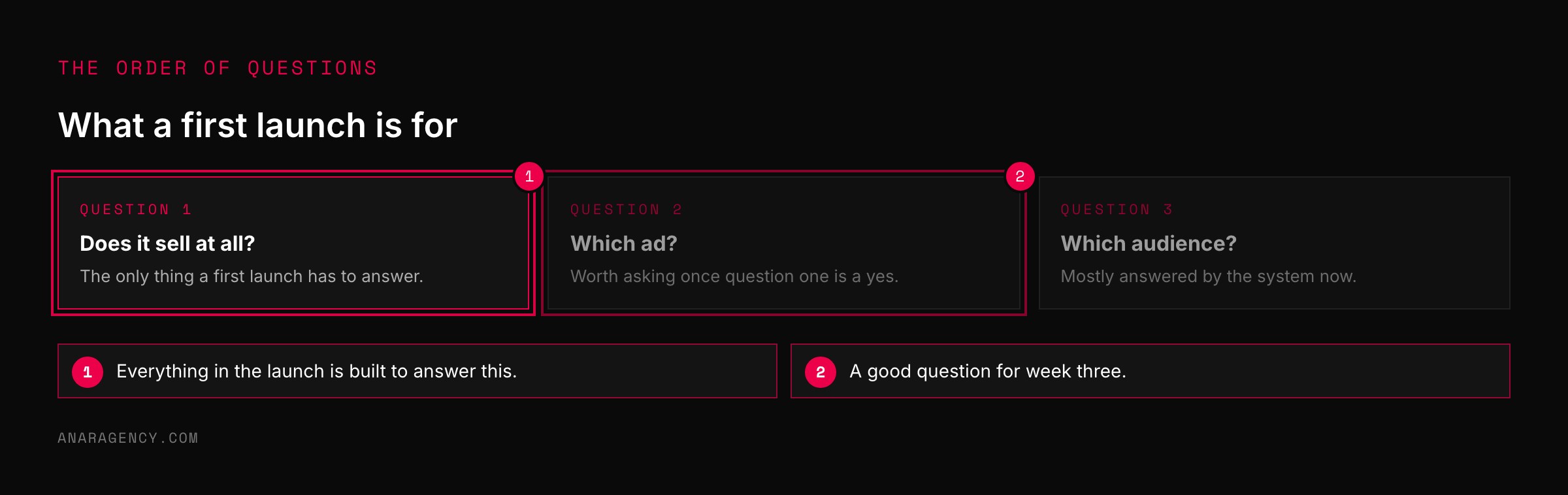
A budget of $100 a day and an expected cost of $50 a sale is 2 sales a day. That is 14 a week.
Now look at what Meta says. In its guide to the learning phase, an ad set usually finishes learning after about 50 results in the week after its last significant edit. Until then, it says, performance is less stable and cost per result is usually higher.
Fourteen is not fifty. If you split that $100 across three ad sets, each one gets about five results a week. Meta has a label for that: learning limited.
So an ad set is not really an audience. It is a budget. It is a container that needs a certain number of results to work properly, and your money decides how many containers you can fill.
For most new offers on small budgets, the answer is one. That feels wrong to people who were taught to test five audiences at once. Meta's own advice is to combine ad sets so the learning is pooled.
First do the division: daily budget over expected cost per result gives results per day, and that sets the number of ad sets, since Meta says an ad set usually settles after about 50 results in a week. Then build variety inside the ad set: one fixed body of copy, three to five different openers, three to five clearly different creatives, every opener paired with every creative. Size the grid to the budget.
Spend evenly for several days, make no significant edits, and if it fails, check every step from impression to purchase before changing the price.
Steady Starters: what clean launches have in common
Some advertisers get a clear answer from a few hundred dollars. Others spend the same and learn nothing. The first group does three things.
We call them Steady Starters.
They ask for the thing they actually want. If the goal is a sale, they tell Meta to find buyers, not clickers. It is tempting to pick an easier goal so the numbers fill in faster.
Meta does suggest a more frequent event when an ad set is starved, and that trade is real. But an ad set that is told to find clicks will find people who click.
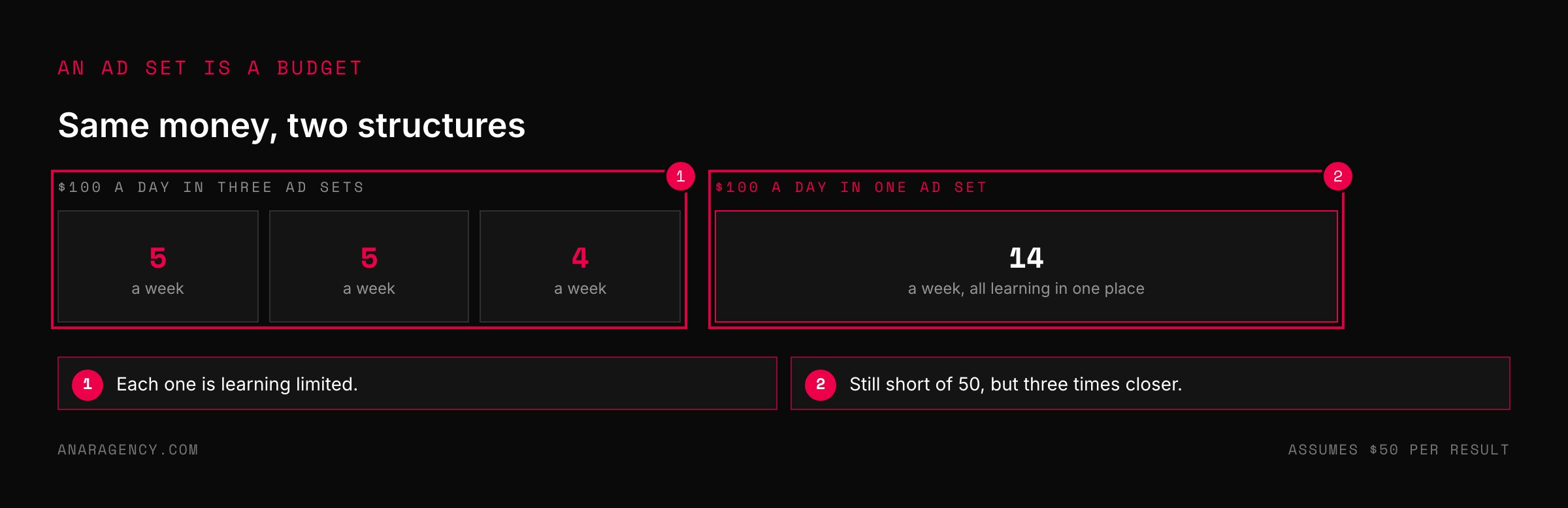
They spend evenly for several days. As a rule of thumb, $100 a day for five days tells you more than $500 in one day. A single day can be a strange day.
Five days average it out, and the system has time to adjust.
They leave it alone. Meta lists the changes that reset learning, and they include changes to budget, targeting, and creative. Every nervous edit on day two starts the clock again.
There is a reason structure matters more than it used to. Meta's engineers wrote in late 2024 about a new system for deciding which ads to consider for each person. Much of the matching that advertisers once did by hand with audiences is now done by the machine, from the ad itself.
Which means the place to put your effort is the ads.
The Opener x Creative Grid
If you only have one ad set, the variety has to live inside it. But writing 25 different ads for an offer that might not work is a bad use of a week.
So write one. Then multiply it.
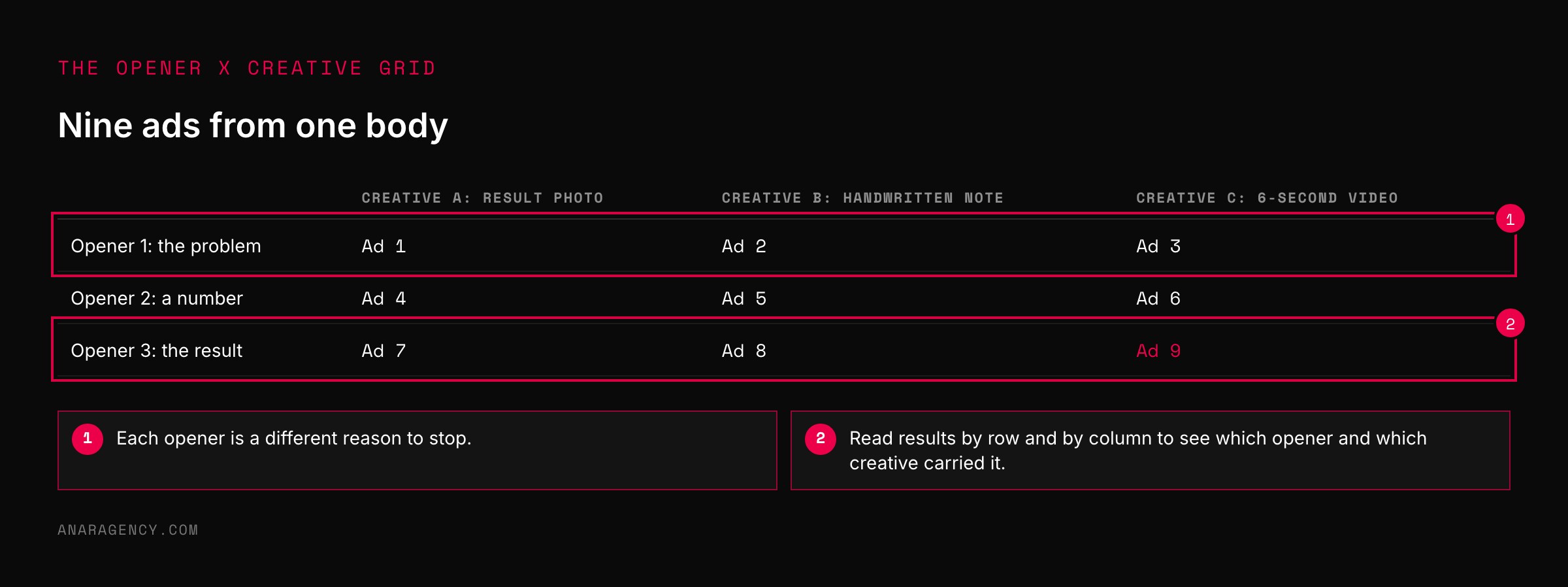
Take the body of the ad, the part that explains the offer, and keep it fixed. Write three to five different openers for it. The opener is the first two lines, the part people see before they tap to read more.
Then make three to five creatives. Different images, or different first seconds of a video. Really different, not the same photo in two colors.
Now pair every opener with every creative. Three by three gives you nine ads. Five by five gives you 25.
All from one piece of writing.
The opener decides who stops, so make each one a different reason to stop: the problem, a number, the result. Our article on before-words and after-words covers which kind to lead with.
One honest caution. Meta's learning guide also says to avoid high ad volumes, because the system learns less about each ad when there are many. So size the grid to the budget.
At $100 a day, run the nine, not the 25.
"It did not sell. The price must be wrong."
You may reach day five with no sales and conclude the offer is dead or the price is too high. Maybe. Check before you decide.
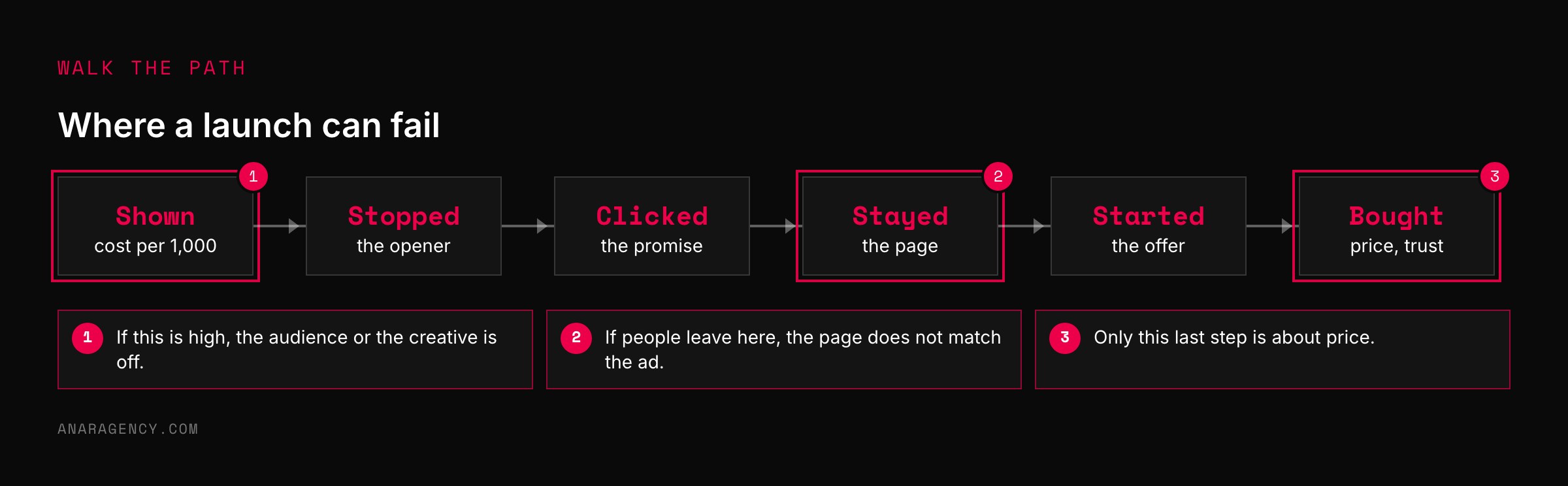
A sale is the last step of a long walk. The ad is shown. Someone stops.
They click. The page loads. They read.
They start to buy. They finish.
Each step has a number in Ads Manager or on your site, and the launch can fail at any of them. If people are not stopping, that is the opener. If they click and leave in two seconds, that is the page, which we cover in ad-to-page alignment.
If they start checkout and quit, then you can talk about price.
Two settings are worth a look while you are there. Know which attribution setting your results are counted under, because it changes what gets credited to an ad. And if you let Meta move money between ad sets with Advantage+ campaign budget, remember that it will, so do not read an ad set that got little spend as a loser.
Our rule of thumb for when to stop: if you have spent about what one or two sales should cost and nobody has even started to buy, pause and fix the step that broke. More money will only buy the same answer again.
What to read next, and why
About the learning phase (Meta documentation): The source of the 50-results figure. Short, and it settles most arguments about structure.
About learning limited (Meta documentation): What happens when a budget is spread too thin, in Meta's words, with its list of fixes.
Significant edits and the learning phase (Meta documentation): The list of changes that reset learning. Read it before you touch a live campaign.
Our own budget sizing article (article): Written for Google Ads, and the same back-solve works here. Start from the sales you need.
So the simple takeaway is this: for a new offer, do the division first. Budget over cost per sale tells you how many ad sets you get, and for most people the answer is one.
Questions executives ask
How many ad sets should I run for a new offer?
As many as your budget can feed, which is often one. Divide your daily budget by your expected cost per result to get results per day. Meta says an ad set usually exits the learning phase after about 50 results in a week, so splitting a small budget across several ad sets leaves each one short.
What is the Facebook ads learning phase?
It is the period when Meta's delivery system is still learning how to deliver an ad set. Meta says performance is less stable and cost per result is usually higher during it, and that ad sets usually exit after about 50 results in the week after their last significant edit.
How much should I spend to test a new offer on Meta?
Enough for several fair attempts at a sale, spread over several days. As a rule of thumb, spending evenly across five days tells you more than the same total in one day. If you have spent what one or two sales should cost and nobody has started checkout, pause and find the step that failed.
How many ads should be in one ad set?
Size it to the budget. A grid of three openers by three creatives gives nine ads from one body of copy and suits a small budget. Meta's guidance warns that with many ads the system learns less about each one, so the larger five-by-five grid belongs with larger budgets.
Should I test audiences or creatives first?
Neither comes first for a new offer. The first test is whether the offer sells at all. After that, put the effort into clearly different ads, because Meta's delivery system now does much of the audience matching from the ad itself.

Filip Kovacevic is the founder of Anar Agency in Phoenix. He spent five years running SEO, Meta ads, email, and content for medical practices across the United States, and now does the same work for healthcare, home-service, legal, and professional-service businesses, alongside AI implementation. More from Filip →
Talk it through in 15 minutes
Bring one AI question from this article. We will tell you what we would do, whether or not you hire us.
Book a 15-Min Chat →