Quick Win Offers: Replace the Free Audit With a Paid First Step

A Quick Win offer replaces the free audit and free proposal with a short call that ends in one real fix the prospect can use within about a day. That fix earns the right to sell the second step: a fixed-price roadmap, which is the diagnostic work agencies normally do unpaid. Then comes a 90-day sprint paid up front, then ongoing work.
It suits established, time-poor buyers who have been pitched too often to give a stranger an hour, and it works because trust is built by producing a result, not by describing one.
The audit nobody reads
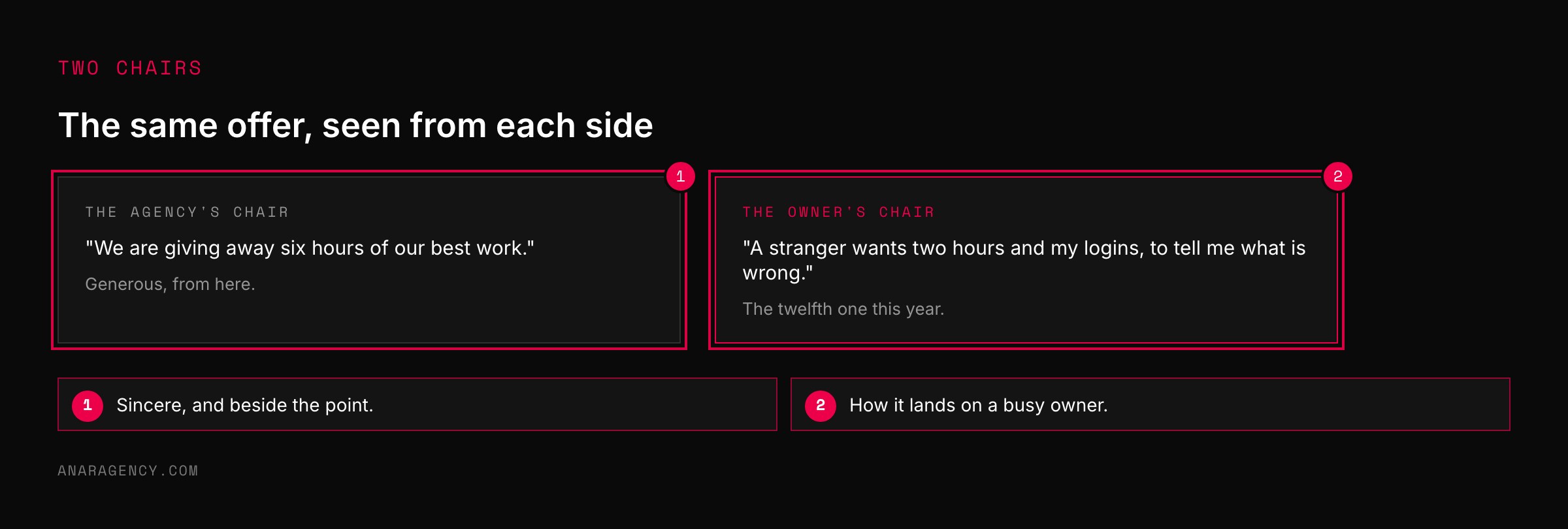
Here is how agencies have won clients for twenty years. Offer a free audit. Spend six hours on it.
Present it on a call. Send a proposal. Follow up four times.
Now look at it from the other chair. A stranger wants an hour of your time, access to your accounts, and then another hour to hear what is wrong with your business.
The owner worth having has been through that a dozen times. They know the audit is a sales document. They stopped saying yes.
So the agency is left giving its best free work to the prospects with the most time on their hands, who are rarely the ones with the budget.
Flip the order
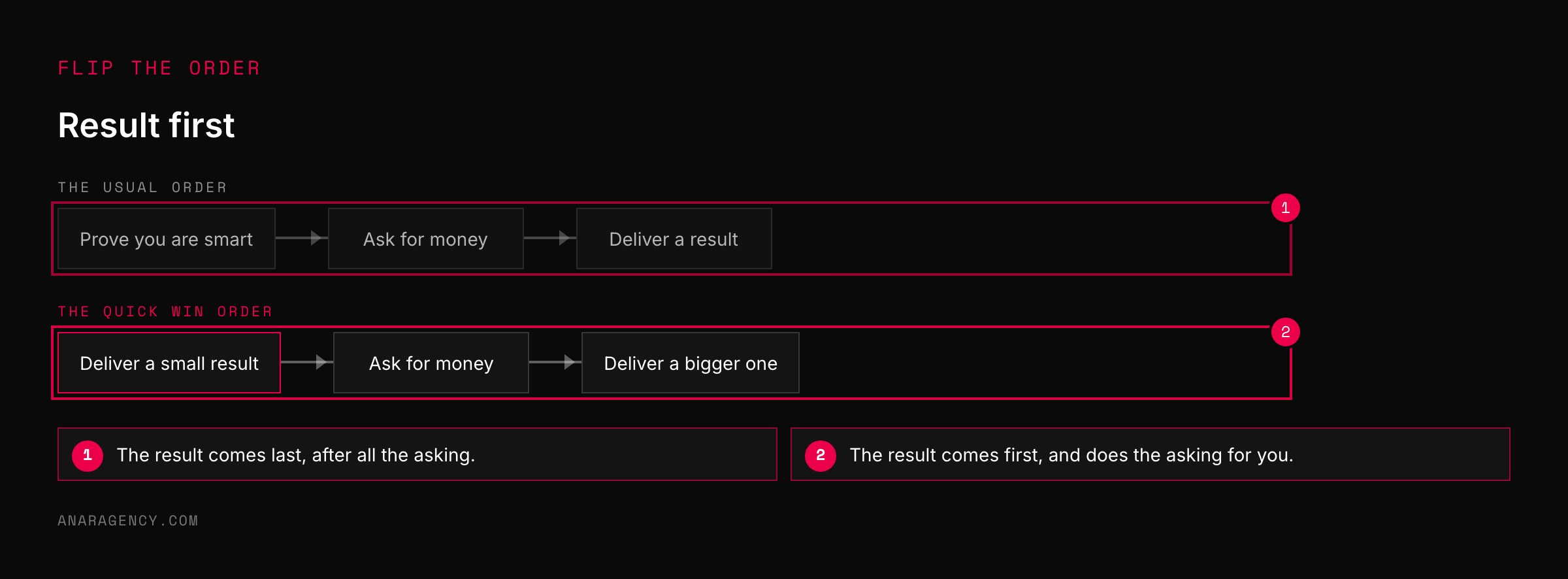
The usual sequence is: prove you are smart, then ask for money, then deliver a result.
A Quick Win turns it around. Deliver a small result first. Then ask for money.
Then deliver a bigger one.
It is fifteen minutes, not sixty. And the prospect leaves with one thing they can put in place by tomorrow.
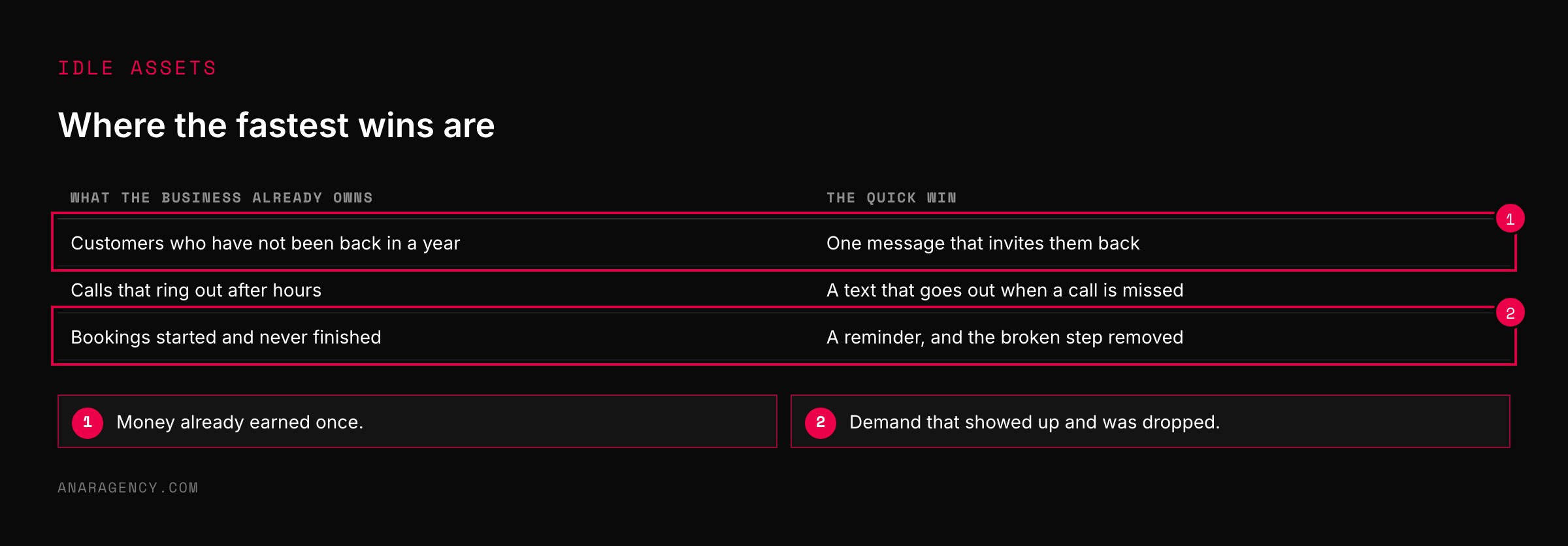
Not a list of findings. One fix. A text that goes out when a call is missed.
A message to customers who have not been back in a year. A booking page with the broken step removed.
There is solid psychology under this. Researchers call it the foot-in-the-door effect: a person who has said yes to something small is more likely to say yes to something larger afterward. A small real result is a far better first yes than a signature on a proposal.
Four rungs: a 15-minute call that ends in one fix usable within about a day; a fixed-price roadmap that sells the diagnostic work; a 90-day sprint paid up front; then ongoing work. A real Quick Win passes seven tests: it is a result, fast and low-risk, high value at low cost to you, built on an asset the prospect already owns, framed as an opportunity, points to a bigger job, and does not give away the whole plan. Check consent rules before touching a customer list and fee-sharing rules before proposing a results share.
The four rungs
A Quick Win is the bottom of a ladder. There are four rungs.
The Quick Win. Fifteen minutes. One fix.
Free, or a token fee to filter out the idly curious.
The paid roadmap. A fixed-scope, fixed-price diagnosis and plan. This is the thinking agencies normally give away in the first unpaid month.
Sold as a product, it is worth real money by itself, and the client can take it elsewhere if they wish.
The 90-day sprint. Execution against the roadmap, paid before the work starts. A fixed price on rung two makes paying up front feel normal by rung three.
Ongoing work. A retainer, or where it is allowed, a share of results.
The roadmap is the rung that changes the economics. In business it would be called a proof of concept: a small paid piece of work that settles whether the larger one is worth doing. Both sides find out cheaply.
Result Givers: what makes a Quick Win real
Plenty of firms now offer something they call a quick win that is a discovery call in a new coat. The real ones pass seven tests. We call the firms that pass them Result Givers.
They hand over a result, not access. The call ends with something working.
They use what the prospect already owns. The strongest quick wins recover money from an asset sitting idle: a list of past customers, missed calls, bookings that were started and not finished.
Each of those is real. Harvard Business Review's lead-response research found most firms respond to new leads far too slowly, and Baymard's checkout research puts the average cart abandonment rate at about 70 percent. There is recoverable money in nearly every business.
They frame it as an opportunity. "Here is revenue you already earned and have not collected" lands better than "here is what you are doing wrong."
They hold something back, honestly. One fix, done fully. Not the whole plan.
The fix should make the bigger job visible without a pitch.
They build it once. A quick win is designed per trade, not per prospect. That is what makes fifteen minutes possible.
"Why would I give away a result for free?"
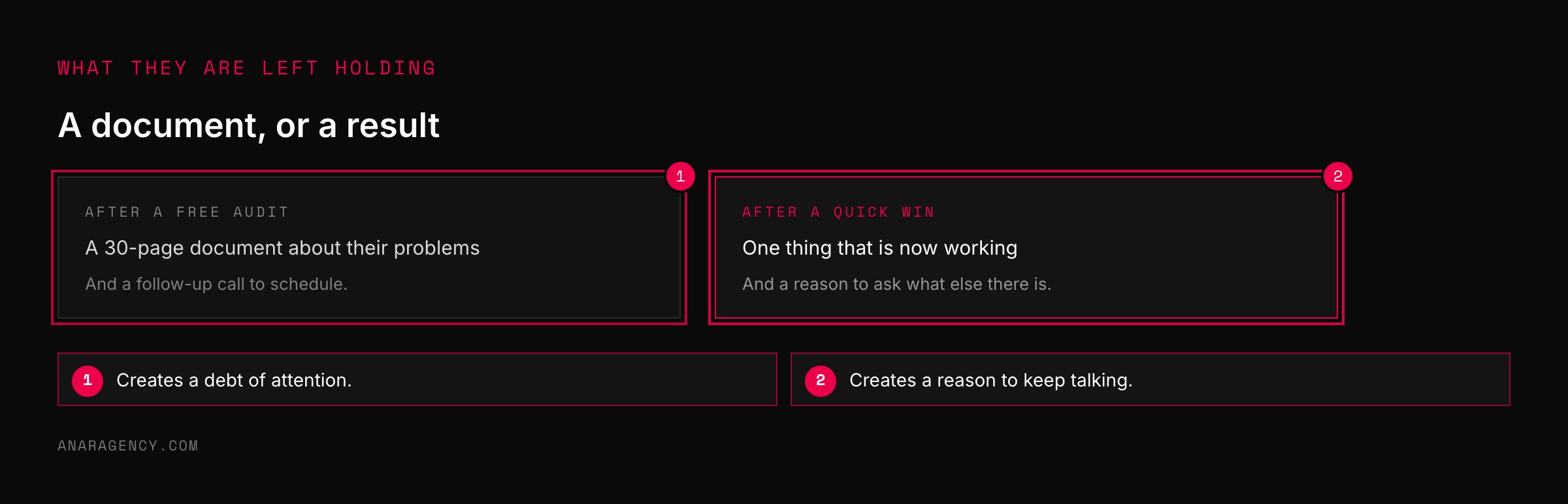
You may be thinking this is just a free audit made smaller. The difference is what the prospect is left holding.
After an audit, they hold a document about their problems. After a Quick Win, they hold something that works. The first creates a debt of attention.
The second creates a reason to keep talking.
It also filters. A prospect who will not give fifteen minutes for a working fix was not going to buy a roadmap.
There are limits you must check before you copy this. If the fix sends messages to a customer list, consent and opt-out rules apply. The FTC's CAN-SPAM guide covers email, and text messages have stricter rules of their own.
The top rung has limits too. In some regulated fields, paying a marketing firm a share of fees is restricted or banned. Law is the clearest case.
Check the rules of the client's profession before you propose a results share, and use a flat fee where they apply.
This is the model we use ourselves. The older version, a customized audit used as the first step, is in audits as lead magnets, and what to send between steps is in lead-first nurture.
What to read next, and why
Foot-in-the-door technique (encyclopedia entry): The research on why a small first yes changes what follows.
The Short Life of Online Sales Leads (research): The source for the most common quick win of all, answering leads faster.
Proof of concept (encyclopedia entry): The idea behind a small paid first project.
CAN-SPAM Act: A Compliance Guide for Business (FTC guide): Read it before any quick win that touches a customer email list.
So the simple takeaway is this: stop offering to tell people what is wrong. Offer to fix one thing in fifteen minutes, and let the fix do the selling.
Questions executives ask
What is a quick win offer?
A first step in which a prospect gets one real, working fix in a short call, usually about fifteen minutes, instead of a free audit or proposal. The fix builds trust by producing a result, and leads to a paid, fixed-price roadmap.
What can agencies offer instead of a free audit?
A short call that delivers one implemented fix, followed by a paid roadmap with a fixed scope and price. The roadmap is the diagnostic and planning work agencies usually do unpaid, sold as a product the client can use with or without the agency.
What makes a good quick win?
It recovers value from something the prospect already owns, such as past customers who have not returned, missed calls, or unfinished bookings. It should be usable within about a day, carry little risk, and reveal a larger opportunity without pitching it.
Should the first step be free or paid?
Either can work. A token fee filters out prospects who are only curious. What matters more is that the second step, the roadmap, is paid at a fixed price, because that sets the expectation of paying before work begins.
Can an agency work for a share of results?
In many industries yes, but not all. Some regulated professions restrict or prohibit sharing fees with non-members, and law is the clearest example. Check the rules of the client's profession and use a flat fee where a results share is not allowed.

Filip Kovacevic is the founder of Anar Agency in Phoenix. He spent five years running SEO, Meta ads, email, and content for medical practices across the United States, and now does the same work for healthcare, home-service, legal, and professional-service businesses, alongside AI implementation. More from Filip →
Talk it through in 15 minutes
Bring one AI question from this article. We will tell you what we would do, whether or not you hire us.
Book a 15-Min Chat →