Offers Start With Principles, Not Products
An offer that lasts is built in a fixed order: principles, point of view, process, product, message, distribution. Principles are the things that must be true for a customer to get the result, whoever does the work. Stack them and you have a point of view.
The point of view dictates a process, the process becomes a product, and the product gives you a message that is easy to write and true. Most businesses start at the top with distribution and work down, which is why their offers need constant reinventing.
The offer that needed a new hook every month
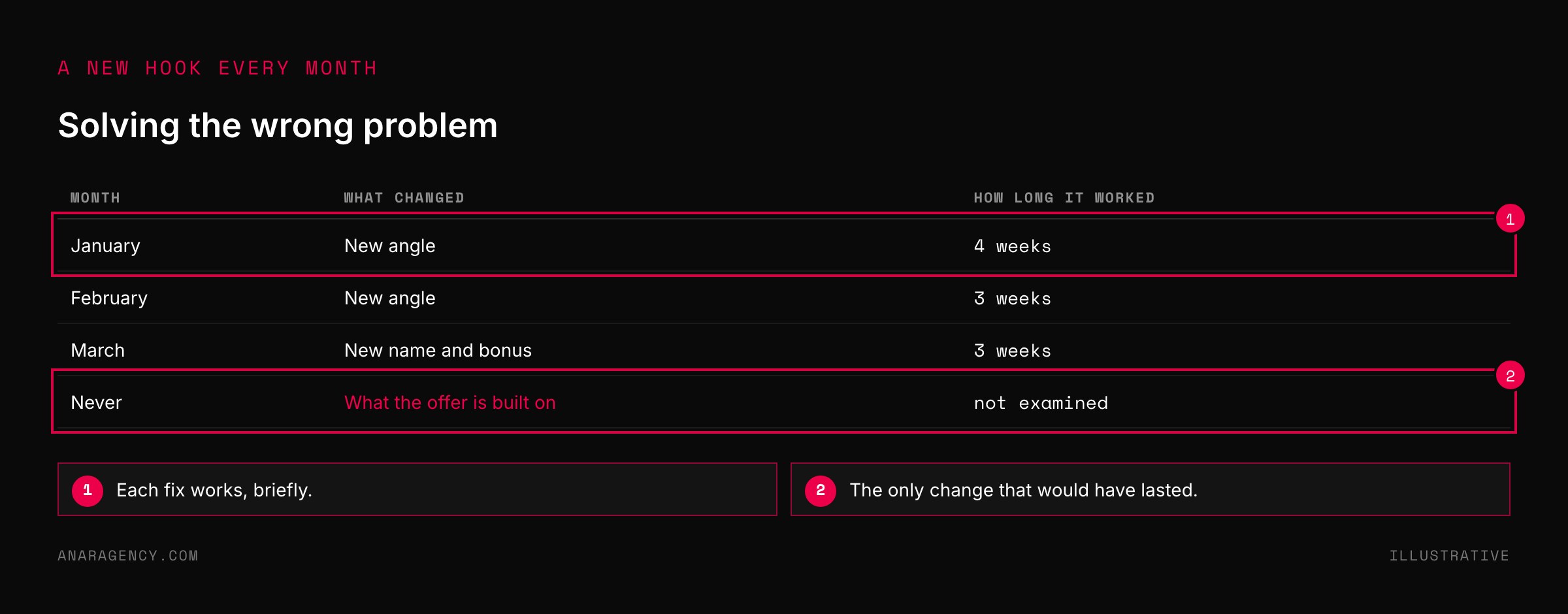
A consultant launches a program. The first ads work. A month later they stop.
So she writes a new angle. That works for three weeks. Then another.
Then a new name for the program, a new bonus, a new price.
She is good at marketing. That is the problem. She keeps solving a marketing problem, and she does not have one.
What she has is an offer with nothing underneath it. There is no reason it works that she could state in a sentence, so every month she has to convince people from scratch. Including herself.
Built backward
Here is how most offers get made. Someone sees a format selling well for a competitor. A challenge, a course, a done-for-you package.
They pick the format. They write the sales page. Then, last, they work out what is actually inside.
That is building from the top down: start with how it will be sold, end with what it is.
It is fast, and it launches. But the marketing is doing all the work. The product is an afterthought, so nothing about it makes a customer come back or tell a friend.
Here is the cost, in plain terms. An ad can only earn the first sale. Every sale after that has to be earned by the work itself.
Six rungs, built from the bottom. Principles: what must be true for the customer to get the result, whoever does the work. Point of view: what your principles add up to.
Process: the steps that follow. Product: the process, packaged. Message: a plain description of the product.
Distribution: where the message goes. To find your principles, list what was true in your three best results and missing from your three worst.
The Principle Ladder
The other way starts at the bottom. Six rungs.
Principles. What must be true for the customer to get the result? Not your preferences.
Things that would hold no matter who did the work. Thinkers have called this reasoning from first principles for a very long time.
Point of view. Put your principles side by side and a way of seeing the problem appears. This is what makes your offer yours.
Process. The steps that follow from that point of view, in order.
Product. The process, packaged. What is included, how long it takes, what it costs.
Message. What you say about it. By this rung it almost writes itself, because you are describing something real.
Distribution. Where the message goes. Ads, articles, email.
This is the last rung, not the first.
Bottom-Up Builders: a company that did it
The clearest large example is an airline. For decades Southwest Airlines was the odd one in its industry, and consistently profitable while rivals were not.
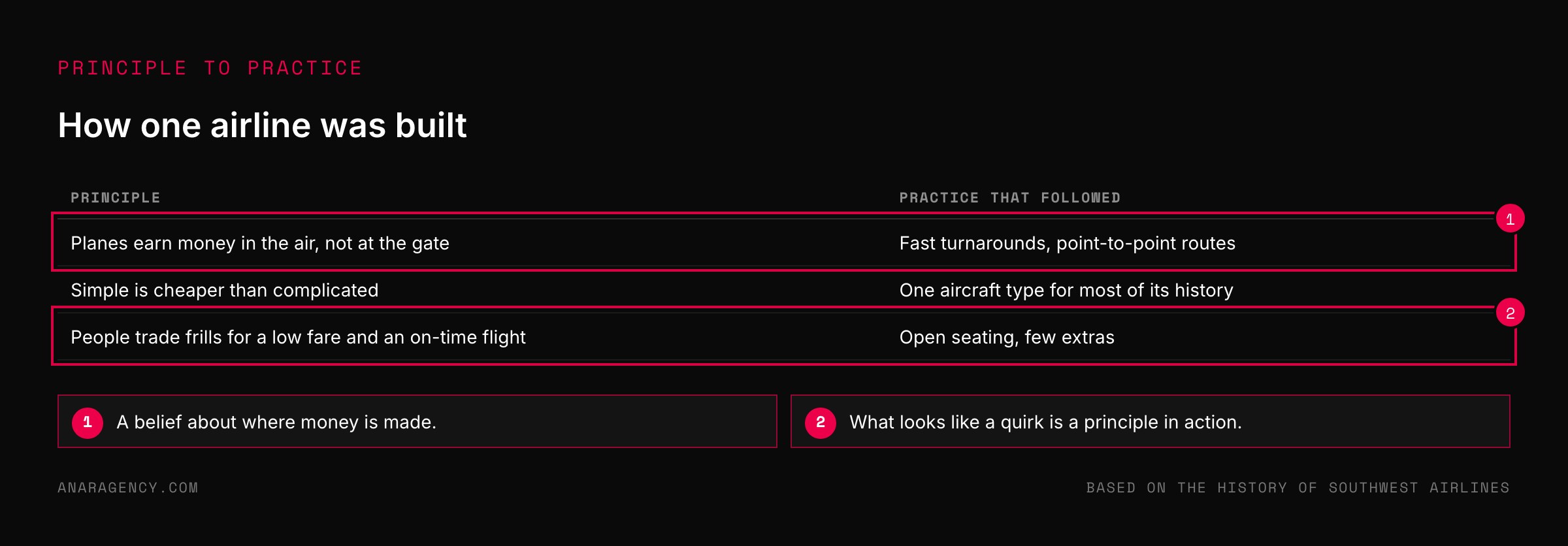
It began from a few things it held to be true. Planes make money in the air, not at the gate. Simple is cheaper than complicated.
People will give up frills for a low fare and a flight that leaves on time.
Look at what followed from those. For most of its history it flew one type of aircraft, the Boeing 737. One type means one set of parts, one kind of training, any crew on any plane.
It flew point to point instead of through big hubs. It did not assign seats. Each of those looks like a quirk.
Each is a principle turned into a process.
And the message, low fares with no nonsense, did not have to be invented. It was a plain description of how the company already ran.
The same thinking sits behind the Toyota Production System, which starts from a handful of principles about waste and builds every practice on top of them. Bottom-Up Builders do not need a new hook each month. The hook is the way they work.
"I do not have principles. I just do good work."
You may be thinking this is for airlines and car makers, and you just do good work for clients. You have principles. You have never written them down.
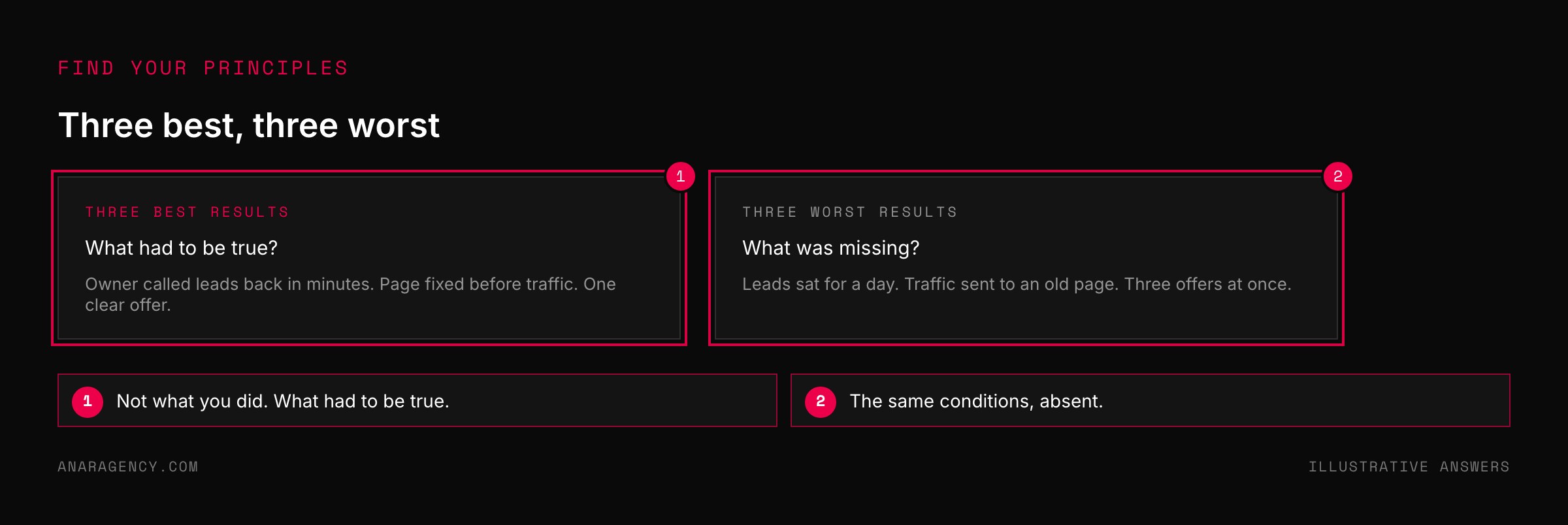
Here is a twenty-minute way to find them. Think of your three best client results. For each, ask what had to be true for that to happen.
Not what you did. What had to be true. "The owner answered the phone within five minutes."
"We fixed the page before we bought any traffic."
Then think of your three worst. What was missing?
The things that show up in every success and are absent from every failure are your principles. There will be four or five.
Those are also the things worth saying no over. A prospect who will not accept one of them is a future bad result. This is the same instinct behind the gate in our conversion-first audit, and it starts from knowing the job the customer is trying to get done.
What to read next, and why
Southwest Airlines (encyclopedia entry): Read the history with one question in mind. Which decisions were principles, and which followed from them?
First principle (encyclopedia entry): The old idea of reasoning from what must be true instead of from what others do.
Toyota Production System (encyclopedia entry): A whole company built upward from a few stated principles.
Know Your Customers' "Jobs to Be Done" (Harvard Business Review): How to find what the customer is really trying to accomplish, which is where principles come from.
So the simple takeaway is this: before you write another ad, write down the four or five things that must be true for your customer to win. Your offer is whatever follows from those.
Questions executives ask
How do I create an offer?
Start with what must be true for the customer to get the result, not with the format or the ad. Write those principles down, let them form a point of view, derive the process from it, package the process as a product, and only then write the message and choose where to promote it.
Why does my offer stop working after a few weeks?
Often because it was built from the marketing down. If the product has no clear reason it works, each campaign has to persuade buyers from nothing, and each new angle wears out. An offer built on stated principles gives the marketing something stable to describe.
What is a principle in offer design?
Something that must be true for the customer to get the outcome, regardless of who delivers it. For example: a lead must be called back within minutes, or the page must be fixed before traffic is bought. A principle is not a preference or a tactic.
How do I find my own principles?
Take your three best client results and ask what had to be true for each to happen. Do the same for your three worst and ask what was missing. The conditions present in every success and absent from every failure are your principles.
What made Southwest Airlines different?
It built its operations from a few principles: planes earn money in the air, simplicity is cheaper, and travelers will trade frills for low fares and punctuality. From those came a single aircraft type for most of its history, point-to-point routes, and open seating.

Filip Kovacevic is the founder of Anar Agency in Phoenix. He spent five years running SEO, Meta ads, email, and content for medical practices across the United States, and now does the same work for healthcare, home-service, legal, and professional-service businesses, alongside AI implementation. More from Filip →
Talk it through in 15 minutes
Bring one AI question from this article. We will tell you what we would do, whether or not you hire us.
Book a 15-Min Chat →