Limitations Are Expectations: Offers as Expectation Engineering

Every offer sets four expectations whether it means to or not: how much effort the buyer will put in, how long results will take, what it will cost in total, and who it will not work for. Buyers judge the result against those expectations, not on its own. Set them deliberately and honestly.
State the effort, give a time range, show the full cost, and say the limits first. A modest, accurate expectation that is then beaten produces satisfied customers and referrals. A hopeful one that is merely met produces refund requests.
Sixty-three percent
In 2011 a group of researchers asked people to build things. Simple furniture from a flat pack. Origami figures.
Small models from plastic bricks.
Then they asked how much the participants would pay for what they had made, and for the same item made by someone else.
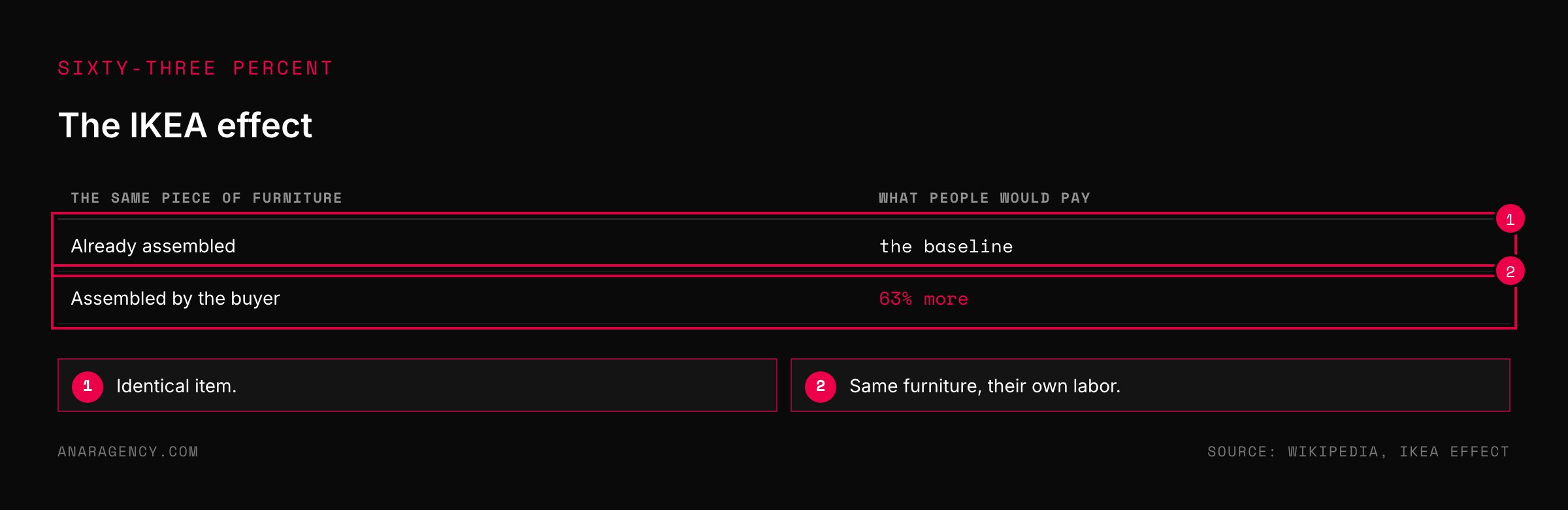
People were willing to pay 63 percent more for furniture they had assembled themselves than for the identical piece already put together.
The researchers named it the IKEA effect. Effort a person puts in raises the value they place on the result.
It is a useful finding and a dangerous one. Effort can raise value. Effort the buyer did not expect does the opposite.
Limits are expectations in disguise
When a buyer hesitates, they usually describe a limit. "I do not have the time." "I cannot afford it."
"That sounds like a lot of work."
Look closer and each limit is a guess about the future. How much time will this take? How much will it really cost?
How hard will it be?
Those guesses come from somewhere. From past purchases, from competitors, and from whatever your offer told them, or failed to tell them.
So a limit is partly an expectation, and expectations can be set.
One sign of this is how value collapses when the effort a result requires falls to nearly nothing. Tasks that once needed skill become commodities once a tool can do them, and their price falls with them. People value things in proportion to what they believe it takes to get them.
Every offer sets four expectations: effort, time, total cost, and limits. Buyers judge results against them, so satisfaction is the gap between expectation and outcome. State the effort, give a time range, show the full cost including renewals, and say who it will not work for first.
Promise what you reliably deliver and add something unpromised. Be specific, modest, and true, never vague, and state typical results where they differ from the best.
Satisfaction is a gap
Here is the part that changes how an offer should be written.
Researchers who study customer satisfaction describe it as a comparison. People form an expectation before buying, then judge what they got against it. The model is known as expectation confirmation theory.
The result alone does not decide whether someone is happy. The gap does.
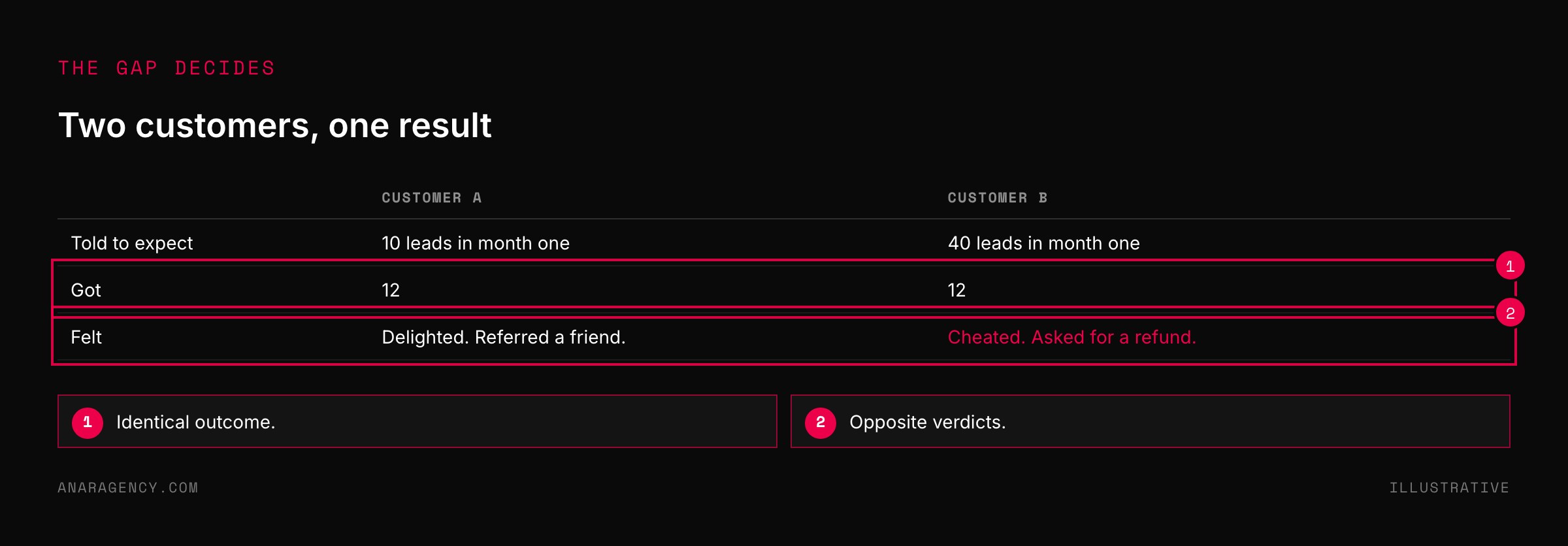
Two customers can get the same result. One was told to expect ten leads in the first month and got twelve. The other was told to expect forty and got twelve.
The first refers a friend. The second asks for a refund. Same work, same outcome, opposite customers.
So the expectations an offer sets are not just a sales matter. They decide reviews, refunds, and referrals months later.
Expectation Designers: four expectations, set on purpose
Some firms have unusually happy customers without doing unusually better work. They set expectations as carefully as they set prices. We call them Expectation Designers.
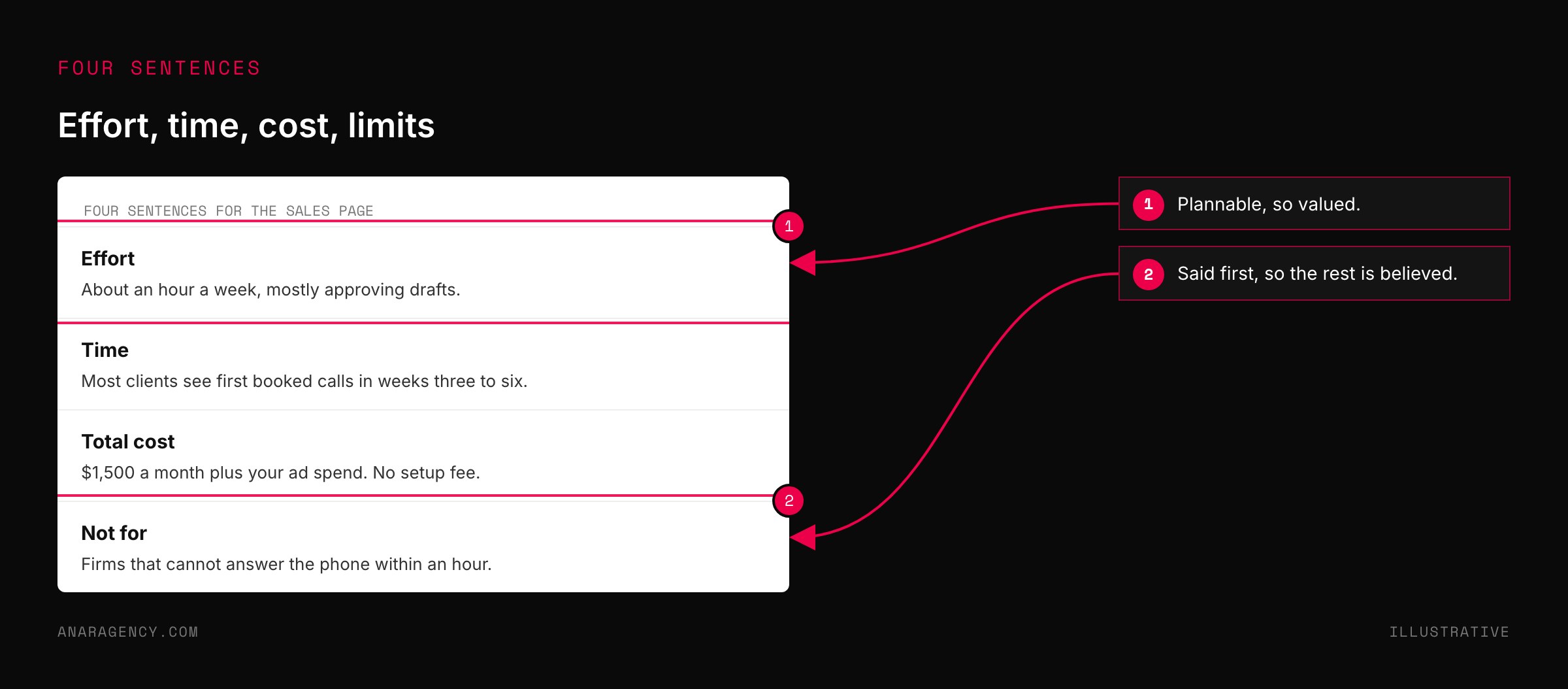
They state the effort. "You will spend about an hour a week on this, mostly approving drafts." A buyer who knows the effort can plan for it, and the IKEA effect works in your favor.
They give a time range. "Most clients see the first booked calls in weeks three to six." A range is more honest than a date and harder to be disappointed by.
They show the full cost. Including ad spend, setup, and anything that renews. A cost that appears later is a broken expectation, whatever the contract says.
They say the limits first. "This will not work if you cannot answer the phone within an hour." It filters out the wrong buyers and makes the right ones trust the rest of the page.
They beat the expectation on purpose. Promise what you reliably deliver, then add something small that was not promised. The gap does the selling for the next customer.
The four sit naturally beside the risk questions in what buyers fear losing.
"Will lower expectations not lose me sales?"
You may worry that a sober promise loses to a competitor's bigger one. Some buyers will choose the bigger promise. Many of them are the customers who ask for refunds.
The ones who choose the honest offer tend to stay, and to refer people like themselves.
And honesty about limits often raises conversion among the right buyers, because it makes everything else on the page more believable. We describe that effect in the three stop-beliefs.
There is a legal side too. Results claims, time frames, and total costs are claims. They must be truthful and supported, and if typical results differ from the best ones, say so.
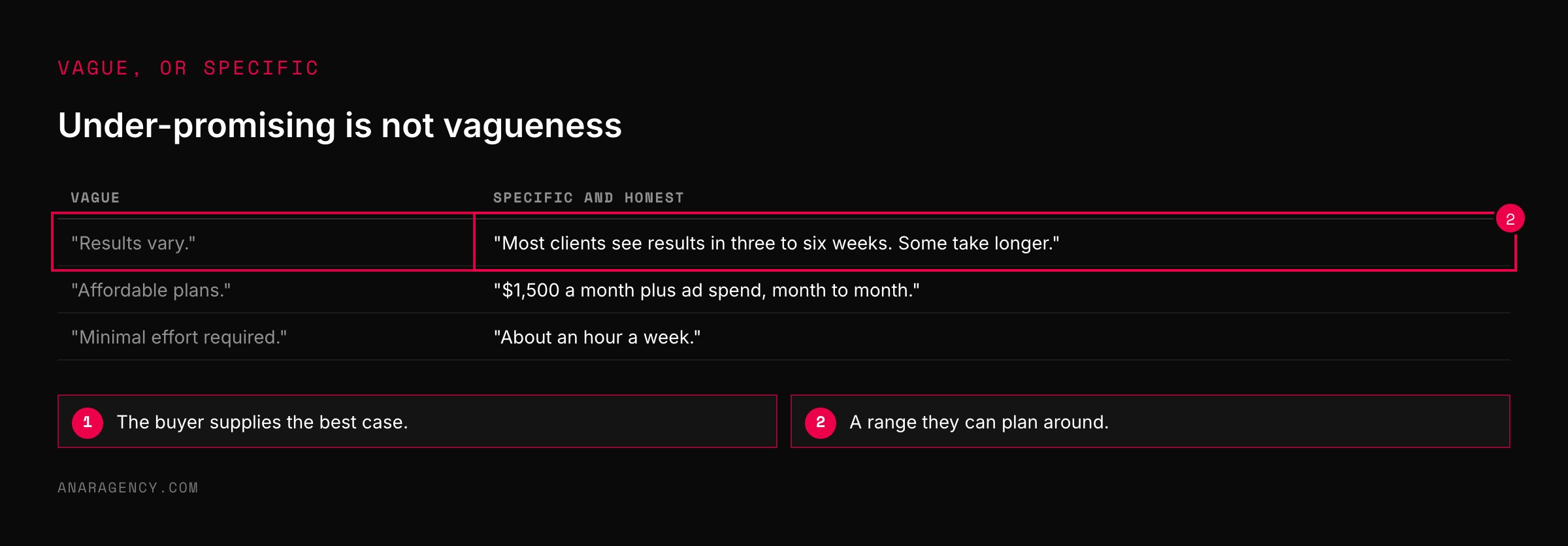
Under-promising does not mean being vague. "Results vary" sets no expectation at all, and the buyer fills the gap with hope.
The aim is a specific, modest, true expectation. Then the work has room to exceed it.
What to read next, and why
IKEA effect (encyclopedia entry): The experiments and the 63 percent figure.
Expectation confirmation theory (encyclopedia entry): The research on satisfaction as the gap between expectation and result.
Commoditization (encyclopedia entry): What happens to price when the effort a result requires disappears.
Advertising FAQs: A Guide for Small Business (FTC guide): The rules on results claims and typical outcomes.
So the simple takeaway is this: write one sentence each on effort, time, total cost, and who it is not for, and put all four on your sales page. Then beat them.
Questions executives ask
How do I set customer expectations?
State four things on the sales page and in the agreement: how much effort the customer will put in, how long results usually take as a range, the total cost including anything recurring, and who the service is not suitable for.
Why do satisfied customers depend on expectations?
Research on customer satisfaction describes it as a comparison between what was expected and what was received. The same result can satisfy a customer who expected less and disappoint one who expected more.
What is the IKEA effect?
The finding that people value things more when they have put effort into making them. In a 2011 study, participants were willing to pay 63 percent more for furniture they had assembled themselves than for identical pre-assembled furniture.
Does under-promising reduce sales?
It may lose some buyers who prefer a bigger promise, but those buyers are more likely to be disappointed. An accurate, specific promise tends to attract customers who stay and refer others, and makes the rest of the offer more credible.
Can I say results vary instead of giving a time frame?
That sets no expectation, so buyers fill the gap with their own hopes. A specific, honest range, with typical results distinguished from the best, protects both the customer and the business.

Filip Kovacevic is the founder of Anar Agency in Phoenix. He spent five years running SEO, Meta ads, email, and content for medical practices across the United States, and now does the same work for healthcare, home-service, legal, and professional-service businesses, alongside AI implementation. More from Filip →
Talk it through in 15 minutes
Bring one AI question from this article. We will tell you what we would do, whether or not you hire us.
Book a 15-Min Chat →