Sell Outcomes, Not Deliverables: Half Your Copy Should Describe the Result

Buyers do not want your deliverables. They want what the deliverables produce. A page that lists twelve included items and spends one line on the result has the proportions backward.
Spend about half your words on the outcome and what life looks like with it, and let the list of what is included support that. Then improve the offer itself with three dials: more of the result, less asked of the customer, and a simpler path from yes to done.
Twelve bullets and no reason
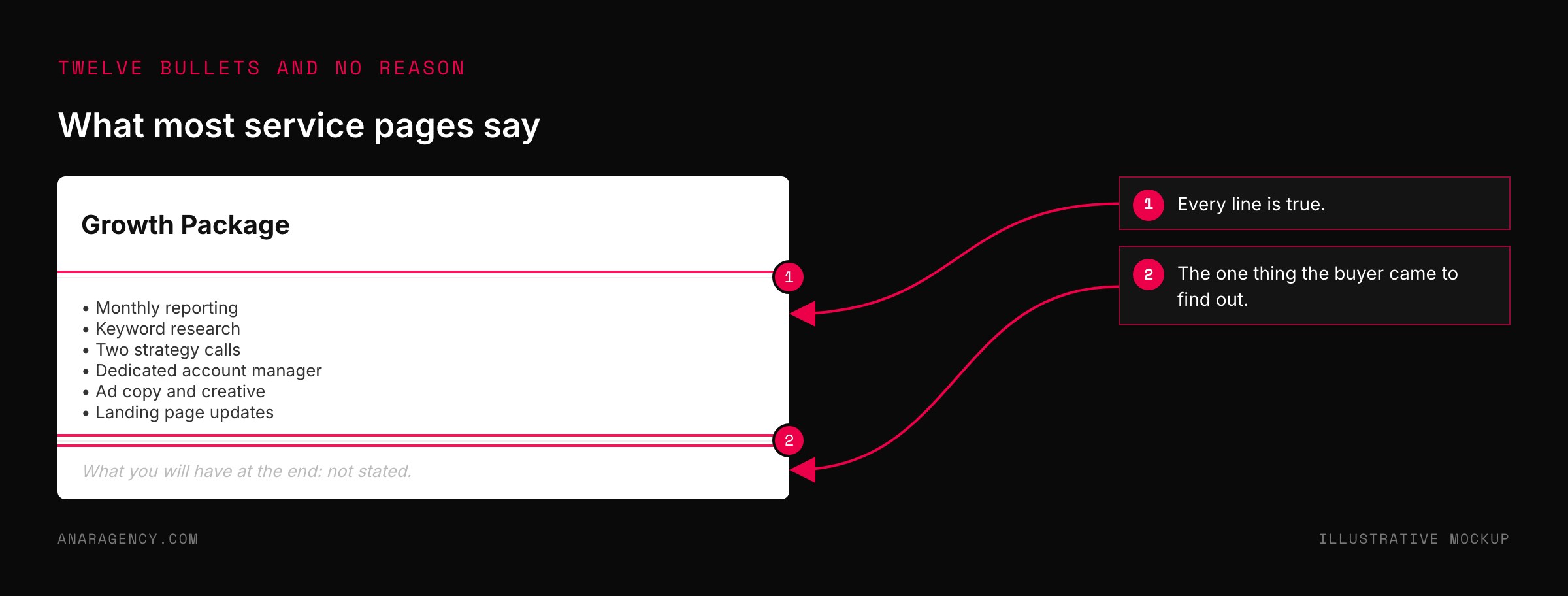
Open the services page of almost any agency, consultant, or contractor. You will find a list.
Monthly reporting. Keyword research. Two strategy calls.
Dedicated account manager. Twelve bullets, each one true.
Now ask what the buyer will have when it is all done. More calls? How many?
By when?
It is usually not there. The page describes the work in loving detail and never says what the work is for.
One thousand songs
The most famous example of getting this right is a pocket-sized music player.
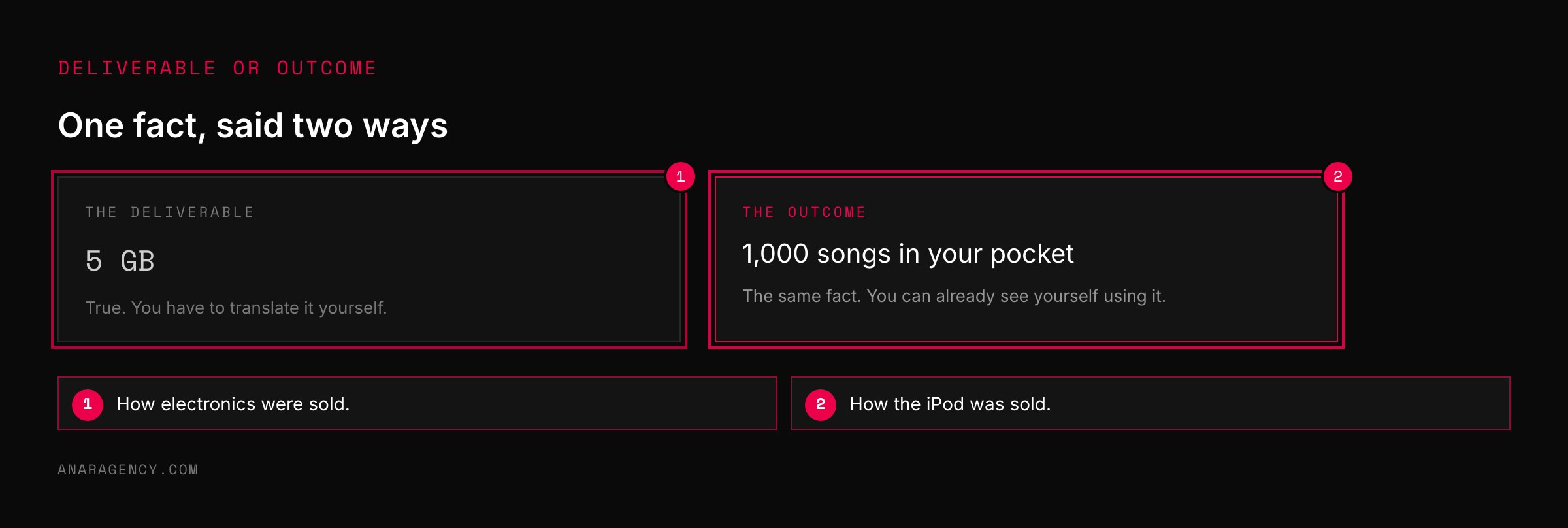
In 2001 there were already MP3 players. They were sold the way electronics are sold: storage in megabytes, battery life in hours, the file formats supported.
Apple launched the iPod with five gigabytes of storage. It could have said so. The line it used was "1,000 songs in your pocket."
Five gigabytes is a deliverable. A thousand songs in your pocket is an outcome. One you have to translate.
The other you can already see yourself using.
The idea is older than the iPod. The Harvard marketing professor Theodore Levitt is remembered for telling his students that people do not want a quarter-inch drill. They want a quarter-inch hole.
Your list of deliverables is the drill.
First, rebalance the copy: about half the words describe the outcome and what life looks like with it, and the list of deliverables supports that. Then turn three dials on the offer itself. More: a bigger, faster, or more certain result, as long as it is true.
Less: fewer hours, decisions, and things to learn asked of the buyer. Simpler: fewer steps from yes to done. Use only results you have produced, and say what they depend on.
Features, benefits, and the layer above them
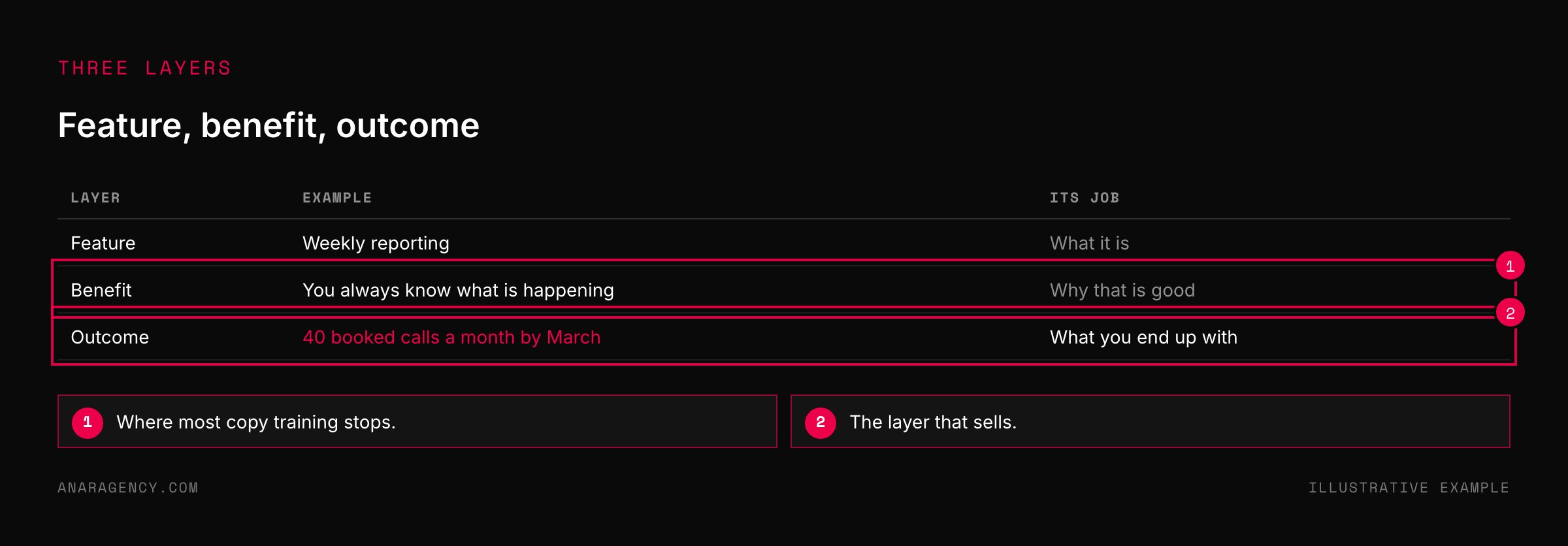
Most people who write copy were taught features and benefits. The feature is what it is. The benefit is why that is good.
There is a third layer, and it is the one that sells. The outcome: what the buyer has at the end.
Feature: weekly reporting. Benefit: you always know what is happening. Outcome: forty booked calls a month by March.
Features and benefits are there to make the outcome believable. They are the evidence, not the promise.
So here is a proportion to aim for. Spend about half the words on the result and what life looks like with it. Use the rest to show why it is believable.
That is our rule of thumb, not a law. But check your own page against it. Most are ninety percent drill.
More, Less, Simpler
Describing the outcome better is half of it. The other half is making the offer itself better, and there are three dials.
More of the result. Can the outcome be bigger, faster, or more certain, and still true?
Less from them. What does the buyer have to put in? Hours, decisions, things to learn.
Every one you remove makes the offer worth more.
Simpler to do. How many steps sit between yes and done? Cut them.
This is why done-for-you costs more than a course on the same subject. The result is the same. What the buyer has to put in drops to nearly nothing.
It also tells you what to fix when an offer is not selling. Owners reach for the price. Usually one of the other three dials is the problem: the result is vague, or the buyer is being asked to do too much.
The principles under the offer come first, and we cover those in offers start with principles.
"I cannot promise results. Too much is out of my hands."
You may be thinking that you cannot name an outcome because you cannot guarantee it. That is honest, and it is no reason to hide in a list of tasks.
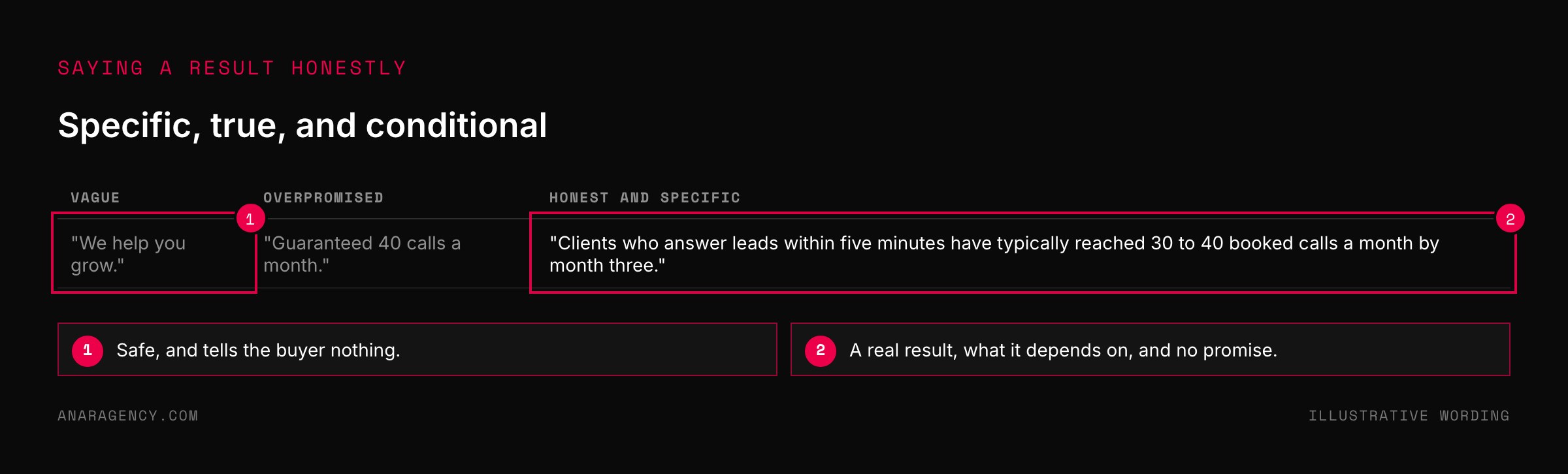
Describing an outcome is not the same as guaranteeing it. You can say what the work is for, what a typical client has seen, and what it depends on.
"Clients who answer leads within five minutes have typically reached 30 to 40 booked calls a month by the third month." That is specific, true, and tells the buyer their part.
Three rules keep it honest. Use only results you have actually produced. Say what the result depends on.
And never state a typical result as a promise.
A vague page is not safer. It just moves the question to the sales call, where the buyer asks it out loud and you answer it anyway.
To find the outcome your buyers care about, ask what they are trying to get done, not what they want to buy. The jobs-to-be-done idea is the best tool for that, and it is the basis of our piece on problem pages.
What to read next, and why
iPod (encyclopedia entry): The launch, and the line that described an outcome while competitors described storage.
Theodore Levitt (encyclopedia entry): The professor behind the drill and the hole, and much of modern marketing.
Know Your Customers' "Jobs to Be Done" (Harvard Business Review): How to find the outcome a buyer is really after.
Copywriting (encyclopedia entry): The craft's history and standard methods, so you can see the layer most of them leave out.
So the simple takeaway is this: count the words on your offer page that describe what the buyer ends up with. If it is under half, you are selling the drill.
Questions executives ask
What does it mean to sell outcomes instead of deliverables?
It means describing what the buyer will have at the end, such as a number of booked calls by a date, instead of listing the tasks you will perform. The deliverables still appear, but as evidence that the outcome is believable.
What is the difference between a feature, a benefit, and an outcome?
A feature is what the product or service is. A benefit is why that feature is good. An outcome is what the buyer ends up with.
Weekly reporting is a feature, always knowing what is happening is a benefit, and forty booked calls a month is an outcome.
How do I make my offer more valuable without lowering the price?
Turn one of three dials: make the result bigger, faster, or more certain; reduce what the buyer has to contribute in time and decisions; or cut the number of steps between saying yes and getting the result.
Can I describe results if I cannot guarantee them?
Yes. State what the work is for, what clients have typically seen, and what the result depends on. Use only results you have actually produced and do not present a typical result as a promise.
Why did Apple say "1,000 songs in your pocket"?
Because it described an outcome a person could picture, while competing players were described by storage capacity. The first iPod held five gigabytes, and the line translated that specification into what the buyer would have.

Filip Kovacevic is the founder of Anar Agency in Phoenix. He spent five years running SEO, Meta ads, email, and content for medical practices across the United States, and now does the same work for healthcare, home-service, legal, and professional-service businesses, alongside AI implementation. More from Filip →
Talk it through in 15 minutes
Bring one AI question from this article. We will tell you what we would do, whether or not you hire us.
Book a 15-Min Chat →