The Token Economy: Controlling AI Spend Without Capping Productivity

Control AI spend the way you control any cost of goods. Tie it to workflows, price each workflow against the value it produces, cap the failure modes instead of the usage, and review the portfolio once a month. A blanket spending limit protects the budget by destroying the productivity you bought the tools for, and it leaves you watching the wrong number.
Tokens are COGS, not overhead
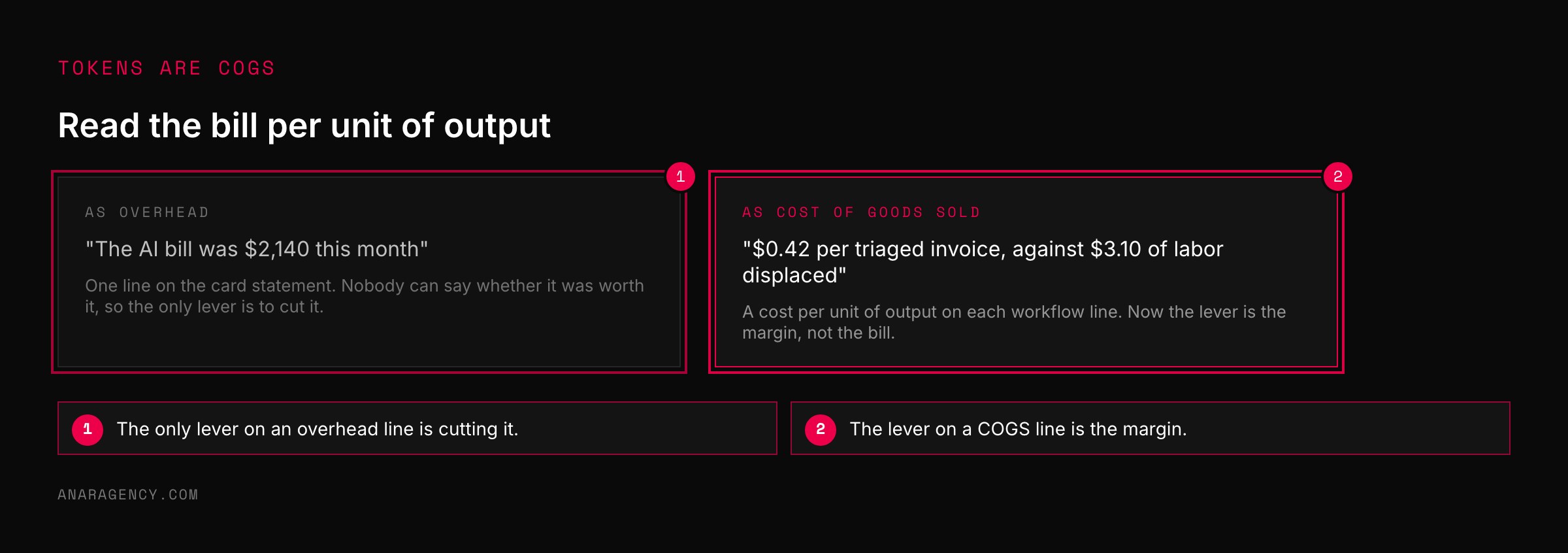
One mental model unlocks the rest: a token is a unit of production cost, like a kilowatt hour or a billable minute.
Treat it as overhead, one big bill with nothing attributed, and AI spend is uncontrollable. Every finance review becomes a fight about the total.
Treat it as cost of goods, attributed per workflow, and it becomes ordinary unit economics. This workflow costs $0.40 per processed ticket and replaces $6 of labor. That one costs $30 per report and saves an afternoon.
Now you are arguing about a margin, and margins you know how to manage.
Attribution means tagging usage by workflow and team at the API layer, which every serious provider supports. If you cannot see spend per workflow, you do not have a cost problem. You have a metering problem, and it is fixable in a week.
The value question: what is a token worth?
Price value at the workflow level, never the token level. There are three honest measures, in descending rigor.
Displaced cost: hours saved times loaded rate, the workhorse metric. Throughput: same team, more output, measured in units. Quality delta: fewer errors and faster cycle time, measured against the pre-AI baseline you instrumented.
A workflow with a token bill and no baseline cannot be priced. That is why measurement comes before automation in every mature program.
Full ROI also counts the costs that are not tokens: the build, the harness, the evaluation time, the review time. A workflow that saves $10k a month in labor but eats $8k of senior review is a different investment than its token bill suggests.
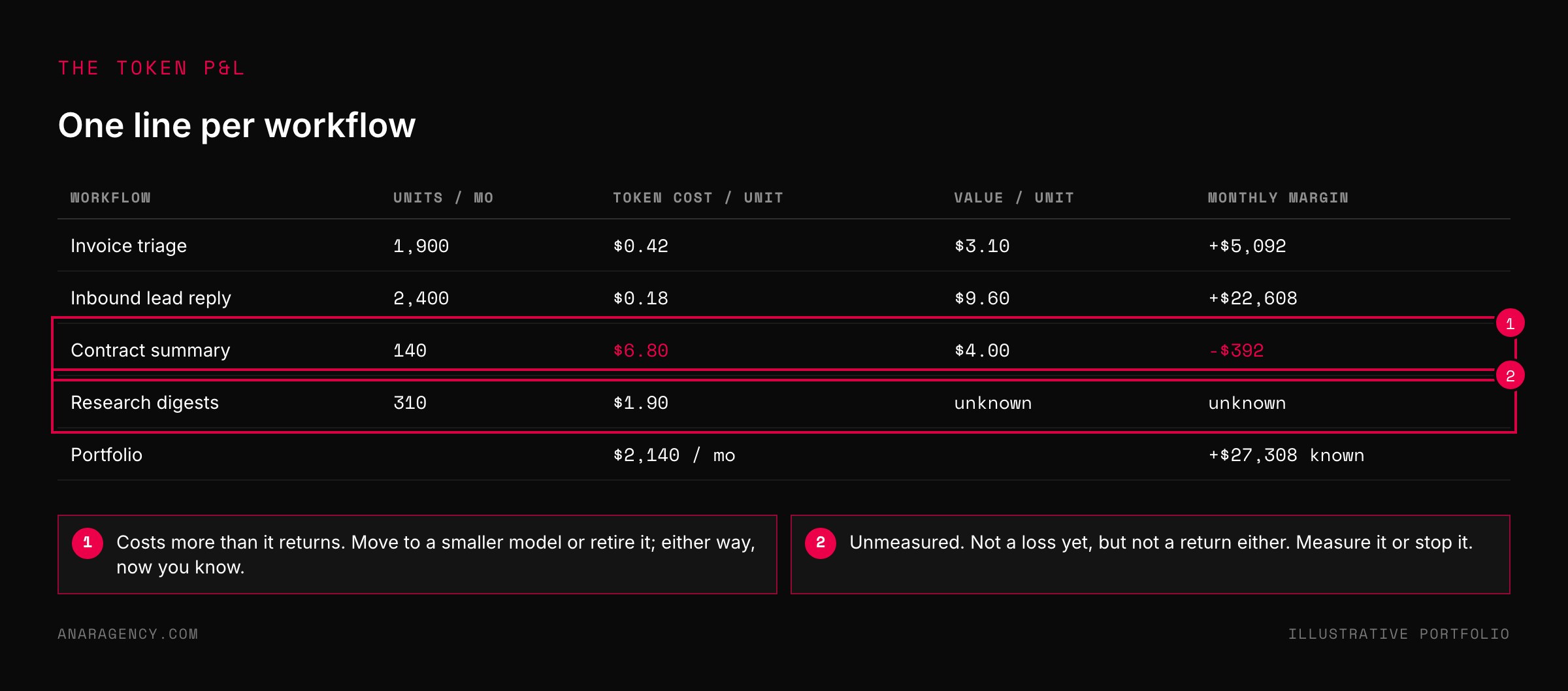
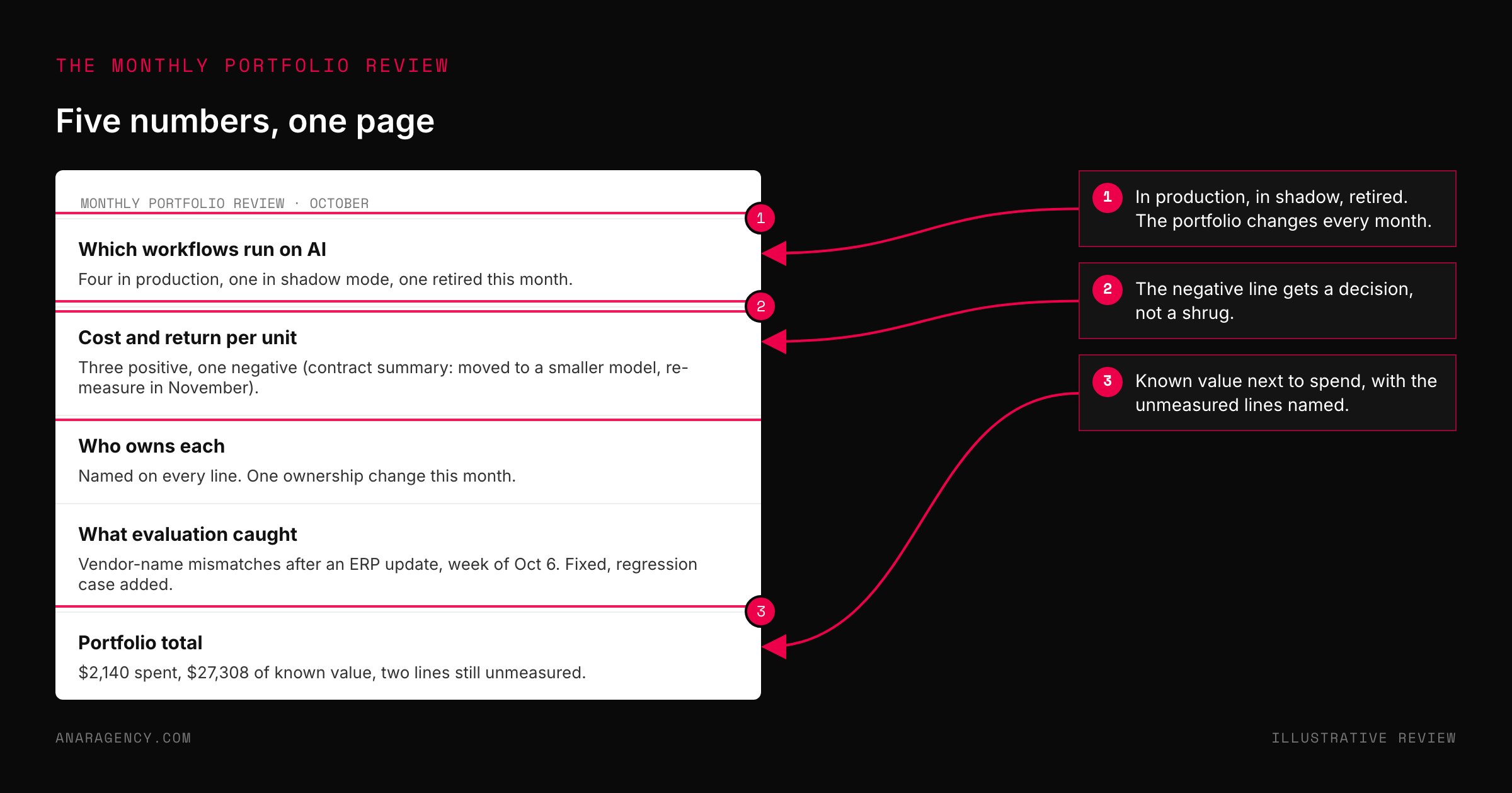
One page, monthly: each production workflow with tokens spent, cost per unit of output, value per unit (displaced cost, throughput, or quality delta), and trend. Workflows without a value line are pilots; pilots get ninety days to earn one.
Caps that protect without capping productivity
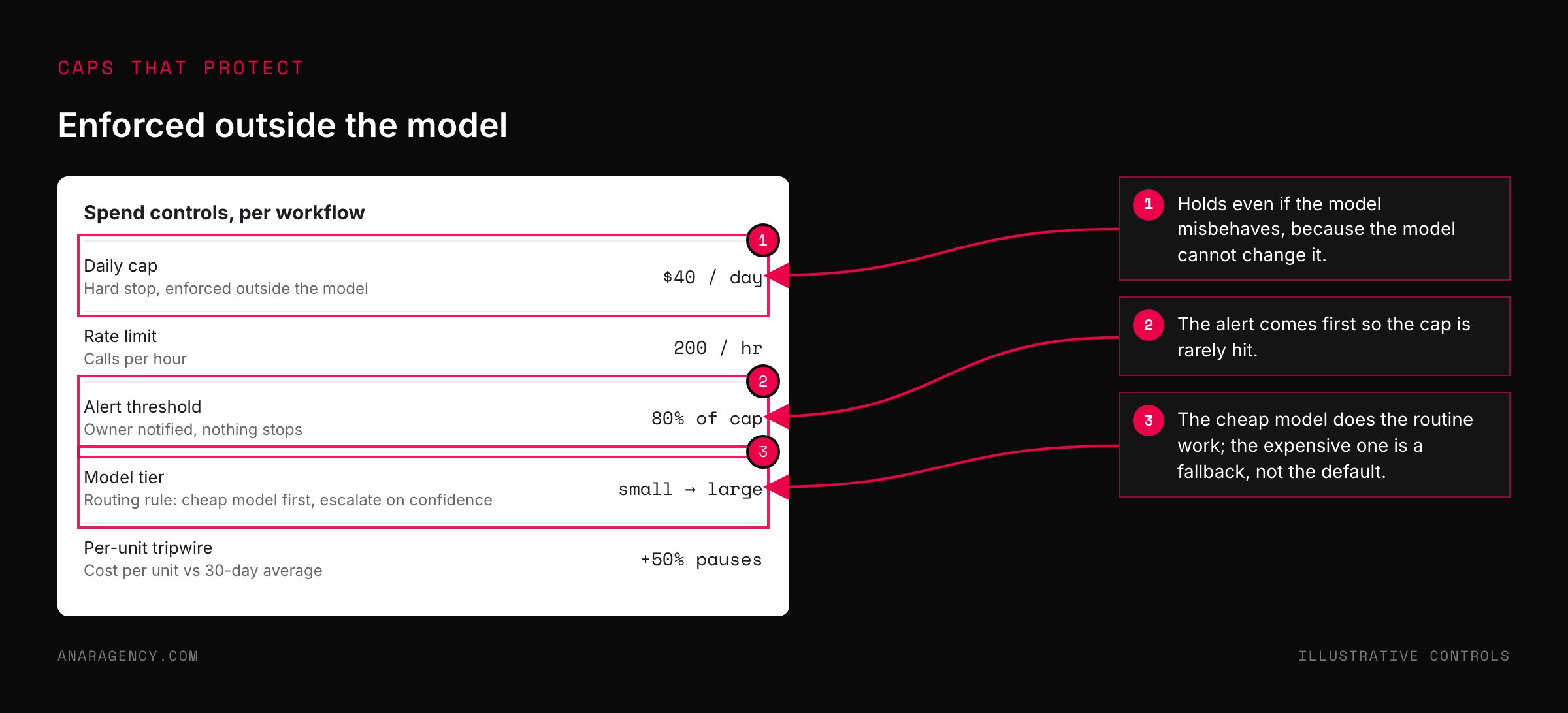
The failure you actually fear is not high usage. It is runaway usage: a looping agent, a misconfigured batch job, a prompt-injected session burning money on garbage. So cap the failure modes, precisely.
Per-session ceilings that halt and escalate instead of failing silently. Per-workflow monthly budgets set at three times the observed baseline, alerting at one and a half. Anomaly alerts on rate of change, because runaway sessions announce themselves in minutes, not months.
And employee-level limits high enough that nobody doing real work ever hits them.
Here is the line to defend in the budget meeting: limits exist to catch malfunctions, not to ration a productivity tool. Rationing a tool that returns multiples on labor cost is the only truly expensive option on the table.
The monthly portfolio review
Run AI spend like an investment portfolio, once a month, on one page: the top ten workflows by spend, each with cost per unit, a value measure, and a trend.
Kill or fix the ones underwater. Feed the winners. Investigate the anomalies.
It takes twenty minutes and the same discipline you already apply to ad spend. It also ends the "AI is expensive" conversation for good, because you have replaced it with line items.
Meter Readers: what companies with a sane AI bill have in common
Some companies run a lot of AI and their bill never becomes a meeting.
They are not spending less. Most of them spend more every quarter. What they have is three habits, and none of them is a spending limit.
We call these companies Meter Readers.
They expect the price to fall and the bill to rise. Both are true at once, and it confuses people. Stanford's AI Index found that the cost of a model at a fixed quality level fell from $20 per million tokens in November 2022 to $0.07 by October 2024.
That is more than 280 times cheaper in about 18 months.
Now look at what companies did with the discount. Menlo Ventures measured enterprise spending on model APIs at $3.5 billion in November 2024 and $8.4 billion by the middle of 2025. The unit got cheaper and the total more than doubled in six months.
Economists have a name for this. When something useful gets cheaper, people find more uses for it. So waiting for prices to drop is not a plan.
The price will drop, and you will run ten times the volume.
They take the discounts sitting in the documentation. Two of them are large and most teams have not switched them on. With prompt caching, the part of a prompt you send over and over, such as instructions and reference text, is billed at one tenth of the normal input price when it is read again.
With batch processing, any job that can wait up to a day runs at half price. OpenAI offers the same deal. Nightly reports, bulk tagging, and backfills almost never need an answer in two seconds.
They meter before they argue. You cannot take either discount, or price a workflow, until usage is tagged by workflow. That is why the Token P&L comes first and the cleverness comes second.
"Prices are collapsing. Why manage this at all?"
You may be thinking that a cost falling 280 times does not need a process. Fair question, and the spending number is the answer.
A bill that doubles in six months while unit prices fall is not a pricing story. It is a volume story, and volume is decided inside your company, one workflow at a time.
There is a second reason. The cheap price is for yesterday's quality. Teams tend to move up to the newest model, and the newest model is not the one that got 280 times cheaper.
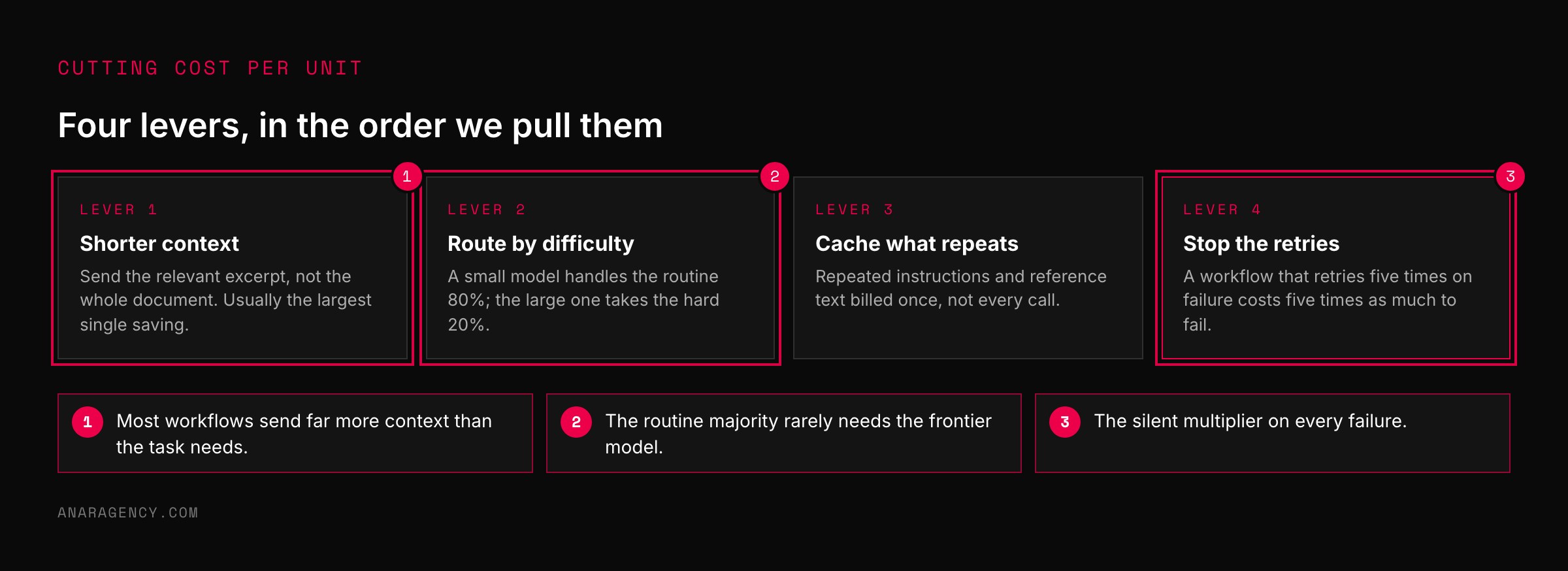
So the habit that pays is boring. Know the cost per unit of each workflow, send the routine work to the smaller model, and save the expensive one for the hard cases. The FinOps Foundation's guidance on AI lands in the same place: shorter prompts, caching, and tracking where the tokens go.
None of that caps anybody. It is the same reason we tell clients to manage ad spend by cost per lead instead of by a monthly ceiling, which we cover in sizing a Google Ads budget.
What to read next, and why
AI Index 2025: State of AI in 10 Charts (report summary): One chart shows the 280-fold price drop. Show it to whoever approves your budget.
Anthropic's prompt caching documentation (documentation): Skip to the pricing table. If your prompts repeat a long preamble, this is the fastest saving on the page.
FinOps for AI Overview (working paper): Written by the people who taught finance teams to read cloud bills. Dry, and useful.
Welcome to LLMflation (article): A venture firm's case that model prices are falling fast. Read it next to the Menlo spending numbers and the paradox is obvious.
So the simple takeaway is this: the price per token is going down without you, and the bill is going up without you. The only number you control is cost per unit of work, so that is the one to watch.
Questions executives ask
How do we control AI costs across the organization?
Meter spend per workflow and team, cap failure modes (per-session ceilings, anomaly alerts, budget alarms), and review a one-page Token P&L monthly. Attribution plus tripwires beats blanket limits.
Should we set AI spending limits for employees?
Set them high enough that productive work never hits them, and rely on session-level caps and anomaly detection to catch malfunctions. Limits that ration normal usage cost more in lost productivity than they save in tokens.
How do we measure AI ROI?
Per workflow: displaced labor cost, throughput gain, or quality improvement against an instrumented baseline, minus the full cost side (tokens, build, evaluation, review time). Portfolio-level ROI is the sum of workflow lines, not a feeling about the bill.
Are AI model prices going down?
Yes, quickly. Stanford's 2025 AI Index found that the cost of querying a model at GPT-3.5 quality fell from $20 per million tokens in November 2022 to $0.07 by October 2024, more than a 280-fold drop. Total spending still rises, because cheaper models get used far more.
What are the fastest ways to cut AI API costs?
Two discounts are documented by the providers and often unused. Prompt caching bills the repeated part of a prompt at one tenth of the normal input price on Anthropic's API, and batch processing runs jobs that can wait up to a day at half price on both Anthropic's and OpenAI's APIs. Routing routine work to a smaller model is the third.

Filip Kovacevic is the founder of Anar Agency in Phoenix. He spent five years running SEO, Meta ads, email, and content for medical practices across the United States, and now does the same work for healthcare, home-service, legal, and professional-service businesses, alongside AI implementation. More from Filip →
Talk it through in 15 minutes
Bring one AI question from this article. We will tell you what we would do, whether or not you hire us.
Book a 15-Min Chat →