Point of View: What Your Market Deletes, Distorts and Generalizes

Before a buyer believes anything, their mind filters it three ways. It deletes what attention skipped, distorts what it saw to fit what it expected, and generalizes one past case into a rule. What survives is accepted as true, and the search for other evidence stops.
Arguing with the belief rarely works. Change the interpretation that feeds it instead: point at the deleted fact, show the distorted reading next to the accurate one, and show how this case differs from the one they generalized from.
The gorilla nobody saw
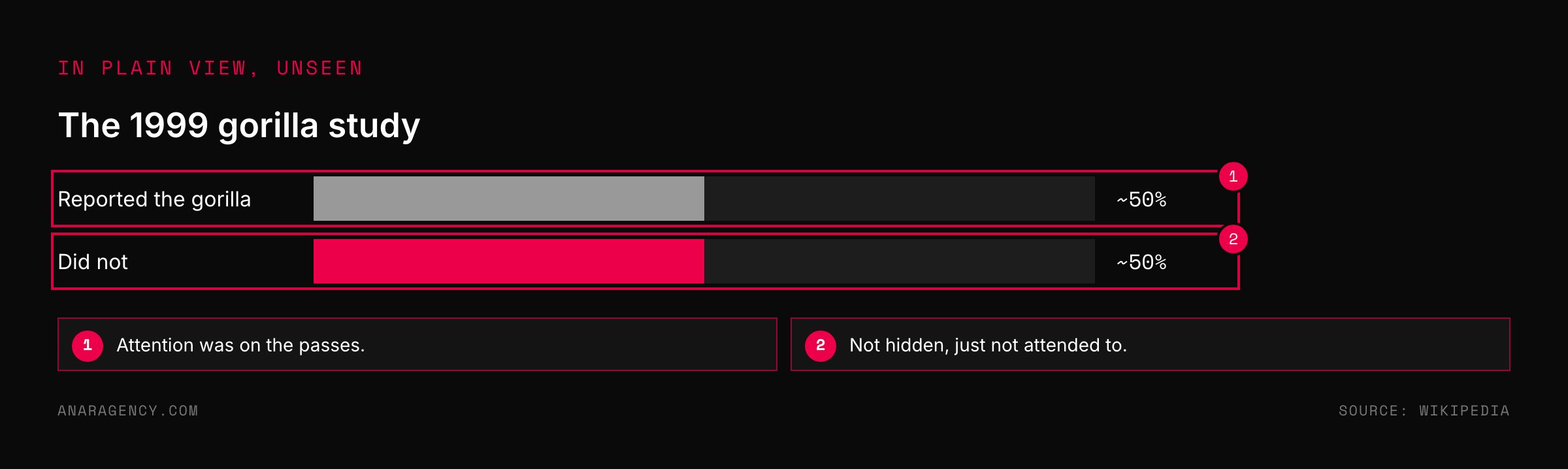
In 1999 two psychologists, Daniel Simons and Christopher Chabris, showed people a short video of two teams passing basketballs. Viewers were asked to count the passes.
Partway through, a person in a gorilla suit walked through the scene. In most groups, about half the viewers did not report seeing it.
The gorilla was not hidden. It was simply outside what they were paying attention to.
Your buyers are counting passes too. Their job, their bills, their last bad experience with someone like you.
So the most important thing on your page may be the gorilla. In plain view, and unseen.
Three filters between your message and the belief
A common way to describe this uses three words: delete, distort, generalize. The model comes from a self-help tradition, neuro-linguistic programming, that has weak scientific support.
But each of the three filters has real research behind it. That is why the model is worth using even if its origin is not.
Delete. Attention is narrow, so most of what passes in front of a person is never noticed. The gorilla is the proof.
Distort. What is noticed gets bent to fit what was expected. The next section has the classic study.
Generalize. One past case becomes a rule for every case that looks similar. Reasoning from too few examples is a known error, called faulty generalization.
What survives all three is accepted as true. After that, people tend to look for evidence that agrees and pass over evidence that does not, a pattern called confirmation bias.
Before anything becomes a belief, the mind deletes what attention skipped, distorts what it saw to fit expectations, and generalizes from too few cases. What survives is accepted as true and the search for more evidence stops. Instead of arguing with the belief, change the interpretation: point at the deleted fact, set the accurate reading beside the distorted one, and separate the buyer's case from the one they generalized from.
Every fact must be true.
One word can bend what people saw
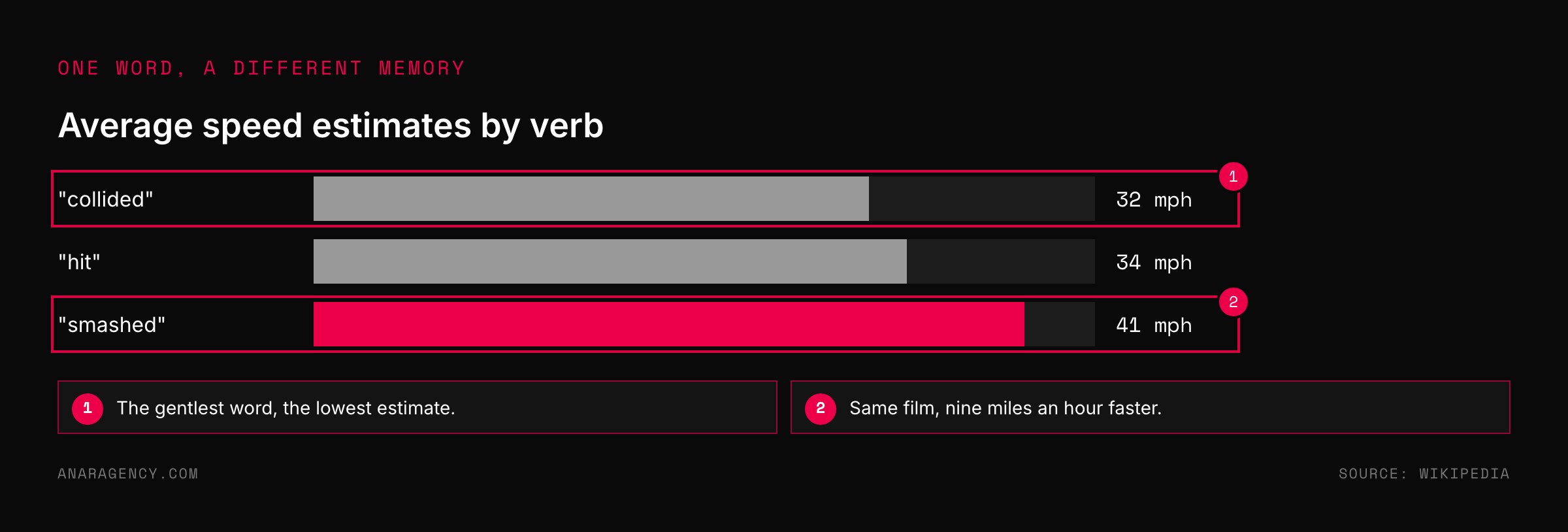
In the 1970s, the psychologist Elizabeth Loftus showed students films of car crashes and asked how fast the cars were going.
The only change was one verb in the question. When asked about cars that "collided", the average estimate was 32 mph. With "hit", it was 34, and with "smashed", 41.
Same film, different word, different memory. Later work on the misinformation effect showed that information added after an event can change what people recall of it.
Your market has its own verbs. "Agencies take your money and disappear." "Ads stopped working."
Those words are already shaping how buyers read your page. Know them before you write.
The point-of-view method
Most marketing argues with the belief at the end of the chain. That rarely works, because the person can feel the argument pulling at something they consider true.
Work one step earlier. Change the interpretation that feeds the belief, and the belief loosens on its own.
For what they deleted: point at it. Put the missed fact where they are already looking, such as in the headline, the first line of the ad, or the first thing said on a call.
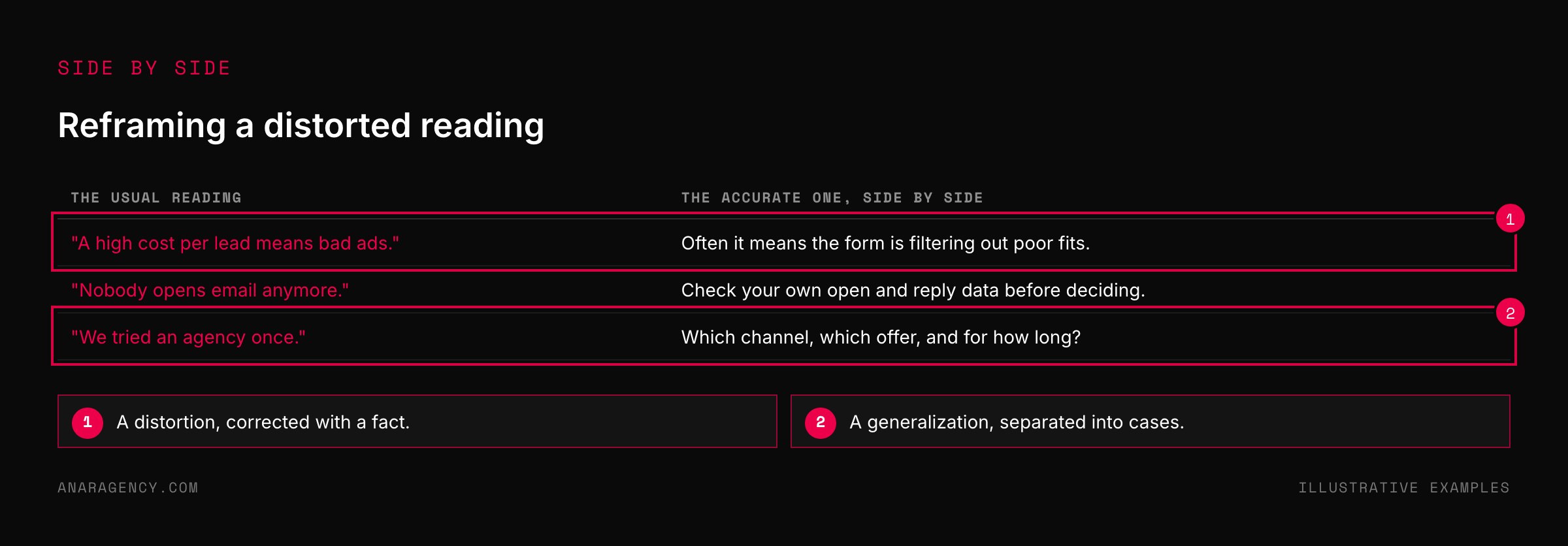
For what they distorted: name the usual reading, then put the accurate one next to it. "Most owners read a high cost per lead as bad ads. Often it means the form is filtering well."
For what they generalized: separate the cases. Show exactly how their situation differs from the one that burned them.
Then let them reach the conclusion. A conclusion a person reaches holds better than one they are handed, as in let them say it.
"Isn't this just manipulation?"
It is the opposite when the facts are true. You are showing people something they missed, not hiding something they would want to see.
The line is the same as anywhere in marketing. Every fact you point to must be accurate, and the reframe must not create a false impression.
Use it to correct a reading, not to invent one. If the usual reading is right, say so and move on.
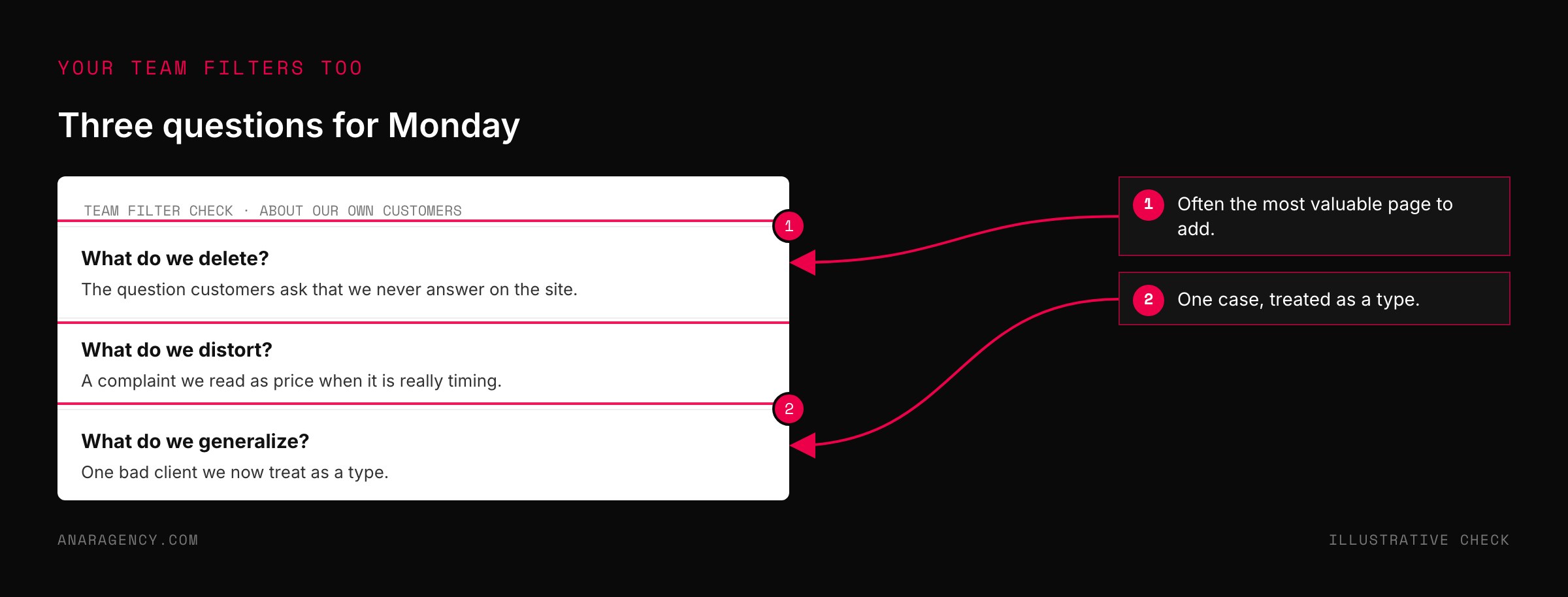
And it works on you too. Ask what your team deletes about your own customers, what it distorts, and what single bad client it generalizes from.
For the bigger story a market tells itself, see argue against the story your market believes.
Where the gorilla hides on your page
On a web page, deletion has a shape. Eyetracking research by the Nielsen Norman Group found that people often scan text in an F-shaped pattern: across the top, across again a little lower, then down the left side.
The group warns that this means people may skip important content simply because it sits on the right side of the page. On many service pages, that is where the price, the guarantee, or the phone number lives.
So check your page against the F. The most important fact belongs in the headline, the first line, or the left edge of a bold subheading.
Distortion has a home too. It lives in the words your market already uses for your category, such as "agency", "coach", or "software".
Each of those words arrives carrying someone else's bad experience. If the word your page leads with is the word that burned them, the rest is read through that memory.
Generalization hides in the testimonials. A page full of customers unlike the reader lets them conclude "this works for other kinds of people".
Put one testimonial from someone exactly like your typical buyer near the top. It interrupts the generalization before it settles.
Then ask a stranger to read the page for thirty seconds and tell you what it offers. Whatever they leave out is what your market deletes.
Fix that one thing first. A missed fact is usually cheaper to fix than a wrong belief.
What to read next, and why
Inattentional blindness (encyclopedia entry): The gorilla study and the research around it.
Elizabeth Loftus (encyclopedia entry): The car crash experiments and her work on memory.
Confirmation bias (encyclopedia entry): Why accepted beliefs stop the search for evidence.
Neuro-linguistic programming (encyclopedia entry): Where the three-word model comes from, and why to use it carefully.
So the simple takeaway is this: write down one thing your buyers delete, one they distort, and one they generalize, and fix the first one on your page this week.
Questions executives ask
What is point of view in marketing?
The interpretation a buyer uses to make sense of a problem. Changing that interpretation often changes the belief more easily than arguing with the belief directly.
What does delete, distort, generalize mean?
Three ways the mind filters information: missing things outside attention, bending what is seen to fit expectations, and turning one case into a rule. The model comes from neuro-linguistic programming, but each filter has research support.
Why don't customers notice key information on my page?
Attention is narrow. In the well-known gorilla study about half of viewers missed something obvious while counting passes. Put the key fact where buyers are already looking.
Can wording change how people remember something?
Yes. In Elizabeth Loftus's car crash study, asking how fast cars "smashed" produced higher speed estimates than asking how fast they "collided".
Is reframing manipulative?
Not when the facts are true and the reframe corrects a misreading. It becomes deceptive when it creates a false impression.

Filip Kovacevic is the founder of Anar Agency in Phoenix. He spent five years running SEO, Meta ads, email, and content for medical practices across the United States, and now does the same work for healthcare, home-service, legal, and professional-service businesses, alongside AI implementation. More from Filip →
Talk it through in 15 minutes
Bring one AI question from this article. We will tell you what we would do, whether or not you hire us.
Book a 15-Min Chat →