Four Sources of Credibility

Credibility comes from four places. Results, which customers report in testimonials. Borrowed trust, from endorsements by people the market already believes.
Your record, the documented past work. And your story, your own true account of how you got here. Each one has rules.
Testimonials about results are read as typical, so either have proof they are or state the typical result. Endorsers with a connection to you must disclose it. Fake reviews are banned.
And your story has to be true.
A seal, and a complaint
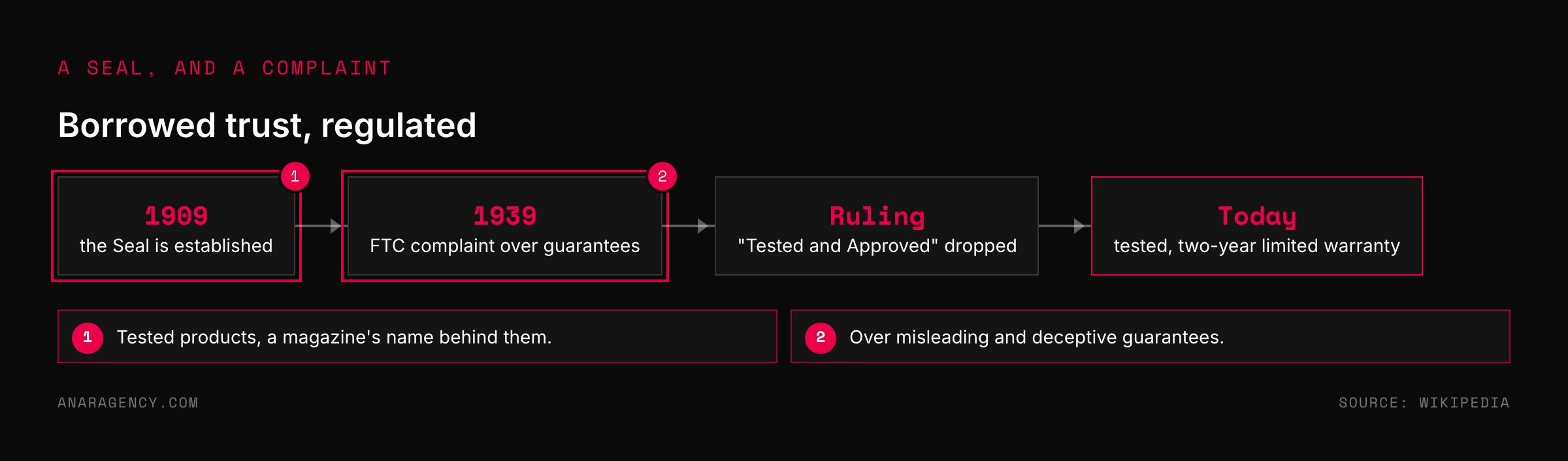
In 1909 Good Housekeeping magazine established its Seal for products advertised in its pages. The products were tested, and today the Seal comes with a two-year limited warranty.
It worked because it was borrowed trust. A reader who did not know the toaster company knew the magazine.
In 1939 the Federal Trade Commission filed a complaint over the magazine's "misleading and deceptive" guarantees. The ruling went against the magazine, and the words "Tested and Approved" were dropped from the Seal.
The magazine kept growing anyway. The Seal stayed, in a more careful form.
Two lessons in one story. Credibility can be borrowed, and the borrowing has rules.
Four places credibility comes from
When a buyer decides whether to believe you, they draw on four sources. We call them the Four Sources.
Results. What customers say happened after they worked with you.
Borrowed. Someone the market already trusts, saying you are worth trusting.
Record. Your documented past work. What the job was, what changed, what happened.
Story. Your own true account of how you came to do this.
This is different from the evidence for an offer, which we cover in the Proof Grid. These four answer a narrower question: why should I believe this person?
Credibility comes from four sources: results that customers report, trust borrowed from endorsers the market already believes, a documented track record, and your own true story. Testimonials must name specific results and be typical or show the typical result. Endorsers with a material connection must disclose it.
Fake reviews are banned. Record and story are the two you control; build the record one documented job at a time and tell the story plainly and truthfully.
Results: testimonials that say what happened
Most testimonials are about likability. "Great to work with." "Really nice people."
Those are pleasant and nearly useless. A buyer is not deciding whether you are nice.
A useful testimonial names a specific change and a specific result. What the customer did, what you changed, and what moved.
There is a rule here. The FTC says endorsements claiming specific results will usually be read as what others can expect, and "results not typical" does not change that.
So you have two choices. Have proof the result is typical, or state the typical result clearly next to it.
And never write them yourself. The FTC's 2024 rule bans fake reviews and testimonials, including ones that misrepresent who wrote them.
Borrowed: endorsements and the halo
An endorsement lends you someone else's trust. If a buyer trusts the person, some of that trust transfers to you.
It can transfer even when the endorser knows little about the subject. People tend to let one good impression color their judgment of other traits, a pattern called the halo effect.
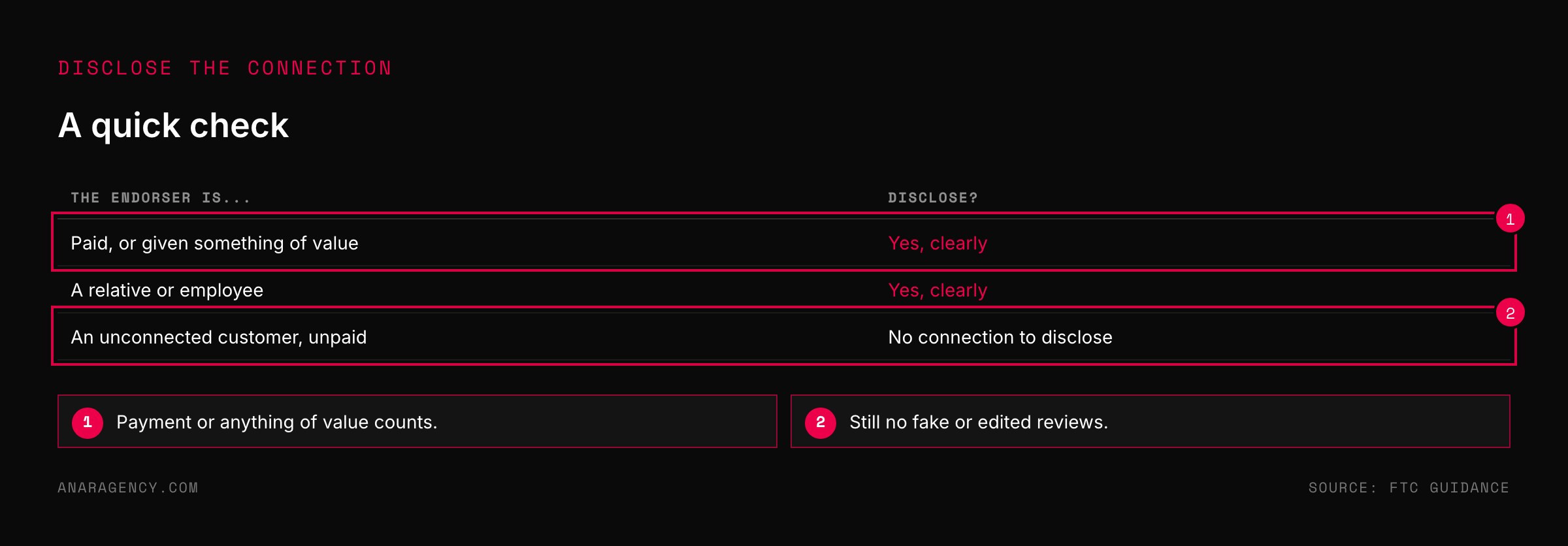
That is why endorsements work, and why they are regulated. If the endorser is paid, given something of value, or related to you, the connection should be disclosed clearly.
The best endorsements for a small firm are rarely celebrities. They are respected people in the buyer's own world: a trade association, a well-known peer, a partner firm.
Ask for a specific sentence they are comfortable standing behind. A vague compliment from a respected name is still vague.
Record and story: the two you control
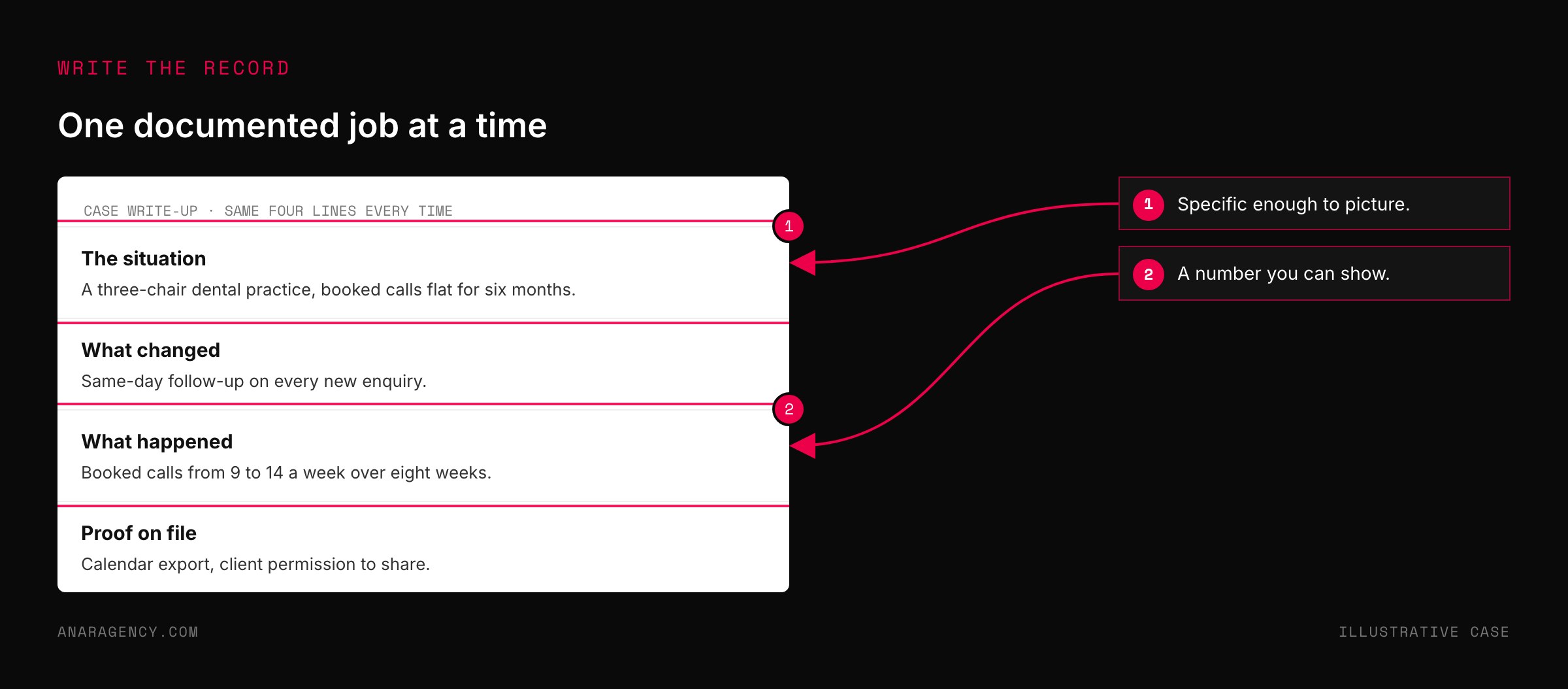
Your record is the one source nobody can give you. It is built one documented job at a time.
Write each one up the same way. What the situation was, what you changed, what happened, with numbers you can show.
Then repeat your three to five strongest points everywhere: site, proposals, ads, calls. Our rule of thumb is that a buyer should hear the same few facts so often that they could repeat them.
Your story is the fourth source. Buyers trust people who seem like them, a tendency researchers call homophily, so a real account of where you started can do what credentials cannot.
It must be true. Do not invent a low point, borrow someone else's hardship, or inflate the numbers. A story is a claim like any other, and a false one is deception.
Tell it plainly. The facts of a real story are usually enough.
"I am new. I have none of the four."
You have more than you think, and the first one is easy to start.
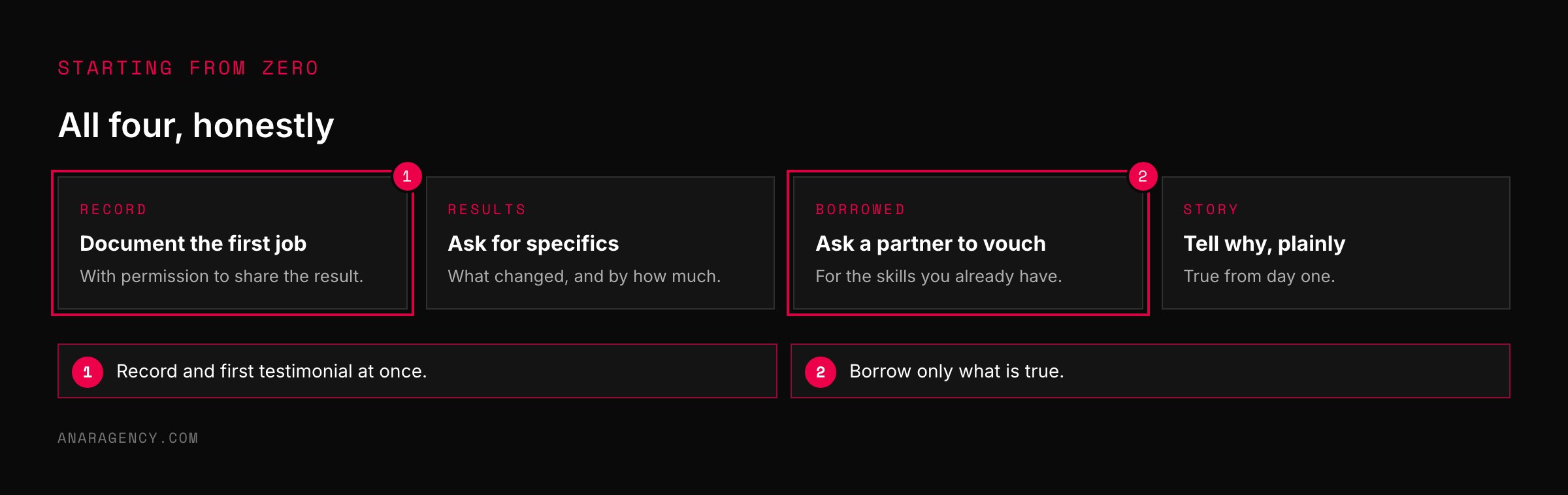
Do one job well and document it carefully, with the client's permission to use the result. That is your record and your first testimonial at once.
Borrow credibility honestly. A partner firm, a past employer, or a professional body can vouch for the skills you already have.
Your story is available on day one, because it is just the truth about why you do this work.
For how to position yourself before the record exists, see experience vs experienced.
What to read next, and why
FTC's Endorsement Guides: What People Are Asking (FTC guide): The plain-language rules for testimonials, results claims, and disclosures.
FTC rule banning fake reviews and testimonials (FTC press release): What became illegal in 2024.
Source credibility (encyclopedia entry): The research on why we believe some speakers more than others.
Good Housekeeping (encyclopedia entry): The Seal's history, including the 1939 complaint.
So the simple takeaway is this: list what you have under each of the four sources today, and fix the weakest one first.
Questions executives ask
How do you build credibility in marketing?
Draw on four sources: customer results, endorsements from people your market trusts, a documented track record, and your own true story. Strengthen the weakest one first.
What is the difference between a testimonial and an endorsement?
A testimonial usually comes from a customer describing their own experience. An endorsement usually comes from someone with their own reputation lending trust to you.
Can I use testimonials that show exceptional results?
Under FTC guidance, specific results are usually read as what others can expect. You need proof they are typical, or you must clearly state the typical result. "Results not typical" alone is not enough.
Do endorsers have to disclose payment?
If an endorser has a connection to you that buyers would not expect, such as payment, free products, or a family or employment tie, it should be disclosed clearly.
How can a new business build credibility?
Document the first jobs carefully with permission to share results, borrow credibility honestly from partners or past employers, and tell your true story about why you do the work.

Filip Kovacevic is the founder of Anar Agency in Phoenix. He spent five years running SEO, Meta ads, email, and content for medical practices across the United States, and now does the same work for healthcare, home-service, legal, and professional-service businesses, alongside AI implementation. More from Filip →
Talk it through in 15 minutes
Bring one AI question from this article. We will tell you what we would do, whether or not you hire us.
Book a 15-Min Chat →