Let the Prospect Land on the Claim Themselves

A claim you state is something the reader can argue with. A conclusion they reach themselves is something they defend. So instead of making the claim and backing it with proof, lay out the reasoning in order: a real starting point they recognize, a chain of cause and effect, and the obstacle it explains.
Then stop just before the conclusion and let them reach it, with a line like "and that is why." Research shows people remember what they generate better than what they read. The facts must be true, or it is only a cleverer way to mislead.
Franklin's method
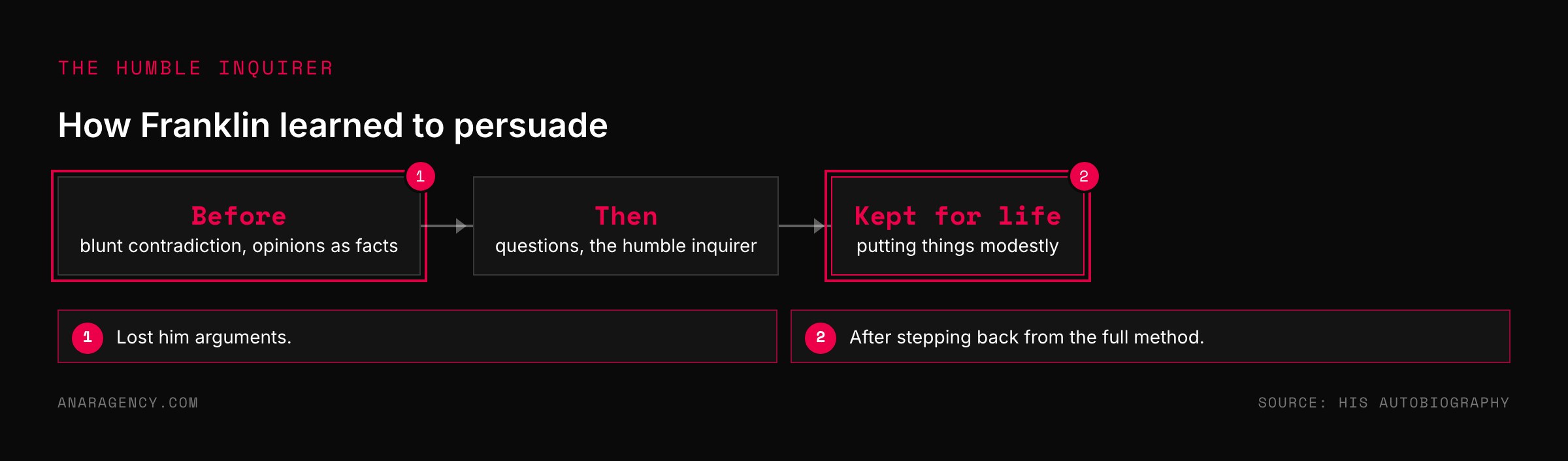
As a teenager in Boston, Benjamin Franklin liked to argue. He contradicted people bluntly and set out his opinions as facts.
Then he read accounts of how Socrates argued, by asking questions instead of making assertions. He wrote that he adopted it, dropping his abrupt contradiction and becoming the humble inquirer.
He found he could lead people, even people who knew more than he did, to conclusions they did not see coming. They reached them through their own answers.
He also wrote, with unusual honesty, that it won him victories that neither he nor his cause always deserved. He gave up the full method after a few years.
What he kept was the habit of putting things modestly, and he credited it with helping him persuade people for the rest of his life.
Claims invite argument
Most sales copy is built on claims. We get results. Our method works.
You will see a difference.
Then the rest of the page defends the claim. Testimonials, figures, guarantees, case studies.
That structure asks the reader to trust you. And anything that asks for trust can be met with distrust. Each claim is an invitation to look for the flaw.
There is another way to reach the same conclusion. Set out the facts in an order that leads somewhere, and let the reader arrive.
Psychologists have studied why that works. People remember information better when they produce it themselves than when they simply read it, a finding called the generation effect. A conclusion the reader generates is one they keep.
A stated claim invites argument; a conclusion the reader reaches is defended. Lay out four steps: a real origin the reader recognizes, a chain of cause and effect, the obstacle it explains, then stop and let the reader conclude. Start with something checkable, link with because and so, let the reader confirm the obstacle, and still source the facts.
Every step must be true and the conclusion must genuinely follow.
The Self-Landed Claim
Here is the structure in four steps.
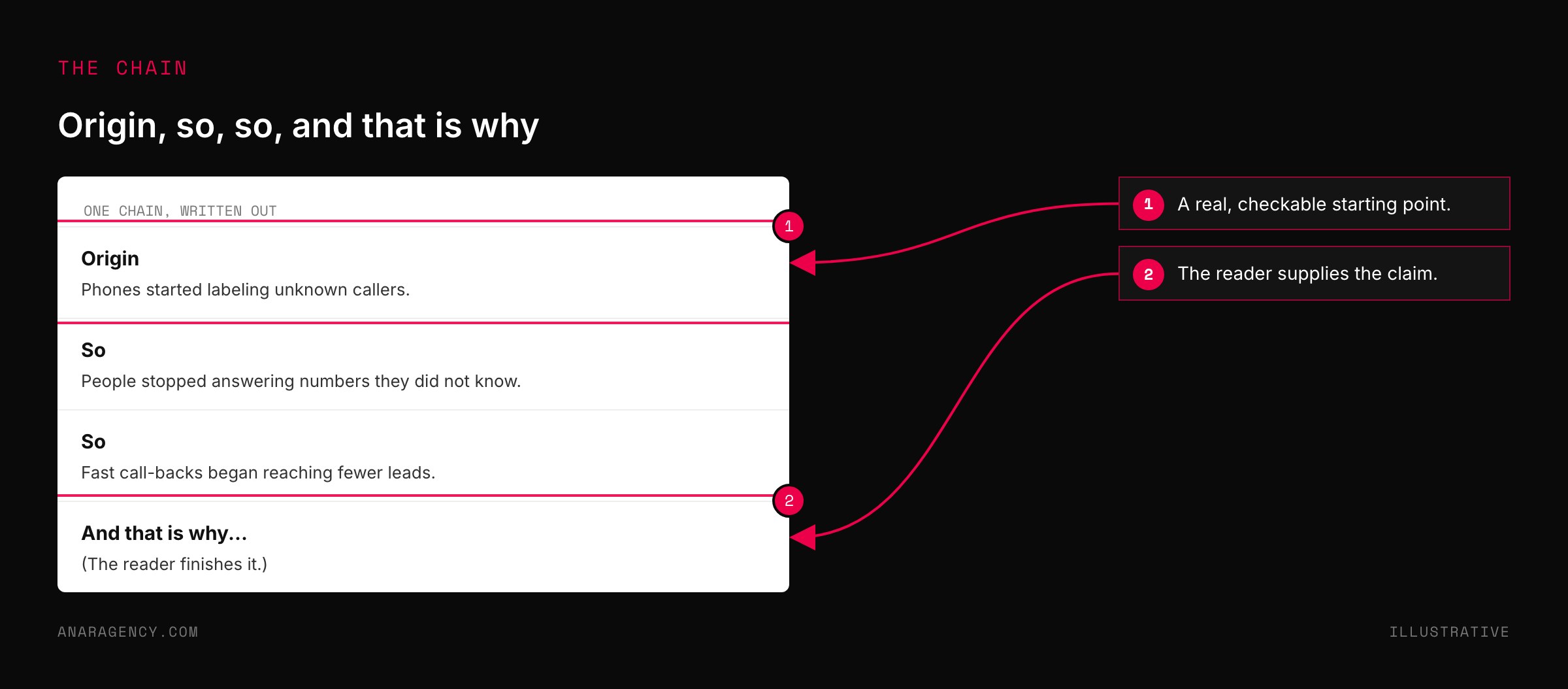
1. An origin. A real starting point the reader recognizes.
An event in their trade, a change in the rules, a discovery. "In 2021, phones started hiding who was calling."
2. Cause and effect. This happened, so that followed, because of this.
"So people stopped answering numbers they did not know. So firms that called leads back started reaching fewer of them."
3. The limit it explains. The obstacle the reader has been living with, now accounted for.
"That is why your follow-up calls go to voicemail, however fast you are."
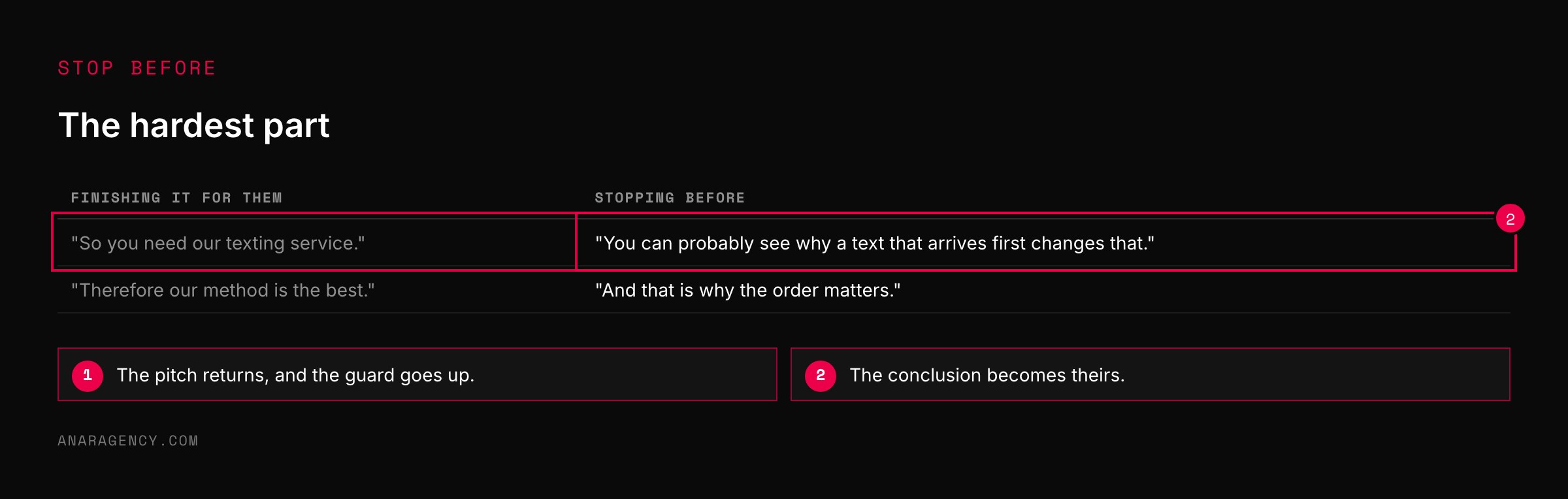
4. Stop. Let them finish the thought.
"And you can probably see why a text that arrives first changes that."
Notice that step four is barely a claim. The reader was walked to the edge and stepped over themselves. Researchers who study self-persuasion find that arguments people make to themselves tend to last longer than ones made to them.
Guides: how they write it
Writers who do this well sound less like salespeople and more like someone explaining how a thing works. We call them Guides.
They start somewhere real. A date, a rule, a public event. Something the reader can check.
The origin is what makes the chain feel like truth and not opinion.
They link with because and so. Each sentence is the reason for the next. If a link is weak, the reader stops following.
They let the reader name the obstacle. "You have probably noticed..." The reader confirms it from their own experience.
They stop before the claim. "And that is why..." or "You can see where this leads." The urge to finish the thought for the reader is strong.
Resist it.
They still provide proof. The structure reduces the need for proof. It does not remove it.
Back the facts in the chain with sources, as in the Proof Grid.
The approach pairs naturally with a cause the reader already accepts, which is the subject of cause first.
"Is leading someone to a conclusion not a trick?"
Franklin thought it could be. He admitted the method won arguments his cause did not always deserve, and he stepped back from it. That is the right worry to have.
The difference between guiding and tricking lies in the facts and in where they lead.
If every step is true and the conclusion genuinely follows, you have explained something. The reader would reach the same place if they looked into it themselves.
If a step is false, or the chain skips a link that would lead somewhere else, you have manipulated them, however gently.
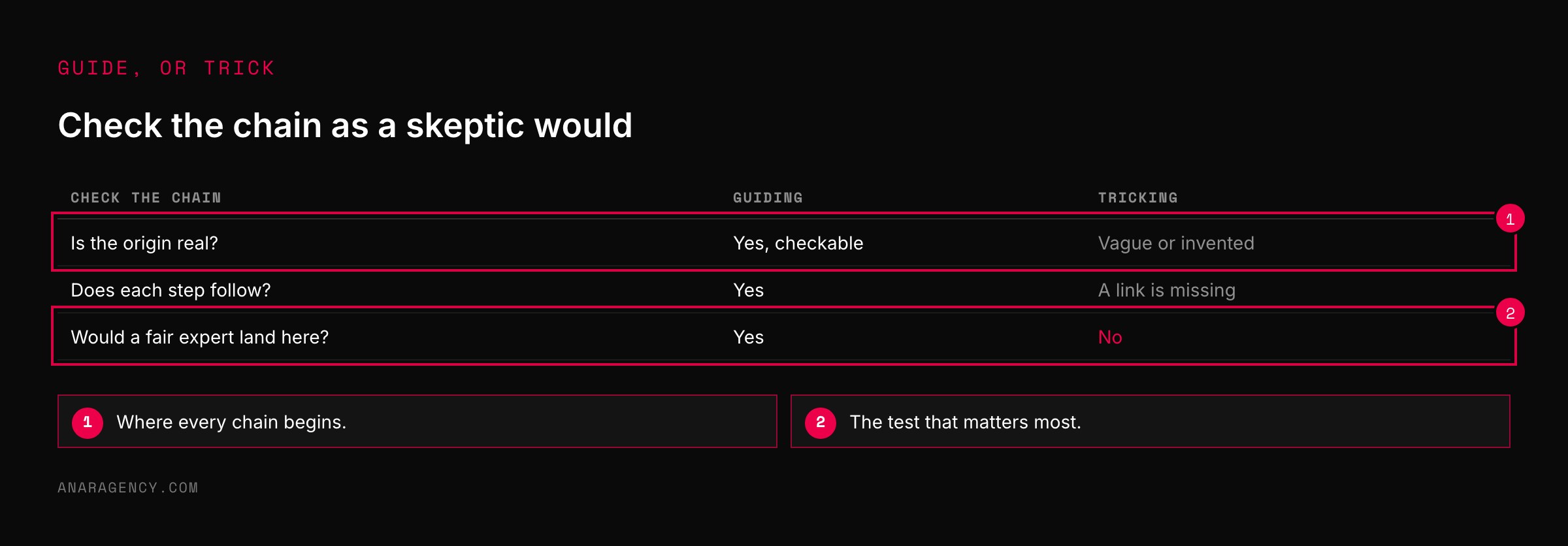
So check the chain as a skeptic would. Is the origin real? Does each step follow?
Would a fair-minded expert land on the same conclusion?
And the conclusion still has to be honest about your offer. The Socratic method is a tool for finding truth, not a way around it.
What to read next, and why
The Autobiography of Benjamin Franklin (book, free online): The passage on the Socratic method, including his own warning.
Generation effect (encyclopedia entry): Why people remember what they work out better than what they read.
Self-persuasion (encyclopedia entry): The research on arguments people make to themselves.
Socratic method (encyclopedia entry): The method of reaching conclusions through questions.
So the simple takeaway is this: take the boldest claim on your sales page and delete it. Then write the three facts that lead to it, in order, and see whether the reader can finish the sentence.
Questions executives ask
How do you build trust in marketing copy?
Rely less on claims that ask for trust and more on facts the reader can follow. Lay out a real starting point, a chain of cause and effect, and the obstacle it explains, then let the reader reach the conclusion. Back each fact with a source.
What is the self-landed claim?
A way of structuring copy so that the reader reaches the main conclusion themselves. The writer sets out an origin, cause and effect, and the limitation it explains, and stops short of stating the claim.
Why are self-reached conclusions more persuasive?
Research on the generation effect shows people remember information better when they produce it themselves. Research on self-persuasion suggests arguments people make to themselves tend to last longer than arguments made to them.
Did Benjamin Franklin use this technique?
In his autobiography Franklin describes adopting the Socratic method as a young man, asking questions instead of asserting, and leading people to conclusions they did not foresee. He also wrote that it won victories his cause did not always deserve, and moderated it later.
When does guiding a reader become manipulation?
When a step in the chain is false, or the reasoning skips a link that would lead elsewhere. If every step is true and an informed, fair-minded reader would reach the same conclusion, it is explanation, not manipulation.

Filip Kovacevic is the founder of Anar Agency in Phoenix. He spent five years running SEO, Meta ads, email, and content for medical practices across the United States, and now does the same work for healthcare, home-service, legal, and professional-service businesses, alongside AI implementation. More from Filip →
Talk it through in 15 minutes
Bring one AI question from this article. We will tell you what we would do, whether or not you hire us.
Book a 15-Min Chat →